In early 1923 a Fenland farm was visited by strange destructive phenomena – household objects mysteriously flying across the room and smashing. Some said the house was haunted by a poltergeist, others blamed witchcraft or even demons. The haunted house became a national sensation, leading to psychic investigators, spiritualists, an exorcist, a witch and Arthur Conan Doyle all trying to solve the mystery. But perhaps the answer was right under their nose all along…
New Barn Farm overlooked the haunting fenlands in the East of England and was covered by a light dusting of snow in February 1923. It was occupied by fruit farmer Joseph Scrimshaw, his elderly mother and Joseph’s 15 year old daughter Olive. The house was also shared by Olive’s pet lamb and fourteen cats.

The house had gained a reputation in the local area. Apparently, crockery would fly off the shelves and smash on the floor. The weighty pianola had mysteriously moved away from the wall. Wash stands had toppled over with no body in the room. Ornaments threw themselves off the mantelpiece and Mrs Scrimshaw’s night cap had gone flying across her bedroom. Books fell from the bookshelves and clocks dropped off the wall. And these events were happening daily, resulting in £200 worth of damage – a considerable sum at the time.[i]
When the newspapers got wind of the phenomenon, they dubbed it the Gorefield Ghost. By the middle of February, crowds of curious onlookers were flocking to the farmhouse, fascinated by rumours of the destructive spook. Mr Scrimshaw began receiving letters – hundreds and hundreds of them, according to the farmer – requesting permission to hold seances in the house…
Those blooming spiritualist people
In early March the Scrimshaws had another mysterious visitation. Just as the clocks were striking midnight, four strangers hammered on the farm door and invited themselves into the farm. Mr Scrimshaw would later refer to them as ‘those blooming spiritualists.’ The uninvited guests were Mr H. Racey, president of a nearby Spiritualist Society, Mr H. Stimpson, the secretary and members Mr and Mrs Taylor.
The spiritualists sat by the log fire along with the Scrimshaws and called for quiet before singing a hymn and then reciting a prayer. Not knowing they were spiritualists, Mr Scrimshaw was totally bemused by the performance, interrupting it to ask if he could smoke. The grumpy spiritualist told him he could but he must keep quiet. At this point another visitor arrived, a shire horse breeder and friend of the family called Mr Ward, and it was he who informed the Scrimshaws that their surprise guests were actually spiritualist mediums.
One of the mediums pointed to Mr Ward and said he could see the spirit of an elderly lady with grey hair with a centre parting, wearing a shawl and carrying a little child. No one else could see anything, and on being asked Mr Ward said he didn’t recognise the description of the invisible apparition.
The mediums then proceeded to describe various spirits they claimed they could see, but no body recognised any of them. Finally, Mrs Taylor asked Mr Scrimshaw if he knew anyone called Lizzie, presumably because she had a message from the beyond for him. Mr Scrimshaw said yes – he knew hundreds of Lizzies who’d helped out with the fruit picking on his farm, but they were all back in London now.
Mrs Scrimshaw had had enough and told everyone to stop this silliness. As they were being escorted out of the door, one of the spiritualists told Mr Scrimshaw that he had seen the ghost that was the cause of all the trouble. It was, he said, the spirit of a 20-year-old young man with a bandaged head. In life he had loved practical jokes, but died after falling from a horse. Now his ghost was continuing the pranks he had once loved. Mr Scrimshaw was assured that the spirit was now quietened and that they would have no more trouble.
The Society for Psychical Research
The following day it was the turn of Mr E.J. Dingwall, secretary of the Society for Psychical Research to investigate. Olive showed him round the farm and he made copious notes in his large notebook, commenting that this was a very important case for the science of psychical research. He noted that, curiously, nobody had actually witnessed the objects fly through the air. The episodes all happened when no one was looking, something that was common in poltergeist cases, according to Mr Dingwall. He concluded that Olive may have mediumistic ability and that this unconscious power was what was causing the phenomena.
He believed that the disturbance would stop in a few days, as most poltergeist cases usually do.
Arthur Conan Doyle
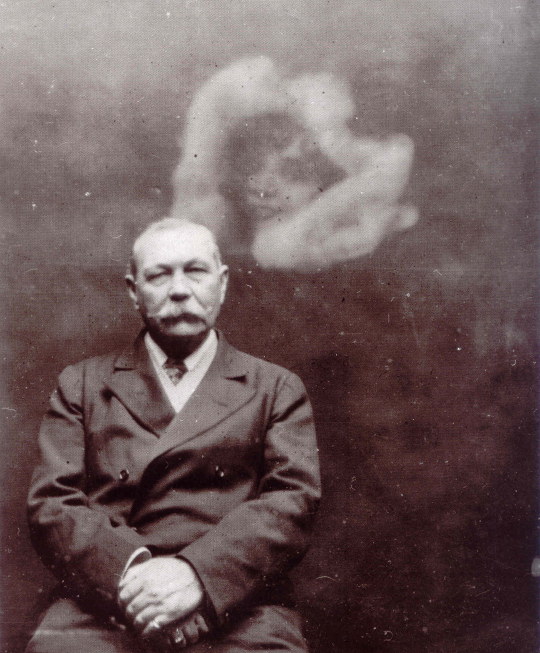
The next to offer a theory was Sherlock Holmes author, Sir Arthur Conan Doyle who had developed a keen – some would say gullible – interest in all things mediumistic. Doyle wrote to the Scrimshaws suggesting that ‘mischievous material children of the psychic world’ were using Olive to create the strange phenomena. Doyle concurred with Dingwall of the Society for Psychical Research, that Olive was the unconscious cause of the flying crockery. The solution was elementary – Olive must go away for a few days, the vicar should say a few prayers in the house and the windows should be opened.[ii]
It seems the Scrimshaws didn’t follow Sir Arthur’s advice, for still the ornaments fell mysteriously from the mantlepiece.
Under an Evil Tongue
However, many of the locals were not impressed with the theories of the spiritualists, the psychic investigator or even Sir Arthur. They had their own theory – witchcraft. The unfortunate family had been cursed, or as the locals put it, they were ‘under an evil tongue’.
A wealthy farmer called James Garner from nearby Wisbech decided to come to the rescue. He knew a wise woman who would break the spell with a ‘fire charm’. He introduced the Scrimshaw’s to Mrs Holmes, whom the newspapers noted, was not the wizened old crone one might expect, but was rather a ‘fine, healthy, buxom woman’ with a clean house. Mrs Holmes was born in the chime hours – at the time of night reserved for monastic prayer – and that gave her the ability to see things that others cannot.
Mrs Holmes arrived at the farm a couple of days after Mr Dingwall had visited and took toe nail and hair clippings from each family member. She put these in an empty bottle along with six apple pips and two black hairpins and warned the family not to say a word or they would break the spell. She placed the bottle on the kitchen fire. A few moments later it shattered with a bang. ‘There’, she said. ‘The spell is broken, and the ill tongue can do no more evil.’[iii]
The Spalding Guardian, which reported on these events, was astonished that in 1923 people still believed in witchcraft. In fact, it claimed that 60% of the population in the fens believed in witches, which was confirmed by Reverend Hagley Rutter, the local vicar.
A few days later Mrs Holmes died after suffering from a fit, a condition she was subject to. Nevertheless, her death would surely have fuelled tales among the locals that the farm really was cursed.
After a few days, the poltergeist activity resumed.[iv]
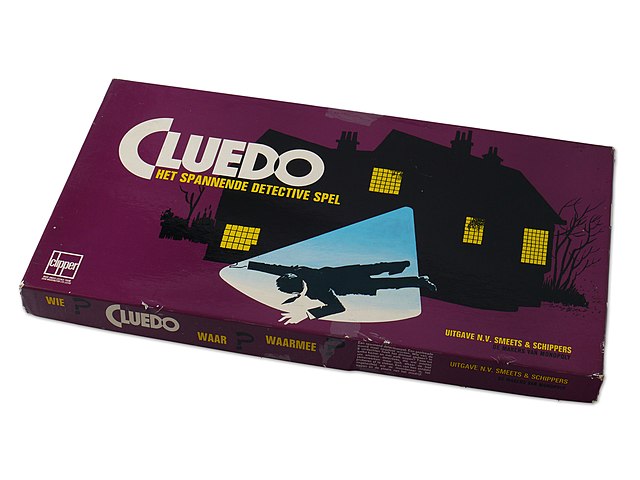
Poltergeist Cluedo
Let’s put aside talk of curses and witchcraft for the moment and play a game of Poltergeist Cluedo. The fact that nobody saw any of the objects actually flying means it’s reasonable to suspect that someone in the Scrimshaw household was playing tricks – dropping or throwing objects when nobody was looking. So, in my game of Poltergeist Cluedo, the suspects for faking the spooky phenomena are:
Mr Scrimshaw: He never seemed very perturbed by the weird goings-on in his house, which may be suspicious. One journalist overheard him say how this notoriety had been good for his trade in potatoes.[v]
Mrs Scrimshaw: Although an elderly woman, this would mean that nobody would suspect her of any mischief.
Olive Scrimshaw: Because she was a teenage girl, many thought Olive was at the centre of the poltergeist phenomena because she may have latent mediumistic talents or was being used by supernatural forces. However, it’s distinctly possible that she was at the centre of the whole episode but in a much more direct way, playing an audacious trick on her family and others.
The cats: There were (assuming the papers got this right) fourteen of them. Cats are well-known for their penchant for knocking objects off tables and mantlepieces. Could the mysterious damage have been caused by clumsy, careless or mischievous felines? Well, they couldn’t move a pianola, but I would be surprised if these cats were not in some ways accomplices to the mischief.
Although she may have been aided by the cats, I would put my money on Olive being the prankster. She was a teenage girl, and poltergeist activity is long known to occur in the presence of a teenage girl. Believers might say that’s because unknown forces can manifest themselves using the psychic energy of very young women. Because, it was assumed that an innocent young girl could never outwit her elders or those learned ladies and gentlemen who came to investigate.
But I think this is exactly what happened. I suspect that Olive managed to prank spiritualists, psychic investigators, witches, journalists and even the creator of Sherlock Holmes.
Epilogue
It is at this point that the Gorefield Ghost takes his (or perhaps I should say her) leave of the historical records. One possible explanation for the sudden cessation of the poltergeist larks was the fact that in early May New Barn Farm was visited by a tragedy. Frederick Robbins, a farm labourer for Mr Scrimshaw was burned to death when the discarded railway carriage he slept in on the farm caught fire, possibly because he had been smoking in bed.[vi] One could imagine that Olive would surely not continue her jinx after the awful death of one of their workers.
I can also imagine that after Robbins’ death by burning, many of the locals would give each other a knowing look. Perhaps the New Barn Farm really was under an ill tongue.
[i] ‘Ghost that moves furniture’, Daily News 19 February 1923, p.1; ‘Ghost as heavy weightlifter’, Daily News 20 February 1920, p.1
[ii] ‘The Cambridgeshire Ghost’, Saffron Walden Weekly News 23 February 1923, p.7
[iii] ‘The Gorefield Spook’, The Spalding Guardian 3 March 1923, p.7
[iv] ‘Fen Ghost Reappears’, Newcastle Daily Chronicle 10 March 1923, p.1
[v] ‘The Gorefield Spook’, The Spalding Guardian 3 March 1923, p.7
[vi] ‘Burned to death in bed’, Diss Express 11 May 1923, p.8
 Paul Weatherhead
“Not knowing they were spiritualists, Mr. Scrimshaw was totally bemused by the performance, interrupting it to ask if he could smoke.” Approved
LikeLike