
In June 1912 over one hundred music teachers, singers and physicians gathered at the New York Music Teaching Convention at Columbia University. They were to witness an extraordinary musical demonstration that seemed to come straight out of a lurid novel.
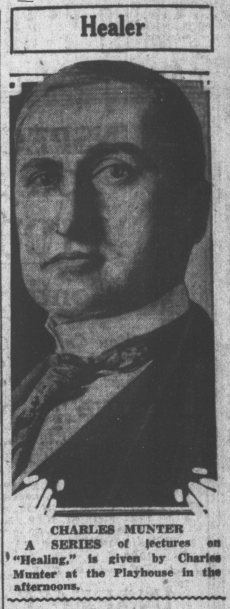
Professor Charles Munter, a little man in a white suit and green waistcoat, introduced the audience to his secretary Miss Marian Graham. Miss Graham was described as a stunning young woman with blue black hair and blue grey eyes with a ‘well-rounded figure’. However, she was a shy girl and when asked to sing, her voice was awful – flat and lifeless.
Professor Munter stared into the young woman’s eyes until she seemed to fall asleep. A record player was brought out and turned on. ‘I am now transferring my magnetic personality… into Miss Graham’s vocal cords,’ Munter told the audience. ‘I am sending the physical energy of my body through space into the blood cells of the brain where they are fused with the suggestion to sing.’

And sing she did, perfectly hitting the highest of high notes and the lowest of low notes. The audience went wild with astonishment. Even stranger, when in a hypnotic trance, Miss Graham could expertly sing songs she had never even heard before – presumably the words and music being telepathically beamed into her by Professor Munter.
She told the press ‘Most of the songs I sing I do not know… They say I sing beautifully, but have no knowledge for I do not hear a note…They tell me I surpass the best of the opera singers.’[i]

The previous May five hundred physicians had gathered in New York at the Medical and Laryngological Society convention for a similar demonstration by Miss Graham and the Professor. After being hypnotised, Marian sang beautifully and danced around in perfect time to the music with uncharacteristic girlish abandon. The medical men were convinced they were witnessing a miracle of hypnosis.
If it seems like something out of a novel, that’s because it is. All the press reports of Munter and Graham’s demonstrations make reference to George Du Maurier’s 1894 novel Trilby which concerns a beautiful tone deaf Parisian woman called Trilby. Trilby is hypnotised by the villain Svengali, and becomes a golden voiced operatic diva filling the opera houses of Europe – all the time unaware that she was a star and with no memory of her performances. The character Svengali gave his name to any domineering manipulator, and thanks to headwear the lead actress wore in a stage adaptation of the novel, the eponymous heroine gave her name to the Trilby hat. But the wildly popular novel surely inspired Professor Munter’s display of mesmeric prowess.
So who was Professor Munter, this real life Svengali?

The Real Life Svengali
Charles Munter (it seems unlikely that he was really a professor) was a health entrepreneur. If we are to be less kind, we might call him a quack. He was often called the Prince of Healers. Thirty years prior to hitting the headlines with Miss Graham, he had been dying in the tuberculosis ward of an orphanage asylum and the doctors had given up on him. He set to thinking hard and worked out to how to save himself – he had discovered a panacea. In any case, that’s what he told the press.[ii]
His panacea was warm water and lots of it. Forty to fifty glasses a day. Cold water won’t do – Munter called it the demon drink. It must be warm. On top of that – heavy breathing. These alone can cure any and every disease from blindness to paralysis and from insanity to being overweight. He would cry to his patients: ‘Breathe and live for ever.’ Munter quite rightly pointed out: ‘If you keep on breathing they will never let you in the cemetery.’[iii]
The nose was the rudder of the human ship, according to Munter.[iv]
Munter gave frequent demonstrations of his healing powers in the 1920s and 1930s in the USA, UK and France. In May 1922 hundreds of women turned up to see the ‘miracle man’ on his first visit to Washington. In what was probably a typical performance, he supposedly cured a woman who had a paralysed left arm and hip by passing his hand over her face and jerking her head from side to side.
With the same technique he cured Mrs Christina Martinowitz – a woman who was depressed almost to the point of suicide because of her weight. When Munter gave the woman the corset he had designed to try, she was suddenly able to kneel as well as run round the stage like a young girl. She even danced an impromptu jig for the astonished audience.
The cynic in me can’t help but suspect that Mrs Martinowitz was an accomplice – a plant in the audience. I also can’t help but wonder if she was one and the same person as the hypnotised diva Miss Marian Graham…
The Corset of Immortality
In any case, Professor Munter’s lectures and demonstrations all seemed to end up in corsets. He may have been the Prince of Healers, but he was the King of Corsets. But these weren’t just any corsets. These were magic – as well as hiding flabby bellies and shaping the figure, they helped the wearer to breathe deeply, and this (along with warm water) was all that was needed for immortality.
He didn’t just body shame women into wearing his patented underwear, though. He made them for men and children too. His adverts were ubiquitous in the 1920s and 1930s. He could not be accused of underselling himself. One advertisement said of his lectures and corset demonstrations: ‘Every word is interesting – every thought is a key that unlocks doors to new and undreamed of possibilities.’[v]

Another advert said that his Nulife corsets would make women more fashionable and beautiful as well as preventing nervous breakdowns. The corsets, Munter claimed, would also lead to happiness, success and would ‘make your desires in life come true’.[vi]
Crowds would flock to his lectures and demonstrations and although he never charged for his miracles, he no doubt compensated for this through the sale of his miraculous corsets.
Epilogue
Professor Munter took the nineteenth century snake oil salesman and updated it for the early twentieth century by exploiting the popularity of the best-selling novel Trilby and its subsequent widely seen adaptations for stage and screen. His musical scam fooled scientists and musicians alike. But it was all about the corsets.
His health recommendations were refreshingly simple. All you need is lots of warm water and deep breathing. And the best way to achieve the latter is by squeezing yourself into one of his magical corsets.
Adverts for his corsets continued appearing regularly in the US press into the 1940s, but I can’t find a definite obituary for Professor Charles Munter. I can only conclude that he still walks among us, having really found the corset of immortality…
UPDATE: Thanks to Patricia Howe for sending me his obituary. He died aged 73 in 1944 in New York.
[i] ‘She is Trilby in real life’, Milwaukee Leader, 18 May 1912, p.12; ‘Woman, hypnotised, sings operatic airs’, Bridgeport Evening Farmer, 29 June 1912, p.10
[ii] ‘Prince of Healers’, Westminster Gazette, 26 July 1923, p.7; ‘Professor Munter himself…’, Catholic Telegraph, 10 March 1921, p.10
[iii] ‘Jail sentences recommended for those who are sick’, The Ogden Standard, 23 May 1914; ‘The Munter Method’, Western Evening Herald, 26 July 1923, p.2
[iv] Margaret Hubbard Ayer, ‘Girls, don’t marry sharp-nosed men’, Omaha Daily Bee, 7 September 1912,
[v] Birmingham Herald, 22 September 1918, p.19
[vi] Washington Evening Star, 3 May 1922, p.20
 Paul Weatherhead