In 1806, the good people of Leeds were preparing for the end of the world. Millenarian sects warned of the coming apocalypse and many were convinced they were living through the Last Days before the second coming of Jesus Christ.
There were strange signs and wonders that portended End Times, and one of these came from the chicken of notorious Yorkshire witch and serial killer, Mary Bateman.
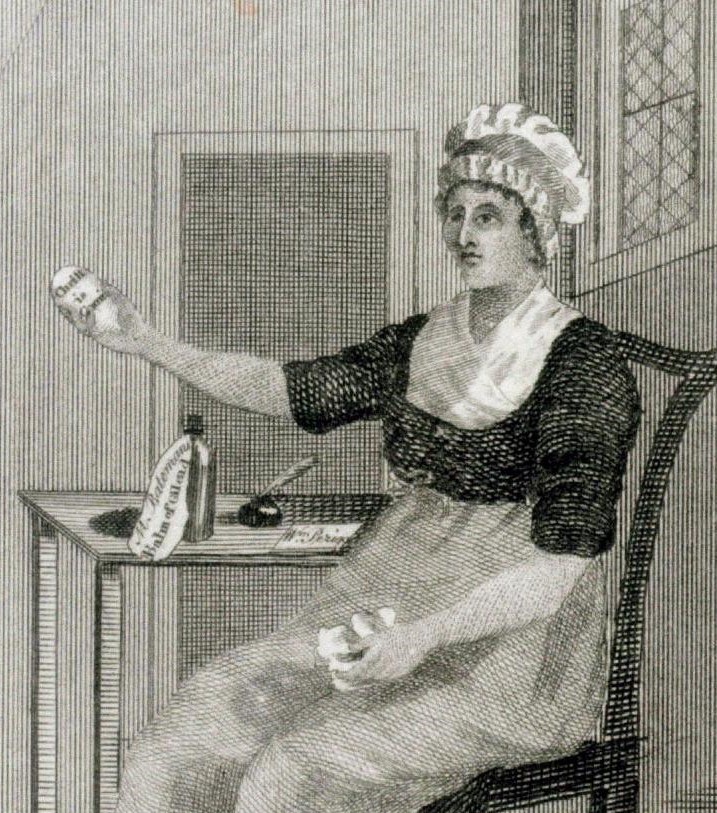
Mrs Bateman had had a vision in which she was told that her hen would lay fourteen special eggs and the final one would mark the apocalypse.
When the first of the eggs came, the words ‘Crist is coming’ were clearly visible on the shell. More eggs with the same oddly spelled message followed, sometimes coming out of the hen before the astonished eyes of witnesses.
These doomsday eggs caused widespread panic and anxiety in Leeds in 1806, and Mary Bateman made the most of it. She charged people a shilling to see the miraculous chicken that laid the prophetic egg. She sold bits of paper with the initials JC on them which she said would be a guarantee of entry to heaven when the end came. She sold thousands of these.
Unfortunately, Mary was caught in the act of using corrosive vinegar to write apocalyptic messages on the eggs then stuffing them back into the poor chicken to be ‘laid’ later.[i]
The Yorkshire Witch
Mary Harker was born near Thirsk in North Yorkshire in 1768. Even then she was known, according to her biography, as of a ‘knavish and vicious disposition’. She found employment as a servant, though was sacked for theft on more than one occasion.
In 1788 she moved to Leeds and worked in a clothes shop, but took up fortune telling and removing witches’ curses as a side-hustle. Typically, Mary would tell her clients that they were under an evil spell, and that the person who wanted to harm them needed to be ‘screwed down’. The evil spell, in other words, had to be counteracted. Roaming husbands could also be magically screwed down, as could creditors.
Mary would tell her clients that she could not do this, but she knew a woman who could: Mrs Moore, the seventh child of a seventh child and therefore, as the belief went, psychically gifted. Mrs Moore had the power to ‘screw down’ those roaming husbands and irksome creditors – if the clients had the money, which they would give to Mary to pass onto the enigmatic Mrs Moore.
Mrs Moore, of course, did not exist. It was part of Mary’s elaborate con.
Mary Bateman was what we might call a cunning woman. Cunning folk would use a mixture of folk magic and Christian rituals to lift the evil eye, cast love spells, tell fortunes with a bit of quackery thrown in for good measure. Many, like Mrs Bateman, were also back-street abortionists. Cunning folk were often seen as disreputable, but it didn’t stop people paying for their services.[ii]
In 1783, after a whirlwind romance, Mary married wheelwright John Bateman.
She was not exactly a loving wife. She forged a letter to her husband claiming that his father was on his death bed in Thirsk and not expected to live long. Mr Bateman dashed off to see his father, expecting the worse. When he arrived in Thirsk, he was surprised to see his father was alive and well and had not been ill at all. When Bateman returned to Leeds, his wife had sold all the contents of their house in order to pay off the many people she had been caught stealing from.
He evidently forgave her and they had several children together.
Don’t Eat the Pudding
In 1803, Mary was nursing a shopkeeper called Mrs Kitchen and treating her with her own medicine. Despite the treatment – or more likely because of the treatment – Mrs Kitchen died. When the woman’s mother and daughter came to the house, they did not survive long.
Their deaths were put down to cholera, though it’s suspected that Mary had poisoned them with arsenic. Mary made sure to strip Mrs Kitchen’s shop and house of any content that was of value.
Another of Mary’s unfortunate clients was Rachel Perigo of Bramley, Leeds. She suffered from palpitations and believed herself to be haunted by a huge black dog. Her doctor told her she was under a spell, and that’s when Mary stepped into the picture.
In order to lift the curse, Mary visited the woman and her husband Richard and got them to place money into a silk bag which Mary tied. These bags were to be fastened around the bed and not opened for eighteen months and that would lift the curse. This was a trick Mary had used many times. If the Perigos had opened those magic bags, they would have found that the notes had turned into paper and the gold coins become pennies…
Mary continued swindling money and household goods from the poor couple until informing them that they would die unless they were to eat a pudding prepared with special ingredients that she provided.

Desperate to make herself well, Rachel ate the pudding and honey she had been told to eat. The worse she felt, the more she ate and the worse she got. After an agonising week, Rachel passed away.
When her husband opened the bags around the bed and found he had been swindled, he decided to confront Mary. She agreed to meet him on the banks of the Leeds Liverpool canal. For Mary, Richard Perigo was unfinished business. In her bag she carried a bottle of ‘medicine’ especially for him.
However, Perigo had brought William Duffield, the police constable of Leeds with him. When Mary saw Perigo was not alone, she pretended to vomit as if he had tried to poison her, but it was to no effect.
Mary was arrested and charged with the murder of Rachel Perigo. At the trial some of Mary’s incriminating letters were produced and the Perigos’ neighbour told how after she had tried some of the pudding she threw up green and yellow vomit. When a cat was given some, the unfortunate creature died.
After a trial lasting 11 hours, it didn’t take long for the jury to return a guilty verdict. Mary Bateman was sentenced to death by hanging, followed by dissection of her remains.
But Mary had one final trick up her sleeve… she claimed to be pregnant. ‘Pleading the belly’, as it was known, was a possible means by which a condemned woman might escape execution. The judge immediately requested a panel of twelve married women be formed from the public gallery to conduct an intimate examination of Bateman. This caused a mass exodus as all the women eligible for this duty desperately tried to flee. The judge had to lock the doors to prevent all the ‘volunteers’ from running from the court.
A reluctant panel of married women was formed and after examining Mary, declared she was not with child. Mary was doomed.
In her condemned cell, Mary wrote to her husband enclosing her wedding ring, which she requested be given to her oldest daughter. Her youngest daughter was a babe in arms and was with Mary in her cell. In the letter Mary expressed regret for the shame she had brought on the family, and admitted to the various frauds she had committed, but maintained her innocence of any murder.
As execution day approached, Mary showed no signs of remorse and would not confess to the murder she’d been convicted of, despite the efforts of the Rev George Brown.
In fact, Mary continued her trickery in prison. A young female prisoner wanted to be visited by her sweetheart, so Mary told her to bring some money which she then sewed into the woman’s underwear. This magic, she said, would compel the girl’s lover to visit her. When no lover came, the lovelorn prisoner grew suspicious and opened the charms to discover that her money had miraculously vanished…
At 5am on the morning of 20 March 1809 Mary kissed her sleeping infant goodbye and was taken from her cell to the place of execution behind York Castle. Many thousands had turned up from Leeds and beyond to witness the event. The crowds were unusually quiet and respectful. It was reported that many believed Mary would use her magical powers to escape her fate at the last minute and fly off into the sunrise on a broomstick.[iii]
With the noose fastened around Mary’s neck, Rev Brown whispered into her ear, offering her a final opportunity to confess her crimes. She did not.
She, along with two other poor souls, were tumbled into the next world with the pull of the hangman’s lever.[iv]
Yorkshire Psycho
Mary’s body was taken to Leeds Infirmary where a fair sum was raised for the hospital by charging people to view her remains. It seems rather befitting that after being dissected, Mary’s skin was removed and tanned and sold as lucky charms. It was even rumoured that the Prince of Wales (later to become King George IV) had a volume bound in the woman’s skin. Her tongue was on view in a shop in Ilkley at the end of the nineteenth century. Part of her skeleton was still on display in Thackray Medical Museum in Leeds until fairly recently.[v]

Mary Bateman was certainly dishonest, a thief and a murderer. However, she was also someone with a reputation as a healer with a sympathetic and plausible manner. This along with her brazen callousness and impulsive recklessness is certainly enough to make us wonder if the Yorkshire Witch was actually a Yorkshire Psychopath.
Epilogue
As for the hen that laid the doomsday egg, Mary had sold it to a neighbour for a handsome sum. The neighbour waited in vain for the bird to produce more prophetic eggs, but none came. After her fifteen minutes of fame, the hen had her neck wrung and ended up in the cooking pot.
[i] Arthur Vincent, Lives of twelve bad women; illustrations and reviews of feminine turpitude set forth by impartial hands, (London: T.F. Unwin,1897); E. Baines, Extraordinary Life and Character of Mary Bateman, the Yorkshire Witch: Traced from the Earliest Thefts of Her Infancy, Etc Till Her Execution on the 20th of March, 1809 (leeds: Davis and co, 1811
[ii] Owen Davies, Popular Magic: Cunning-Folk in English History, (London: Hambledon Continuum, 2007)
[iii] Globe 27 March 1809
[iv] William Knipe, Criminal chronology of York castle; with a register of criminals capitally convicted and executed at the County assizes, commencing March 1st, 1379, to the present time, (York: C.L. Burdekin, 1867)
[v] See Summer Strevans, The Yorkshire Witch, (Barnsley: Pen and Sword, 2017) for the full story of Mary Bateman.
 Paul Weatherhead
One thought on “Yorkshire Serial Killer Witch’s Chicken Lays Doomsday Egg”