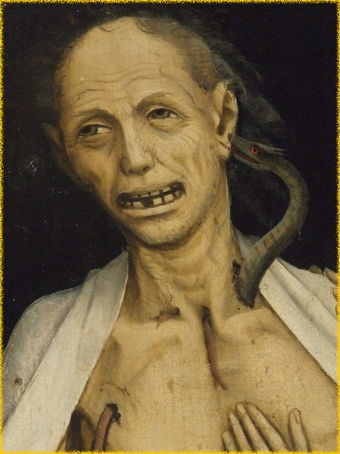
Yorkshire in the 1300s was a strange and frightening place. The living dead crawled from their graves, wandered round the lanes and accosted the villagers, at least according to accounts written by an anonymous monk. But these zombies were very different from the gut munchers of modern popular culture, and it wasn’t your brain they were after. So why were the dead shuffling round Yorkshire six centuries ago? What did they want? And how could they be stopped?
I see dead people
Sometime around the year 1400, a Cistercian monk residing in Byland Abbey, North Yorkshire, began collecting and recording strange and supposedly true events from the surrounding villages. He wrote them down in Latin on spare blank pages of a volume that was already 200 hundred years old.[i]
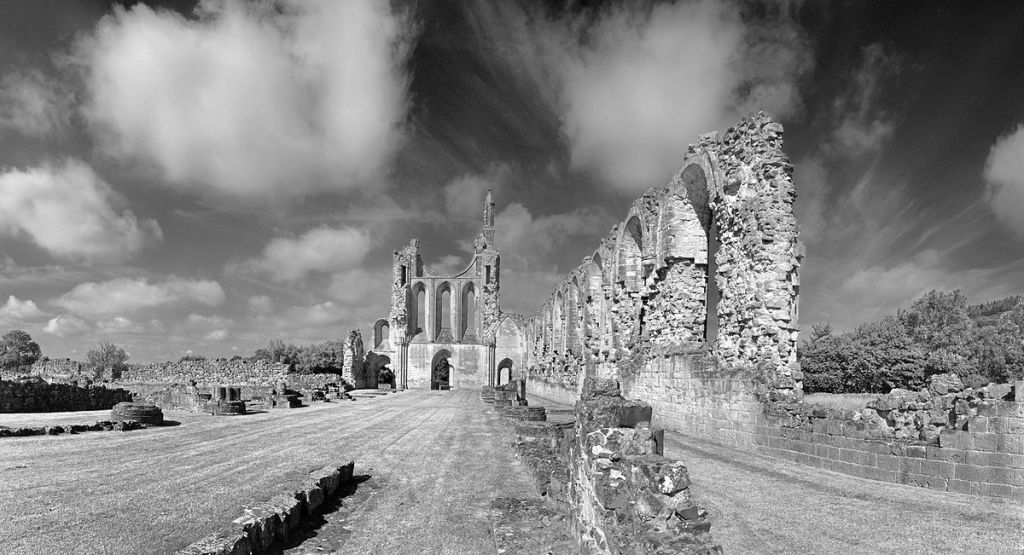
The events he recounted feature encounters with various supernatural entities, which the author often refers to as ‘ghosts’, though these spirits are very different to the ethereal, floaty, semi-transparent literary ghosts of recent centuries. The medieval Yorkshire ghosts sometimes take the forms of tall, sinister human figures, but can change their shape to other creatures such as a raven, a pale horse or a saucer-eyed bull with no mouth. Sometimes the spirit manifests itself as a pile of peat or a rolling bale of hay.
But the most interesting of the accounts in the manuscript are about revenants, corpses that rise from the grave – in other words, zombies.
Robert Son of Robert – A Yorkshire Zombie
One of the accounts in the Byland manuscript concerns Robert, son of Robert de Boltby, of Kilburn. Although he was dead and buried, he wouldn’t stay in his grave. At night he would crawl from his coffin and leave the church yard and wander round the village, scaring everyone. Dogs followed him wherever he went, barking madly.
However, Robert didn’t attack anyone. Rather sadly, he would stand outside people’s doors and windows as if he was listening, or perhaps waiting for someone to help him.
Some brave young men decided to catch Robert and so waited at the cemetery as night fell. Sure enough, Robert shuffled out from the graveyard, though the brave young men were so terrified that they ran for home as fast as they could. Only two men stood their ground. One, Robert Foxton, grabbed the zombie and put him on the church gate while the other ran to get a priest.
In the folklore of the time, the walking dead are ‘jinxed’, meaning they cannot speak unless they are ‘conjured’ – that is, unless they are asked in the name of God what it is they want.
The priest duly arrived and conjured Robert. Robert could now speak. His voice was eerily hollow: ‘he spoke in the inside of his bowels, and not with his tongue, but as it were in an empty cask.’
The zombie confessed that he had when alive assisted in a murder ‘and that he had done other evil things of which I must not speak in detail at present’, as the author coyly recorded. The priest absolved the dead man of his sin and from that time on he rested in peace.
What do Zombies Want?
It’s clear from the story above that the medieval dead don’t want your brains, they want absolution for their sins. This reflects a very down to earth, demotic version of the catholic doctrine of purgatory – a place where sinful souls go to be purified through suffering so that they may eventually be admitted to paradise.

For the folk of medieval Yorkshire, purgatory was not some abstract place where sins were purified. It was there in the hills, moors and villages, and this was where sinful sufferers wandered as animated corpses, desperate for absolution yet unable to ask for it unless ‘conjured’. Robert’s sin was murder (and other unnamed evil acts), though other peripatetic corpses suffered the zombie walk of shame for lesser crimes. One unfortunate priest, the former canon of Newburgh, walked the earth after death because in life he had stolen some spoons.
The spoon stealing zombie tore at a man’s clothes (unable to express himself) until the man conjured him in the name of God. Then the ghoul told the man where he’d hidden the stolen cutlery and begged him to return them to the rightful owner. The spoons were indeed found in the place indicated and after being returned the zombie was absolved of his sin by a priest and returned to his grave.[ii]
Medieval Zombie Survival Kit
Should medieval style zombies ever make a comeback, in Yorkshire or elsewhere, here’s everything you need to know.
First, although the medieval dead are not interested in eating your brains or pulling out your intestines, they can be dangerous. One zombie (James Tankerlay, in life a former rector of Kirby) crawled from his grave at Byland Abbey and walked to nearby Kirby where he ‘blew out the eye’ of his concubine. It’s not clear what this means. Possibly zombie breath causes blindness – a good reason to keep one’s distance.
In the manuscript, the unfortunate villagers who come into contact with the walking dead are seriously ill after their experience – contact with the supernatural is bad for one’s health.
In order to send a zombie back to his grave, we have seen that they need to be ‘conjured’ – asked in the name of something holy what they want. Then, if a priest can absolve them of their sin, they can leave their nocturnal wanderings and return to the tomb.
The eye blowing zombie James Tankerlay, however, received no such assistance. The abbot ordered his coffin to be thrown into a lake. The oxen pulling the cart nearly died of fear. So that’s another option – dig up the coffin and chuck the zombie in the nearest body of water.
Judging from the number of exhumed medieval corpses that had been decapitated, chopping their heads off may also be worth a try.
So what have we learned?
We’ve learned that zombies are human too and require our forgiveness.
We’ve also seen how the modern concept of a ‘ghost’ in the folklore of recent centuries is very different from the cold, fleshy, shapeshifting revenants that haunted medieval Yorkshire.
And I hope we learned that stealing spoons is wrong.
[i] S.R. Young, The Ghosts of Medieval Yorkshire (2023, Pwca Books and Pamphlets)
[ii] The full text of the ghost stories can be read here: https://www.anselm-classics.com/byland/about.html
 Paul Weatherhead