
On Sunday 29 January 1899, Rosa Day, an athletic nineteen year old woman from Cheshire, decided to go ice-skating instead of joining the rest of her family at church. She didn’t come home.
Search parties retraced her route and explored the fields, lanes and ponds for her without success. It was feared she had fallen through the ice and drowned. By the following Tuesday the searches were intensified and the police dragged all the surrounding ponds and the canal but found nothing.[i]
Rosa lived with her step mother, sisters and brother in the quiet village of Rowton, near Chester. Her father (who used to manage the local lead works) had died in 1892. She was, according to the press, ‘well-connected and highly respected’.[ii]
Although Rosa was described as strong and athletic in the newspapers, she was also said to have been in ill health since Christmas after a terrifying adventure. She had been out gathering ivy to decorate the church when she tumbled over a cliff face in a quarry. Fortunately, her dress caught in some thorns, but she was left hanging there over the precipice for an agonising twenty minutes before she attracted the attention of two men walking by. One of the men held the other’s ankles and lowered him head first over the cliff where he caught Rosa’s arms and she was pulled to safety.
This brush with death was said to have affected her mind.[iii]
And now, just a few days after this dramatic escapade, she had vanished into thin air…
Brutality
Five days passed, and still Rosa’s distraught family had still heard nothing.
Then, on Thursday 2 February the household maid noticed something strange outside the front door – a woman’s hat lying on the doorstep. She went to fetch Kathleen, Rosa’s sister, and they ran outside. The hat belonged to Rosa.
And sprawled near the water pump was the missing woman. She was bloody, filthy and lying in an unconscious heap. Rosa was brought inside just in time. The family were about to retire to bed, and the night was so cold that if Rosa had not been found she would have frozen to death.

Medical help was sent for. The verdict of Dr Taylor and Dr Griffen was that Rosa’s appearance ‘bore unmistakeable evidence that nothing less than brutality must have been used against her.’[iv]
Newspaper reports said that Rosa was bruised all over and her face was swollen. She had what seemed to be rope marks on her wrists and ankles. Worst of all was a wound to her forehead, described as being down to the bone, and her skull was fractured as if she had received a blow from a blunt implement. She was also weak from starvation. She hadn’t eaten for five days.[v]
When Rosa had recovered enough to tell her story, the whole country was shocked and amazed by her sensational adventure…
Carried off by a Lunatic
Rosa told how on the Sunday she had skipped church to go skating. She thought that the ice looked unsafe on the pond near her home, so she walked to another pond three quarters of a mile away. As she sat on the grass to put her skates on, a man approached her from behind, blindfolded her and demanded money. Rosa had none, and the stranger swore and cursed her dreadfully. He then tied her hands behind her back, saying ‘If you scream, I will shoot you.’[vi]
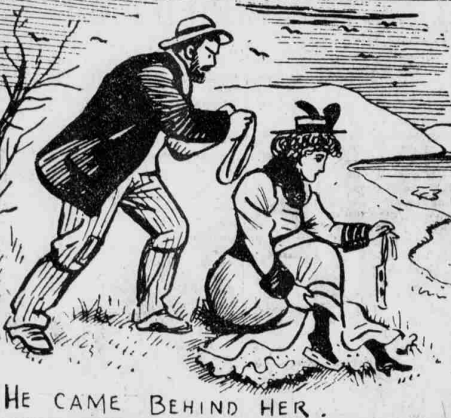
In accounts a few days later, Rosa changed this part of her story somewhat. She clarified that the man had actually approached her and asked her the time. As she felt in her pocket for her watch (which she forgot she had left at home), he grabbed her hands, tied them behind her back and blindfolded her, but not before she had seen the man’s face. ‘Don’t make a sound, or I’ll shoot you,’ he said before marching her for some distance.
He then demanded money, and when she said she had none, he cursed her and delivered a blow to her forehead that rendered her unconscious.[vii]

Rosa described her captor as being about thirty years old with a dark complexion and a large lower lip. He was, she said, ‘horrid looking’. In an enigmatic catty aside, she added that the ugly man resembled a female that she knew. The newspaper report does not give us the name of this female. The attacker was dressed as a labourer. The press speculated that he may have been a lunatic.[viii] He certainly was a man of great strength, for it seemed he carried the unconscious woman a considerable distance.
Dramatic Escape
When Rosa gained her senses, she found herself in a dark hole, she knew not where. She later realised it was a strange loft in which she was locked. As she drifted in and out of consciousness over the next five days, the ugly stranger would sometimes appear, but did not give her food.[ix] She later amended this to say that as she was often semi-conscious, she didn’t know if or when she was being watched.[x] We are not told if there was access to water or toilet facilities. Doctor Taylor later confirmed that during her captivity, there had been ‘no suggestion of outrage’.[xi]
She tried to escape a number of times when she was conscious, and after five days finally found a weak spot in the roof which she was able to make into a hole large enough to crawl through.[xii] She dropped down to the ground, and not looking back, staggered and crawled through the fields. Eventually, she found a stream that she recognised and followed it to Rowton. It was an agonising five hour journey, as weak from starvation and loss of blood she collapsed from exhaustion on a number of occasions and was sometimes paralysed and unable to move at all.[xiii]
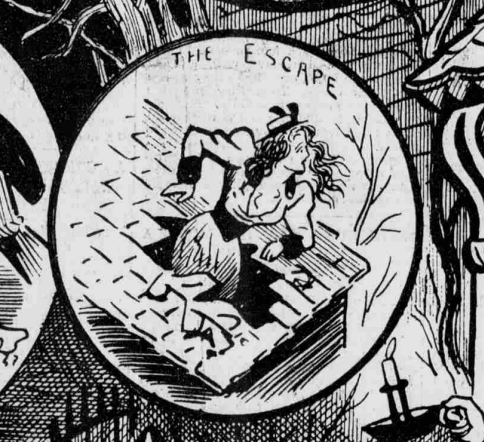
When Rosa finally made it to her house, she was so overwhelmed that she swooned before she could get to the front door. With her last ounce of strength and a great sense of melodrama she threw her hat onto the doorstep, leading to her eventual discovery.
Rosa Day’s sensational abduction and escape made headline news around the country and was featured in an edition of Illustrated Police News, sometimes referred to as Britain’s worst newspaper for its lurid true crime stories and melodramatic pictures.
The police searched the surrounding countryside for the shed or outhouse where Rosa had been imprisoned, but nothing could be found. Nor was there any trace of the ugly stranger, though many men in Rowton were so incensed at poor Rosa’s treatment that they were ready to lynch the ruffian should he be found. The episode led to a feeling of deep insecurity among the locals and, according to the Cheshire Observer, ‘struck horror into the hearts of all people’.[xiv]
The Day family were under a great deal of strain. So many well-wishers and curiosity seekers were turning up at their house that they placed bulletin notices on the garden gate giving updates on Rosa’s recovery.[xv]
The Plot Thickens
However, some press accounts had more than a hint of scepticism about Rosa’s story. Some were even downright sarcastic, such as the Daily Telegraph, which noted that Rosa’s adventure was similar to the kind of cheap novel one might buy at a train station bookstore.[xvi] It was also noted that the ruffian who had abducted the young, strong and athletic woman had somehow carried her unaided, unobserved and in broad daylight across fields and over hedges for quite a distance.
The evil stranger had demanded money from Rosa, yet did not show any interest in the gold brooch she was wearing. And it seems strange that the would-be thief would drag the woman across the countryside and then keep her locked, unmolested in a loft for no particular purpose. Her family, who totally accepted Rosa’s version of events, assumed that the kidnapper had left her in the loft thinking she was dead.[xvii]
It’s not clear whether the various changes in Rosa’s story were made by her or were rather newspapers misreporting what she said, but it does seem that her story was rather fluid. It was also clarified that Rosa was not, as was previously reported, covered in bruises, though she did have a head wound.[xviii]
Some went so far as to suggest that Rosa was suffering from a ‘mental aberration’ that caused her to have hallucinations. Contrary to earlier reports, local police were inclined to disbelieve the story of the abduction.[xix] It seems at some point, the investigation was quietly dropped.
A number of newspapers noted the similarity of Rosa’s escapade with that of Elizabeth Canning, a teenage girl who claimed to have been seized by two men and taken to a house full of gypsies on New Year’s Day 1753. She was imprisoned there for three weeks before she made a hole in the roof and escaped to safety. She walked home and was found starving, bleeding and bruised outside her mum’s house just as the household was going to bed.

Elizabeth Canning accused the gypsy family of having abducted her, but was instead found guilty of perjury. The case gripped the public with strong feelings on the side of those who believed and those who doubted Canning’s story.[xx]
In any case, the similarity between the two adventures are certainly notable.
What Happened to Rosa Day?
Rosa Day kept to her story. But the whole tale seems too melodramatic and sensational to be plausible. So what happened?
It seems she made the story up, but why? One possibility is that Rosa wanted to conceal an unwanted pregnancy and had sought an illicit termination. She then invented the story of the kidnapping – and injured herself on the forehead – to explain her mysterious absence. Indeed, this is also a likely explanation for Elizabeth Canning’s mysterious disappearance a century earlier.[xxi]
It seems that Rosa had a penchant for making up stories. Her claim that on Christmas Eve she had been dangling over a precipice with her dress caught on some thorns only to be saved by a man lowered over the edge while his friend held on to his ankles also seems like it could be another thrilling but imaginary adventure.
Epilogue
Rosa never, to my knowledge, confessed to fabricating her implausible adventure. She went on to have a long career as a nurse working in Bangor and Liverpool as well as helping the war effort as a nurse in the South of France in 1914. She was awarded the Royal Red Cross and after the war went into ‘psychological nursing’. Rosa never married.
She died in Rowton 1937 aged 59. Her obituary described her as beloved by all and of ‘beautiful disposition and character’.[xxii]
The secret of what really happened to her in 1899, she took to the grave.
[i] ‘Local and General Notes’, Cheshire Observer, 4 February 1899, p.5
[ii] ‘Extraordinary Mystery at Chester’, Illustrated Police News, 11 February 1899, p.2; ‘Strange Adventure of a Chester Lady’, Liverpool Weekly, 4 February 1899, p.6
[iii] ‘The Chester Mystery’, Weekly Dispatch, 5 February 1899, p.1; ‘Strange Adventure of a Chester Lady’, Liverpool Weekly Courier, 4 February 1899, p.6
[iv] ‘Local and General Notes’, Cheshire Observer, 4 February 1899, p.5
[v] ‘Local and General Notes’, Cheshire Observer, 4 February 1899, p.5; ‘The Chester Mystery’, Weekly Dispatch, 5 February 1899, p.1; ‘Extraordinary Mystery at Chester’, Illustrated Police News, 11 February 1899, p.2
[vi] ‘Extraordinary Mystery at Chester’, Illustrated Police News, 11 February 1899, p.2; Local and General Notes’, Cheshire Observer, 4 February 1899, p.5
[vii] ‘The Rowton Mystery’, Cheshire Observer, 11 February 1899, p.7
[viii] ‘Strange Adventure of a Chester Lady’, Liverpool Weekly Courier, 4 February 1899, p.6
[ix] ‘Extraordinary Mystery at Chester’, Illustrated Police News, 11 February 1899, p.2
[x] ‘Local and General Notes’, Cheshire Observer, 4 February 1899, p.5
[xi] ‘Strange Adventure of a Chester Lady’, Liverpool Weekly Courier, 4 February 1899, p.6
[xii] ‘Local and General Notes’, Cheshire Observer, 4 February 1899, p.5
[xiii] ‘Extraordinary Mystery at Chester’, Illustrated Police News, 11 February 1899, p.2
[xiv] ‘Local and General Notes’, Cheshire Observer, 4 February 1899, p.5; ‘The Rowton Mystery’, Cheshire Observer, 11 February 1899, p.7
[xv] ‘The Rowton Mystery’, Cheshire Observer, 11 February 1899, p.7
[xvi] Quoted in ‘The Rowton Mystery’, Cheshire Observer, 11 February 1899, p.7
[xvii] ‘The Chester Mystery’, Weekly Dispatch, 5 February 1899, p.1
[xviii] ‘The Rowton Mystery’, Cheshire Observer, 11 February 1899, p.7
[xix] ‘The Chester Kidnapping Story’, Daily News, 6 February 1899, p.2
[xx] ‘Kidnapped at Chester’, Morning Leader, 6 February 1899, p.4
[xxi] Nottinghamshire Guardian
[xxii] ‘Death of Miss Rosa Day’, Cheshire Observer, 16 October 1937, p.10
 Paul Weatherhead
One thought on “The Rosa Day Mystery”