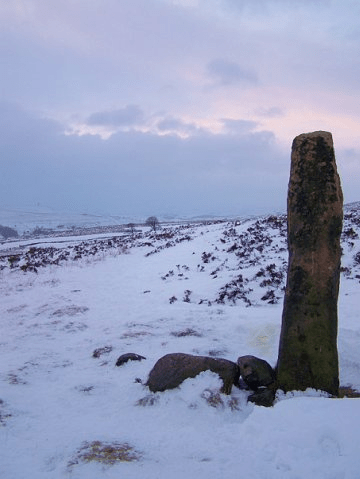
Secret lovers’ trysts, a deal with the devil, a vengeful ghost, pennies from heaven, the plague and killer foxes… all have been associated with one of my favourite standing stones – Churn Milk Joan.
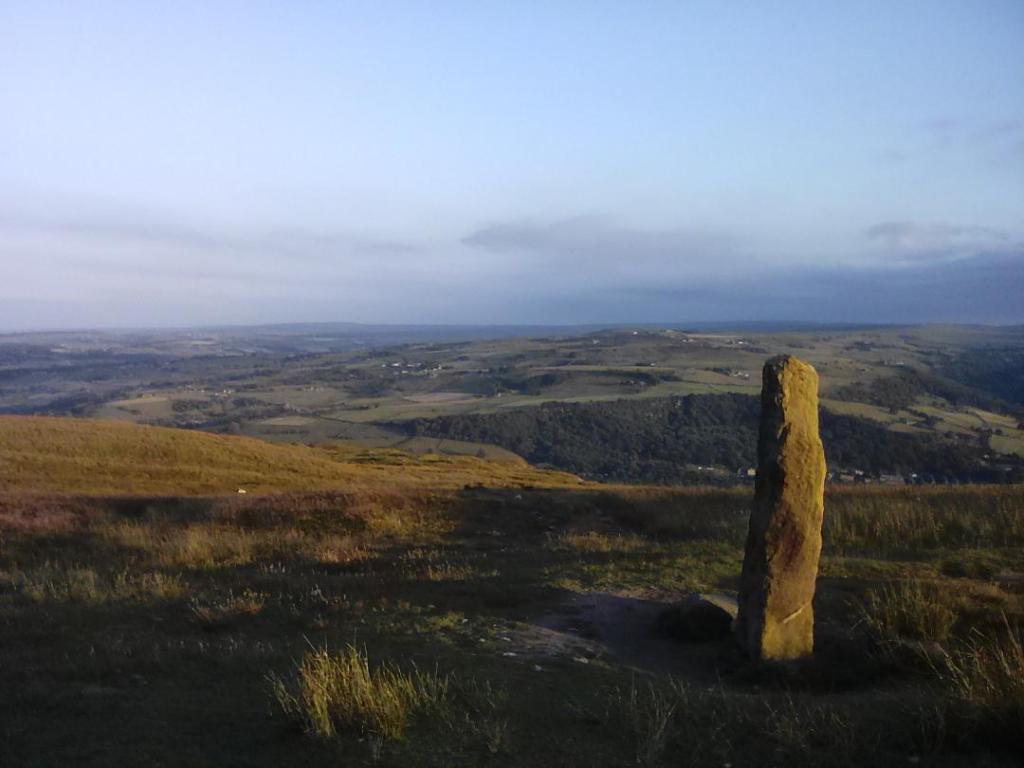
The stone stands around 7 feet tall on the outskirts of Midgely Moor overlooking the Calder Valley, and although it probably only dates back to around 1600 when it was erected as a boundary stone, it has been a magnet for a variety of legends and traditions.
The Awful Death of Churn Milk Joan
Joan was a young farmer’s daughter and would often make the lonely journey over the tops of Midgely Moor to deliver her churn full of milk to the villages beyond. One snowy evening, though, she encountered the devil where the stone now stands (at a crossing of paths), and he told her he was on his way to take the souls of her ailing parents. However, Joan made a bargain with the Devil – her soul in the place of her parents. Presumably Old Nick thought this a good deal, for the next morning Joan’s frozen body was found under the standing stone, surrounded by the icy milk spilt from her churn.
And that’s how the stone got its name. At least according to my favourite version of the legend.
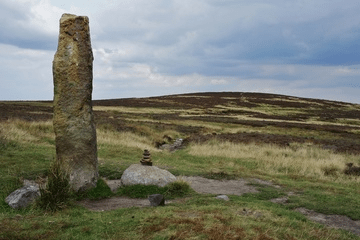
According to Mytholmroyd poet Ted Hughes, who wrote a poem about the standing stone in his 1979 collection Remains of Elmet, Joan was done in by killer foxes. The poem, titled ‘Churn Milk Joan’, begins:
A lonely stone
Afloat in the stone heavings of emptiness
Keeps telling her tale. Foxes killed her.
I think you’re about as likely to be killed by a shark as a fox on Midgely Moor, but that’s the legend as our Ted tells it. It caused some controversy when a sculpture was commissioned for the centre of Mytholmroyd depicting a milk churn and two rather cute foxes – representing the Disneyfication of Ted Hughes and his work, according to one article in the Guardian.[i]

Other versions have poor Joan getting lost and disoriented in a blizzard, and laying down to freeze to death next to the stone that subsequently bore her name. This seems to be the most common version of the story. Indeed, a similar story is attached to the Two Lads cairns on the moors above Crag Vale.[ii]
But not all the legends are so dark. According to Samuel Fielding (writing in 1903), the name came from the custom of boundary officials taking a break at the stone and being supplied with a welcome drink of milk from Joan, who was a ‘merry buxom farmer’s wife’.[iii]
Other sources say that the stone was the location where a fam girl called Joan used to meet her lover.[iv]
Turn Turn Turn
Churn Milk Joan is said to turn round three times at midnight on New Year’s Eve when the church bells in Mytholmroyd chime for midnight. I’ve often thought of spending New Year on Midgely Moor with a video camera to record what happens as the church bells ring and the valley is lit up with fireworks…
But a night on Midgely Moor in winter is not that appealing, and I can’t help thinking that anyone who witnesses her nocturnal perambulations would not live long…
Relic of the Plague
Churn Milk Joan has a hollow on top of it, and the custom is for passers-by to take a coin out and replace it with one of their own. The common belief is that the stone was, as Hughes puts it in his poem, a ‘relic of the plague’. The idea was that during times of plague, the hollow at the top of the stone would be filled with vinegar so that any coins that exchanged hands between traders and customers could be disinfected.
It’s a nice idea, though as John Billingsley has pointed out, Joan is a bit too tall for such a purpose.[v] Robin Hood’s Pennystone – just over the moor – has a similar hollow and is a more realistic height for a ‘plague stone’.
Other legends say that the hollow was used to collect funds for Joan’s funeral, or that the stone has magical properties and produces coins magically from thin air.[vi] Or that Joan’s ghost will haunt you if you don’t leave an offering for her…[vii]
Some of the newspaper sources from the early twentieth century suggest that although the tradition of putting money into Joan’s hollow was known about, it was very rare to actually find any.[viii]
However, in the many visits I’ve paid in the last three decades, there have always been a few coppers or some silver nestling on top of her. One time when I visited to take some photos for the first edition of my book Weird Calderdale, I neglected to take some loose change with me and balked at the idea of leaving her a twenty pound note. When I went to take the photos, the camera’s battery was completely flat, despite it being fully charged when I set off… as far as I can remember, anyway.
I’m not superstitious but…after that, I always make sure I have something to drop in her little hollow to placate Joan’s ghost. The last time I visited (June 2024), instead of the usual copper, there was a pound coin – inflation even affects folklore. I naturally swapped Joan’s pound with one of my own.
I can’t help wondering if one day Joan will be card payments only…
[i] Martha Gill, ‘Even Ted Hughes has fallen to the sickly cult of the twee’, The Guardian, 9 October 2022. Available at: https://www.theguardian.com/commentisfree/2022/oct/09/even-ted-hughes-fallen-sickly-cult-of-twee
[ii] John Billingsley, Folk Tales from Calderdale Vol 1, (Northern Earth: Mytholmroyd, 2007), pp.55-63
[iii] S. Fielding, ‘Walks About Hebden Bridge’, Todmorden and District News, 22 October, 1903
[iv] ‘Churn Milk Joan’, Halifax Courier and Guardian, 10 February, 1932
[v] Billingsley (2007), p.58
[vi] S. Fielding, ‘Walks About Hebden Bridge’, Todmorden and District News, 22 October, 1903; ‘Country Day by Day’, Halifax Evening Courier, 20 October 1941
[vii] See some of the comments here: https://www.themodernantiquarian.com/site/5553/churn_milk_joan.html
[viii] Churn Milk Joan’, Halifax Courier and Guardian ,10 February, 1932
 Paul Weatherhead