
In 1874, a macabre and bizarre criminal fail was widely reported in the UK press – a burglar was captured by a skeleton.
In January 1874, so the story goes, two unnamed burglars broke into a doctor’s surgery in Greensburg, Pennsylvania. While one of the men explored one part of the room with the lantern he was carrying, the other opened a closet and groped around in the dark feeling for clothing at the height of clothes hooks.
As he fumbled blindly, a ghoulish fear that he might be sticking his fingers into the jaws of a skeleton struck him. At that moment, his hand was grasped – bitten – by what felt like teeth.
The burglar gave a surprised shriek, and his companion turned his lantern on the closet. The burglar’s hand was indeed immured in the jaws of a skeleton. The jaws had been adjusted with a coil spring and held open with a thread which the hapless thief had broken when he inadvertently stuck his hand in the skull.
When he saw that his fears were indeed true and that his hand was gripped in ‘the grim and ghastly jaws of death’, overcome with terror, he fainted, pulling the skeleton down on top of him. His companion, seeing his partner in crime wrestled to the floor by this skeletal vigilante, fled.
Of course, the commotion was such that the doctor ran in and secured the robber, who was still lying in the skeleton’s bony embrace.[i]
It’s a great story, splendidly captured in an image from the Illustrated Police News.[ii]
However, although the story was widely reported in the British press, none have any details (such as the exact date, the name of the burglar or the doctor), and all the accounts are almost word for word the same. In fact, it looks like an urban legend – a story that’s just too good to be true.
To try to get to the bottom of this, I tracked down the medical journals that many of the news reports cited as the source of the story, the Philadelphia Medical Times and the Medical and Press Circular.[iii] Frustratingly, these accounts are exactly the same as those that appeared in the British press.
The Toe of his Boot
The story of the skeleton and the burglar was also widely reported in the US, and though no names are given in American versions, some accounts have a nice epilogue to the report which was not included in British papers.
After the doctor finds the burglar sprawled on his surgery floor with the skeleton on top of him, he recognises the criminal as a man of some esteem in the local community. When the thief recovers from his swoon and realises he’s been caught, he begs and pleads most piteously to the doctor so that instead of turning him in, he orders him to get out of town and ‘showed him the door and bade him goodnight with the toe of his right boot’.[iv]
Moreover, a number of US newspapers attribute the story to Greensburg newspaper proprietor and writer Frank Cowan – a man with a reputation for pranks and hoaxes, some of which were both macabre and skeletal in nature.[v]
The Last of the Vikings
Frank Cowan was born in Greensburg, Pennsylvania in 1844. He was a man of many talents, qualifying as both a doctor and a lawyer as well as writing fiction and non-fiction. However, he was also known as a prankster, and it was his fascination with Viking mythology that was the inspiration for his best-known hoax.

The hoax took the form of a letter to the Evening Union newspaper published on 8 July 1867 from Cowan writing under the name of the fictitious Thomas C. Raffinnson of Copenhagen Royal Society of Northern Antiquaries.
The letter claimed that he had discovered the skeletal remains of an Icelandic woman along with various Viking artefacts on the banks of the Potomac river, around 15 miles north west of Washington D.C.
Nearby a runic inscription covered in lichen was found, saying in translation:
Here rests Syasy, or Suasu, the fair-haired, a person from the east of Iceland, the widow of Kjoldr, and sister of Thorgr, children of the same father….twenty-five years of age. May God make glad her soul. 1051.
Raffinnson argued that this proved that the Vikings were in North America centuries before Columbus, an idea that although widely accepted now was in Cowan’s time on the fringes of academic respectability. Furthermore, the letter suggested that the presence of this (entirely invented) Viking find provides support for the Skalholt Saga which told of the voyage of Hervadur to Vinland (the Norse word for the North American coast) and how his daughter had died at ‘White Shirt Falls’.
Raffinnson’s letter explained that the Skalholt Saga also told how even before the Vikings, the Irish had settled in North America. This, it was claimed, was now more plausible as the remains of the Icelandic woman proved the reliability of the Skalholt Saga.
The only problem was the Skalholt Saga, like Syasu the Fair-haired Viking, was entirely a figment of Frank Cowan’s imagination.

The newspaper was in on the joke and printed the letter on the front page and it caused a media sensation. The hoax also fooled scholars and was reported in some academic journals, even after it had been revealed as a prank to boost newspaper circulation.[vi]
In 1872, Cowan started his own newspaper titled Frank Cowan’s Paper, and this seems to be where the story of the skeleton catching the burglar originated. Given Cowan’s mischievous reputation, it seems likely that he made up the story (or possibly retold an urban legend that he had heard).
Epilogue
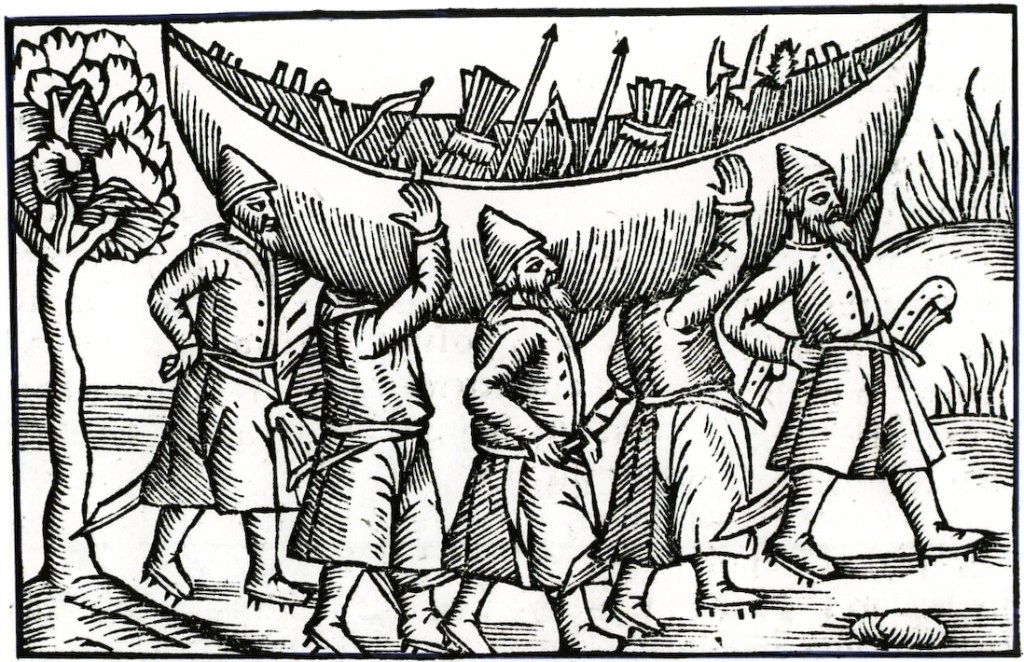
Frank Cowan went on to write numerous books on a variety of subjects, travel the world and work as secretary to President Andrew Johnson. However, even on his deathbed he had one more macabre hoax up his sleeve. He commissioned a local carpenter to build him a Viking funeral ‘fire-ship’ which he was to be buried in under a tree on his estate. He wrote to a local paper:
I, as the last of the Vikings or Berserkers, desire my effigy or cold corpus to drift away over the mountainous billows of the Sea of Appalachia and sink in a blaze of glory in the womb of the west – which, from the pier of my departure is the cloud of smoke and soot over the city of Pittsburgh.[vii]
A flood of angry letters followed, including from a member of the clergy outraged at this ‘heathenish’ desecration of a Christian burial rite.
Cowan died aged 60 in February 1905 and was buried in a local cemetery, and not in a Viking funeral ship. He had fooled the world again.[viii]
Just as he had fooled and amused the world with his skeleton catches burglar story. The skeleton can now come out of the closet and join the Viking Princess Syasy the Fair-Haired as a character in one of Cowan’s most effective journalistic japes.
[i] ‘A burglar bitten by a skeleton’, Illustrated Police News, 26 June 1874, pp.1-2
[ii] Ibid
[iii] ‘The burglar and the skeleton’, Philadelphia Medical Times, 16 May 1874, p.528; ‘Burglars Beware’, Medical Press and Circular, 10 June 1874, p.498
[iv] ‘A burglar captured by a skeleton’, Kingston Daily Freeman, 6 December 1874, p.2
[v] ‘Captured by a skeleton’, Harrisburg Telegraph, 26 January 1874, p.1
[vi] Scott Tribble, ‘Last of the Vikings’, Western Pennsylvania History, Fall 2007, pp.48-57
[vii] Ibid
[viii] Ibid
 Paul Weatherhead