In late August 1884, two pale and trembling strangers entered the White Lion Inn in the Midlands village of Ivy Church Green. They both sank a pint of ale to steady their clearly frayed nerves, and the landlord and the regulars looked on with interest. What had terrified the two men so?
Eventually, one of the strangers revealed what had happened. They had been walking down a narrow path past a derelict church about half a mile away when they had come face to face with a ghost. It had an awful ‘death’s head’ for a face as if it had just climbed out of its grave.
A number of the regulars, perhaps emboldened by some Dutch courage, decided to go and investigate this ghost for themselves. The two strangers accompanied them as they traversed the short distance to the ruined church and took up positions outside the graveyard. Nothing would entice the two strangers or any of the others to go any closer.
A Ghostly Figure
Soon a ghostly figure appeared moving in a peculiar fashion among the tombs, holding aloft a lantern. It looked as if it were lost and trying to find its way back to the sepulchre, but then it turned towards the party from the pub and began to approach them. Some wanted to run, but most held their nerves as the phantom came closer, revealing a face both sorrowful and hideous in the pale lamp light. The figure beckoned as if it wanted the onlookers to enter the graveyard.
However, as suddenly as the ghost had appeared, the lantern went out and the figure seemed to vanish into the gloomy ruined church. No trace could be found.
Over the next few nights, the mysterious spectre appeared regularly in the graveyard, hovering around the tombs. Every night, a crowd gathered to witness the apparition, though none dared to approach it. Soon hundreds of curious onlookers were hanging around the graveyard every evening watching for the ghost, and the whole village was in a state of intense excitement.
Night of the Demon
One man, however, was brave enough to lay the ghost. Living in the village was a famous comic actor who declared that if nobody else was prepared to take on the ghost, he would. He took out a room at the White Lion Inn and all the pub regulars gathered there along with the landlord. The actor entered wrapped in a cloak, and to great effect, threw it off to reveal that he was dressed as a terrifying theatrical demon. Perhaps it was a costume left from a performance of Christopher Marlowe’s Dr Faustus, but in any case the actor was covered in red, green and yellow foil which on catching the gas light gave the impression that he was glowing hot straight from the pits of Hell. From the horns on his head to his cloven feet, the actor presented a perfectly Satanic sight. He then amused the gathered regulars with demonic ditties and dances.
The following night, the devilishly costumed actor again swaddled himself in a blanket and hid behind a tomb in the graveyard. Outside the gates, the pubs had emptied an eager mob who waited to see what would happen. Soon enough, a pale figure carrying a lantern emerged from the ruined church to the astonishment of the large crowd, many of whom believed the ghost to be real.
The ghost approached and raised its lantern only to be confronted by the actor who had thrown off his cloak and sprung from behind a tombstone to reveal a ghastly Satanic vision of terror, the coloured foil glittering in the lantern’s light as if the smouldering demon had just emerged from the infernal regions. This moment is immortalised in the wonderful drawing below from the Illustrated Police News.

The demon then put his hand firmly on the ghost’s shoulder and intoned in his best booming theatrical voice that his time had come and that he was here on behalf of his Satanic Majesty to carry him away into the inky abyss since the grave had apparently disgorged him.
The demon continued: ‘You have sold yourself to Satan so irresistibly, you must follow me and before another moon and croaking sounds of hungry vultures you will be hurled into the bottomless pit of darkness and despair.’
The ‘ghost’ seemed overcome with remorse and looked as if he was going to faint with terror, and the crowd, realising it had all been a prank, were now baying for his blood. Taking pity on the ghost, the actor caught him in his arms just as he was about to collapse and guided him through a back entrance to the churchyard and hid him in a nearby house.
Outside the crowd roared ‘Bring him out! Where is he? Hand him over! Let us tear him piecemeal!’ The mob were frantic and may well have torn him to pieces had he not been hidden.
Meanwhile, in his safe haven, the ‘ghost’ confessed to his prank. Asked why he had done it, he replied ‘Well, I can’t say exactly why I should have acted so foolishly. I didn’t give it thought. I must have had ghosts upon the brain, and imagined the people would be rather interested than otherwise.’
At this point, the actor pulled out a revolver saying that the ghost would now be turned over to the authorities. However, he begged and pleaded to be forgiven as he was a man of means and being prosecuted would lead to his ruin. In the end, a £30 bribe was agreed which was put behind the bar of the White Lion Inn to appease the thirsty ghost hunters, which indeed it did.
Playing the Ghost
So how much credence should we give to this story? There are some reasons for suspicion.
Firstly, I can’t find any evidence that the midlands village of Ivy Church Green exists. Secondly, it was reported in the Illustrated Police News which (like other newspapers of the day) was not averse to making up stories or presenting urban legends as true reports.[i] Suspiciously, many details are lacking in this account. The original account strangely switches to a first person narrator near the end, though it’s unclear whether the narrator is the actor or someone else.
And finally, the ghost prankster getting his just deserts seems a bit too good to be true. It seems unlikely to me that a ghost hoaxer would be fooled by a theatrical devil costume, no matter how well-made – he clearly had experience in creating his own scary costume after all.
However, the bizarre hobby of dressing as a ghost and scaring unsuspecting passers-by was a common feature of nineteenth and early twentieth century life. This was often referred to as ‘playing the ghost’ and frequently caused considerable uproar. These ghost pranks would frequently lead to what I’ve called ghost flash mobs – large impromptu gatherings of probably drunk amateur ghost hunters out to have a riotous ghost hunt.[ii]
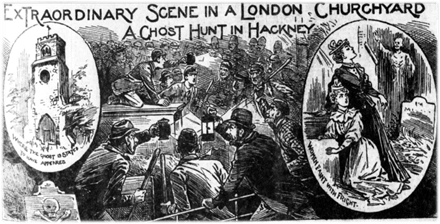
The story of the actor and the ghost has the mob waiting outside the churchyard gates and too scared to approach the ghost, but this is highly unrealistic. The ghost hunting hordes were much more likely to run amok among the gravestones, pranking each other and howling like banshees as they enjoyed some supernatural drunken fun and games. Police would often lose control as more and more curiosity seekers and revellers would turn up on subsequent nights having heard about the previous evening’s high-jinx. For an example, see the image below of a ghost flash mob in Hackney in 1895, as depicted in the Illustrated Police News.[iii]
If a ghost hoaxer was caught, he would be extremely lucky to get away with having to buy a round of drinks at the pub. Many were beaten to a pulp and thrown into the nearest river, pond or sewer…

Epilogue
I’ve become so obsessed with these ghost hoaxing escapades that I’ve written a book about it. It’s called Phantoms of Christmas Past: Festive Ghost Hoaxes, Ghost Hunts and Ghost Panics, it’s published by Sixth Books and will be out at the end of summer 2025 and is available to pre-order now:
There was a lot of chattering class concern about the effect of encountering a ghost hoaxer on women, who, it was feared, would be scared to death of driven irretrievably insane, such were their delicate constitutions. This perhaps explains the number of urban legends circulating in which ghost hoaxes go wrong. For more, see below…
[i] ‘An authentic and remarkable ghost story’, Illustrated Police News, 9 August 1884 pp.1-2
[ii] Robert Bartholomew and Paul Weatherhead (2024) Social Panics and Phantom Attackers (Palgrave Macmillan) p.322-326
[iii] ‘Extraordinary scene in a London church yard’, Illustrated Police News 13 August 1895 p.1
 Paul Weatherhead