In 1790, Georgian London was haunted by a Monster. No woman was safe. Typically, he would approach a pretty young lady as she walked home and make lewd comments to her, and then he would attack her with a blade. Sometimes the blade would be attached to his knee and he would kick his victim in the buttocks or thighs until she bled. Sometimes he had a metal claw attached to his arm with which he would scratch the unfortunate lady. At other times, he would force a bouquet of flowers under his victim’s nose, and then stab her in the face with a knife hidden among the flowers.
London was in a state of hysterical panic. Many were afraid to go out at night and any man in the wrong place at the wrong time might find himself accused of being the Monster. John Julius Angerstein, a founder of Lloyds and well-known philanthropist conducted a massive poster campaign offering a reward for the Monster’s capture.

The London Monster’s reign of terror was amplified by lurid newspaper reports and salacious prints. In the image above by Isaac Cruikshank, the Monster with blades attached to his knee attacks a woman with a knife – note Angerstein’s poster in the background. In the second panel, the young lady buys herself some copper knickers to frustrate any future attacks by the Monster. Above them are copper knickers of varying sizes and prices for young ladies, ladies and very fat ladies.

In the image above, two old maids are accosted by the Monster – depicted with three fire-breathing heads with a little green demon sitting on the middle one. The implication is that they are dreaming about the Monster as he was rumoured to only attack the most beautiful of women. One of ladies dashes in terror from the bed, putting her foot in the chamber pot and spilling the contents on the floor.

The famous satirist James Gillray also featured the London Monster in some of his work. In the above print the Monster is depicted as a grotesque ogre clutching a huge knife and fork about to tuck into the behind of a young lady who he’s holding aloft by her skirts, revealing her backside. Unfortunately for the Monster, the woman is wearing a copper cooking pot strapped over her bottom, thus frustrating his appetite.
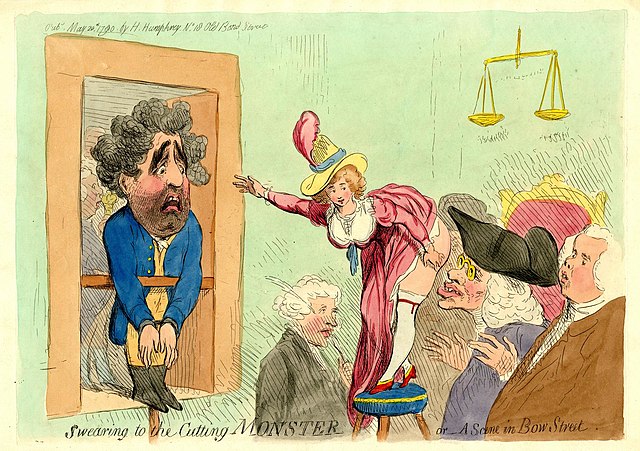
Another of Gillray’s bawdy prints highlights the concern that the investigators and monster hunters were a little overzealous in their inspection of the wounded thighs and bottoms of the young and pretty victims. The print (below) shows the Monster (depicted as politician Charles James Fox) handcuffed in the Bow Street office. A pretty young woman stands on a stool bending over with her dress pulled up over her waist displaying her stockinged leg and buttocks to grotesque caricatures of Bow Street Magistrate Sir Samson Wright who peers grotesquely at the woman’s behind.
Angerstein’s poster campaign offered a generous reward for the capture of the Monster and resulted in dozens false arrests and accusations as well as some mob violence as vigilantes went monster hunting on London’s dark streets.
German Sugar Boiler in Drag Hunts the Monster
My favourite London Monster panic anecdote is the story of the German sugar boiler who thought he might win for himself some glory and make himself £100 richer with a cunning plan to catch the Monster. He decided to dress as a woman and walk the streets waiting to be stabbed and thus secure the culprit.
He borrowed some clothes from the cook at the sugar factory where he worked, and she helped the German boiler to pass as a delicate and modest young maid. As he set off down the street, however, he stood aside to let a young couple pass, but not being used to walking in petticoats, his legs became entangled in them and he fell against the woman. The husband shouted “You damn’d drunken old whore, can’t you see?” The boiler replied, “I beg your pardon; d—n the narrow pavement.” On hearing the rough masculine voice, the wife cried “Oh, that’s the wretch who cuts the women.”
The husband grabbed the German and shouted for help, and it wasn’t long before an unruly mob arrived. As the crowd jostled and manhandled the boiler, they ripped his clothes to shreds and the more he tried to explain in broken German, the more the mob became convinced he was the Monster. Many were relieved to find that – as they suspected – the Monster was not an Englishman, but a foreigner. The German was dragged to the watchhouse where, fortunately, someone recognized him and using a watchman’s cloak to cover the last torn rags of the cook’s best underwear, he was brought safely home.
The London Monster panic fizzled out when one Rhenwick Williams was arrested, charged and after two farcical trials found guilty of being the Monster. He was very likely an unfortunate scapegoat.
Some of the Monster attacks turned out to be hoaxes, and others were thought to be the result of clumsy pickpockets slashing at pockets to get purses. It’s unclear how many, if any, of the attacks were real.
The episode is an example of a Phantom Attacker panic. A community becomes convinced that an imaginary assailant is haunting the streets and reacts with an escalating cycle of fear, hysteria and vigilantism.
For the amazing full story of the London Monster and other bizarre phantom attackers such as the Halifax Slasher, Delhi Monkey Man, The Mad Gasser of Mattoon, Satanic Cat Killers and Nigerian Penis Thieves, see my new book – coauthored with Robert Bartholomew (the world expert on such things) – Social Panics and Phantom Attackers.

 Paul Weatherhead