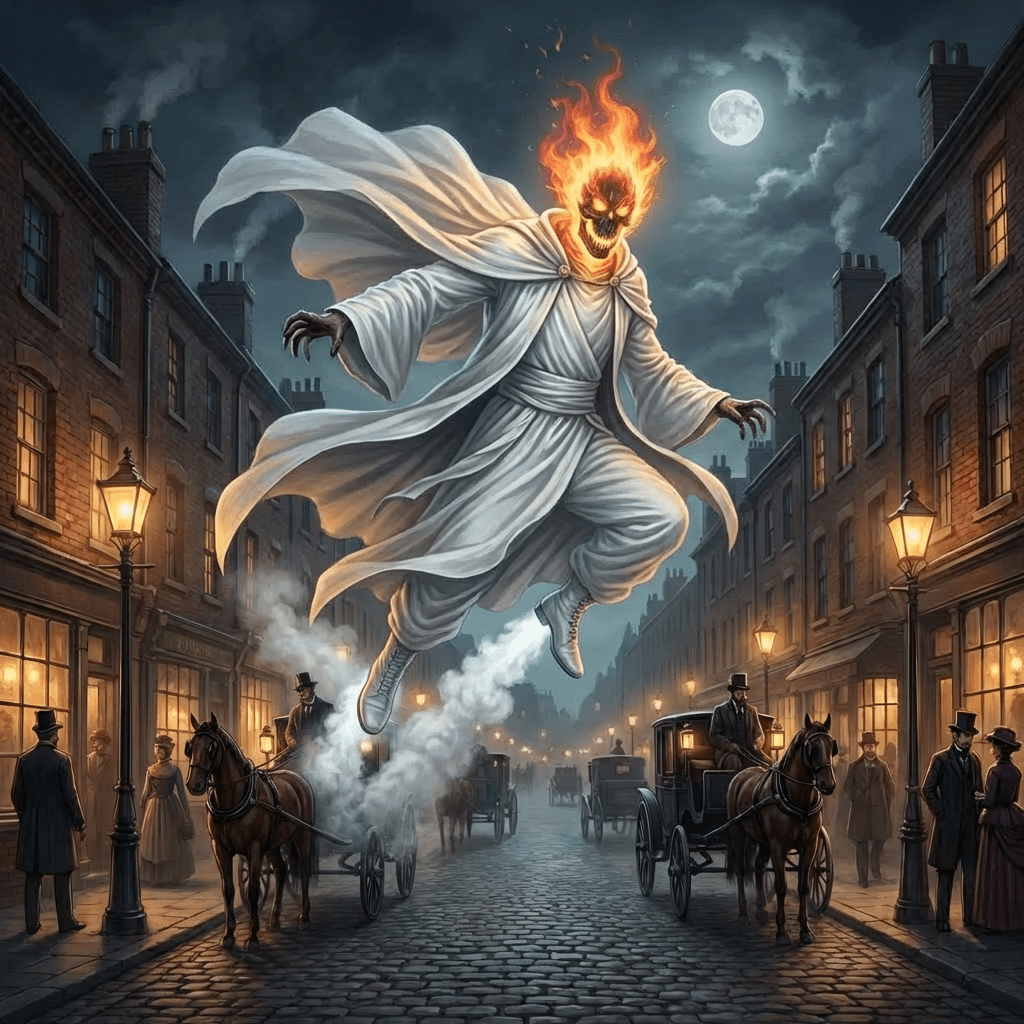
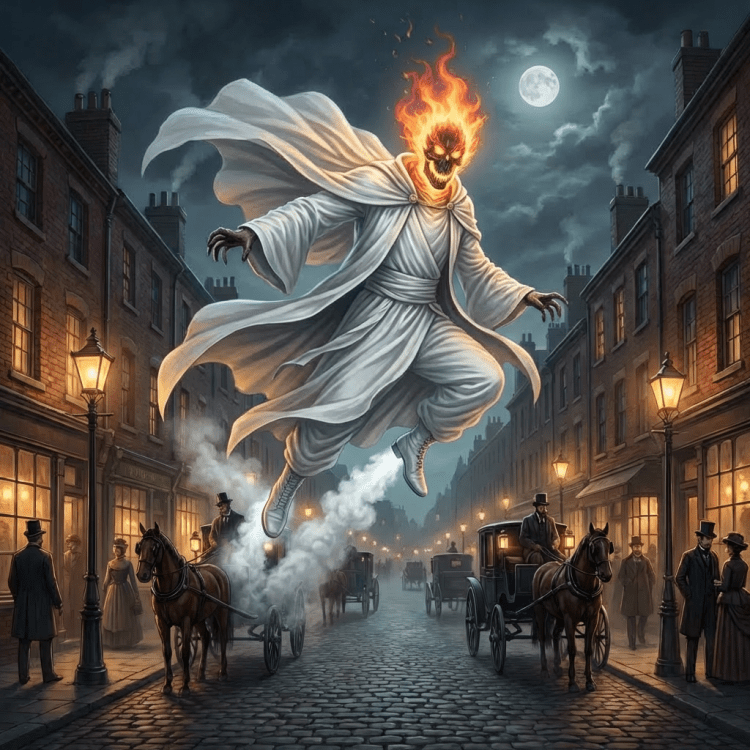
A strange and terrifying figure haunted Birmingham in the autumn of 1886. He was tall, powerful, shrouded in white and his hideous face burned with an unearthly fiery glow and the sight of him was enough to send you insane. Some thought him a ghost and some thought him a devil. Others suspected he was a cruel prankster, but none could catch him. He could leap and bound over hedges and rooftops with almost supernatural strength and agility before vanishing into the night. It was rumoured that he had invented a pneumatic device attached to his boots that could send him flying with a blast of steam over the roofs and chimneys of Birmingham. You’ve heard of Spring-Heeled Jack, the Terror of London; but this is the story of Wind-Heeled Jack, the Terror of Brum…
A Tall White Thing with a Fiery Face
In October 1886, a nine-year-old milkman’s son called Burton was standing at the gates of a farm on, ironically, Spring Hill Lane, when ‘a little black thing’ came jumping around him like a dog and a moment later the boy was confronted by the monster that had been haunting the outskirts of Birmingham for weeks.
The figure was all in white, tall and powerful. He cavorted grotesquely in a ghost like manner before disappearing behind a hedge only to return with his face ‘all over fire’. The flaming faced ghost capered in front of the young lad who was frozen with terror.
On the same night, Frank George (18) was walking home from work on Foxholly Road when he came across ‘a tall white thing with a fiery face’ who danced in front of him before vanishing. The youth was said to be brave, but this experience shattered his nerves.
Many people had similar experiences with the Acock’s Green Ghost as it was first called after the Birmingham suburb where the early sightings proliferated. It was assumed that a powerfully built man was responsible and that he was painting his face with phosphorous to give him a fiery glow, though it is more likely he was using a luminous mask.
In any case young men formed patrol groups to try and catch the culprit and reportedly gave chase to the Ghost on one occasion but he was too fast for them. It was rumoured that the guilty party was a young toff who had made a bet that he could frighten people for three months without getting caught.[i]
Britain was plagued by similar ghosts throughout the nineteenth and early twentieth centuries. People would dress up in white sheets or devil masks then jump out and scare people after dark.
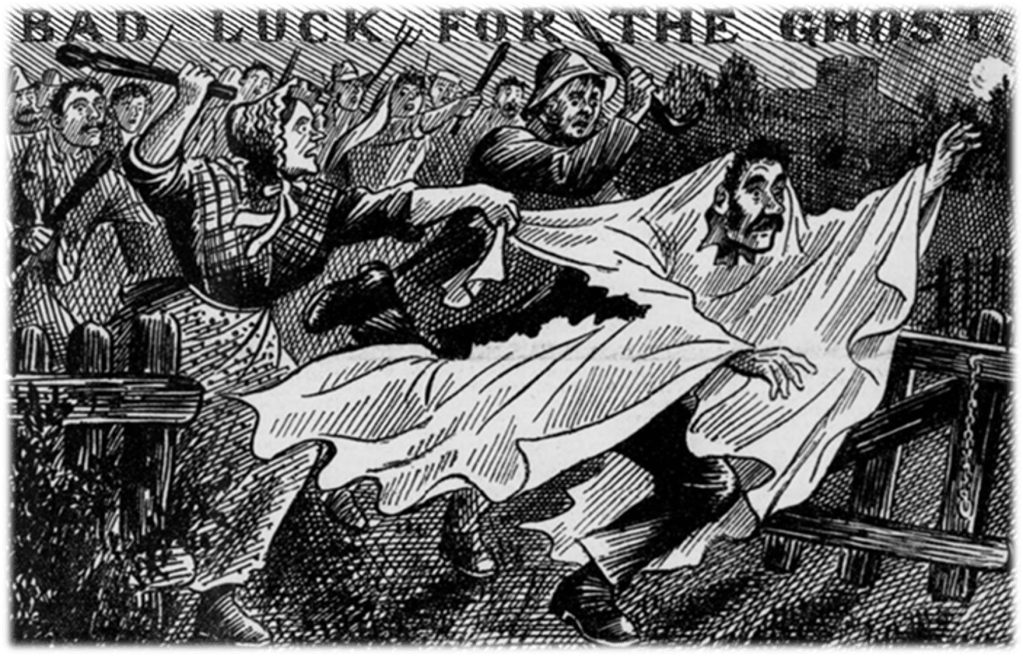
This bizarre pass time was called ‘playing the ghost’ and was a regular occurrence. Often it would lead to mass impromptu drunken ghost hunts where revellers and the curious gathered to catch, see or at least talk about the ghost. Sometimes it would lead to angry mobs rioting drunkenly through the streets. It would often lead to copycat hoaxers who would carry out similar pranks as well as to opportunistic ‘victims’ who would fabricate encounters with the Ghost and then harvest the attention and sympathy as they languished melodramatically suffering from the shock. People would be scared to go out.[ii]
These ghost panics really gripped communities.
The press often referred to these ghost pranksters (somewhat ironically) as ‘Spring-Heeled Jacks’ after the legendary monster that haunted London in the 1830s. Jack wore a devil mask, had metal claws and would vomit blue fire in the faces of his victims before bouncing over the hedges and rooftops on his specially designed boots. He was also rumoured to be a toff trying to win a wager that he could scare his victims to death.
That’s the legend. However, descriptions of Jack varied. Sometimes he wore an animal skin or a white sheet over his head. It is likely that some of the racier attacks by Spring-Heeled Jack were invented by twentieth century researchers. We know from episodes like the Halifax Slasher that it is also quite probable that some of the supposed victims of Jack made up their stories. The press were also likely to make up stories, print rumours and urban legends as facts and exaggerate and sensationalise wherever they could. (So, what’s new, you may ask?)
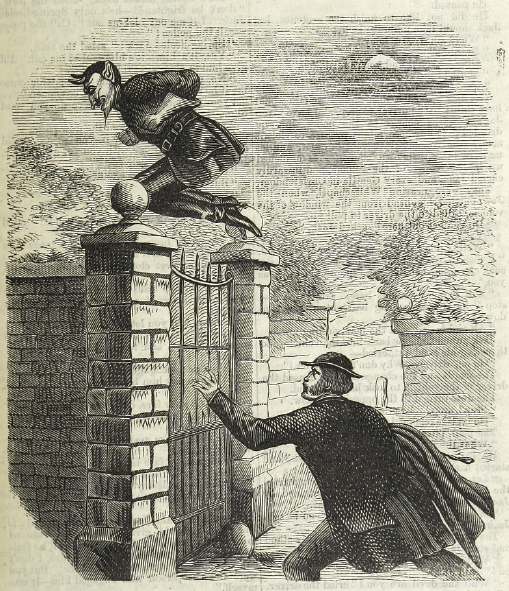
As the nineteenth century wore on, the label of Spring-Heeled Jack was applied to any mischief maker with a white sheet over his head. And remember, ghost pranksters were legion in this time. The same is true of Birmingham in 1886 – the Acocks Green Ghost soon became known as the latest incarnation of Spring-Heeled Jack. As is often the case in these episodes, the panic migrates from one area to another – ghost panics are contagious.
Jack Goes to School
In late October hundreds gathered outside Birmingham’s Summer Lane elementary school every night. It was rumoured that the city’s Spring-Heeled Jack would be seen, and indeed some claimed to have seen this mysterious figure skipping over the rooftops, though no specific witnesses are named and this was likely just a rumour. Others suggested a magic lantern had been used to project images onto the skyline. Horror shows called Phantasmagoria were very popular throughout Europe at the time. In these events projectors and mirrors were used to create scary images of ghosts, demons and skeletons on a semi-transparent screen.
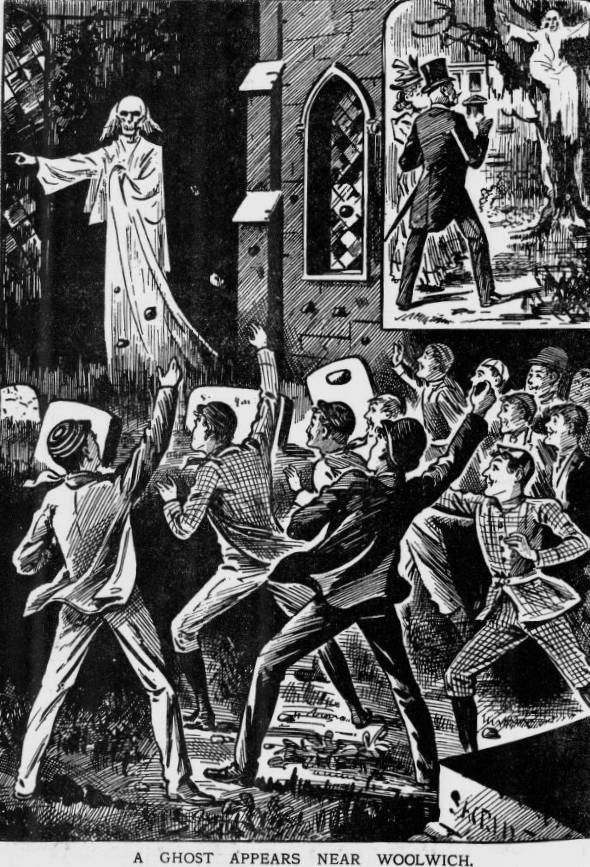
In any case, the crowds grew until they numbered five or six hundred, at least according to the press. When Jack failed to appear, scuffles broke out, stones were thrown and some pockets were picked. The police, along with a caretaker expertly wielding his trusty broom, managed to disperse the disorderly crowd.[iii]
Wind-Heeled Jack
On 13 November 1886 a mysterious letter was published in the Birmingham Mail that purported to explain the mysterious goings on of the previous weeks. The letter was signed ‘Spring-Heeled Jack’.
The author of the letter claimed to be a professional gymnast who had invented a contraption in which compressed air was pumped through tubes attached to the man’s legs and feet and controlled by levers. The letter explained:
By turning a stopcock I allow a certain quantity of air to go to the levers which are then pressed with great force against the ground, causing one to rebound a considerable distance into the air.
London’s Spring-Heeled Jack was reputed to have springs hidden in the heels of his boots, but Birmingham’s equivalent goes even further with a beautifully steam punk compressed air accessory allowing him to make his death-defying leaps. I’ve taken the liberty of giving him the nickname Wind-Heeled Jack.
The author of the letter had, he went on, been experimenting in secret with this device while wearing his white gymnast’s costume and this is what witnesses, first at Alcocks Green and later at the Summer Lane school, had seen.
The letter further claimed that now the inventor had perfected the steering mechanism and that he would demonstrate this the following Monday evening between 7 and 8pm at Birmingham’s famous Bull Ring by leaping from the top of the Market Hall to the Tower of Saint Martin’s Church – an impossibly daring feat.
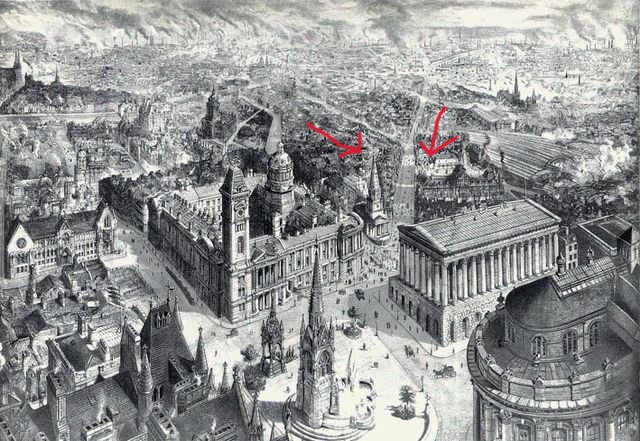
Of course, as Monday 15 November came, expectant crowds gathered in the Bull Ring waiting to see Jack’s acrobatics. The crowds supposedly numbered ten thousand, though one source says there were (rather improbably) a hundred thousand onlookers stood gawping in anticipation at the Birmingham skyline.
Some excitement was created when a top floor window was opened, but this was a false alarm. Attention was also caught by a bright object floating above the Bull Ring, though this turned out to be a balloon.
The disappointed crowd soon dispersed.[iv] It seemed that Wind-Heeled Jack had chickened out…
Epilogue
The letter printed in the Birmingham Mail was clearly a hoax perpetrated by the newspaper and inspired by recent spooky pranks. Ghost related newspaper hoaxes were fairly common in the nineteenth and early twentieth centuries (see the bottom of this post for links to more of these), and this is a classic that doesn’t appear to have been written about anywhere else.
That this was a hoax was made obvious by a follow-up letter again purporting to be from Spring-Heeled Jack published on 20 November.
In this letter, Jack claimed he didn’t show because he had emigrated to Wellington, New Zealand. He had so perfected his pneumatic apparatus that he could now leap across continents and even oceans, landing occasionally on the odd, fortuitous ship to make it all the way down under.
He had leapt back across the ocean to deliver his final letter explaining his no-show before bounding away on his steam-powered boots to the other side of the world.[v]
And so ends the story of Spring-Heeled Jack’s Brummie cousin, Wind-Heeled Jack.
[i] ‘Playing the Ghost at Acock’s Green’, Birmingham Mail, 2 October 1886, p.3
[ii] Robert Bartholomew and Paul Weatherhead, Social Panics and Phantom Attackers: A Study of Imaginary Assailants (Palgrave Macmillan)
[iii] ‘Extraordinary Hoax’, Eddowes’s Shrewsbury Journal, 20 October 1886, p.5
[iv] Robin Goodfellow, ‘Table Talk’, Birmingham Daily Mail, 13 November 1886, p.2; ‘The Gullibility of Birmingham’, Portsmouth Evening News, 17 November 1886, p.4; ‘The Spring-Heeled Jack Hoax’, Newark Herald, 20 November 1886, p.8
[v] Robin Goodfellow, ‘Table Talk’, Birmingham Daily Mail, 20 November 1886, p.2
 Paul Weatherhead