Imagine being woken by the soft thud of loose soil falling on wood. Lying in the darkness you wonder where you are or how you got there, but as you try to move you realise you’re confined in a narrow box. Then the full horror of the situation hits you, but your screams are muffled as the earth continues to pile onto your coffin and you desperately scratch at the lid…
Vivisepulture – or being buried alive – is a pretty universal fear, and so I’ve unearthed two tales of premature burial with surprise twists…
Lived Once, Buried Twice: Helena Fritsch (Hungary, 1906)
Helena Fritsch was the beautiful daughter of a rich farmer in Egerozeg in Hungary. When she died, her burial was a lavish ceremony and Helena’s body was dressed in her finest clothes and with her collection of precious rings on her fingers.
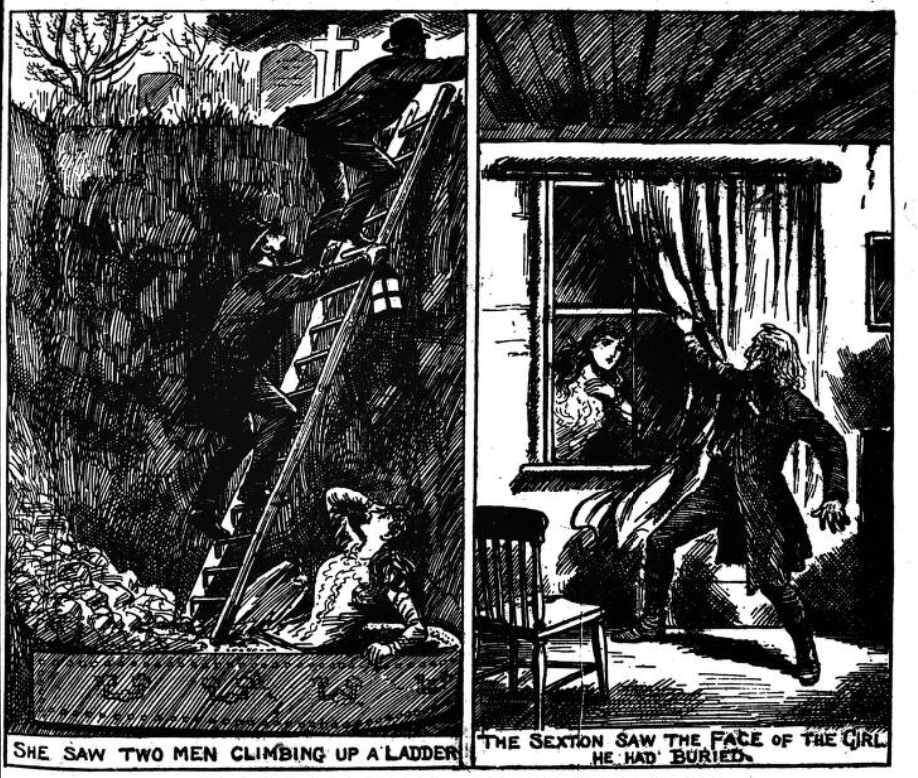
Later that evening long after the mourners had gone, the gravedigger heard a gentle tapping on the window of his cottage. There he saw the face of the girl he had buried earlier that day. Blood dripping from her hand left a dark trail behind her, all the way back to her grave…
Helena later revealed what had happened to her. She had suddenly become aware of an intense pain in her hand, and then realised that she was lying in a coffin, the lid of which had been smashed. She saw two men – grave robbers – climbing a ladder out of the grave. Three fingers on her right hand – and the rings on them – were gone.
It was then that the girl climbed out of the grave and went in search of help, finding the gravedigger who had not long since buried her. The story was depicted in the IllustratedPolice News as seen at the top of this post.
The grave robbers cutting her fingers off to steal her ring had saved her life by waking her from a death-like trance it was supposed. Helena was returned to her family home.[i]
However, although widely reported in the press in 1906, this story seems to be a version of the urban legend sometimes called ‘The Lady Returned to Life’ or ‘The Lady and the Ring’.[ii] The legend generally features a rich woman buried prematurely with her jewellery who is roused in her coffin by gravediggers trying to cut off her finger to steal her ring. In some versions, the grave robber gets his just deserts and dies of fright when the woman’s eyes open.
An Irish version of the legend gives the woman the name Margorie McCall, though this telling has a dark twist. After coming round in the grave to find a graverobber trying to cut off her finger, Margorie leaves the churchyard and makes her way home. When her husband opens the door to see the wife he had just buried standing there in her grave clothes with blood dripping from her hand, he drops dead from the shock. He is buried in the grave Margorie has left vacant.
Or so the dubious story goes. There’s no evidence that Margorie’s tale is true, though there is a gravestone in Shankill Cemetery in Lurgan that says ‘Margorie McCall, Lived Once, Buried Twice’. However, the stone was created in 1860, over a century after the events were supposed to have happened.[iii]
Versions of the legend are found all over Europe as well as in the USA, Turkey and beyond. Although this story may be a legend, the following is all too true…
A Grave Error of Judgement: Clement Passal (Paris, 1929)
Clement Passal, a former criminal who went by the assumed name of the Marquis de Chamaubert, was a haunted man. Passal was being persecuted by a mysterious secret society that had sent threatening letters to both him and his mother.
In September 1929, the secret society finally exacted a terrible vengeance on Passal. After abducting and torturing him, they buried him alive.
This was revealed in a letter to Passal’s friend M. Gryvallet which described his awful fate and gave directions to where the coffin was buried. The letter said that Passal would have starved to death by this time.
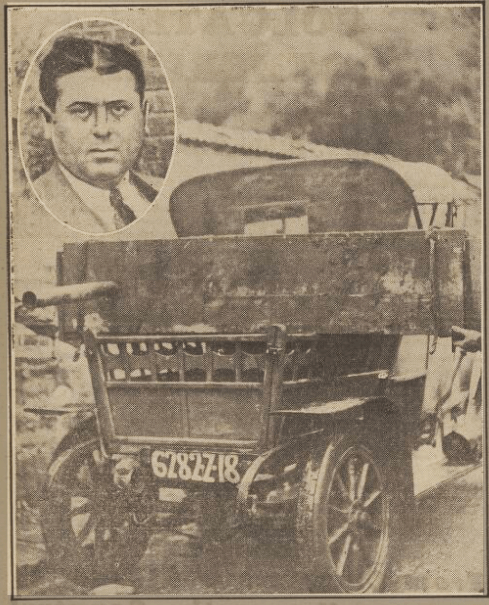
Gryvallet accompanied the police to a forest near St Germain and they soon found the grave. After removing the earth they came across a wooden coffin that was nailed shut. Curiously it had a pipe attached to it, as if to allow air through.
Inside the coffin, dressed in only his shirt was the dead body of Passal.
Illustrated Police News 1929
But all was not as it seems. Police investigations revealed that the anonymous letters from the secret society had been typed on Passal’s own typewriter. Police interrogated three of Passal’s friends, including Gryvallet, and they made a remarkable confession.
Passal had invented the story of the secret society persecuting him. He asked his friends to bury him alive with a breathing tube in the coffin so that he could be dramatically rescued, and forged the letter about his abduction, torture and burial to his friends. It did not go to plan. It seems he died from asphyxiation, though some reports say he died in an agony of starvation.
Passal (inset) and his coffin (Sunday Mirror, 6 October 1929)
Why would anyone carry out such a crazy stunt? Well, Passal had a book to sell. Or he would if he could get a publisher, and the sensational story of being buried alive by a nefarious secret society and melodramatically saved in the nick of time would be perfect publicity.
Near the coffin were some notes that Passal had written for the contents of his criminal memoir. He had been the lover of a countess at 13 years old. He had committed a number of sensational robberies and made a fortune. He had duelled with American police. He had a fiendish plan to topple the Eiffel Tower. And he had discovered an invisible death ray.[iv]
Or so he claimed…
[i] ‘A Young Girl’s Resurrection’, Illustrated Police News, 7 May 1904, p.2
Christmas Eve with a Ghost – or Murdered Thirty Years Ago…
Here’s a strange Christmas ghost story that was supposed to have occurred in Halifax in 1875. Unfortunately, it’s not at all clear which Halifax is meant. It was reported in the notorious true crime tabloid the Illustrated Police News on 1 January 1876.
On Christmas Eve 1875, Mr Bristow, a farmer living near Halifax, was walking past his barn with his two labourers when they were greeted by a bizarre sight. A grey headed old man in frock coat and breeches fell to his knees outside the barn and began to wail piteously.
On being asked what was wrong with him, the crazed old man said that he could see the ghost of his dead master urging him implacably toward the barn to reveal a dreadful secret.
Inside the barn, the old man pointed to a spot on the ground and asked the labourers to dig down a few feet. Within quarter of an hour they discovered a human skeleton.
The old man then confessed that the remains belonged to his former master whom he had murdered and buried there over thirty years ago. After confessing, the old man sank into a stupor from which he never recovered.
He died in the early hours of Christmas Day.
The Mystery
I can’t find any other references to this story in the local or national press of the time. The Illustrated Police News account – which comes with the gloomy illustration at the top of this article – says the report originates from Langstown’s New Letter, though I can find no reference to this either.
Although Mr Bristow is named in the report, the murderer and his victim are not. I can’t find any reference to the disappearance of a Halifax (Yorkshire) farmer from 30 years or so prior to 1876. Nor can I find any reference to the story elsewhere, such as in Halifax, Canada. The newspaper report said that the story ‘reaches’ us from Halifax, perhaps suggesting it’s come from a distant Halifax. If so, why wouldn’t the report specify Halifax, Canada? On the other hand, it would be fair to assume that in a British newspaper, ‘Halifax’ would refer to the Yorkshire town.
This festive tale of a murderer tormented by his guilty conscience, the melodramatic confession, the skeletal reveal and convenient death on Christmas day, not to mention the supernatural trimmings, all seems a bit too good to be true.
The tone of the article in the Illustrated Police News is fairly sceptical, noting that the events could form the basis of an ‘admirable little story’ and hedges the report by introducing it with ‘it appears that…’
So here’s the Christmas mystery. Did the events take place as described, and if so who was the murderer and who was the victim? And did it take place in our Halifax (the Yorkshire one) or elsewhere?
If you thought the tradition of the Christmas ghost story started with Charles Dickens, think again. In the eighteenth century many people’s Christmas reading list would have included a best-selling little pamphlet called Round About Our Coal Fire: Christmas Entertainments. It was written by an anonymous author who called himself Jack Merryman, and featured articles about seasonal games and traditions, ribald jokes and stories including the first known version of ‘Jack and the Beanstalk’ – or ‘The Story of Jack Spriggins and the Enchanted Bean’ as it was originally known.
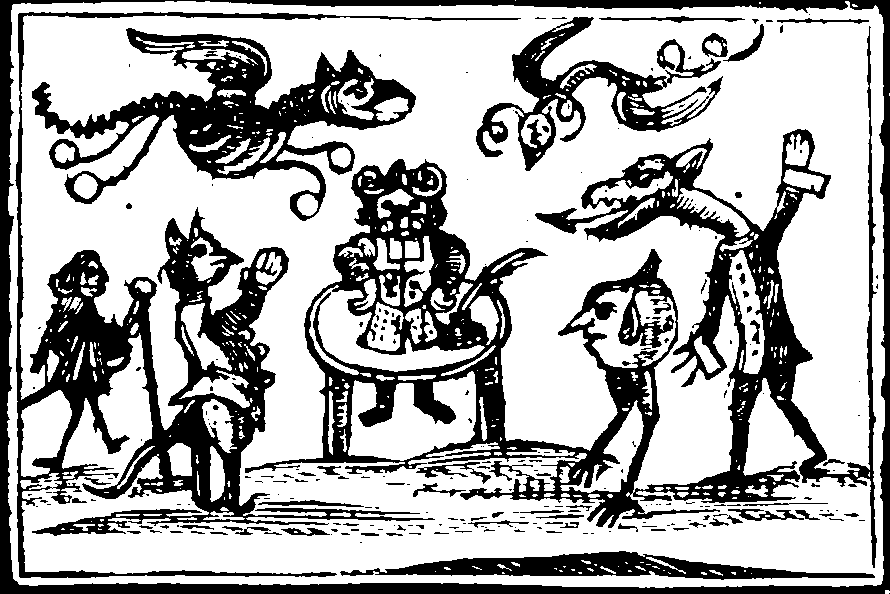
However, the pamphlet also included chapters about ‘fiddle-faddle stuff’ – in other words, ‘Fairies, Ghosts, Hobgoblins, Witches, Bull-beggars, Rawheads and Bloody Bones’.[i]
Bull-beggars, Rawheads and Bloody Bones are various kinds of unpleasant fairies, hobgoblins or bogey men. The wood cut at the top of this article from Round About Our Coal Fire gives you an idea what they look like…
These scary legends and stories in the pamphlet were told for fun, and as an excuse for young couples to cling tightly to one another in the dark midwinter, though some of these supposedly true tales seem very odd to modern sensibilities.
One of the ghostly accounts in the pamphlet is interesting because its depiction of a ghost is as far removed from the stately Victorian apparition as could be, and it also answers the burning question of why is a ghost like a fart?
The Ghost of Mr Thomas Stringer
Mr Thomas Stringer was a successful young gentleman with a promising future before him. What’s more, he had courted and won the heart of a great beauty and they pledged eternal love by bending a piece of gold between them. However, after they married, the young woman still attracted streams of admirers, and eventually fell for one of them.
Mr Stringer found out and confronted his wife about her infidelity, though she simply replied that she would do as she wished.
Her distraught husband poisoned himself, leaving his wife free to be with her lover.
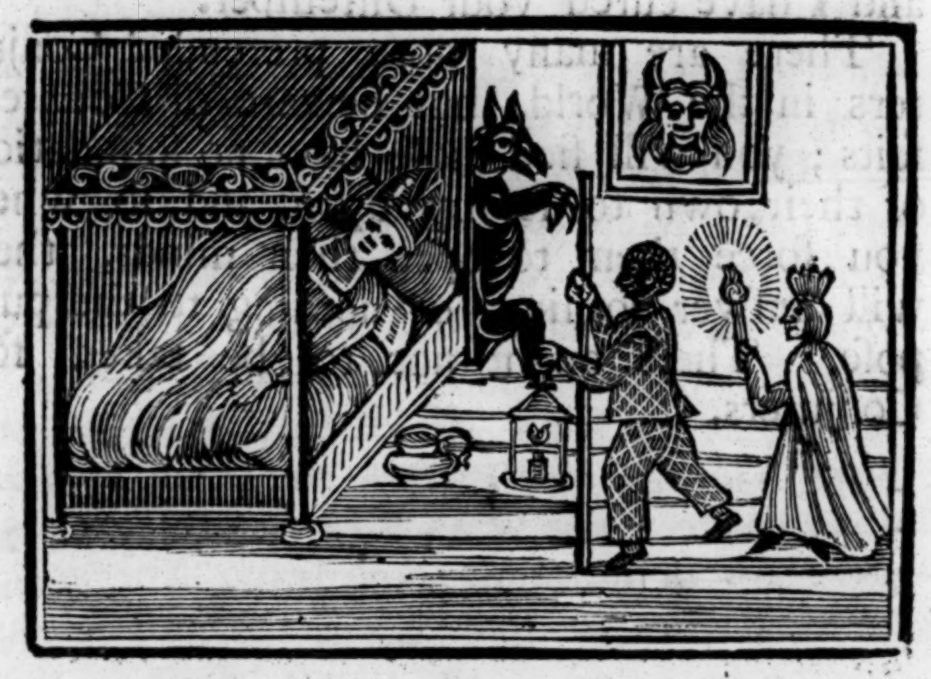
One night as she lay in bed with her new man, an eerie red glow appeared in her bed chamber. Thomas Stringer had returned from the grave. His hair was made of serpents and his hands and feet were eagle’s talons. The spirit crawled along the floor like a toad croaking hideously all the while, his glaring eyes fixed on his faithless wife. He appeared red hot as the unearthly crimson glow surrounded him.
Mrs Stringer attempted to wake her fancy man, but couldn’t. The toad shaped creature crawled up onto the bed and kissed his wife with his ugly mouth before spitting venom in her face and saying in a loathsome voice: ‘Now I have caught the faithless Bitch, Damn your Blood!’
Then with his iron claws he tore her to pieces and sent the scraps to the devil.
And all the while the candle burned blue.
Not sure what’s going on in this wood cut from Round About Our Coal Fire (1734
Corpse Candles
The candle burning blue alludes to the ghostlore of centuries past when spirits were often thought to take the form of luminescent blue flames. Sometimes these ghostly glows were called corpse candles or death lights. At the moment someone died these bluish flames would leave the house and traverse the path along which the funeral procession was to follow to the church. The corpse candle would then pass into the church where the coffin was to be taken and light up the whole building with brilliant blue light before proceeding to the grave that was soon to be the deceased’s final resting place.[ii] When the light burns blue, it’s as if a portal opens between our world and another.
That’s why on the eve of his death at the battle of Bosworth, Shakespeare has King Richard III say:
The lights burn blue; it is now dead night.
Cold fearful drops stand on my trembling flesh
This was when the ghosts of the people Richard destroyed on his bloody rise to the top came back to haunt him.
And this is why Dick Merryman decided to end his ghostly story like this, which sounds like it came straight out of a Georgian Christmas cracker: ‘A Ghost and a Fart are the same Thing, for a Fart will make the Candle burn Blue as well a Ghost…’
Woodcut of Xmas Festivities from Round About Our Coal Fire, 1734
[i] Jack Merryman, Round About Our Coal Fire, or Christmas Entertainments. (J. Roberts, 1734). It’s easy to find online.
[ii] Owen Davies, The Haunted: A Social History of Ghosts (Basingstoke: Palgrave Macmillan, 2007), p.18
In February 1844 a woman called Nancy Houldsworth and an unnamed friend burst into the newspaper office of the Halifax Guardian. Nancy proceeded to tell the astonished journalists a true ‘tale of mystery’.[i] A tale of love, death, curses and witchcraft.
The story begins in 1841 with two sweethearts, Mary Wilson and Samuel Bottomley, both of Old Bank, Halifax. The young couple were in love and were planning their future together. Unfortunately, poor Mary sickened and died and a witch’s curse was suspected. Samuel was distraught and mourned his lost love. Sometime later, though, as he recovered from his loss, he began to develop feelings for another young woman. This time the object of his affections was Nancy Houldsworth’s niece, Sarah. Things seemed to be going well for the couple and Samuel once more started to look forward to a happy future with his beloved. Unfortunately, it seems the curse, whatever it was, had not been lifted and poor Sarah also sickened and died earlier in 1844 leaving Samuel bereft again.
Even before Sarah died, though, Samuel’s eye had been caught by a young lady who went by the name of Mary Baxendale and he whispered many ‘sweet nothings’ into her ear. But the same curse struck again. Mary number two developed a sudden illness and seemed to be at death’s door. Neither Samuel nor the people in the neighbourhood could understand the poor lad’s misfortune in love.
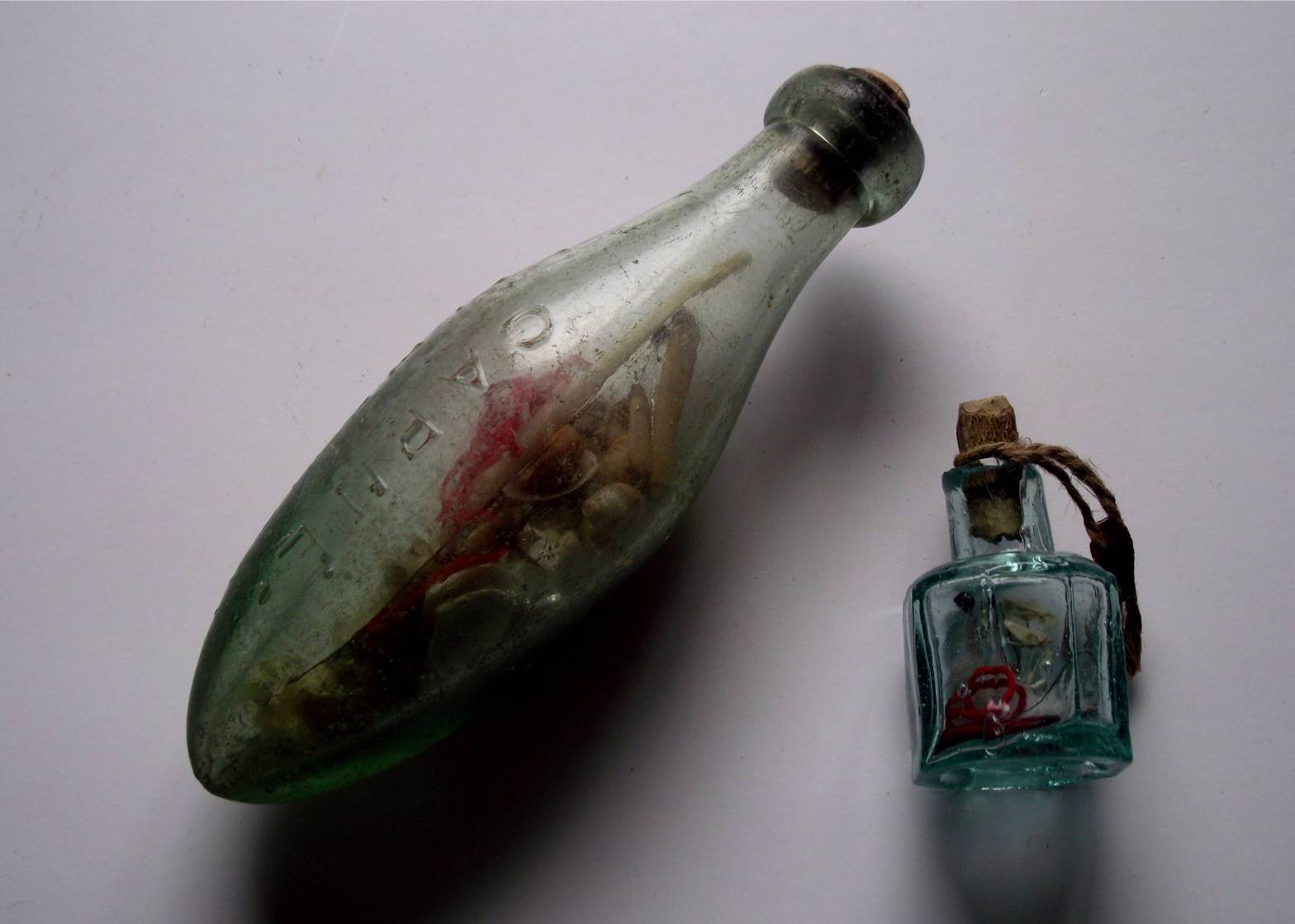
Now, Nancy, the narrator of this sad tale, was contacted by a mysterious unnamed person. This mystery person offered to tell her the truth about the curse on the condition that she would promise to keep it a secret. Nancy was told that beneath a flag in the cellar of Betty Wilson’s old house there was buried a witch’s bottle that would bring bad luck to whoever walked out with Samuel Bottomley. However, Nancy didn’t keep her promise and immediately told everyone she knew around Old Bank about the cursed bottle.
A man called John Lister was employed to dig up the cellar and he did indeed uncover a buried bottle, bottom up under the flag. The bottle was made of stone with flat sides and had a cork in the top. Unfortunately, Lister damaged the bottle when he was digging and a ‘bottle imp’ flew out and disappeared leaving a noxious smell behind it.
Nancy produced the broken bottle (sadly without the imp) for the inspection of the gathered journalists and assured them that now the charm was broken and that young Mary Baxendale was on the road to recovery.
But that’s not the end of the story. The newspaper did some digging of its own and found that the bottle was actually buried by one Mrs Sutcliffe, the sister of Mary Wilson, Samuel’s first lost love. At the time Mary (number one) was suffering from Tuberculosis and her sister suspected that she had been bewitched. To try and cure Mary, Mrs Sutcliffe had contacted ‘an old hag of a fortune teller’ named Jenny Jardine for help. The fortune teller said that Mary must fill the witch’s bottle with a liquid (the report is coy, but we may assume that she was told to urinate in the bottle). Then the bottle must be buried bottom up and parts of the Bible recited with one foot touching the bottle.
‘So much for the age we live in,’ was the reporter’s conclusion to this strange tale.
For more true tales of Calderdale witchcraft, demonic possession, ghosts, UFOs, vampires, murders and mass hysteria see my book Weird Calderdale.
[i]Halifax Guardian and Huddersfield and Bradford Advertiser 10 February 1844
Image: Mal Corvus Witchcraft & Folklore artefact private collection owned by Malcolm Lidbury (aka Pink Pasty) Witchcraft Tools
In June 1912 over one hundred music teachers, singers and physicians gathered at the New York Music Teaching Convention at Columbia University. They were to witness an extraordinary musical demonstration that seemed to come straight out of a lurid novel.
Professor Charles Munter, a little man in a white suit and green waistcoat, introduced the audience to his secretary Miss Marian Graham. Miss Graham was described as a stunning young woman with blue black hair and blue grey eyes with a ‘well-rounded figure’. However, she was a shy girl and when asked to sing, her voice was awful – flat and lifeless.
Professor Munter stared into the young woman’s eyes until she seemed to fall asleep. A record player was brought out and turned on. ‘I am now transferring my magnetic personality… into Miss Graham’s vocal cords,’ Munter told the audience. ‘I am sending the physical energy of my body through space into the blood cells of the brain where they are fused with the suggestion to sing.’
Marian Graham the hypnotised diva (Omaha Daily Bee 2 June 1912)
And sing she did, perfectly hitting the highest of high notes and the lowest of low notes. The audience went wild with astonishment. Even stranger, when in a hypnotic trance, Miss Graham could expertly sing songs she had never even heard before – presumably the words and music being telepathically beamed into her by Professor Munter.
She told the press ‘Most of the songs I sing I do not know… They say I sing beautifully, but have no knowledge for I do not hear a note…They tell me I surpass the best of the opera singers.’[i]
Marian Graham melodramatically collapses into Professor Munter’s arms (Omaha Daily Bee 2 June 1912)
The previous May five hundred physicians had gathered in New York at the Medical and Laryngological Society convention for a similar demonstration by Miss Graham and the Professor. After being hypnotised, Marian sang beautifully and danced around in perfect time to the music with uncharacteristic girlish abandon. The medical men were convinced they were witnessing a miracle of hypnosis.
If it seems like something out of a novel, that’s because it is. All the press reports of Munter and Graham’s demonstrations make reference to George Du Maurier’s 1894 novel Trilby which concerns a beautiful tone deaf Parisian woman called Trilby. Trilby is hypnotised by the villain Svengali, and becomes a golden voiced operatic diva filling the opera houses of Europe – all the time unaware that she was a star and with no memory of her performances. The character Svengali gave his name to any domineering manipulator, and thanks to headwear the lead actress wore in a stage adaptation of the novel, the eponymous heroine gave her name to the Trilby hat. But the wildly popular novel surely inspired Professor Munter’s display of mesmeric prowess.
So who was Professor Munter, this real life Svengali?
George Du Maurier’s depiction of the villainous Svengali from Trilby (1894)
The Real Life Svengali
Charles Munter (it seems unlikely that he was really a professor) was a health entrepreneur. If we are to be less kind, we might call him a quack. He was often called the Prince of Healers. Thirty years prior to hitting the headlines with Miss Graham, he had been dying in the tuberculosis ward of an orphanage asylum and the doctors had given up on him. He set to thinking hard and worked out to how to save himself – he had discovered a panacea. In any case, that’s what he told the press.[ii]
His panacea was warm water and lots of it. Forty to fifty glasses a day. Cold water won’t do – Munter called it the demon drink. It must be warm. On top of that – heavy breathing. These alone can cure any and every disease from blindness to paralysis and from insanity to being overweight. He would cry to his patients: ‘Breathe and live for ever.’ Munter quite rightly pointed out: ‘If you keep on breathing they will never let you in the cemetery.’[iii]
The nose was the rudder of the human ship, according to Munter.[iv]
Munter gave frequent demonstrations of his healing powers in the 1920s and 1930s in the USA, UK and France. In May 1922 hundreds of women turned up to see the ‘miracle man’ on his first visit to Washington. In what was probably a typical performance, he supposedly cured a woman who had a paralysed left arm and hip by passing his hand over her face and jerking her head from side to side.
With the same technique he cured Mrs Christina Martinowitz – a woman who was depressed almost to the point of suicide because of her weight. When Munter gave the woman the corset he had designed to try, she was suddenly able to kneel as well as run round the stage like a young girl. She even danced an impromptu jig for the astonished audience.
The cynic in me can’t help but suspect that Mrs Martinowitz was an accomplice – a plant in the audience. I also can’t help but wonder if she was one and the same person as the hypnotised diva Miss Marian Graham…
The Corset of Immortality
In any case, Professor Munter’s lectures and demonstrations all seemed to end up in corsets. He may have been the Prince of Healers, but he was the King of Corsets. But these weren’t just any corsets. These were magic – as well as hiding flabby bellies and shaping the figure, they helped the wearer to breathe deeply, and this (along with warm water) was all that was needed for immortality.
He didn’t just body shame women into wearing his patented underwear, though. He made them for men and children too. His adverts were ubiquitous in the 1920s and 1930s. He could not be accused of underselling himself. One advertisement said of his lectures and corset demonstrations: ‘Every word is interesting – every thought is a key that unlocks doors to new and undreamed of possibilities.’[v]
Washington Times 18 April 1928
Another advert said that his Nulife corsets would make women more fashionable and beautiful as well as preventing nervous breakdowns. The corsets, Munter claimed, would also lead to happiness, success and would ‘make your desires in life come true’.[vi]
Crowds would flock to his lectures and demonstrations and although he never charged for his miracles, he no doubt compensated for this through the sale of his miraculous corsets.
Epilogue
Professor Munter took the nineteenth century snake oil salesman and updated it for the early twentieth century by exploiting the popularity of the best-selling novel Trilby and its subsequent widely seen adaptations for stage and screen. His musical scam fooled scientists and musicians alike. But it was all about the corsets.
His health recommendations were refreshingly simple. All you need is lots of warm water and deep breathing. And the best way to achieve the latter is by squeezing yourself into one of his magical corsets.
Adverts for his corsets continued appearing regularly in the US press into the 1940s, but I can’t find a definite obituary for Professor Charles Munter. I can only conclude that he still walks among us, having really found the corset of immortality…
UPDATE: Thanks to Patricia Howe for sending me his obituary. He died aged 73 in 1944 in New York.
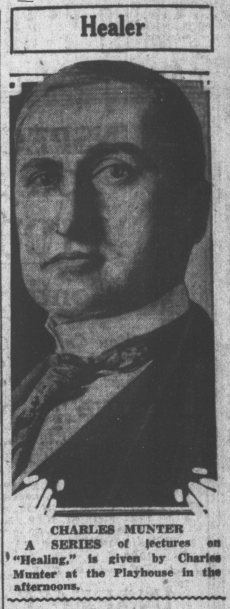
Professor Charles Munter
[i] ‘She is Trilby in real life’, Milwaukee Leader, 18 May 1912, p.12; ‘Woman, hypnotised, sings operatic airs’, Bridgeport Evening Farmer, 29 June 1912, p.10
[ii] ‘Prince of Healers’, Westminster Gazette, 26 July 1923, p.7; ‘Professor Munter himself…’, Catholic Telegraph, 10 March 1921, p.10
[iii] ‘Jail sentences recommended for those who are sick’, The Ogden Standard, 23 May 1914; ‘The Munter Method’, Western Evening Herald, 26 July 1923, p.2
[iv] Margaret Hubbard Ayer, ‘Girls, don’t marry sharp-nosed men’, Omaha Daily Bee, 7 September 1912,
Notorious medium Helen Duncan, known as ‘Hellish Nell’ in her Scottish hometown, has gone down in history for being imprisoned after she was charged under the 1735 Witchcraft Act in 1944.
Duncan, described as a large coarse woman even by her admirers, was a controversial ‘materialising medium’, meaning sitters at her seances would see ghostly forms of their deceased loved ones emerge from the darkness, formed from the spiritual substance known as ectoplasm which emanated from various orifices of the medium’s entranced body.
Helen Duncan – Hellish Nell the Medium
Her mediumistic performances attracted the attention of spiritualists, scientists and of course the authorities.[i] Before her Old Bailey trial towards the end of the Second World War, she visited Todmorden on two occasions and one of the sitters wrote up an uncritical account for the Todmorden News and Advertiser which gives us a glimpse into the peculiar lost world of materialising mediums and those who put their faith in them.
Since its origins in the USA in the nineteenth century, Spiritualism spread rapidly to the UK and was especially popular in the north. The first spiritualist church in England was founded in Keighley in 1853.[ii] By the mid-thirties there were around 2,000 Spiritualist churches in the country with around 250,000 members.[iii] Calderdale was no exception, and in 1934, Todmorden spiritualists were excited to have one of Britain’s best-known mediumistic stars come to visit them.
If your love is as big as yourselves then I should like to have it
Helen Duncan’s first Todmorden séance took place on Friday 17 December 1934 at 33 Wellington Road.[iv] An audience of 18 people gathered to witness the spectacle and a ‘cabinet’ was created by using a dark cloth to partition off part of the room. Inside this area, hidden from the view of the audience, was a chair for the medium to sit on and a small table with a vase of flowers on it. The room was weakly lit by three dim red lights, giving the space an eerie glow. According to the sitter who wrote up the séance, these were ‘ideal’ test conditions.
Helen would have been in her mid-thirties at this time. She was extremely large with jet black hair and a powerful stare, and was at the height of her powers. Before entering the séance room, Helen was stripped and searched by ‘two competent ladies’ and dressed in a black robe which had been examined by those present.[v] These measures were taken to ensure there was no trickery involved and that no fake ectoplasm was hidden about her person. How careful or intimate these searches were, we are not told.
Helen entered the séance room and proceeded to her cabinet and the curtain was drawn. This was supposedly to allow the medium to gather her psychic energy and enter a trance state. With Helen hidden, the gathered spiritualists invoked ‘the name and the spirit of the Master’. A few minutes later, a spirit form emerged into the rose-tinted gloom. This was Albert, Duncan’s ‘spirit control’ who acted as a ghostly master of ceremonies. Albert had been a man of Scottish extraction who had emigrated to Australia and drowned in 1913. In contrast to Helen Duncan’s heavy Glaswegian accent, Albert spoke, we are told, in precise BBC English and would offer rather ambiguous wisdom to the sitters such as ‘If your love is as big as yourselves then I should like to have it.’[vi] On this occasion in Todmorden, Albert materialised and said, ‘How beautiful to hear the words of the Master’ and would introduce the spirits before retiring into the darkness.
Although no one in the Todmorden sitting had a camera, several of Helen Duncan’s spiritualist manifestations were caught on film, as seen at the top of this article.
The first Todmordian spirit to manifest itself was that of a well-known local woman who had died several months ago. We’re told that a dozen people present recognised the spirit and even the deceased woman’s daughter testified that it was her mother. Several more spirits appeared in quick succession, all of them recognised as family or friends by those present. One of these beat its hands on its chest to demonstrate that it was solid. Another, rather bizarrely, invited one of the sitters to put his finger in its mouth, which he did. He commented that the ghost’s mouth was wet, warm… and toothless.
A ghost of a little girl appeared and said her name was ‘Sunshine’. The spirit of an elderly lady, one of the sitter’s grandmother, came out of the cabinet and complained that she had no slippers before dematerialising in front of the curtain.
Next came one of Helen Duncan’s regular characters, the spirit of a mischievous little Glaswegian girl called Peggy who provided light relief amidst the intense emotion of sitters meeting up with their departed loved ones. Peggy distracted the audience with comic chatter and jokes about one gentleman’s baldness before singing ‘O Danny Boy’ and ‘Bicycle Made for Two’. When a sitter attempted to join in with one of the songs, the cheeky wee ghost stopped and said: ‘I’m singing this song not you!’
Ectoplasm Stinks
Peggy departed back to the spirit world and the more po-faced control spirit Albert returned for the next part of the séance: an ectoplasmic demonstration. There was no real agreement among Spiritualists and the various scientists who studied seances and mediums about what exactly ectoplasm was. It was a substance that was supposed to be both physical and spiritual, and it emerged from various orifices of entranced mediums. It would billow, shimmer and shine as it twirled around and formed into a spirit. There was something reproductive in the production of ectoplasm. The medium would often utter orgasmic moans or groan as if suffering labour pains. The sitters attending the séance might be told to sit with their legs uncrossed to allow ‘reproductive matter’ to flow from them to assist the medium.
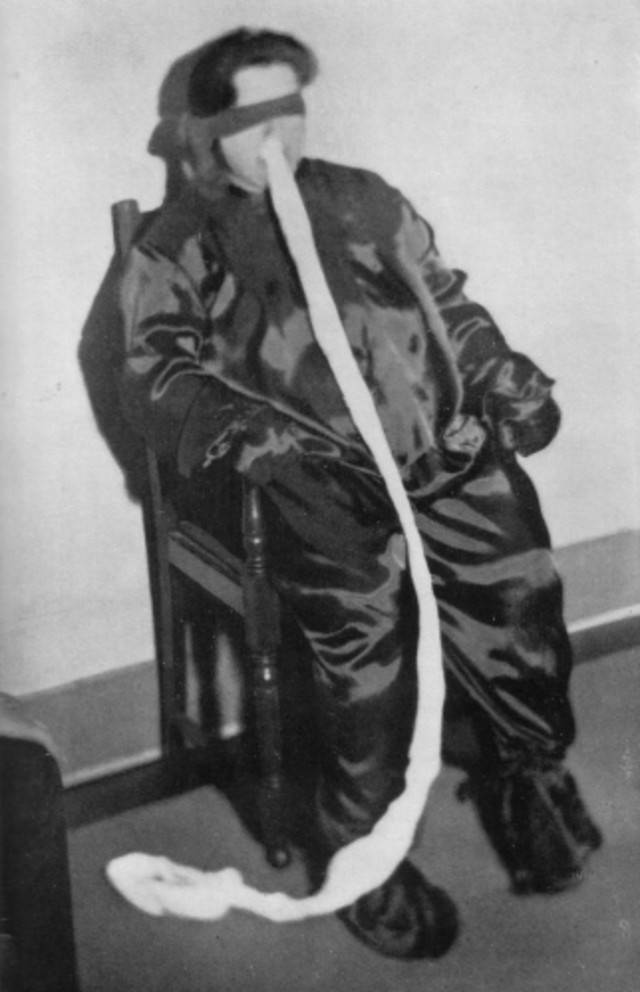
Helen produces ectoplasm – hold your nose (photo Harry Price)
On this occasion, ghostly hands parted the curtains of the cabinet to reveal Helen Duncan in her trance and the sitters witnessed ectoplasm emanating from the medium and forming into a voice box. From reports of some of Duncan’s other seances, we have an idea of what this ghost’s ectoplasmic voice box looked like. Some describe it as like a ‘large white potato’, while others described it as a large pair of disembodied lips. Another still said it was a square box on a rod of ectoplasm, while cynics said it looked like Helen Duncan’s fist under some luminous cloth. We are not told from whence Mrs Duncan produced the ectoplasm in Todmorden. One thing would have been clear to the sitters, though. Ectoplasm stinks.
The séance lasted a little under two hours, and in the words of the sitter who wrote the report for the local paper: ‘All the sitters who recognised their friends and relations who had returned from the other side of life, testified to the genuineness of the materialisations.’[vii]
Hellish Nell Returns to Tod
Helen Duncan returned to Todmorden to give another demonstration in June 1935.[viii] This time the séance was held in Eagle Street Spiritualist Church, and again was a success, with the newspaper correspondent writing: ‘What joy was given to those whose friends materialised before their eyes!’
Again, Albert was master of proceedings. In his posh voice he berated the ‘appalling grammar’ of the entranced medium. Several spirits appeared over the session and most were recognised by the sitters except for one ghost who couldn’t be identified by the relevant sitter as she had forgotten her glasses! And as always, Peggy, the charming little Scottish girl with the cheeky sense of humour, made an appearance and made everyone laugh before spilling some water from a vase of flowers and making Albert cross.
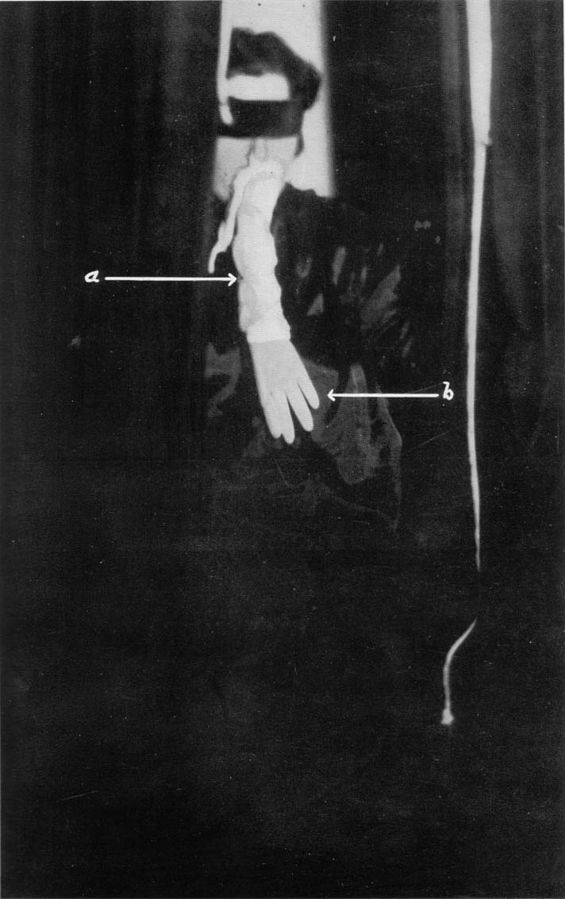
Looking at the photos of the materialisations produced by Helen Duncan, it’s hard to see how people were taken in by them. The painted doll faces look grotesque atop their coat hanger shoulders and white net gowns to be sure. But in the séance itself, with the heightened sense of expectation, the very dim red light and with luminous paint applied to the spirits, they must have been more convincing than under the harsh and unforgiving flash bulb.
As for the ectoplasm, influential psychic investigator Harry Price, for whom Duncan had held a demonstration of her powers in his London laboratory, suspected it was regurgitated surgical gauze, as he found when he analysed a sample. When Duncan was given blue dye to swallow before a demonstration, no ectoplasm was manifested. In fact, Price said: ‘I was impressed with the brazen affrontery that prompted the Duncans to come to my Laboratory… I was impressed with the amazing credulity of the Spiritualists who had sat with the Duncans for six solid months.’
Duncan had been exposed as a fraud on a number of occasions before her two visits to Todmorden. One of these exposures was the result of Harry Price’s experiments, which he wrote about in his tastefully titled book Regurgitation and the Duncan Mediumship in 1931.[ix]
Helen materialises a ghost…or a rubber glove (photo: Harry Price
In 1932, maids employed by Duncan admitted the medium had dummies and various masks for use in seances. One of them also told how she had been made to wash long lengths of stained, slimy muslin that stank of urine.
In 1933, a year before she visited Todmorden for the first time, a trap was set for her at a séance in Edinburgh. During the séance in question, some noted that most spirits looked and smelled like Duncan with some white cloth draped over her. One of the sitters groped a male apparition to discover it had two large female breasts.
When naughty little Peggy appeared, the trap was sprung. Someone turned on a bright light while an accomplice grabbed at Peggy. In the light it could be seen that the little girl Peggy was actually Duncan on her knees waving a white doll around. Poor Peggy was subjected to a farcical tug-o-war between the sitter and Duncan before being stuffed up Duncan’s dress. In her fury, Duncan waved a chair around in the air yelling ‘I’ll brain you, you bloody buggar!’[x]
These events were widely reported, yet Duncan remained popular. Her fans reasoned that she was only human and may have resorted to fraud on those occasions, but at other times her performances were genuine because they had seen their loved ones with their own eyes.
Epilogue
Duncan’s mediumship continued through the 1930s and 1940s until disaster struck. At a séance in Portsmouth in 1944, Helen materialised a spirit of a petty officer from the warship HMS Barham. The only problem was, although this ship had indeed been lost, the government had not yet released this information to the public. This was too much for the authorities, and Duncan was tried under the 1735 witchcraft act and sent to prison, serving 172 days.
In fact, it was a sitter who mentioned the Barham, not Duncan, though that did not save her. Why Duncan was nobbled with the archaic Witchcraft Act is unclear and rather murky. What is clear, is that she made an impression on the people of Todmorden when she was at the height of her dubious powers.
This is an excerpt from Weird Calderdale: Strange and Horrible Local History – buy it here.
[i] Malcolm Gaskill, Hellish Nell: Last of Britain’s Witches (London: Harper Collins, 2001)
[ii] Ibid p.53
[iii] Ibid p.110
[iv] Todmorden News and Advertiser 14 December 1934
[v] Ibid
[vi] Gaskill p.82
[vii] Todmorden News and Advertiser 14 December 1934
On Sunday 29 January 1899, Rosa Day, an athletic nineteen year old woman from Cheshire, decided to go ice-skating instead of joining the rest of her family at church. She didn’t come home.
Search parties retraced her route and explored the fields, lanes and ponds for her without success. It was feared she had fallen through the ice and drowned. By the following Tuesday the searches were intensified and the police dragged all the surrounding ponds and the canal but found nothing.[i]
Rosa lived with her step mother, sisters and brother in the quiet village of Rowton, near Chester. Her father (who used to manage the local lead works) had died in 1892. She was, according to the press, ‘well-connected and highly respected’.[ii]
Although Rosa was described as strong and athletic in the newspapers, she was also said to have been in ill health since Christmas after a terrifying adventure. She had been out gathering ivy to decorate the church when she tumbled over a cliff face in a quarry. Fortunately, her dress caught in some thorns, but she was left hanging there over the precipice for an agonising twenty minutes before she attracted the attention of two men walking by. One of the men held the other’s ankles and lowered him head first over the cliff where he caught Rosa’s arms and she was pulled to safety.
This brush with death was said to have affected her mind.[iii]
And now, just a few days after this dramatic escapade, she had vanished into thin air…
Brutality
Five days passed, and still Rosa’s distraught family had still heard nothing.
Then, on Thursday 2 February the household maid noticed something strange outside the front door – a woman’s hat lying on the doorstep. She went to fetch Kathleen, Rosa’s sister, and they ran outside. The hat belonged to Rosa.
And sprawled near the water pump was the missing woman. She was bloody, filthy and lying in an unconscious heap. Rosa was brought inside just in time. The family were about to retire to bed, and the night was so cold that if Rosa had not been found she would have frozen to death.
Illustrated Police News 11 February 1899
Medical help was sent for. The verdict of Dr Taylor and Dr Griffen was that Rosa’s appearance ‘bore unmistakeable evidence that nothing less than brutality must have been used against her.’[iv]
Newspaper reports said that Rosa was bruised all over and her face was swollen. She had what seemed to be rope marks on her wrists and ankles. Worst of all was a wound to her forehead, described as being down to the bone, and her skull was fractured as if she had received a blow from a blunt implement. She was also weak from starvation. She hadn’t eaten for five days.[v]
When Rosa had recovered enough to tell her story, the whole country was shocked and amazed by her sensational adventure…
Carried off by a Lunatic
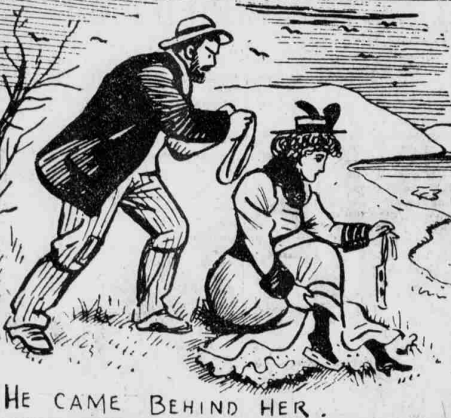
Rosa told how on the Sunday she had skipped church to go skating. She thought that the ice looked unsafe on the pond near her home, so she walked to another pond three quarters of a mile away. As she sat on the grass to put her skates on, a man approached her from behind, blindfolded her and demanded money. Rosa had none, and the stranger swore and cursed her dreadfully. He then tied her hands behind her back, saying ‘If you scream, I will shoot you.’[vi]
Illustrated Police News 11 February 1899
In accounts a few days later, Rosa changed this part of her story somewhat. She clarified that the man had actually approached her and asked her the time. As she felt in her pocket for her watch (which she forgot she had left at home), he grabbed her hands, tied them behind her back and blindfolded her, but not before she had seen the man’s face. ‘Don’t make a sound, or I’ll shoot you,’ he said before marching her for some distance.
He then demanded money, and when she said she had none, he cursed her and delivered a blow to her forehead that rendered her unconscious.[vii]
Illustrated Police News 11 February 1899
Rosa described her captor as being about thirty years old with a dark complexion and a large lower lip. He was, she said, ‘horrid looking’. In an enigmatic catty aside, she added that the ugly man resembled a female that she knew. The newspaper report does not give us the name of this female. The attacker was dressed as a labourer. The press speculated that he may have been a lunatic.[viii] He certainly was a man of great strength, for it seemed he carried the unconscious woman a considerable distance.
Dramatic Escape
When Rosa gained her senses, she found herself in a dark hole, she knew not where. She later realised it was a strange loft in which she was locked. As she drifted in and out of consciousness over the next five days, the ugly stranger would sometimes appear, but did not give her food.[ix] She later amended this to say that as she was often semi-conscious, she didn’t know if or when she was being watched.[x] We are not told if there was access to water or toilet facilities. Doctor Taylor later confirmed that during her captivity, there had been ‘no suggestion of outrage’.[xi]
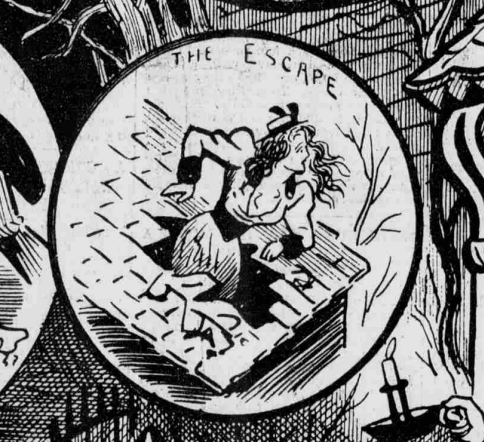
She tried to escape a number of times when she was conscious, and after five days finally found a weak spot in the roof which she was able to make into a hole large enough to crawl through.[xii] She dropped down to the ground, and not looking back, staggered and crawled through the fields. Eventually, she found a stream that she recognised and followed it to Rowton. It was an agonising five hour journey, as weak from starvation and loss of blood she collapsed from exhaustion on a number of occasions and was sometimes paralysed and unable to move at all.[xiii]
Illustrated Police News 11 February 1899
When Rosa finally made it to her house, she was so overwhelmed that she swooned before she could get to the front door. With her last ounce of strength and a great sense of melodrama she threw her hat onto the doorstep, leading to her eventual discovery.
Rosa Day’s sensational abduction and escape made headline news around the country and was featured in an edition of Illustrated Police News, sometimes referred to as Britain’s worst newspaper for its lurid true crime stories and melodramatic pictures.
The police searched the surrounding countryside for the shed or outhouse where Rosa had been imprisoned, but nothing could be found. Nor was there any trace of the ugly stranger, though many men in Rowton were so incensed at poor Rosa’s treatment that they were ready to lynch the ruffian should he be found. The episode led to a feeling of deep insecurity among the locals and, according to the Cheshire Observer, ‘struck horror into the hearts of all people’.[xiv]
The Day family were under a great deal of strain. So many well-wishers and curiosity seekers were turning up at their house that they placed bulletin notices on the garden gate giving updates on Rosa’s recovery.[xv]
The Plot Thickens
However, some press accounts had more than a hint of scepticism about Rosa’s story. Some were even downright sarcastic, such as the Daily Telegraph, which noted that Rosa’s adventure was similar to the kind of cheap novel one might buy at a train station bookstore.[xvi] It was also noted that the ruffian who had abducted the young, strong and athletic woman had somehow carried her unaided, unobserved and in broad daylight across fields and over hedges for quite a distance.
The evil stranger had demanded money from Rosa, yet did not show any interest in the gold brooch she was wearing. And it seems strange that the would-be thief would drag the woman across the countryside and then keep her locked, unmolested in a loft for no particular purpose. Her family, who totally accepted Rosa’s version of events, assumed that the kidnapper had left her in the loft thinking she was dead.[xvii]
It’s not clear whether the various changes in Rosa’s story were made by her or were rather newspapers misreporting what she said, but it does seem that her story was rather fluid. It was also clarified that Rosa was not, as was previously reported, covered in bruises, though she did have a head wound.[xviii]
Some went so far as to suggest that Rosa was suffering from a ‘mental aberration’ that caused her to have hallucinations. Contrary to earlier reports, local police were inclined to disbelieve the story of the abduction.[xix] It seems at some point, the investigation was quietly dropped.
A number of newspapers noted the similarity of Rosa’s escapade with that of Elizabeth Canning, a teenage girl who claimed to have been seized by two men and taken to a house full of gypsies on New Year’s Day 1753. She was imprisoned there for three weeks before she made a hole in the roof and escaped to safety. She walked home and was found starving, bleeding and bruised outside her mum’s house just as the household was going to bed.
The Trial of Elizabeth Canning
Elizabeth Canning accused the gypsy family of having abducted her, but was instead found guilty of perjury. The case gripped the public with strong feelings on the side of those who believed and those who doubted Canning’s story.[xx]
In any case, the similarity between the two adventures are certainly notable.
What Happened to Rosa Day?
Rosa Day kept to her story. But the whole tale seems too melodramatic and sensational to be plausible. So what happened?
It seems she made the story up, but why? One possibility is that Rosa wanted to conceal an unwanted pregnancy and had sought an illicit termination. She then invented the story of the kidnapping – and injured herself on the forehead – to explain her mysterious absence. Indeed, this is also a likely explanation for Elizabeth Canning’s mysterious disappearance a century earlier.[xxi]
It seems that Rosa had a penchant for making up stories. Her claim that on Christmas Eve she had been dangling over a precipice with her dress caught on some thorns only to be saved by a man lowered over the edge while his friend held on to his ankles also seems like it could be another thrilling but imaginary adventure.
Epilogue
Rosa never, to my knowledge, confessed to fabricating her implausible adventure. She went on to have a long career as a nurse working in Bangor and Liverpool as well as helping the war effort as a nurse in the South of France in 1914. She was awarded the Royal Red Cross and after the war went into ‘psychological nursing’. Rosa never married.
She died in Rowton 1937 aged 59. Her obituary described her as beloved by all and of ‘beautiful disposition and character’.[xxii]
The secret of what really happened to her in 1899, she took to the grave.
[i] ‘Local and General Notes’, Cheshire Observer, 4 February 1899, p.5
[ii] ‘Extraordinary Mystery at Chester’, Illustrated Police News, 11 February 1899, p.2; ‘Strange Adventure of a Chester Lady’, Liverpool Weekly, 4 February 1899, p.6
[iii] ‘The Chester Mystery’, Weekly Dispatch, 5 February 1899, p.1; ‘Strange Adventure of a Chester Lady’, Liverpool Weekly Courier, 4 February 1899, p.6
[iv]‘Local and General Notes’, Cheshire Observer, 4 February 1899, p.5
[v] ‘Local and General Notes’, Cheshire Observer, 4 February 1899, p.5; ‘The Chester Mystery’, Weekly Dispatch, 5 February 1899, p.1; ‘Extraordinary Mystery at Chester’, Illustrated Police News, 11 February 1899, p.2
[vi] ‘Extraordinary Mystery at Chester’, Illustrated Police News, 11 February 1899, p.2; Local and General Notes’, Cheshire Observer, 4 February 1899, p.5
[vii] ‘The Rowton Mystery’, Cheshire Observer, 11 February 1899, p.7
[viii] ‘Strange Adventure of a Chester Lady’, Liverpool Weekly Courier, 4 February 1899, p.6
[ix] ‘Extraordinary Mystery at Chester’, Illustrated Police News, 11 February 1899, p.2
[x] ‘Local and General Notes’, Cheshire Observer, 4 February 1899, p.5
[xi] ‘Strange Adventure of a Chester Lady’, Liverpool Weekly Courier, 4 February 1899, p.6
[xii] ‘Local and General Notes’, Cheshire Observer, 4 February 1899, p.5
[xiii] ‘Extraordinary Mystery at Chester’, Illustrated Police News, 11 February 1899, p.2
[xiv] ‘Local and General Notes’, Cheshire Observer, 4 February 1899, p.5; ‘The Rowton Mystery’, Cheshire Observer, 11 February 1899, p.7
[xv] ‘The Rowton Mystery’, Cheshire Observer, 11 February 1899, p.7
[xvi] Quoted in ‘The Rowton Mystery’, Cheshire Observer, 11 February 1899, p.7
[xvii] ‘The Chester Mystery’, Weekly Dispatch, 5 February 1899, p.1
[xviii] ‘The Rowton Mystery’, Cheshire Observer, 11 February 1899, p.7
In September 1897, the strange story of Emily Raynor mesmerised the British public. It was a tale of sinister men in black, hypnotism, abduction and an innocent girl who narrowly avoided a life of slavery in an Ottoman bordello…
The Lady Vanishes
Emily Raynor (19) was the daughter of a doctor and a nurse from Bishop Aukland, and was described as of ‘extremely prepossessing appearance and manners’.[i] On Friday 17 September 1897 she moved to Leamington to take up the position of governess to the children of Mr and Mrs Cowper. The following Monday, Emily, wearing a blue serge dress and dark straw hat, set out to post a letter to her mother saying that she was very happy in her new position. She did not come back.[ii]
Her employers searched for her and contacted the police when they realised Emily was missing, though no sign of her could be found. The Cowpers were relieved, though, when the following day they received a telegram saying Emily had been found in London. She was soon reunited with her mother and told the police a remarkable story that gripped the whole country.
The Men in Black
Emily recounted how on the morning of her disappearance, she had been picking flowers in the garden when two men approached her. One of them said ‘Good morning!’ to her over the hedge, but she ignored them. They were dressed in black with tall black top hats, and one of the men had particularly ‘ferrety’ eyes.[iii]
Later she went out to post the letter to her mother, and was again accosted by the two sinister black-clad strangers. One of these touched her on the back of the neck with his finger and she swooned and lost consciousness. She had a vague impression of being driven somewhere in a horse-drawn cab, but the next time she became fully conscious, she was surprised to find that she was in a first class train carriage. Sitting opposite her, to her horror, were the two men in black. One of the men, presumably the one with the ferrety eyes, reached over and touched her again and everything immediately went black.
The next time she became conscious, the strangers were shuffling her through the London streets. She took this opportunity to escape her captors and threw herself into the arms of a passing elderly gentleman, begging for his protection. The sinister strangers disappeared into the London streets.[iv]
The man escorted Emily to Macready House Theatrical Mission on Henrietta Street. This mission was opened in 1885 and was run by evangelical Christians as a club for young women who worked in the theatre to provide a safe place for them between rehearsals and performances – young actresses were seen as being in grave moral danger.[v]
The Mission contacted Emily’s mother, and the girl told her remarkable story. It also turned out that her money and jewellery had been stolen, presumably by the sinister men when she was unconscious in what appeared to be a hypnotic trance.
Indeed, when her employer Mrs Cowper next met Emily, she said that Emily appeared dazed as if recovering from some kind of hypnotic sleep. Mrs Cowper told the press that she believed that the men in black were trying to abscond abroad with the ‘young and innocent girl’ for improper purposes.[vi] This interpretation was confirmed, according to the press, when Emily’s mother was told by Scotland Yard authorities of a similar case that occurred a few days earlier. They believed that an underground gang were attempting to abduct young girls and smuggle them to Constantinople, where a dismal fate awaited them.[vii]
See Emily Play
The police investigations into Emily’s story were revealing. They could not trace any cab driver who had taken an unconscious girl and two suspicious men in black to Leamington station, but a railway official had seen Emily. He saw her pass the ticket gate and enter a third class carriage of the London train – alone.[viii]
Even stranger, investigations showed that Emily had visited a Leamington jeweller’s shop where she had sold some items at 2.30 pm on the day she had dissappeared. This was after her alleged abduction by the ferrety eyed hypnotist.[ix]
Emily, it seems, had stars in her eyes and dreamed of a career on the stage, but her mother disapproved. The girl had sold her jewellery and then bought a train ticket to London, where she heard that a theatrical agent in Henrietta Street was offering board and lodgings as well as training to aspiring actresses. She wandered round Henrietta Street looking for this agent, and eventually found a Mr Denton, who immediately escorted her to Macready House Mission and asked the superintendent there to take care of her and contact her family and friends.[x]
Although Emily stayed at the Mission all day Tuesday, she made no mention of being hypnotised or abducted. Only when she was told that her mother was coming to collect her did she confide her exciting adventure and desperate escape from sex slavery.[xi]
Contrary to previous reports, it seems the police had never believed her abduction tale.[xii]
Emily Borrows Somebody’s Dreams
Emily had run away to join the theatre and then concocted her melodramatic adventures with ferrety-eyed hypnotists in black to keep her escapade from her mother. The newspapers, though, could not but help admire the girl’s imagination. She ‘ought to be a journalist or an author of melodrama,’ said one local newspaper. ‘She has imagination, grip, insight. She knows a good story when she sees it.’[xiii]
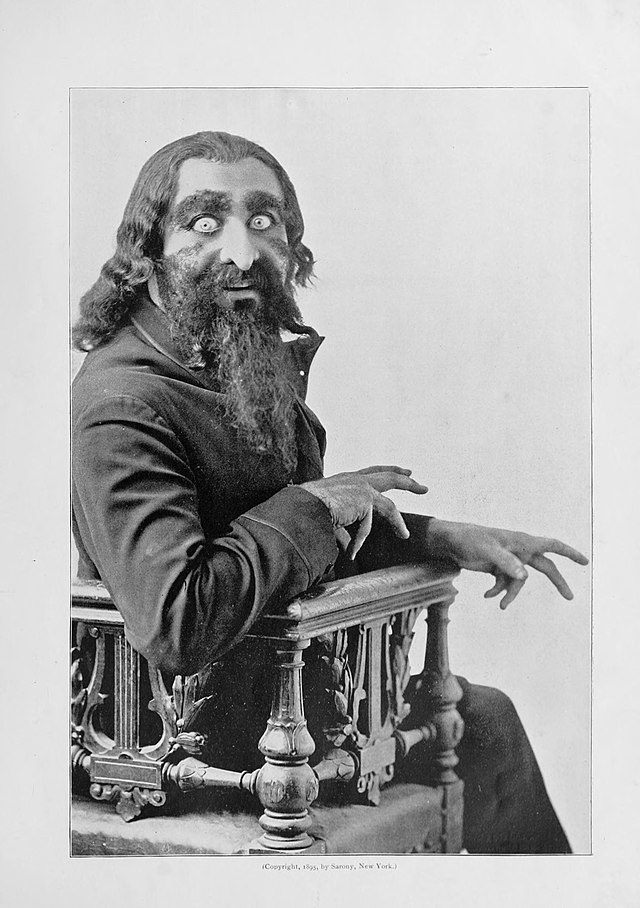
Emily’s tale reflects a number of themes that would have been prominent in the public mind at the time. Certainly hypnosis had started being used as a plot device in sensationalist fiction such as the Moonstone by Wilkie Collins (1868) and George Du Maurier’s bestseller Trilby (1895). Trilby tells the story of how a beautiful tone deaf Parisian woman named Trilby is hypnotised, seduced and exploited by Svengali who turns her into a hugely successful opera singer without her being aware of it. The character of Svengali gave his name to anyone who dominates and manipulates those around him with his hypnotic personality. The novel became a hit stage play, and it seems that Emily’s story owes something to these Victorian melodramas.
Portrait of Svengali
The fear that women might be abducted and sold into prostitution was another concern that helped make Emily’s story attractive to the media. This would have seemed plausible in the light of W.T. Stead sensational series of articles on child prostitution ‘The Maiden Tribute of Modern Babylon’[xiv] published in 1885.
However, hypnotism is not an effective means of abducting one’s victim and belongs purely in the realm of fiction. It was this imaginary flourish that ultimately made Emily’s account implausible. As with cases of alien abduction or Satanic Ritual Abuse, if hypnotism is part of the story, great scepticism is required.
Epilogue
Presumably Emily’s dreams of a glamorous showbusiness career went unfulfilled, though she certainly was centre stage in her own exciting melodrama.
Ironically, as one newspaper noted: ‘So much publicity, however, has been given to the affair that there are probably plenty of theatrical managers who would now be only too pleased to secure her services.’[xv]
Here’s a sad and curious tale from a Weird Calderdale chapter on local quacks that was left out due to space constraints…
John Holmes was a ‘dispenser of herbs, barks, draughts’ and other unconventional treatments, though his critics, and there were many, would call him a quack.[i] Details are sketchy, but he came to the attention of the local media when he courted and won the affections of a lonely widow who resided in the Calderdale countryside. He persuaded her to marry him and they settled down in King Street, a respectable part of Brighouse, in the autumn of 1874.
However, it wasn’t long before this quiet neighbourhood had ‘its sense of propriety shocked’ by Mr Holmes.[ii] He had returned home steaming drunk one evening and created a rumpus that ‘disgusted the whole neighbourhood.’ His drunken and threatening behaviour were such that his poor wife fled their home with barely more than the clothes she was wearing. Holmes proceeded to lock her out and would not let her in even to pick up a change of clothes or any of her other property.
The authorities and all her neighbours were on her side, though, and she was given a warrant to enter the property and take back what was hers. She did this by breaking into the house when nobody was home while her neighbours kept a look out for her disreputable husband. She retrieved her property successfully and her husband, when he eventually returned, was furious, though there was little he could do about it.
Holmes soon left Brighouse and moved to Wyke where he met another widow. He told her he was a widower and again persuaded her to marry him. This union did not last, however, and when his new wife witnessed his behaviour she abandoned him in disgust.
All the while Holmes was treating his patients with his various quack remedies. Unfortunately for him, while treating someone with an infected finger, some of the pus from the digit found its way into a bruise on Holmes’s hand and he contracted blood poisoning.[iii] This is how the Brighouse News reported it, though it seems unlikely that an infection would enter though bruised skin which would probably be unbroken. In any case, he suffered greatly with the infection and was confined to his bed. Shortly after he suffered a stroke and lost the power of speech. His reputation was so bad in the neighbourhood that we are told that no woman would go near him to nurse him, including either of his wives. He died 16 May 1875 in Wyke.
After his death it was discovered that he had left a total of five wives, four of whom were still living. He had, it seems, in each occasion identified a lonely widow, courted her and then wed her without bothering to divorce his previous spouse.
His funeral card read:
Farewell, my wife and children dear,
My sorrows now are o’er;
But oh prepare to meet me there,
Where we shall part no more.
The Brighouse News could not resist adding sarcastically: ‘The question is naturally suggested, which of his wives is meant?’[iv]
In 1841, journalist Charles Mackay wrote a remarkable book titled Extraordinary Popular Delusions and the Madness of Crowds, one of my favourite books. In it he examined what happens when nations and even continents go mad so that ‘millions of people become simultaneously impressed with one delusion, and run after it, till their attention is caught by some new folly more captivating than the first’.
The delusions he detailed included historical financial crashes such as the Dutch Tulipomania speculative bubble that occurred in the 1630s. He also described the crusading madness of the Middle Ages as European armies swarmed across the Holy Land driven by a bloodthirsty sanctimonious fire. Then there was the witch mania – trials and persecutions of supposed witches in sixteenth and seventeenth century Europe when communities inflicted enormous cruelty on those they deemed heretical, different or suspicious. All that craziness was enthusiastically supported by normal people from all walks of life.
Of course, such things as Mackay described would never happen in modern times… Or would they?
Imagine Charles Mackay came across a steam punk time machine and travelled to the present day in order to update his classic book on weird history and crowd psychology. What are the extraordinary popular delusions and examples of crowd madness that infect the world today?
Here are my suggestions for the top three Extraordinary Popular Delusions and Madness of Crowds happening in the twenty first century: Covid Hysteria, the Trans Delusion and Russophobia…
3. Covid Hysteria
Let’s start with a fairy tale:
Once upon a time there was an evil invisible demon that came from the east. If it possessed you, you were doomed. The demon could be hiding in anyone and everyone you met, waiting to possess your soul. However, the demon was rendered powerless by magic face shields, but just to be on the safe side everyone in the kingdom was confined to a dungeon. Luckily, wise men created a safe and effective magic potion that defeated the demon and everyone lived happily ever after.
During the dystopian covid era, I got used to being in a minority of one – the only person in the train carriage or the shop not wearing a face mask. I wasn’t exempt. I refused because they don’t work, they’re dehumanising, unhygienic and a highly visible symbol of compliance and conformity.[i] Occasionally seeing another bare-faced refusenik gave me some faith in humanity – perhaps we would recover from the mass hysteria that was our grotesque overreaction to the pandemic.
Covid had an infection fatality rate that was similar to a bad flu and was mostly a risk to the very old or very ill. It quickly became known that the risk to the young and the middle aged was vanishingly small.[ii] And yet people shut themselves in their homes, left the elderly to die alone, stopped living, loving, learning, singing, dancing and covered their faces with ineffective gob-nappies before queuing up time and again to be injected with an experimental drug… and they still got covid.
‘I had three doses of the vaccine then I caught covid, which shows how good the vaccines really are,’ said a friend of mine in all seriousness.
I still find it hard to believe the hysterical authoritarian turn the world took over a virus that, whatever its origin, was virtually unstoppable and highly likely to only cause mild symptoms in most people.
Of course the doctors or academics who argued for a realistic and measured approach were vilified, demonised or cancelled. The scientists from the universities of Harvard, Stanford and Oxford who signed the Great Barrington Declaration calling for a rational approach to the pandemic being a case in point.[iii]
Did social distancing and groups of six stop the virus? No. Did lockdown stop the virus? No. Did school closures stop the virus? No. Did face masks stop the virus? No. Did the jabs stop the virus? No. Did the sinister and cynical use of covid fear porn by the government stop the virus? No. We witnessed an unholy confluence of big pharma mendacity, technocratic authoritarianism, hypocritical fearmongering, political cowardice and unquestioning public compliance with all of the above.
Covid Hysteria gets a place among the Extraordinary Popular Delusions and the Madness of Crowds of the 21st century.
2. The Trans Delusion
Sitting comfortably? Another fairy tale:
Once upon a time there were knights and princesses. However, there came a time when some of the knights thought they were princesses and some of the princesses thought they were knights. So the princesses put on the knights’ shining armour and the knights put on the princesses’ beautiful pink dresses and lo and behold the knights were magically transformed into princesses and the princesses were magically transformed into knights. Just to be on the safe side, the wise men invented magic potions to help the transformations along, and the process was completed with a few chops of a magic sword and then everyone lived happily ever after.
Over recent years there’s been a marked increase in the number of children identifying as transgender. This is especially true of young girls.[iv] These children may be put on a pathway that includes puberty blockers in childhood, followed by treatment with cross-sex hormones in their teens and may result in gruesome life-changing surgery. All of these interventions have their dangers and long-term, sometimes life-shortening consequences.[v] It’s rational, reasonable and compassionate to be sceptical of them, especially in the case of children and young adults.
This isn’t to say people who identify as trans shouldn’t be treated with the same respect and consideration as everyone else. Of course they should.
Children growing up may display non-conforming gender behaviour – just as they may pretend to be a dinosaur or a superhero. For many it will just be a phase they will grow out of. In fact, research suggests over 80% of children who identify as the other sex will eventually revert to identifying with their real sex. Many will turn out to be homosexual.[vi] Viewing non-gender conforming behaviours of children as evidence for the need for life-changing, risky and invasive medical interventions is grotesque. It’s the sinister medicalisation of the normal spectrum of human behaviour.
Many teenagers – especially girls – experience discomfort with their bodies during adolescence. It seems that gender reassignment is being offered as a panacea for this psychological pain. Once they change their pronouns, or get puberty blockers, or get hormone treatment, or their breasts removed… all their problems will be over, or so they may be led to believe. The danger, it is often argued, is that if a child is not put on the pathway to transitioning, they are at risk of committing suicide. By questioning this, you’re actually killing people.
But here’s an inconvenient fact. Studies have shown that people who transition are still much more likely to kill themselves than the general population.[vii] In many cases, transitioning may be a tragic case of treating the symptom rather than the cause…
What’s behind the rise of children and young people wanting to transition?
Surely, social media plays a large role. Young girls who are feeling the common discomfort with their body that puberty brings are able to access thousands of affirming videos that tell them they may be a person of the opposite sex trapped in the wrong body. Their feelings are confirmed and amplified by supportive activists and therapists and a clear pathway to a ‘solution’ for their woes is offered.
These well-meaning therapists and activists play a role in this delusion. If a child presents as transgender, this self-diagnosis will be affirmed without sufficient consideration of whether the child’s issues are the result of mental illness, common teenage anxieties about gender and physical development, an emerging awareness of homosexuality or hysterical social contagion.[viii]
What does it even mean to be born into the wrong body? We are our body. We are not some gendered soul floating round in the ether waiting to be born into either the correct or incorrect body like an Amazon parcel delivered to the wrong address. It makes no logical or philosophical sense because it’s a metaphysical delusion of the early 21st century. And when metaphysical delusions and mass hysteria are medicalised, the results can be tragic.
In the past, deluded conservatives tried to ‘cure’ gay people with pseudoscientific psychological conversion therapies. Nowadays, compassionate liberals cure gayness by pumping confused children full of drugs and hormones and grooming them for having their tits or balls chopped off.
The trans delusion also earns its place among the great insanities of the century.
1. Russophobia
All right, just one more fairy tale before the lights go out:
Once upon a time there was an Evil King who ruled an Evil Kingdom with an iron fist. One day, he decided to show the world how evil he was by conquering the neighbouring Borderland Kingdom. However, all the good kingdoms of the world came together and presented the Borderland Kingdom with magic wonder swords and the Evil Kingdom was defeated. The people of the Evil Kingdom then deposed their Evil King, and the Evil Kingdom was no more and all the lands of the world gave praise to the Good Kingdoms for bringing peace and prosperity to all and everyone lived happily ever after.
Are you still burning with righteous hatred of Vladimir Putin and all that he stands for? Are you still filled with gushing admiration for brave Zelensky and his photogenic defiance of the Russian invaders? Of course you are because that’s what all good people think and feel, isn’t it? But doesn’t it ever seem to you that we’ve been corralled into some kind of Orwellian two-minute hate? Could the western world be in the grip of Russophobic hysteria?
The same media and political class that sold us the war against Afghanistan, the war against Iraq and the war against Libya are also selling us our proxy war against Russia. If you didn’t question those wars, you owe it to yourself to question this one. Heroic Zelensky (always winning but never victorious), Evil Putin (always losing but never defeated), blue and yellow flags, the Ghost of Kiev, David and Goliath, Good versus Evil, democracy versus tyranny… it was easy to see how people got emotionally swept up in the fairy story, especially so soon after the delirium of the covid era.
The story the media has told us in the West is that the Ukraine war was an act of unprovoked aggression by Putin’s Russia. The word ‘unprovoked’ was repeated as a mantra by politicians and pundits to drive this point home. Poor little Ukraine. Big bad Russia. Putin invaded because he’s evil. Or he’s the new Hitler. Or he wanted to revive the Soviet Union. Or he wanted to reprise the Tsarist empire. Or he’s mad. Or he’s dying….
These are the shamefully shallow analyses we’ve been given. The complex geopolitical conflict is treated as a Manichean pantomime. Putin’s behind you. Boo, hiss.
Bob Moran
However, the war was knowingly and deliberately provoked by the West. The first provocation was the reckless expansion of NATO to encircle Russia, despite agreements not to do so as the Soviet Union was dissolved. For some unfathomable reason, Russia sees being surrounded by an anti-Russian military alliance despite promises to the contrary as an existential threat – just as the US saw Soviet missiles in Cuba in the early 60s as an existential threat which nearly led to nuclear Armageddon.
The Ukraine war is surely one of the dumbest wars in history and one of the easiest to have avoided. When William Burns, the director of the CIA, was ambassador to Moscow, he told the US government that expanding NATO to Ukraine was a red line for Russia – Nyet means Nyet, he said. The words of his famous cable sent to the US government after being called in to see Sergei Lavrov in early 2008 are particularly prescient:
Not only does Russia perceive encirclement, and efforts to undermine Russia’s influence in the region, but it also fears unpredictable and uncontrolled consequences which would seriously affect Russian security interests. Experts tell us that Russia is particularly worried that the strong divisions in Ukraine over NATO membership, with much of the ethnic-Russian community against membership, could lead to a major split, involving violence or at worst, civil war. In that eventuality, Russia would have to decide whether to intervene; a decision Russia does not want to have to face.[ix]
We knew Russia would see NATO expansion to Ukraine as a declaration of war, because that’s what it was. All we had to do was say ‘Sorry, Ukraine. You can’t join NATO. Ever.’ Done. The war – and the Ukrainian civil war that had been boiling since the violent far-right overthrow of the democratically elected government in 2014 – would have been avoided. Hundreds of thousands of lives would have been saved and it would have cost us nothing.
But our Russophobic elites wanted this war, and got it. Way back in April 2022, shortly after the invasion, Boris Johnson scuppered negotiations that almost led to peace breaking out in discussions brokered by Turkey and Israel. Keep fighting, our Prime Minister told Zelensky, because we won’t support a peace agreement.[x] This makes it OUR war. The SAS being on the ground in Ukraine – as recent leaks revealed – also makes this is OUR war. Our contribution of depleted uranium and long-range weapons make this OUR war.[xi] The Conservative government and its Labour mini-me is using the Ukrainian conflict as a bloody but highly profitable advertisement for our weapons industry.[xii]
However, it’s not turning out how we imagined.
We thought the rouble would turn to rubble because of our sanctions. Delusion. It’s our own economies that are tanking. Sanctions have backfired.
We thought the Russian people would turn against Putin and drive him from power in a glorious colour revolution, replacing him with a pliable liberal westerniser. Delusion. If anything, many Russians feel Putin has been too cautious. Our attempt to engineer a regime change in Moscow has backfired.
We thought our weapons, intelligence and military assistance would win the war for Ukraine. Delusion. Ukraine is kidnapping children and old men and sending them to the front where they will die over whether a village you can’t even pronounce is in Ukraine or Russia. Our military strategy has backfired – Ukraine and the West are being demilitarised.
The truth is that western political elites don’t care about Ukraine. If they did, this war would have been avoided. We aren’t saving Ukraine. We’re sacrificing Ukraine in our war against Russia. Our rabidly Russophobic elites only care about harming Russia, and Ukraine is a tool for doing this. A proxy. A pawn in geopolitical chess, the aim being that a defeated, weakened Russia will disintegrate as Yugoslavia did. The western world has been seized by a hysterical Russophobia. The rest of the world looks on aghast as our hypocritical, sanctimonious, profiteering brings chaos wherever it goes.
But sanctions didn’t destroy the Russian economy. So we imposed more. That didn’t work, so we imposed more. And more. All the money and weapons we sent to Ukraine haven’t saved it, so we sent more. That didn’t work, so we sent more. And more. The much-hyped Ukrainian spring-cum-summer-cum-autumn offensive has done little except kill Ukrainian teenagers and pensioners fighting on the front line, so let’s send more… If something doesn’t work – keep doing it!
We all know what Einstein said about this. Doing the same thing over and over and expecting different results is insanity.
The logic is inescapable. Russia’s victory is all but inevitable. It always has been. It’s bigger than Ukraine, has a bigger population, has a bigger and more sophisticated military. The maths is grim but obvious. We knew this from the start.
This is a time for realism, not idealism.
Or you could just go back to your daily two-minute hate of Putin and hope it all ends happily ever after.
If Extraordinary Popular Delusions and the Madness of Crowds were updated to include the twenty-first century, Russophobia may well be the final chapter.
[ii] John P. A. Ioannidis, ‘Infection fatality rate of COVID-19 inferred from seroprevalence data’, Bull World Health Organ 99(19) doi: http://dx.doi.org/10.2471/BLT.20.265892; A.M. Pezzullo, C. Axfors, DG Contopoulos-Ioannidis, A. Apostolatos, J.P.A. Ioannidis, ‘Age-stratified infection fatality rate of COVID-19 in the non-elderly population’, Environmental Research. 2023 Jan 1(216) (Pt 3):114655. doi: 10.1016/j.envres.2022.114655. Epub 2022 Oct 28. PMID: 36341800; PMCID: PMC9613797.
[vii] C. Dhejne, P. Lichtenstein, M. Boman, ALV Johansson, N. Långström, et al. (2011) ‘Long-Term Follow-Up of Transsexual Persons Undergoing Sex Reassignment Surgery: Cohort Study in Sweden’, PLOS ONE 6(2), e16885. https://doi.org/10.1371/journal.pone.0016885
















 Paul Weatherhead