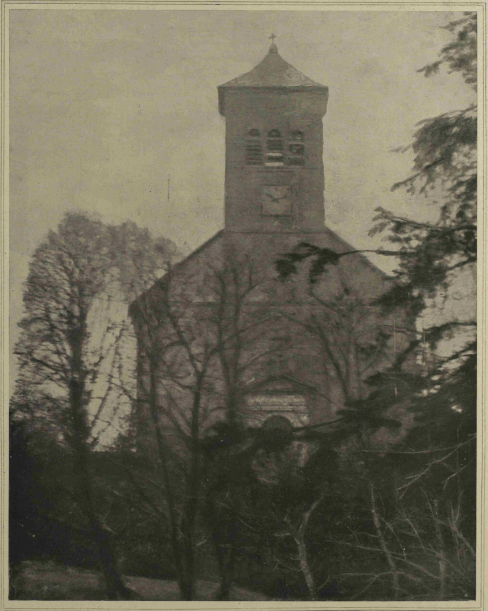
January 1922, Noveant, north west France. As the sun sets behind the village church, a large crowd from the surrounding villages gather to witness a miracle. Then she appears – the Virgin Mary in robes of light floating in the trees and looking kindly down on the faithful.
This vision had appeared at sunset daily since 16 January and had been witnessed, we are told by many women and children at first, but was now attracting scores of visitors to witness the holy vision – and they were not disappointed.[i]
Mary herself can clearly be seen in the contemporary photo (cropped above, full version below) from the Illustrated London News. The same paper says that the sunlight shining through interlacing branches is what the ‘superstitious’ were fooled by.[ii]
The simulacrum still works well in the grainy low quality photos and is a nice example of pareidolia – our tendency to see patterns everywhere. Wish fulfilment at work:
When I find myself in times of trouble, Mother Mary comes to me
Speaking words of wisdom….From a tree…
The Virgin in the Trees (centre left), Illustrated London News 31 January 1920
[i] ‘Vision of the virgin’, Westminster Gazette, 20 January, 1920 p.4
[ii] ‘A mysterious appearance of the Virgin in France explained’, Illustrated London News, 31 January, 1920 p.3
In the dim moonlight of a nineteenth century lane, if you came across a pale spectral figure as naked as the day he was born, you might take it for a restless spirit. However, perhaps you had encountered a naked ghost – people who wandered the streets at night frightening any unlucky victim they happened to meet. They were a combination of ghost hoaxer, streaker and flasher and were surprisingly frequent, especially in the early nineteenth century.
The sight of someone stalking a secluded location with his wan naked body eerily reflecting the gas lamps or moon light would have been a very disconcerting, threatening and scary experience. It has an element of the bizarre and surreal about it, so it’s easy to see why these figures would be seen as otherworldly – why they were referred to as ghosts.
Here’s a selection of true tales of ghostly streakers. Contains nudity.
A Giant Horny Naked Lady Ghost
The watchmen who patrolled the vicinity of the Walworth turnpike near Lambeth were initially sceptical when they heard tales of a ghost at the end of March 1818. An unnamed man had burst into their office scared out of his wits claiming he had seen a woman with horns on her head rise out of the earth in front of him. The watchmen had heard his screams and hurried to the vicinity, but dismissed the man’s claim that he had seen a ghost.
However, when another man told them that he had also seen a strange apparition that had vanished into thin air before his eyes, they began to take the reports more seriously.
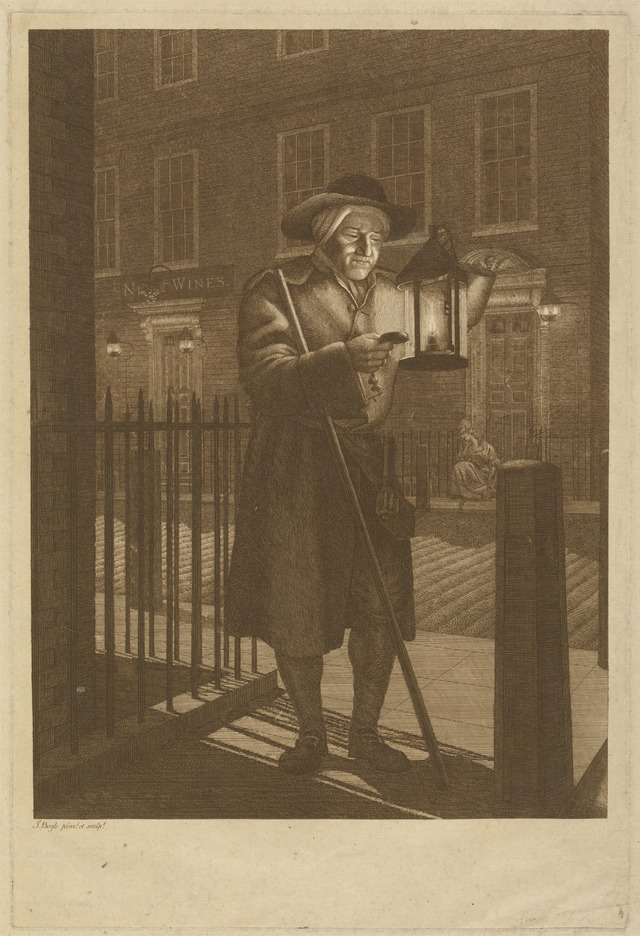
A Watchman was likely to meet a naked ghost
The following night the watchmen were already feeling on edge as the sound of soft music was heard at around 11pm. This was followed by a man running to their office and telling them the ghost had made another appearance. One of the watchmen, Mr Snow, decided to get to the bottom of the mystery and followed the terrified man, when he was surprised to see another watchman, Mr Mathews, running in terror towards him fleeing from what seemed to be a gigantic naked figure. Mathews was desperately calling for help, and shouted at the apparition ‘If you follow me, I will shoot you!’
Snow was made of sterner stuff and approached the ghost which turned and retreated. Snow pursued the figure and when he caught it, realised the ‘ghost’ was actually a naked woman who burst into hysterical maniacal laughter. Snow put his coat round her and brought her back to the office, where from her incoherent speech and state of undress he assumed she was an escaped lunatic from an asylum. This was indeed the case, and Mrs Ashton, as she was called, had apparently been insane for some time and was taken to the workhouse before appropriate accommodation was found for her.[i]
The surprising thing about this sad but rather comical story is how the witness’s imagination could turn an unfortunate naked woman into a horned gigantic ghost that was capable of vanishing and spreading such terror among the night watchmen.
It’s not clear where the soft music was coming from, but we may suppose the ‘ghost’ was singing to herself as she wandered naked through the dark lanes terrifying the locals.
A Cheshire Boggart in the Buff
For three years in the 1830s, Windsford in Chesire had been bothered by a ‘boggart’. The word ‘boggart’ is often used to mean a malevolent spirit of a house or location such as a wood or a bridge, but was frequently used to describe any spooky phenomenon from goblin like creatures to ghosts to poltergeists. In this instance the boggart took the form of a naked man.
The naked boggart was often seen at dusk on local roads around this Cheshire village and led to many women being scared to go out at night for fear of meeting him. However, in January 1834, the boggart met his match in the form of a brave hearted pub landlord.
Late in the evening of 4 January a servant girl was washing the floors in the pub while other members of the household were asleep. She heard a gentle tapping on the window and looked up to see the naked boggart leering in at her through the window. She screamed and fainted, and the landlord, hearing the noise ran out of the house and gave pursuit to the mysterious figure.
On being caught by the plucky landlord, the ‘boggart’, who was a member of a nearby Wesleyan chapel and was named George Barlow, said he had only come for a glass of ale. Why he had left his clothes at home is unknown.
In any case, he was sentenced to three months hard labour on the treadmill at Knutsford.[ii]
Penal Treadmill, London 1817 – how a naked ghost might be punished
The Naked Ghost of Bolton
In late 1871 the people of Bolton, Lancashire were being terrified by an unclad ghostly figure stalking the streets after dark instigating what the papers called a ‘reign of terror’. The question on everyone’s lips was ‘Have you seen the ghost?’
In June 1841 Ann Gledwin was asleep on her sofa when she was awoken at around midnight by the barking of a dog. In her house was the naked ghost, behaving ‘indecently’. She screamed and the figure left.
Other residents were also shocked to find their home had been invaded by this audacious unclad apparition. In October of the same year Isabella Jackson was sitting by the fire with her young daughter when a naked figure entered her house. He stood there for a few minutes in silence before leaving.
On Shrove Tuesday Martha Weaver was in her shop when a little girl who was standing on the shop counter said, ‘Oh, there’s the naked man.’ Martha looked and saw the ghost peeping round the corner at them. He then moved towards the window and acted indecently.
Esther Hargreaves saw the naked apparition outside St James’s Church. She screamed and ran, though only after watching it for a full five minutes.
Saint James’s Church, Bolton – Haunt of the Naked Ghost
As reports continued, Chief Constable Thomas Beech took action and extra police were put on patrol and almost caught the miscreant. However, this ghost was lubricated from head to foot so whenever police managed to catch him, he slipped from their grasp with ease. He once even leapt from a railway bridge into the darkness below to escape capture.
The police tried to dial down the ghost rumours by telling the press that all that had happened was a ‘half-demented’ man had wandered naked into a neighbour’s house at around the same time that a flasher had exposed himself to a young woman, causing her to be scared into convulsions. These two unconnected events, they said, had given rise to the rumours of the naked ghost haunting Bolton’s streets.
Nevertheless, people were afraid to go out at night and the stories kept coming in. Citizen vigilante patrols were formed and finally the ghost was caught. In April 1872 John Henry Smith and several others saw the ghost – this time only half naked and with his trousers on – just before 11pm near Saint James’s Church and they gave chase. At one point the semi-clad ghost turned to his pursuers and said ‘You might as well go back, you will never catch me.’
However, catch him they did, and he soon changed his tune to ‘Oh Lord have mercy upon him [sic]; let me go this once, and I will do so no more.’ He was carrying his shirt under his arm and he was made to dress before carried by the legs and arms through the streets of Bolton to the police.
Ironically, this naked ghost turned out to be a tailor named Taylor. In court he gave a rambling defence blaming taking ‘salts of prunella’ for a disease of the lips possibly related to scurvy after which he went out forgetting his shirt. It was suggested that he may have been suffering from delirium tremens.
In any case, Bolton’s naked ghost was given 28 days in prison for indecency.[iii]
[i] ‘A ghost at Newington’, The Globe 30 March 1818, p.4
[ii] ‘Commitment of a ghost to the treadmill’, The Globe 21 January 1834, p.4
[iii] ‘A ghost panic in Bolton’, Bolton Chronicle 7 October 1871, p.5; ‘The Bolton Ghost’, Bolton Evening News, 17 April 1872, p.3; ‘The Bolton Ghost’, Bolton Evening News, 18 April 1872, p.3; ‘Capture of a ghost at Bolton’, Liverpool Mercury, 18 April 1872, p.3; Liverpool Weekly Courier, 20 April 1872, p.1; ‘Capture of a ghost’, South London Press, 27 April 1872, p.4
On the 19 April 1943 chemist Albert Hofmann became the first person in history to give themselves a dose of a newly synthesised mind-altering drug. When things got too weird in his laboratory, he went on a psychedelic bicycle ride home through the mother of all bad trips. This is the story of how eighty years ago a Swiss chemist gave birth to what he called his ‘problem child’ – LSD.
After studying chemistry at the University of Zurich, Albert Hofmann started work as a research chemist for a company called Sandoz in Basel Switzerland. He spent many years synthesising various compounds that might have medicinal use, one of which was modelled on ergot, a fungus parasitic on rye. In 1938, he produced the 25th such compound – Lysergic Acid Diethylamide or LSD-25 for short. It was thought that the drug may have uses in obstetrics and could stimulate the respiratory system or the circulation.
Albert Hofmann – Father of LSD
The compound was tested on animals – particularly for its effect on the uterus – and it was noticed that the animals seemed rather restless when under the influence of the drug. At the time, it seemed there was nothing particularly interesting about the chemical, so it was forgotten about for five years.
A Peculiar Presentiment
However, Hofmann had a ‘peculiar presentiment’ that LSD-25 had other properties that might have been missed. He took the unusual step of returning to it and produced some more of the compound in the Spring of 1943. In the final stages of production, he began to feel odd. In his original notes he wrote the following:
Last Friday, April 16, 1943, I was forced to interrupt my work in the laboratory in the middle of the afternoon and proceed home, being affected by a remarkable restlessness, combined with a slight dizziness. At home I lay down and sank into a not unpleasant intoxicated-like condition, characterized by an extremely stimulated imagination. In a dreamlike state, with eyes closed (I found the daylight to be unpleasantly glaring), I perceived an uninterrupted stream of fantastic pictures, extraordinary shapes with intense, kaleidoscopic play of colors. After some two hours this condition faded away.
He assumed that some of the chemical must have entered his bloodstream somehow, perhaps through a small cut in his skin. But, being a scientist, he couldn’t be sure that it was LSD-25 that had produced these effects rather than something else, so he decided to the test the hypothesis by deliberately dosing himself with the drug.
Self-experiment
On April 19 Hofmann gave himself what he mistakenly thought was a small dose of the drug, 250 milligrams. This was the first time anyone had purposefully ingested LSD. Within an hour he began to feel dizzy and anxious. He started experiencing visual distortion and a strange desire to laugh. Soon, though, the trip began to feel threatening.
By this time Hofmann was struggling to speak intelligibly but managed to ask the lab assistant (who knew about the experiment) to escort him home. War time restrictions meant no cars were available, so they rode home on bicycles. Cycling home along that Swiss road off his head on acid, Hofmann said that ‘everything in my field of vision wavered and was distorted as if seen in a curved mirror.’
Tabs of LSD commemorating Hofmann’s psychedelic bike ride
Hofmann was afraid he had been fatally poisoned by the drug he’d taken, so when they got home he asked the lab assistant to call a doctor and then bring some milk from a neighbour. He hoped that the milk would help to counteract the poison until the doctor arrived.
The chemist lay down on the sofa. This is how he described the experience on reaching home:
My surroundings had now transformed themselves in more terrifying ways. Everything in the room spun around, and the familiar objects and pieces of furniture assumed grotesque, threatening forms. They were in continuous motion, animated, as if driven by an inner restlessness.
His neighbour brought him some milk, but Hofmann saw her as an evil witch wearing a coloured mask. He drank two litres of milk over the evening. He feared that he was either going insane or dying. In his own words:
Every exertion of my will, every attempt to put an end to the disintegration of the outer world and the dissolution of my ego, seemed to be wasted effort. A demon had invaded me, had taken possession of my body, mind, and soul. I jumped up and screamed, trying to free myself from him, but then sank down again and lay helpless on the sofa.
As he lay there on the sofa waiting for the doctor to arrive, he became aware that he was dying without being able to take leave of his wife and family who were away for the day. Like Dr Frankenstein, he came to a terrible realisation:
Another reflection took shape, an idea full of bitter irony: if I was now forced to leave this world prematurely, it was because of this Iysergic acid diethylamide that I myself had brought forth into the world.
The doctor arrived and Hofmann told him he had fatally poisoned himself. The doctor checked his pulse, breathing and blood pressure. All were normal. The only odd symptom the doctor noted was that Hofmann’s pupils were extremely dilated.
Exploding in Coloured Fountains
As the trip mellowed, Hofmann’s terror started to change to gratitude as he realised he was neither going mad nor dying. He started to relax and enjoy the phantasmagorical coloured patterns he could see with his eyes closed. This is how he described it:
Kaleidoscopic, fantastic images surged in on me, alternating, variegated, opening and then closing themselves in circles and spirals, exploding in colored fountains, rearranging and hybridizing themselves in constant flux. It was particularly remarkable how every acoustic perception, such as the sound of a door handle or a passing automobile, became transformed into optical perceptions. Every sound generated a vividly changing image, with its own consistent form and color.
Hofmann’s wife had been contacted and she was told her husband was having some kind of breakdown. She rushed home, but he had by then recovered.
The following day, he felt physically tired, but also full of ‘a sensation of well-being and renewed life’.[i]
Although Hofmann continued his experiments with his ‘problem child’, he lowered the dose and hopefully avoided bicycles.
Albert Hofmann died in 2008 aged 102.
It was eighty years ago today…
Educational psychologist Thomas B. Roberts wanted to commemorate Hofmann’s discovery and came up with the idea of an annual celebration on 19 April – Bicycle Day. The day celebrates Hofmann’s Acid-fuelled bike ride home on the day of his first deliberate ingestion of the drug. Hofmann himself was not too happy about the bike ride being central to the celebration. The bike ride to him was a minor detail. It was the molecule that should be celebrated. Roberts disagreed. The image of a scientist cycling through a terrifying psychedelic nightmare was much more engaging, and he’s right.[ii] Psychedelic communities celebrate Hofmann’s psychedelic bike ride every day on 19 April, and 2023 marks the eightieth anniversary of that day in 1943.
Perhaps because of Hofmann’s bike ride, bicycles have been a recurring theme in English psychedelic pop music, so in honour of the eightieth anniversary of Hoffman’s trip, here are my top three psychedelic songs about bicycles…
Top Three Bike Psych Songs
3. ‘Bike’ by Pink Floyd
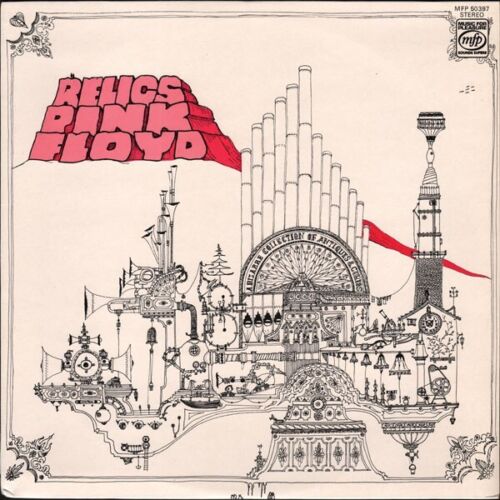
Like many of a certain age I first discovered Pink Floyd’s psychedelic period through a cheapo compilation called Relics released on the ubiquitous budget label Music for Pleasure. The LP’s closer, taken from their first album Piper at the Gates of Dawn, bounces us into the first verse without bothering with an introduction:
I’ve got a bike, you can ride it if you like
It’s got a basket, a bell that rings and things to make it look good
I’d give it to you if I could but I borrowed it…
Relics – Cheapo compilation of early Floyd
The irregular verses go on to tell of a homeless mouse called Gerald and a clan of gingerbread men before disintegrating into a cacophony of daft noises that could well be the creaking gears and madly spinning wheels on Hofmann’s original bicycle trip.
I much prefer the psychedelic whimsy of Syd Barrett’s Pink Floyd to the ponderous prog of later years, so ‘Bike’ earns its place in my Top Three Bike Psych Songs
2. ‘My White Bicycle’ by Tomorrow
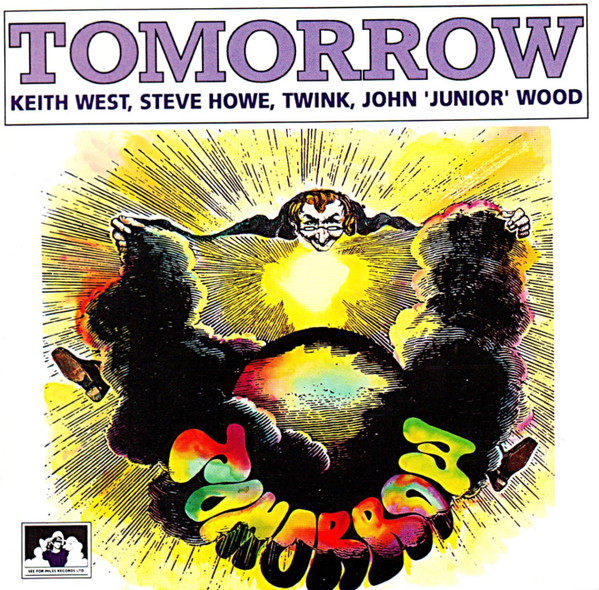
Tomorrow’s psychedelic anthem was recorded at Abbey Road studios at the same time the Beatles were working on Sgt Pepper’s Lonely Hearts Club Band. Supposedly inspired by a Dutch bike sharing scheme in which white bicycles were distributed for free use around Amsterdam, the song rides in on classic psychedelic staples – backwards guitar and cymbals – before the lysergic cyclist proceeds to knock over rubbish bins while avoiding policemen.
Tomorrow’s debut featuring ‘My White Bicycle’
This should have been a hit for Tomorrow, but it wasn’t to be. It’s still a Bike Psych classic, to such an extent that it was covered both by Nazareth and Neil from the Young Ones, and nearly made it to the top spot…
1. ‘Bike Ride to the Moon’ by the Dukes of Stratosphear
The Dukes of Stratosphear were, of course, XTC in disguise who released the mini album 25 O’clock as a kind of psychedelic April Fool’s Day joke in 1985. It kind of backfired as it went on to outsell the albums XTC put out under their own name around the same time.
Dukes of Stratosphear (aka XTC) 25 O’ Clock featuring ‘Bike Ride to the Moon’
The song combines elements of Tomorrow and Barrett’s Floyd with sped up gnome like backing vocals, backwards effects and daft noises as the cyclist heads to the moon with a pot of tea to get some cheese for his auntie. His trip ends in failure as a sharp sputnik gives him a cosmic flat tyre, and he forgot to pack his puncture repair kit.
Despite being from the 80s psychedelic revival, this affectionate pastiche of 60s pop psych cliches earns its yellow vest as the top of the bike psych pops.
Don’t forget, if you’re on your bike, wear white. Evening all… and Happy Bike Day.
[i] Albert Hofmann, LSD: My Problem Child (McGraw-Hill, 1980) pp.4-14
On Good Friday 1962 a saucer-eyed theology student burst out of Marsh Chapel on Boston University campus and ran down the street proclaiming that he had been chosen to tell the world of the coming messiah. He was being chased by some desperate scientists armed with a syringe full of Thorazine – a powerful antipsychotic. The man was captured, restrained and sedated before being dragged away.
If you had stepped inside the chapel on that day and wandered down to the basement, you might have seen several more theology students listening to a Good Friday Service through loudspeakers. Strangely, some of them were lying on the floor instead of sitting on the pews and some were wandering around saucer-eyed and murmuring about God being everywhere…[i]
This is the story of the Good Friday Experiment – when boffins gave psychedelic drugs to theology students to see if they’d see God.
And they did.
The experiment was conducted by Walter Pankhe, a Harvard PhD student working under notorious LSD evangeliser Timothy Leary. Leary had already noted that when he had given psilocybin to prisoners (this was the 60s, remember), these poorly educated and hardened cons described their experience in language that sounded as if it had been taken from the mystical traditions of both east and west.
The Good Friday Experiment, sometimes referred to as the Marsh Chapel Miracle, was an attempt to see if psychedelic drug experiences could also be viewed as life-changing religious or mystical experiences.
So, what is a mystical experience?
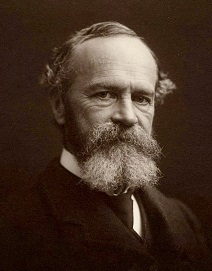
The first problem with defining a mystical experience is that they are seen as undefinable or beyond words by their very nature. However, let’s go with philosopher William James’s characterisation. Firstly, mystical experiences are ineffable – impossible to describe, though they might be characterised metaphorically as a feeling of transcendence or cosmic consciousness. Secondly, they are noetic – they give a feeling of insight or revelation. A third feature James identifies is transience – they don’t last long, though they may have lasting effects. The final feature is passivity – the subject may feel lost to or subsumed into a greater whole.[ii]
William James
Philosophers as is their wont have expanded upon, refined and critiqued James’s classic characterisation, but it’s a useful sketch.
Below are two accounts. One is a description of an ‘organic’ (drug free) mystical experience. One is a description of an LSD trip. Can you tell which is which? The answer is in the footnote.
EXPERIENCE A: I cannot even now find words to render it intelligible. It consisted in a gradual but swiftly progressive obliteration of space, time, sensation, and the multitudinous factors of experience which seem to qualify what we are pleased to call our Self. In proportion as these conditions of ordinary consciousness were subtracted, the sense of an underlying or essential consciousness acquired intensity. At last nothing remained but a pure, absolute, abstract Self.
EXPERIENCE B: Although consciousness of self seemed extinguished, I knew that the boundaries of my being now had been dissolved… I, who seemed to have no identity at all, yet experienced myself as filled with God, and then as (whatever this may mean) passing through God and into a Oneness…. What I experienced in this ALL so far transcends my powers of description…[iii]
Both accounts describe the experiences as ineffable and refer to the loss of the sense of self and the experience of a profound underlying reality. It’s certainly not obvious which is the ‘natural’ (occurring spontaneously or though spiritual practice such as meditation, chanting or fasting for example) and which is the drug-induced experience.
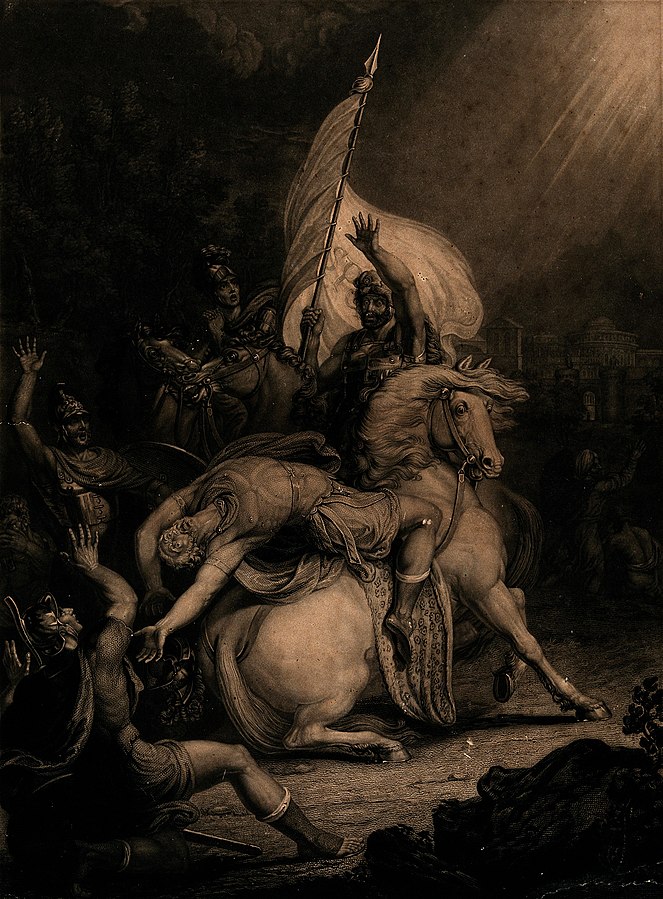
Paul sees the light on the road to Damascus
Philosopher W.T. Stace put it like this: if the phenomenological descriptions of ‘natural’ mystical experiences and those achieved through drugs are indistinguishable, then if one of them counts as a genuine religious experience, so should the other.[iv] Stace called this The Principle of Causal Indifference. It’s not the cause of the experience that matters (whether it’s decades of asceticism and sitting on a spike in the desert or drinking magic mushroom tea), but the experience itself.
The Marsh Chapel Miracle
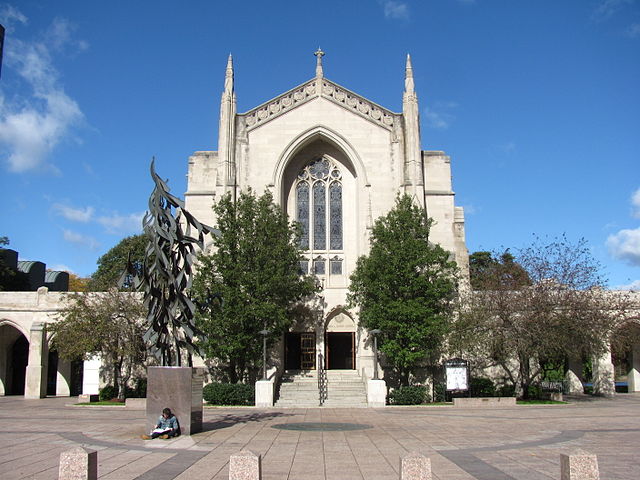
On Good Friday 1962, twenty volunteer theology students from Boston University arrived at Marsh Chapel to hear an Easter service. They were ushered into a basement room separate from the congregation where they could hear the service on loudspeakers. They were all given some white powder which they swallowed. Half of the volunteers had been given an active placebo (nicotinic acid) that produced a mild tingling sensation. The other half had been given a high dose of psilocybin, the psychedelic compound found in many magic mushrooms.[v]
Marsh Chapel, Boston – Scene of the Good Friday Experiment
It soon became clear that the double-blind precautions had been pretty pointless. It was obvious which of the students were off their heads. They were wandering around enraptured, lying blissed out on the floor, murmuring about the glories of God, and in some cases panicking or running down the street shouting about the messiah.
But were the experiences the divinity students had mystical? Well, psychologists have a questionnaire for that. In fact they’ve got several, but in this case the volunteers were asked to rate their experience in terms of a feeling of unity or loss of self, transcendence of time and space, feelings of bliss and joy, sacredness, noetic quality, supposed ineffability, transiency and lasting positive changes in behaviour and attitude.
In every category, the volunteers in the psilocybin group rated their experience higher than those in the control group. The same was true in a follow up study conducted six months later.
Of the students in the psilocybin group, nine of the ten agreed with the statement ‘Yes, this was definitely a religious experience’. Only one of the drug group did not agree.[vi]
Walter Pahnke planned to do a further follow up study to see if the experience on that Good Friday resulted in lasting changes to the subjects’ lives. Tragically, though, Pahnke was killed in a scuba diving accident in 1971 at age forty.
The Good Friday Follow Up
Twenty five years after the original experiment, psychologist Rick Doblin revisited the study. In order to protect the identities of the volunteers, Pahnke had ensured that tracing them would be virtually impossible – fearing that should psychedelic drugs become criminalised (as they were soon to be), the students who had participated in his experiment might face embarrassment, damage to their careers or worse.
Luckily for Doblin, one of the volunteers had put his head above the parapet – Mike Young, now a church minister. He was the one volunteer in the group of ten who had denied that his psilocybin trip was a genuine religious experience. Since then, however, he had changed his mind and had spoken publicly about his experience and his belief in the need for research into the spiritual and therapeutic benefits of psychedelic drugs. Young was still in touch with several of the volunteers, and helped Rick Doblin to trace the rest of them.
Of the twenty, nineteen were traced. One of the placebo group had died. Of the former students in the placebo group, five were still church ministers. Of the former students in the psilocybin group, eight were still ministers. This may not be statistically significant, though the results of the follow up were.
Despite the fact that some of the group had suffered anxiety and distress and one had ‘escaped’ into the street, all said that a quarter of a century after their psychedelic experience, the spiritual insights and positive changes to their way of thinking had continued and in some of the group had even deepened. Doblin concluded that psilocybin does facilitate mystical experiences in religiously inclined people in a spiritual setting and these experiences are profound and lasting.[vii]
Pankhe had been right. Psychedelic drugs can produce an experience that is, in Pankhe’s words, ‘indistinguishable from, if not identical with’ the experiences described by the mystical and spiritual tradition.
Pow!
The fact that the personal and spiritual changes following the drug experience continued and strengthened over time is significant. William James argued that when it comes to mystical experiences, the fruits are more important that the roots. In other words, the lasting changes resulting from the experience matter more than the cause of the experience (whether drugs, meditation, chanting, epilepsy or cheese before bedtime).
This is how original volunteer reverend Mike Young put it: ‘The proof of the experience is in the fruits, not in the size of the Pow! that goes with it.’[viii]
Walter Pahnke felt he had to cover up the fact that one of the volunteers had freaked out and had to be restrained and that some of the group were distressed or anxious for part of their trip. The tide was turning and the days of studies like the Good Friday Experiment were numbered. Pahnke’s insightful and controversial study was indeed one of the last legal experiments with psilocybin in the US for a long time.
Before the term ‘psychedelic’ came into popular use, substances such as LSD, psilocybin and mescaline were termed ‘psychotomimetic’ drugs as they were believed to mimic the effects of psychosis.[ix] Psychiatrists, it was thought, might be able to use the drugs to get an insight into what it feels like to be insane.
However, the Good Friday Experiment seems a more promising and positive approach as research into the use of psychedelic drugs for therapeutic, spiritual and – horror of horrors – recreational use is undergoing a twenty first century renaissance.[x]
Psychedelic Goose Egg by Larisa Moskaleva
[i] Michael Pollan, How to Change Your Mind (Penguin, 2019) pp.45-46
[ii] William James, The Varieties of Religious Experience, ed. by Martin E. Marty (London: Penguin, 1982), p.383
[iii] Experience A is the ‘natural’ mystical experience. Experience B is the LSD trip. William James, The Varieties of Religious Experience, ed. byMartin E. Marty (London: Penguin, 1982), p.383; Robert Masters and Jean Houston, The Varieties of Psychedelic Experience, (Rochester: Park Street Press, 2000), p.308
[iv] W.T. Stace, Mysticism and Philosophy (London: Macmillan, 1961)
[v] Walter Pahnke,’Drugs and Mysticism’, The International Journal of Parapsychology, VIII(2), (1966) pp.295-313
[vi] Mike Young, “If I could Change Your Mind” in Spiritual Growth with Entheogens by T. B. Roberts (Rochester: Park Street Press, 2001), pp.6-15 (p.8)
[vii] Rick Doblin, ‘Pahnke’s Good Friday Experiment: A Long-term Follow-up and Methodological Critique’ in Spiritual Growth with Entheogens by T. B. Roberts (Rochester: Park Street Press, 2001), pp.84-93
[viii] Mike Young, ‘If I could Change Your Mind’ in Spiritual Growth with Entheogens by T. B. Roberts (Rochester: Park Street Press, 2001), pp.6-15 (p.12)
[ix] Robert Masters and Jean Houston, The Varieties of Psychedelic Experience, (Rochester: Park Street Press, 2000), p.6.
[x] See Michael Pollan, How to Change Your Mind (Penguin, 2019)
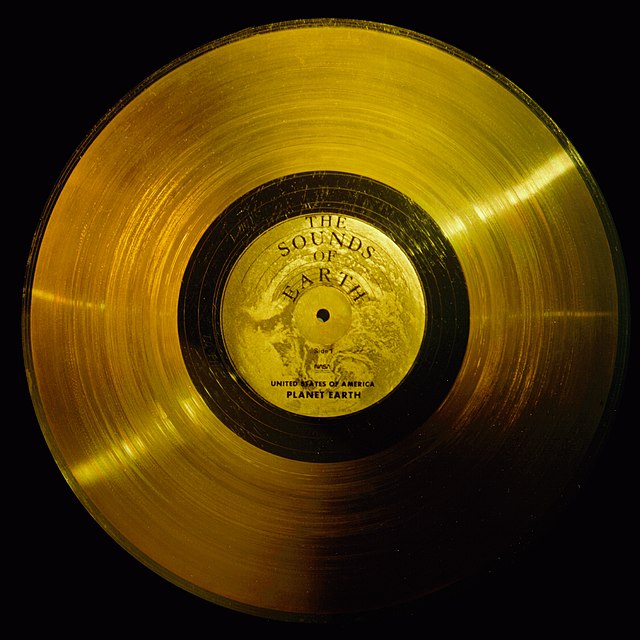
In 1977, NASA launched the probes spacecraft Voyager 1 and 2 on a journey that will eventually have them leave our solar system far behind. They each carry a twelve-inch golden phonograph record with a message to any aliens who might in the distant future find one of the probes. The record’s cover had a diagram telling the aliens where we live, and the golden record featured classical, folk and rock music along with animal noises and greetings from earthlings in languages from around the world.
Only in the 1970s would we think the best way to get a message to extra-terrestrials was to send them a concept album.
The Sounds of Earth – NASA’s 1970s concept album for aliens
In any case, it will be around another 40,000 years before these interplanetary craft reach another solar system.[i]
However, in 1953 an even stranger attempt to contact aliens took place – World Contact Day. On this occasion, the message was sent not by spacecraft but by telepathy.
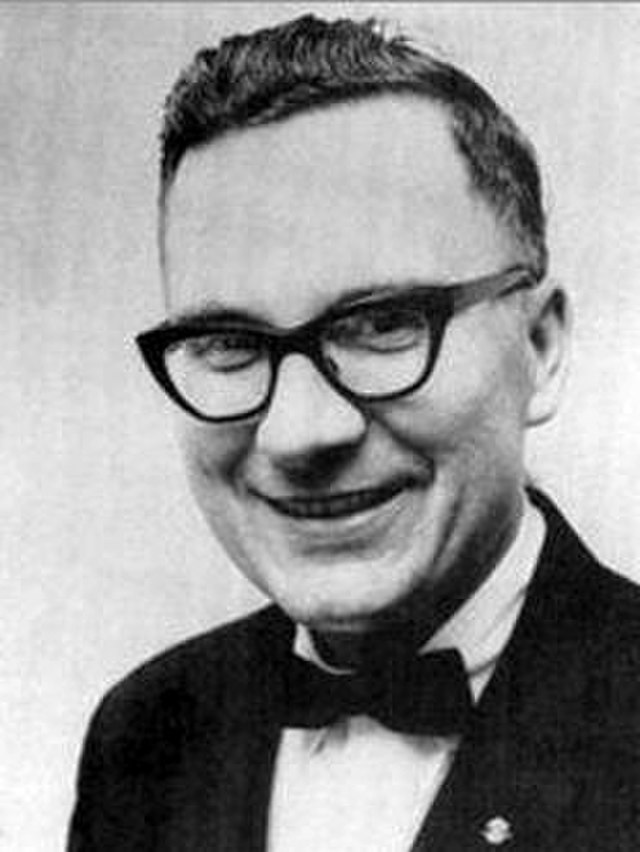
World Contact Day was the brain child of Albert K. Bender, a factory worker from Connecticut who headed one of the few large organisations that studied UFO sightings that existed at that time – the International Flying Saucer Bureau (IFSB).
Albert K. Bender
The reasoning behind World Contact Day was that if aliens were visiting us in flying saucers and if telepathy was a reality, then it might be possible to contact the visitors through thought alone. The collective telepathic ability of many people concentrating on the same message at the same time would surely get through to the aliens.
World Contact Day was declared as 15 March 1953. On that day at a set time (adjusted for one’s time zone), all members of the IFSB in the USA, UK, France, Australia, Canada and New Zealand were asked to close their eyes and concentrate on a message that had been previously memorised. This was the message:
Calling occupants of interplanetary craft! Calling occupants of interplanetary craft that have been observing our planet EARTH. We of IFSB wish to make contact with you. We are your friends, and would like you to make an appearance here on EARTH. Your presence before us will be welcomed with the utmost friendship. We will do all in our power to promote mutual understanding between your people and the people of EARTH. Please come in peace and help us in our EARTHLY problems. Give us some sign that you have received our message. Be responsible for creating a miracle here on our planet to wake up the ignorant ones to reality. Let us hear from you. We are your friends.
We are among you and know your every move
As the day arrived, hundreds – perhaps thousands – of flying saucer enthusiasts all over the world sat down in a quiet place and concentrated on the message. Alfred Bender did the same but the experience he described was markedly at odds with the saucer-eyed hopefulness of the recitation he had memorised.
Bender described how after lying down on his bed and concentrating on the message three times, he developed a sudden chill and intense headache and noticed an unpleasant smell of rotten eggs before seeming to lose consciousness.
He described small blue lights swimming in his brain while an odd feeling of weightlessness came over him. He opened his eyes to find himself floating above his body. It was then that the aliens made contact with a voice Bender described as being in his head. The aliens had the following discouraging message:
We have been watching you and your activities. Please be advised to discontinue delving into the mysteries of the universe. We will make an appearance if you disobey.
The aliens, it seems, were on some special assignment and did not want to be disturbed by humans. ‘We are among you and know your every move,’ they told Bender ominously.
When Bender was aware of being back on his bed, his room was filled with a yellow mist and a shadowy figure stood by his bed before everything melted away.[ii]
Bender’s out of body experience sounds very like an episode of sleep paralysis, a disorder in which the sleeper awakens to find him or herself feeling paralysed or floating, often accompanied by terrifying hallucinations in a kind of waking nightmare.
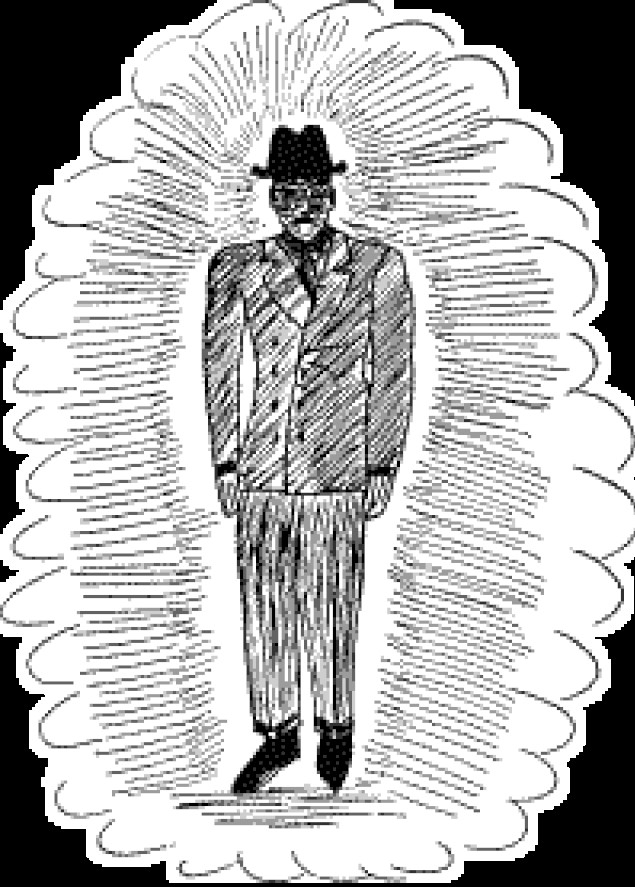
Perhaps Bender had a persecution complex, as aliens were not the only ones keeping watch on him. As well as World Contact Day, Alfred Bender was also responsible for an iconic element of UFO folklore – the Men in Black. Bender claimed to have been visited by three sinister, darkly clad agents who warned him away from his study of flying saucers. This was the first encounter with these notorious Men in Black, who according to UFO legend, threaten and intimidate UFO witnesses to keep quiet about what they have seen or what they know.[iii]
Bender’s sketch of a Man in Black
World Contact Day may not have succeeded in reaching aliens (unless you believe Bender’s ufological adventures), but it did inspire a song that was surely the Carpenter’s weirdest moment – ‘Calling Occupants of Interplanetary Craft (the Recognised Anthem of World Contact Day)’.
Klaatu Barada Nikto
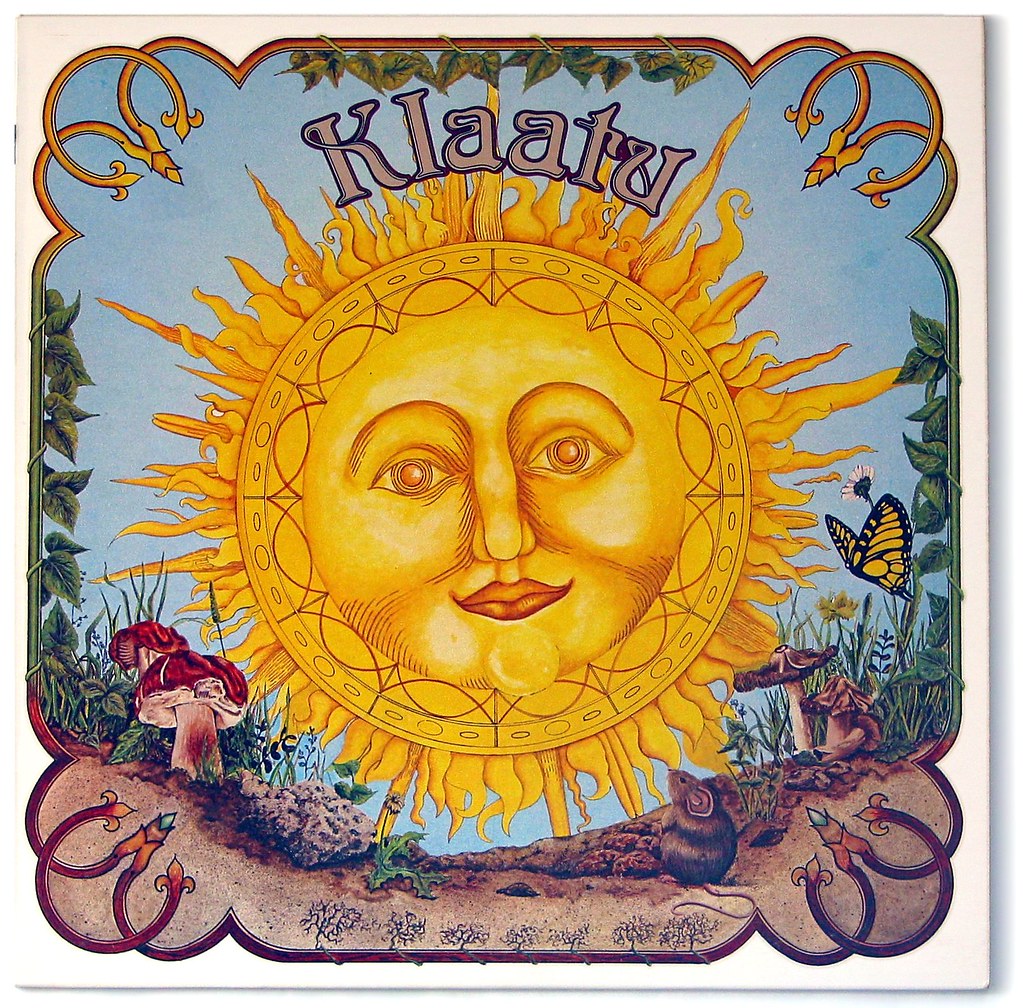
For me, though, this song entered my life as a teenager in the early 1980s. Browsing second hand records on a market stall in Hebden Bridge, West Yorkshire one afternoon, I was struck by the gloriously sunny cover of an album by a mysterious band called Klaatu. Some of the song titles appealed to my teenage mind – ‘Anus of Uranus’, ‘Sir Bodsworth Rugglesby III’ and most of all ‘Calling Occupants of Interplanetary Craft (the Recognized Anthem of World Contact Day)’.
The album was priced at 50p, but I wasn’t going to part with my money that easily. I asked the market stall holder if he’d play a bit on his little turntable. He was curious himself to see what the band sounded like and put on side one track one: ‘Calling Occupants of interplanetary Craft’.
We looked at each other in bemusement as a variety of birdsong came floating from the speaker. After several more seconds of birdsong, the stall holder picked up the stylus and moved it further into the track. Still birds singing. He moved the stylus again. Still birds. ‘I don’t believe this!’ he gasped before moving the needle a final time. And then the song started:
In your mind you have capacity you know
To telepath messages through the vast unknown…
A song about sending telepathic messages to aliens was enough to convince me. I coughed up my 50p and fell in love with the album and the band.
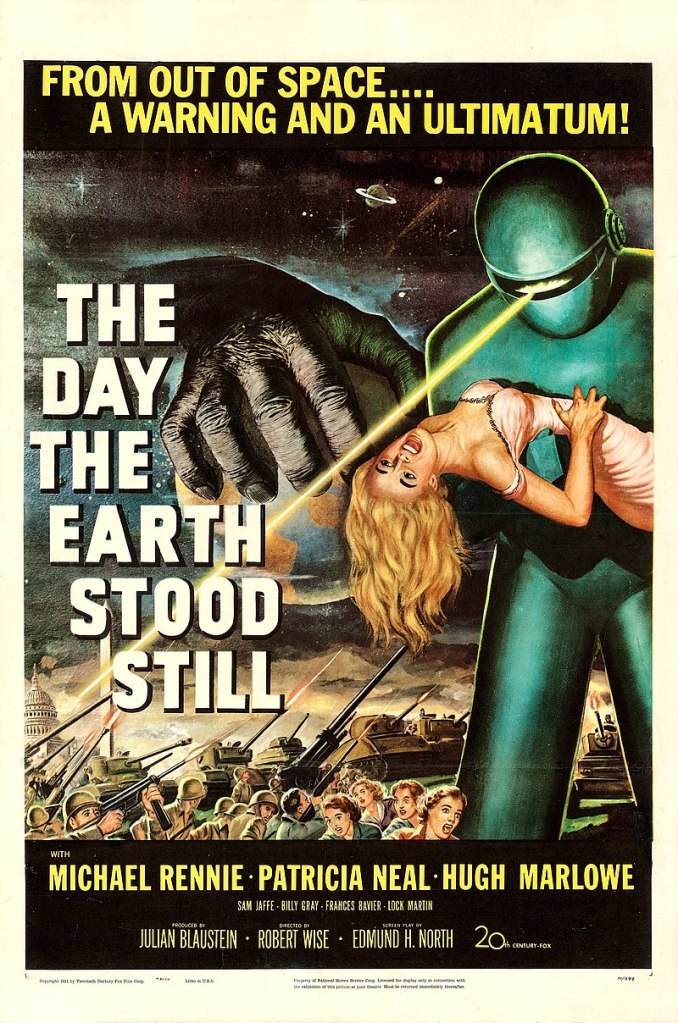
The band Klaatu were something of an enigma. They took their name from the alien in the 1951 science fiction movie The Day the Earth Stood Still, (that’s Tom Cruise in the 2008 remake). Their album sleeve has no band photo, no named credits and no indication of the identity of the band.
The Day the Earth Stood Still (1951)
This led to some intense press speculation that the band were actually the Beatles reformed under a pseudonym and numerous spurious ‘clues’ were found on the album (and various solo Beatle albums) that were supposed to confirm this. The record label, Capitol, seemed in no hurry to scotch the rumours.[iv]
However, while some songs have a distinct anglophile feel and there are some hints of 60s psychedelia, the singers are clearly no scousers. They were in fact Canadian.
As the Beatle rumours went global, Klaatu were actually in London recording with the London Symphony Orchestra. They were working on their second record Hope, a concept album about an alien civilization that destroyed itself leaving as its only survivor a cosmic lighthouse keeper forever keeping watch over his ruined world. But that’s another story.
Fellow Canadian Richard Carpenter heard Klaatu’s debut album and decided to record a cover version of ‘Calling Occupants’, utilising 125 musicians and making it their biggest (and strangest) recording. The success of the movie Star Wars made this song seem perfect for a single, and though it performed modestly in the US, it was a top ten hit in the UK in 1977. ‘Calling Occupants of Interplanetary Craft (the Recognised Anthem of World Contact Day)’ was at the time the longest title of a hit single.[v]
In the movie that gave the band Klaatu its name, The Day the Earth Stood Still, the character Klaatu (an alien peace emissary) uses the pseudonym Carpenter. I assume that this pseudonym is actually a nod to Jesus Christ the Carpenter rather than Richard or Karen Carpenter. Still, it’s a pleasing synchronicity.
The lyrics of ‘Calling Occupants’, written by two members of Klaatu, Terry Draper and John Woloschuk, were inspired by Alfred Bender’s recitation and invite us send a telepathic message – on ‘World Contact Day’ – out to aliens in their spaceships asking them to make contact with Earth and save us from destroying ourselves.
The album’s still one of my favourites and certainly the best 50p I ever spent.
Epilogue
The sixtieth anniversary of World Contact Day in 2013 led to a week of alien and UFO related activities as well as another telepathic attempt to call those occupants of interplanetary craft.[vi]
And now as we approach the seventieth anniversary, we need those interstellar policemen more than ever.
If you want to telepath along on 15 March, the 2013 version of the recitation is below.
Since November 2022, over one thousand students, mostly girls, have reportedly been victims of poison attacks in Iran. The girls in schools across several cities have suffered symptoms such as nausea, dizziness, breathing problems, weakness, fatigue and paralysis. Often the students noticed a strange smell – variously described as tangerines, rotten fish, peppermint, bleach or burning plastic – before the onset of the symptoms.
One unnamed parent described what happened to her daughter to the BBC:
My daughter and two of her friends say they heard something like an explosion and immediately afterwards an unpleasant smell – something like burned plastic filled the air. They were asked to leave the class and go into the yard. Many of the students started collapsing in the yard.[i]
The speculation being reported in western media is that the schoolgirls are being poisoned in revenge for their participation in the protests sparked by the suspicious death of Mahsa Amini while in police custody after she had been arrested for supposedly violating Islamic dress codes. The apparent attacks are also being blamed on religious fundamentalists opposed to the government allowing girls the right to an education.
A spokesman for the Iranian Teachers Trade Association tweeted that ‘the poisoning of students at girls’ schools, which have been confirmed as deliberate acts, was neither arbitrary nor accidental.’ Ned Price, US Department of State spokesman, described the events as ‘very disturbing’ and ‘an abhorrent act’.[ii] Several other Iranian human rights activists have claimed that the poisonings were deliberate.
The deputy education minister Younes Panahi stated on Sunday 26 February that the poisonings were ‘intentional’, adding it was ‘found that some people wanted all schools, especially girls’ schools, to be closed.’ To confuse matters, he later stated he had been misquoted in saying the poisonings were intentional.
There is similar confusion over the death of an 11-year-old girl Fatemah Rezai from Qom where the first such attacks took place in November 2022. Social media have claimed that she was killed in a poison attack, though state media deny this, a version of events supported by the girl’s father. Many activists are sceptical of the government denial and believe the parent has been forced to say what he said.[iii]
Mass Hysteria
However, several aspects of this narrative don’t make sense. For one thing, there is wide variety in the descriptions of the smells the supposed poisons produced, and likewise in the range of symptoms. Furthermore, if the government wanted to stop girl’s attending school they could simply close them rather than relying on random hit and miss poisonings. And investigations have found no evidence of toxins.[iv]
It seems far more likely that these events are cases of mass hysteria. Mass hysteria (or mass psychogenic illness, to give it the more politically correct name) occurs when emotional conflict or anxiety lead to the simultaneous development of physical or mental conditions in a group of people when there is no organic cause. It’s socially contagious and spreads easily between individuals.[v]
The civil unrest and draconian government response in Iran created an environment of anxiety which is often the condition in which hysterical outbreaks occur. On top of this, like much of the world, Iranian people endured the stress and psychological damage caused by covid policies and the fear of contamination – both by the virus and by the vaccine – are also part of the background to this outbreak of hysteria in young Iranian women.
The first cases of Covid in Iran in 2020 were in the city of Qom – the same city where the first gas poisonings were reported.[vi] Ironically, with many parents calling for classes to be online, Iran’s girls may soon find themselves back in a lockdown.[vii]
Typically, in these outbreaks an unusual odour is noticed, then symptoms rapidly spread from person to person and then to nearby communities. Rumours spread of poison gas.
Well-meaning activists and campaigners (‘moral entrepreneurs’ in sociology speak) often play a key role in sharing and escalating these episodes. Media repeat and exaggerate the reports further spreading the hysteria.
The Arjenyattah Epidemic
A similar event known as the Arjenyattah Epidemic (named after some of the villages involved) took place on the Israeli occupied West Bank in the spring of 1983. A teenage girl in the village of Arrabah noticed a smell of rotten eggs in class on the 23 March and soon developed symptoms including breathing problems, dizziness, headaches and blurred vision. Soon after, fifteen of her classmates developed similar symptoms. The following day, 61 students and five adults were affected.
Newspapers speculated about poisoned gas being the cause and exaggerated the symptoms (replacing blurred vision with blindness, for example), and more cases emerged in nearby villages. It was suspected that Israeli forces were responsible for the gas attack. Some press reports referred to the events as an attempted genocide.
Tests on water, soil and air found no traces of poison and as with the Iranian girls, the victims recovered quickly. Israeli and US psychologists concluded that the events were psychological in nature. The smell that started the episode was identified as coming from the school toilet with the girls in the rooms nearest the toilet most affected.[viii]
Women and girls are more likely to suffer from these epidemics of hysteria than men, which is why these outbreaks often occur in girls’ schools. There’s a long history of similar outbreaks, though none of the media reports about the Iranian ‘poisonings’ mention the possibility of mass hysteria, preferring to use the hysteria as an excuse to demonise Iran.
But these mass panics are a normal human response to stress and anxiety – they’ve always been with us and always will. We can’t prevent them because they are part of human nature.
However, when it comes to mass hysteria, it is far wiser to recognise it than to weaponize it. Because one day the person seized by the hysteria could be you.
In the summer of 2008 the skies over the Calder Valley were invaded by mysterious lights, seen by witnesses from Mytholmroyd to Todmorden. MYSTERY LIGHTS FUEL UFO SPECULATION was the headline in the Hebden Bridge Times of 21 August 2008. All the sightings were remarkably similar.
In Todmorden on 26 July, Gemma Kipping’s guests had just left her house when they phoned her to say that ‘aliens’ were hovering above her roof. These ‘aliens’ were yellow glowing balls that moved slowly and silently through the night sky. Many others contacted local newspapers to say that they had seen similar objects. According to Chris Granger, an ex-RAF technician, the lights could not have been aircraft:
They moved in a very erratic manner and did not display the flight characteristics of a conventional aircraft. Nor did they display the normal lighting array of a conventional aircraft – flashing white strobe and red and green navigation lights.[i]
The mystery seems to have been solved by two girls out walking their dogs. Amy Cheetham and Louise Neil found the spent remains of Chinese lanterns on their walk and suggested that these might have been behind the sightings.[ii] This is certainly plausible: Chinese lanterns glow orange or yellow, appear as eerie lights in the sky and change direction unpredictably as they are buffeted by air currents.
In fact, the Sun newspaper told its readers of an ‘alien invasion’ several times in June 2008, many of the descriptions and photos being very similar to the ones described in the Calder Valley. It appears that the trend for letting off Chinese lanterns at wedding receptions and birthday parties triggered a nationwide UFO flap. The significance of these lanterns should not be underestimated: UFO authority Jenny Randles, who fielded reports of UFOs for Jodrell Bank Science Centre, gave the following breakdown. In 2007, 15% of UFO sightings she investigated were likely to have been Chinese lanterns. By 2008, this had risen to 50% of sightings. By November of 2009 it was a phenomenal 90% of UFO sightings that were suspected of being caused by lanterns.[iii]
History doesn’t repeat but it rhymes, and hot air always rises…
Suddenly everyone’s talking about UFOs again. After President Biden ordered the military to shoot down a supposed Chinese spy balloon, several more unidentified flying objects were also tracked and destroyed over North America, with senior military officer General Glen VanHerck saying they were not ruling out the possibility of extra-terrestrial involvement.[i]
Of course, it’s highly unlikely that anyone in the USA’s political and military elite really believes these flying objects were piloted by aliens from another world. Indeed, in a statement that made Trump look eloquent, White House press secretary Karine Jean-Pierre reiterated that there was ‘no indication of aliens or extra-terrestrial activity ’ in the skies over the USA and ‘Canadia’.[ii]
The Chinese balloon was clearly of this earth, whether it was a surveillance craft or a weather balloon blown off course. The other objects over North America were only discovered because radar sensitivity was purposely turned up, though there was not much detail about these at the time of writing. A recent New York Times piece reported that official sources said the objects were unlikely to be surveillance devices.[iii]
But why all this talk of UFOs?
Well one possibility is that it generates headlines and serves as a distraction – it’s a way to bury bad news. And what kind of news is being buried by the UFO hysteria?
One obvious candidate is the report by Pulitzer Prize winning journalist Seymour Hersh which alleges what many long suspected – the USA was responsible for blowing up the Nord Stream 2 gas pipelines, constructed to supply Germany with Russian gas. Hersh details how, with the collusion of Norway (whose energy exports stand to gain considerably by this attack) and undercover of a NATO military exercise, divers planted mines on the pipes that were later remotely detonated.[iv] If true – and it certainly seems credible – it was an audacious attack on Germany, its energy security and the standard of living of its population. It’s arguably an act of war.
With friends like these, who needs enemies?
It’s also likely that the balloon and other flying objects will be used as justification for increased military spending and more overseas intervention.[v] We must be protected against the Russians. Or is it the Chinese now? Oh yes, it’s the aliens.
If you look at the history of UFO sightings over the last century or so, you find they tend to come in waves – often called flaps.
There were phantom airship scares in Britain in 1909, where strange zeppelin-like flying objects were seen in various parts of the country. In 1947, US pilot Kenneth Arnold described seeing some flying objects moving like a saucer skipping over water kickstarting the flying saucer era that followed. The tense period of the cold war featured several UFO flaps. Ominously, it seems many UFO flaps occur at times of great tension such as just after – or shortly before – military conflicts.
Perhaps, as psychologist Robert Bartholomew has predicted, the balloon and other objects being shot out of American skies will lead to a new UFO flap.[vi] Anxious times mean many people are hyper vigilant to threat, and fallible human perception and psychology mean that as more and more people scan the skies looking for anomalous objects, they are bound to see things they wouldn’t normally notice – whether they’re there or not.
But with our eyes on the skies, what are we missing under our noses?
In the autumn of 1989 it was feared that a maniac poisoner was at large in Dublin, coating blackberries with the deadly herbicide Paraquat. Anyone, especially children, could be in danger from this lethal toxin as they went blackberrying. The press called him the ‘Paraquat Lunatic’ or the ‘Poison Maniac’ and it led to understandable questions about the kind of world we are living in where even innocent children picking blackberries are in danger of being murdered by a malevolent psychopath.[i]
It started on the 25 November when an unnamed woman saw a man behaving mysteriously by some blackberry bushes. She told the Sunday World:
I was going to feed a couple of calves in the morning when I saw him at the bushes. When I questioned him, I knew he was up to no good and I hit him with my bucket. He dropped the spray and ran off.[ii]
The man was described as in his early twenties with long blond hair. He was wearing faded denim jeans and rode a distinctive green motorbike with yellow mudguards and no numberplates.[iii]
Don’t take chances – Don’t pick blackberries
It’s not clear if the unnamed bucket-wielding woman told the police or if someone she informed contacted them, but they soon closed a mile long stretch of Moyne Road in Balgriffin, north Dublin county. An emergency meeting was called by Dublin’s chief medical officer Dr Brendon O’Donnell to decide what must be done – to cut down all the blackberry bushes in the area or simply burn them. Samples of the berries were taken and sent for analysis.[iv]
Of course, if a ‘Paraquat Lunatic’ is on the loose, it’s reasonable to assume that he may have poisoned other blackberry bushes. This was the conclusion the Gardai came to, issuing a warning to the public: ‘Don’t take chance. Don’t pick blackberries.’[v]
A Sick Mind
The press, the police and the public all speculated as to who the Poison Maniac was, why he had done what he had done and whether he was going to strike again. One police spokesman said:
It’s reasonable to assume he’s from the area and it’s surprising no one has contacted us with any information about his identity.[vi]
This seems a fair point. A long-haired blond man on a green motorbike with yellow mudguards is pretty distinctive and you would think this would have rung some bells for someone.
Another police spokesperson speculated on the poisoner’s motives and sanity:
This has all the hallmarks of a sick mind. There appears to be no definite target. Anyone could have suffered a terrible fate. But the person responsible obviously needs help. Our main worry is that he may strike again.[vii]
The police admitted they were baffled by the crime.
In order to gain an insight into the thinking of the Mad Motorcyclist, the Sunday World asked a forensic psychiatrist to profile the mind of someone who would carry out such a heinous act. Dr Art O’Conner’s reply was honest, if unhelpful and probably not what the tabloid wanted to hear:
As there are not many cases of this kind, it is impossible to profile the mind of the person involved. Anyway, over the years the practice of profiling an offender, which was very popular in the sixties, has been found to be quite ineffective and at times misleading.[viii]
Others viewed the poisoner not as mad but as evil. In an opinion piece for the Derryman journalist and musician Mickey MacConnell lamented the state of his country:
Things have come to a pretty pass in this country when you cannot pick and eat a blackberry out of the hedge without running the risk of being poisoned by some lunatic running amok with Paraquat. I wonder if the man who poisoned the berry bushes at Moyne Road, Baldoyle, in North County Dublin is really a lunatic or just another manifestation of the face of evil that is becoming more and more visible nowadays.[ix]
A Phantom Attacker?
The Dublin Blackberry Poisoner was never caught, nor did he strike again. However, a couple of points make me suspicious about this story. Firstly, when a crime makes little sense and leaves the police baffled as this did, it’s worth considering it in a more sceptical light. After all, poisoning a blackberry bush in order to harm innocent children (who would be the most likely to eat of the fruit) just seems implausible. Secondly, the results of the analysis of the blackberry bush were never published, which is strange. Even if the results came back negative, surely that information would still be worth releasing. Thirdly, although the description of the young poisoner (jeans and long blond hair) is fairly generic, a green motorbike with yellow mudguards should be easily recognisable, yet the clue led to nothing. And finally, who was the nameless bucket wielding cow girl whose story kicked off the scare?
Although I can’t be sure, after studying many similar cases, this looks to me to have the hallmarks of a hoax, most likely by the anonymous source of the story. Perhaps that’s why the woman refused to be named, fearing that her story had got out of hand.
The Dublin Blackberry Poisoner may in fact be a Phantom Attacker. Often in times of anxiety people imagine or make up stories of malevolent attackers lurking in the shadows waiting to harm innocent people. Examples include the Halifax Slasher (my personal favourite – see my Weird Calderdale for the amazing full story), the Delhi Monkey Man, the Mad Gasser of Mattoon and the recent panic over imaginary needle and drink spiking attacks on young women in nightclubs.
A Bizarre Japanese Serial Killer
However, these Phantom Attacker panics often reflect real anxieties and the Dublin episode is no exception. There were real – and often justified – fears about the use of some chemicals in agriculture, and Paraquat was at the heart of this fear. Perhaps this is understandable as the herbicide was used in suicides and murders, as well as being the weapon of choice of a bizarre Japanese serial killer.
In 1985, an all too real maniac added Paraquat to soft drinks and left them on top of or inside Japanese vending machines. The drink, called Oronamin C, had a buy one get one free offer so many people thought the extra drinks found on the machine or in the slots were part of the promotion. Twelve people died from Paraquat poisoning and many more suffered serious effects. The killings seemed indiscriminate and motiveless. Police had no clue. The poisonings stopped as suddenly as they started and no one was ever caught.[x]
Oronamin C – Poisoned by a mystery Japanese serial killer
However, shocking events like this may have been in people’s minds as the story of the Dublin Blackberry Poisoner spread making it all the more believable.
Witches’ Spit and Devil Piss
Interestingly the Dublin Blackberry poisoning scare also reflected long lost folklore related to the fruit. It used to be widely believed in England and Ireland that blackberries should not be eaten after Michaelmas Day (30 September) – coincidentally, around the time the supposed Dublin poisoning happened. This is because the berries are contaminated by witches or goblins spitting on them after this date, so the belief goes, though why they would do this or how they managed to spit on every blackberry in the British Isles in one day is anyone’s guess. As far as the Devil goes, there’s a clearer motive. Saint Michaelmas Day celebrates Saint Michael who did battle with Lucifer and cast him from heaven, where legend has it he landed in a blackberry bush. Ever since that day, Old Nick curses, spits or pisses on your blackberries after the end of September…[xi]
I’d give them a rinse if I were you…
Epilogue
Paraquat was banned for use in the UK in 2007 due to its danger and a possible link with Parkinson’s Disease. Controversially that hasn’t stopped British companies making the product for export to other countries…[xii]
[ii] Pauline Cronin, ‘Poison Maniac still at large’, Sunday World, 22 October 1989, p.6
[iii] ‘Hunt for Poison Man’, Evening Herald, 26 September 1989, p.6; Pauline Cronin, ‘Poison Maniac still at large’, Sunday World, 22 October 1989, p.6
I recently came across an odd vinyl album on Hebden Bridge flea market called Music for Plants by the Baroque Bouquet (pictured above). The record’s back sleeve claims that playing it to your plants will keep your plants happy and healthy. What kind of music do plants like? Well, that was worth coughing up my pound and buying the LP.
Plants’ musical tastes are helpfully clarified by the album’s sleeve notes. Apparently, a number of experimental chambers were created in which plants were played different kinds of music with all other conditions being kept equal, and the results were clear.
Plants love Bach and classical Indian sitar music and grow better when exposed to it. On the other hand, plants can’t stand acid rock or percussive music.
If everything you grow tends to wither and die, it’s probably all that loud acid rock you’re playing. Instead try Bach, Ravi Shankar or this album of light baroque music with some gurgling synth flourishes. ‘We know,’ the sleeve notes tell us, ‘our music will stimulate a favourable response within your growing plants.’
Roots Music
Anyway, the record inspired me to survey the academic literature to see if there was any more recent research on the effects of music on plants, and there’s rather a lot. Most of the studies detailed experiments similar to the one described on the album’s back sleeve. Researchers played different genres of music to plants over a certain period of time then compared these plants’ growth rates, number of shoots, size of flowers and various other metrics with a control sample of the same plants grown in silence.
I’ve had a look at seventeen of those studies so you don’t have to. The plants and flowers used in the studies included peppers, lettuce, wheat, marigolds, orchids, broccoli, spinach, roses and several others.[i]
The types of music used in the experiments varied, but plants showed positive results when exposed to Indian sitar music, western classical music, Indonesian gamelan and sung verses from the Koran. These results are similar in a number of studies.
Oddly, the studies that found that plants grow best when exposed to Indian (and western classical) music were all conducted in India. The studies showing that plants grow best when exposed to Indonesian gamelan music were conducted in…. you guessed it. And studies showing plants responded best to recordings of recitals from the Koran were conducted in Islamic countries. In fact, much of the research in this area seems to be from India and Indonesia.
Rhythm and Greens
But when it comes to music that has a negative effect on plants, six of the research papers came to the same conclusion – plants hate rock music. In two papers, Led Zeppelin and AC/DC were named and shamed for their deleterious effect.
The paper about AC/DC deserves special attention, though, as it hints at a possible explanation for why plants don’t rock n’ roll. The study by Barton et al was brilliantly titled ‘Testing the AC/DC hypothesis: Rock and roll is noise pollution and weakens a trophic cascade’ and was published in 2018 in the journal Ecology and Evolution. The authors tested AC/DC’s ‘hypothesis’ that ‘Rock n’ Roll Ain’t Noise Pollution’ by exposing an ecosystem consisting of soybean plants, the aphids that fed on the plants and the beetles that fed on the aphids to various sources of urban noise pollution including AC/DC’s hit song of the same name.[ii]
The results showed that when exposed to rock music the beetles became less effective predators, meaning the aphid population grew and the plant suffered resulting in reduced biomass. The authors don’t know why AC/DC’s music had such an effect, but they consider the hypothesis ‘Rock n’ Roll Ain’t Noise Pollution’ to have been refuted. Rock ‘n’ roll, it seems, is noise pollution.
So what explains plants’ apparent dislike for rock? Perhaps the vibrations of the beat, the throbbing bass or the high pitched screams of the lead guitar impact the plants in some way. Perhaps it’s all of the above scaring away the predators that eat the pests that eat the plants.
And what about plants’ penchant for the music of the country where the experiments were conducted? Is this down to methodological flaws and experimenter bias, or are plants just rather conservative in their taste?
Who knows. As for my LP of plant music, I’m hoping it grows on me.
[i] Sorry, there’s no way I’m going to reference all seventeen of those studies. Stick ‘music for plants’ or something into Google Scholar and you’ll find them if you’re that desperate!
[ii] Brandon T. Barton ‘Testing the AC/DC hypothesis: Rock and roll is noise pollution and weakens a trophic cascade’, Ecology and Evolution, 8(15) pp.7649-7656. https://doi.org/10.1002/ece3.4273















 Paul Weatherhead