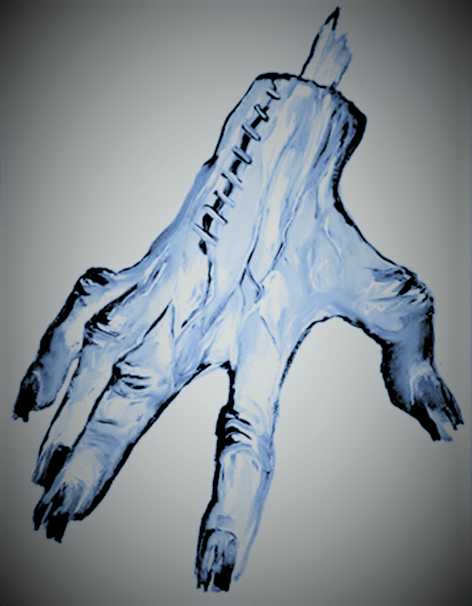
A grave danger faced the terrified pupils of Central Street Infants School in Hebden Bridge in the early 1970s: The Blue Hand.
This ghostly hand scuttled around the school’s corridors and was apt to pounce on unsuspecting children, especially if they were alone in the toilet. The spectral hand would gouge out the little one’s eyes, before strangling the unfortunate mite and then dragging the infant to hell through the toilet.
And the proof was there in plain sight – on the high ceiling of the cloakroom was what appeared to be a smudged handprint. There was no way an adult, let alone a child could reach the ceiling to put a handprint there. It had to be the Blue Hand. This is the story that my classmate, a girl who I will call Karen, told anyone who would listen. The fear this ghost spread lead to many a wet classroom seat as a visit to the toilet on your own was to take your young life into your hands.
When pressed on where the hand came from, Karen claimed that many years ago a crazed murderer had escaped from jail, broken into the school and hanged himself in the boys’ toilets. His body was later dug up by a witch who had a spell which would turn a murderer’s severed hand into a familiar to do her bidding. She cut the withered and now blue hand from the corpse and the spell worked. The hand could now scuttle around at her will, stealing, strangling and all kinds of other mischief. Unfortunately, the spell wore off and the hand turned on its mistress, gouging out her eyes before choking her. And then the hand scurried off back to Central Street school…
Of course, the teachers said the whole thing was nonsense and that the ‘handprint’ on the ceiling was actually a couple of muddy stains from a dirty ball being bounced in there. Karen got into big trouble when the teachers found out where the stories of the Blue Hand were coming from. What her punishment was I can’t remember, but she was made to promise never to mention the Blue Hand again. And she didn’t.
Though she did inform anyone who cared to listen that if you put two pencils tip to tip on the floor and lie on top of them on your stomach, the Devil would appear…
In recent decades there have been some fine zombie films, but these mainstream offerings tend to suffer from one fatal flaw: respectability. The zombie films from the golden age (which I’ve taken as being from the late 60s to the early 90s) are different. They are gloriously disreputable, so much so that many were banned in Britain or were only available in editions butchered by the censors.
There are no athletic sprinting zombies in the choices below. Real zombies are slow and lumbering and with a brisk walking pace you could stay one step ahead of them. But they are relentless, and it’s this slow relentlessness that makes these cheapo horror monsters scary, as far as I’m concerned. The dead don’t run.
And my zombies and the mayhem they cause are all real. Or at least were created with practical effects, make up, stunt men and animatronics. No wafer thin CGI effects here.
But first, the zombie elephant in the room: why no Dawn of the Dead? Although widely considered the best zombie movie ever made, Romero’s 1978 classic – awesome though it is – didn’t make it to my top five for two reasons. Firstly, it’s too long and I’m sick of overlong films. Secondly, the zombies are a weird shade of blue that just doesn’t look right to me.
So let’s get to the meat…
Night of the Living Dead(1968)
There had been other zombie flicks before this one, but director George Romero’s moody black and white masterpiece paved the way for all that followed and created the modern cannibal zombie we know and love today. Before Romero, movie zombies were usually reanimated by supernatural means – voodoo – and shuffled around as undead slaves. Even Hammer’s zombie entry, 1966’s The Plague of the Zombies, has the walking dead working in a Cornish tin mine. Romero brought grainy black and white gore and explicit gut-munching to the zombie genre.
One of the most notorious scenes is when the zombies disembowel and devour a young couple killed in a car crash. The crew referred to this scene as ‘the last supper’, and for extra realism, Romero shipped in real animal entrails and pig hearts for the extras in zombie make up to get their teeth into.[i]
Many of the genre conventions for zombies began here: boarding up the doors and windows as the zombies try and get in, destroying the brain as the only way to stop the undead, political undertones, dark unsettling twist ending and of course graphic zombie cannibalism.
Cause of zombie outbreak: Not really clear, though some of the TV news broadcasts shown in the movie refer to a space probe that had returned from Venus.
Classic Line: They’re coming to get you, Barbara!
The Living Dead at the Manchester Morgue (1974)
Despite the title, the living dead in this underrated Spanish and Italian co-production directed by Jorge Grau spend most of their time devouring the good people of the Lake District. It follows in George Romero’s footsteps with bleak social commentary, but now the gore is in full colour and was plentiful enough to earn it a place on Britain’s notorious list of ‘video nasties’.
The story concerns an antiques dealer who heads to the Lake District for a break from the polluted, congested and streaker infested Manchester of the 1970s, only to find himself in the middle of the zombie apocalypse. Incidentally, some of the shots of an unattractive looking Manchester were actually filmed in Sheffield.[ii] There’s a memorable disembowelment of a policeman and plenty more ghastly downbeat delights to recommend this lost classic.
Cause of zombie outbreak: A pest control machine that blasts insects with ultrasonic waves making them attack each other… What could possibly go wrong?
Classic Line: I wish the dead could come back to life, you bastard, because then I could kill you again.
Zombie Flesh Eaters (1979)
This is confusingly known as Zombi 2 in many territories as it purported to be a sequel to Romero’s Dawn of the Dead (which was released under the title Zombi in some countries, and was, of course a sequel to Romero’s own Night of the Living Dead….). Just as the Italians churned out spaghetti westerns in the 60s, 70s and 80s, they also had a reputation for extreme zombie flicks, and what’s worse, the zombie movie’s even more disreputable cousin, the cannibal movie. However, Lucio Fulci’s gore drenched zombie masterpiece is the best of the bunch when it comes to spaghetti splatter.
Most of the film takes place on a Caribbean island where a scientist is investigating why the dead are coming back to life. The scientist’s daughter and a journalist head to the island to investigate.
In one jaw dropping scene a topless lady is having a swim in the ocean only to be attacked by a shark, which is in turn attacked by a zombie. No CGI here, it’s a real shark and a real nutter in zombie make up wrestling with the maneater – which was apparently stuffed with horse meat and tranquilisers for the scene.[iii]
Zombie versus shark!
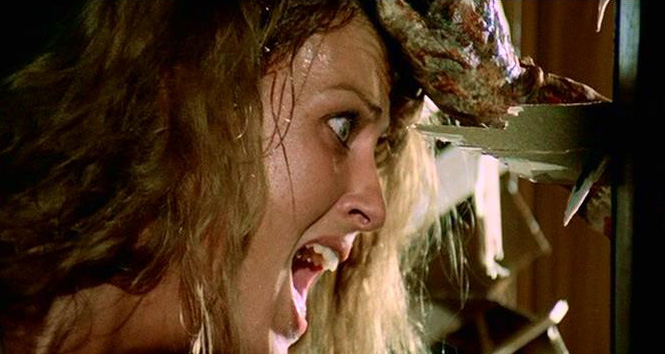
Perhaps Zombie Flesh Eater’s most notorious moment is the eye pop, something that was a bit of a feature in many of Fulci’s horror films. In this movie, a zombie drags the unfortunate victim by the hair closer and closer to a large jagged wooden splinter until it pierces her eyeball in a scene that was censored in the UK for many years. Scenes like this, and several others, earned Zombie Flesh Eaters its coveted place on Britain’s list of banned video nasties.
This is gonna hurt…
Zombie Flesh Eaters ditches the social commentary, and in true exploitative style, goes straight for the jugular.
Cause of zombie outbreak: Voodoo
Classic Line: Radio announcer: I’ve just been informed that zombies have entered the building…. They’re at the door…. They’re coming in….Aaaaarrrrggggggghhhhhhh!
Day of the Dead (1985)
George Romero, being the godfather of zombie cinema, is allowed two entries in my top five. Day of the Dead is the third in the series of ‘Dead’ films and is set in a world totally over run by zombies in which the remnants of humanity – mostly trigger happy military types and scientists studying the zombie – are confined to a claustrophobic underground bunker. In this world, the living (represented by a mad scientist and psychopathic soldiers) are more dangerous than the dead, which are humanised especially in the form of Bub, a zombie that shows signs of memory and intelligence – a first in zombie cinema.
Gore supremo Tom Savini provides the ultra-nasty special effects which are the real star of the show and beat the hell out of sterile modern CGI gore.
Cause of zombie outbreak: Presumably the same as the Night of the Living Dead, though there are some vague murmurings about God’s vengeance.
Classic Line: As zombies pull out his intestines: Choke on ‘em!
Choke on ’em!
Brain Dead (1992)
Director Peter Jackson went on to direct the Lord of the Rings movies and the Beatles Get Back series, but this unhinged but lovingly crafted Kiwi zombie film is his greatest contribution to western civilisation.
We’re gonna need a bigger mop!
Set in the conservative New Zealand of the 1950s, the film is an outrageously gory comedy that goes way beyond anything in the relatively staid and respectable world of Shaun of the Dead. The hero’s mum is bitten by a rat monkey carrying a zombie virus, and the mayhem – set against a romantic love story – begins as the hero attempts to hide his zombified mum in the cellar, along with a motley gang of other walking dead that she has infected.
Zombie sex, a zombie baby and other experiments in extreme tastelessness follow, and the final party scene bloodbath is surely the ultimate in stylish zombie carnage. One thing I learned from this film is that if you’re caught up in the zombie apocalypse and there is no chainsaw to hand, the ultimate weapon of choice for dispatching the undead is the lawnmower.
Cause of zombie outbreak: A bite from an animatronic Sumatran rat monkey.
Classic Line: Your mother ate my dog!
So there we have it – my top 5 cannibal zombie movies from the golden age of gut-munching. I could have chosen more – Reanimator, Return of the Living Dead 3 and The Beyond were bubbling under and almost made my top 5 and all have their gory charms.
But zombie flicks in recent decades have become mainstream, almost respectable. But vanilla is not a satisfying flavour for a lumbering gut muncher, so dig up these classics for some video nasty Halloween viewing…
[i] Jamie Russell, Book of the Dead, (Godalming: FAB, 2005) p.68
[ii] Jay Slater (ed), Eaten Alive: Italian Cannibal and Zombie Movies, (London: Plexus, 2002) p.58
According to Harvard biologist George Wald, civilisation will end in 15-30 years without immediate action. Ecologist Paul Ehrlich says up to 200 million will starve to death in the next ten years due to population increases, which will also cause the deaths of 65 million Americans. Furthermore, oil will be all gone in the next 30 years, if we are to believe ecologist Kenneth Watt. All sounds pretty plausible right?
Except these predictions were made in 1970.
And you don’t have to look far to find other experts who should know better being spectacularly wrong.
Lord Kelvin said in 1883 that x-rays would prove to be a hoax.
In 1903 president of Michigan Savings Bank Horace Rackham wisely intoned that the car is just a fad but the horse is here to stay.
Nuclear energy will never be obtainable, said Einstein in 1932.
In 2007, Microsoft CEO Steve Ballmer claimed the iPhone had no chance of success.
It’s easy to find lots more examples like these. And perhaps I’m just cherry-picking failed predictions to support my point. Well, yes… But.
There is a remarkable experiment conducted by psychologist Phillip Tetlock that tested expert ability at forecasting future events, and the results are depressing – though not without a glimmer of hope.
Tetlock gathered 280 experts from all kinds of academic, political, business and intelligence fields and had them make predictions – 28,000 forecasts on a wide range of subjects. And then he waited to see how many of these predictions came true. He waited for thirty years.
The results were shocking. The average expert performed worse than chance and was, according to Tetlock, worse at predicting the future than a chimp throwing darts at a board. There was no correlation between accuracy of the expert’s forecasts and their political opinions, gender, access to classified intelligence or level of education. There was no doubt – the average expert’s forecasts are simply rubbish. This leads to the question as to why so-called experts get things so spectacularly wrong.
An expert ponders his prediction
Why are those experts full of shit?
For one thing, predicting changes in society, climate and the economy is hard because they’re complex systems. There are impossibly many variables to take into account, and the world is so complicated, chaotic and interrelated that small changes ripple out in unpredictable ways.
Computer models don’t help. They reflect the biases of the programmers and whoever’s funding the research and, like statistics, can be tweaked and adjusted until they cough up the desired result. Computer models are the modern equivalent of the Romans predicting the course of a battle by slaughtering an animal and examining its entrails. Haruspication is what that’s called, and the soothsayers who performed these grisly forecasts were the sage experts of their day. They were THE SCIENCE.
Haruspication – computer modelling in the ancient world
Add to that the fact that humans are subject to psychological biases like confirmation bias (we seek out evidence that backs up what we already believe and discount evidence that doesn’t) and groupthink (there’s enormous social pressure not to rock the boat and to keep your dirty dissident doubts to yourself). Experts are just as susceptible to these kinks in our thinking as the rest of us.
And of course, we like certainty and dislike nuance and ambiguity. To take a controversial example, any discussion of the war in Ukraine is restricted to black and white simplistic analysis – it’s all the fault of everyone’s favourite pantomime villain Big Bad Vlad. It’s Putler’s war and no further discussion of NATO or the Ukrainian government’s roles in contributing to or provoking the conflict is needed. Sanctions plus weapons, that will solve the problem. And if it doesn’t, well it just means we need more sanctions and weapons. If it still doesn’t work, repeat until it does. Journalists who discuss the complexities of this terrible war are likely to find themselves demonetised.[i] Stick to the script and keep it simple. Nuance is confusing and distracts from THE MESSAGING.
Or to take another controversial example, the covid vaccination. Vaccine is a good thing, therefore every vaccine must be a good thing, so anyone who questions the need or the wisdom for the current campaign to inject everyone with leaky vaccines for an illness that is mild for most people is an anti-vaxxer, and that makes them anti-science, a bad person… Nothing to see here, no need to investigate. The experts are certain it’s all fine. Nuance and skepticism are confusing and distract from THE MESSAGING.
The Fox and the Hedgehog
However, there is some room for optimism in the results of Tetlock’s study of expert predictions. Although the average expert was very poor at making predictions, the complete picture had a little more nuance. One cohort of experts seemed to have a modest insight and did slightly better than chance. The other group, though, were even worse than chance would predict – those are the proverbial monkeys throwing darts. Tetlock characterised these two groups as foxes and hedgehogs, based on a fragment of an ancient Greek poem. The poem said that the hedgehog only knows one thing, but it’s a very big thing. The fox, however, only knows little things but he knows many of them. In other words, people’s style of thinking has a profound effect on their accuracy when it comes to assessing the present and forecasting the future. Hedgehogs are hopeless at predicting the future, whereas foxes are much better (though still far from perfect). This is down to their differing thinking styles.
Samuel Howitt Fox and the Hedgehog Yale Center for British Art (looks like a porcupine to me!)
The hedgehog knows one big thing. Therefore, he applies this one idea to all situations and it may prevent him from seeing contradictory evidence. The hedgehog prefers simplicity and clarity. They like black and white answers and are uncomfortable with uncertain, probabilistic answers. Because they have one big idea that they are convinced is correct, they tend to be certain in their opinions as well as being reluctant to change their minds. Big Bad Vlad. Safe and effective. Trust the science.
Foxes, on the other hand, know many little things. In other words, they have different analytical tools that they can apply to different situations. They are comfortable with complexity and accept uncertainty as unavoidable. They tend to be humble and self-critical and have an ability to question their own opinions, which makes them readier to change their minds if they have to.
Tetlock’s research demonstrates that experts who think like hedgehogs are more likely to be wrong and yet feel more certain that they are right. Experts who think like foxes are less certain that they are right, but they are more likely to actually be right. However, the experts who are more likely to be famous are hedgehogs. This is because they offer certainty and simplicity – just what we like.
The paradox is a recipe for disaster. The experts who are most certain they are right are most likely to be wrong. And these experts are also the ones who are more famous and whose opinions we hear the most.[ii]
So the next time you see famous media pundits predicting this and that dire consequence and offering simplistic analyses of complex and multi-layered problems, it’s worth remembering this important insight.
They’re full of shit.
Winston Churchill’s mischievous definition of expertise sums it up best:
“It’s the ability to foretell what will happen tomorrow, next month and next year – and to explain afterwards why it did not happen.”
Among top musicians, claimed one newspaper in 1932, the mandolin is much maligned and seen as ‘a tinkling toy, fit only for people whose musical ambition, like their musical ability, is severely limited’.[i]
Not true, of course. I’ve unearthed a couple of French stories that show that the mandolin has played a role in heinous crimes – and I’m not just talking about crimes against music…
A Mysterious Adventure at Bordeaux
In August 1899, the French city of Bordeaux was alight with fevered speculation about a bizarre crime. Late one Monday evening a young man was walking down the street when from out of a dark alley he was leapt upon by an ‘ill-favoured’ assailant. The attacker stabbed his victim in the back and then disappeared into the night, while the man screamed and dropped to the floor. Some passers-by had seen the attack and were dashing to help the injured man, when from nowhere a landau drew up, two men leapt out and scooped up the young man and threw him into their carriage. They galloped off at a furious speed, but instead of a whip, the driver lashed his horses with a mandolin.[ii]
This strange story appeared in many newspapers, though none give details and it seems to be more rumour than verified crime, but it does have the makings of a thrilling cloak and dagger mystery. From what I can find, the good people of Bordeaux never found a solution, and the young man, his attacker or his mandolin wielding kidnappers were never heard of again.
However, the seemingly random appearance of a mandolin made me wonder if the following remarkable character may have been at the bottom of it all…
The Musical Cobbler ~ France’s Most Wanted
Armand Mousset was one of the most notorious criminals in late nineteenth and early twentieth century France. He was mysterious, elusive, a master of disguise, forger, escapologist and was nearly always one step ahead of the police. The papers called him the musical cobbler, and it was his instrument – the mandolin – which played a part in his eventual downfall.
Police had very little information on Mousset as he robbed and burgled his way across France. All they knew was that in the days before a series of robberies occurred in a town, a mysterious mandolin player would be seen about the place. After the crimes had been committed, he would not be seen again. Soon after, the sudden appearance of a mandolin wielding stranger in another town, perhaps a hundred miles away, would presage another series of crimes. The stranger had the uncanny ability to vanish without trace whenever authorities were getting close.
Mousset was responsible for hundreds of robberies and burglaries across Europe and South America and operated under dozens of names supported by expertly forged passports and birth certificates. The only other thing the police knew about him was that he was a shoemaker – hence his nickname of the musical cobbler.
In 1891, Mousset’s luck ran out and he was caught and sentenced to hard labour on France’s notorious penal colony Devil’s Island, off the coast of French Guiana, South America. Conditions there were grim, and the death rate was 75%. Mousset, however, managed a daring escape and returned to France. Unfortunately, we’re not told how he did this.
Devil’s Island Penal Colony
In 1909 he was recaptured and found himself back on Devil’s Island. After a few years, he again managed to escape. Some sources say he did this by disguising himself and marching out with some soldiers. Other sources have him steal a canoe with five comrades and make the difficult and dangerous journey to Brazil. Four of the escapees died en route, but Mousset again made it back to Paris.
Mousset had his nemesis – Detective Inspector Oudin of the Paris Detective Force who had spent ten years tracking the criminal after his escape from Devil’s Island. Oudin had almost caught him in a house raid in 1926, but arrived just too late finding only some cobbler’s tools and a mandolin.
However, Oudin’s net tightened. In the last days of December 1928, Oudin followed Mousset as he desperately tried to evade capture in an exciting Paris cat and mouse chase. Mousset used all the tricks of his art and frequently changed disguise or doubled back on himself. Finally, Oudin traced him to a squalid hotel room where he was caught with a trunk full of wigs, disguises and forged identity papers.
It was a fair cop, and Mousset gamely congratulated Oudin on his success in finally capturing him after a ten-year chase. On being arrested Mousset defiantly announced that they had better not send him back to Devil’s Island ‘or I should teach all my mates how to escape’.
Indeed, now in his mid-sixties, Mousset’s age meant it likely he would be sent to a French prison rather than back to the penal colony he’d twice escaped from.
I don’t know if there’s a moral to this story, unless it’s that the mandolin is probably not the best instrument for a career criminal.[iii]
In 1549, a huge pageant was held in Brussels in honour of the entry of King Phillip II of Spain into the city. The musical highlight of this spectacle was a moving float upon which a live bear played tunes on an organ. But it wasn’t just any organ. It was a cat organ, sometimes referred to by its German name the Katzenklavier.
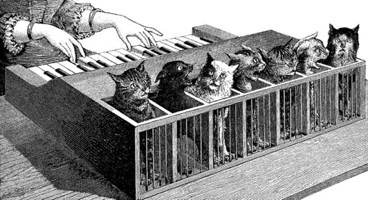
The instrument the bear was playing consisted of twenty cats confined in narrow spaces so they could not move and with their tails sticking out. Their tails were attached to the organ keyboard by cords and the poor animals were arranged in order of the pitch of their meows. Every time the bear pressed a key, it pulled a cat’s tail, leading it to meow the desired note. Also on the float were live dancing monkeys and mechanical dancing wolves and deer.
But the cat organ was the star of the show. Even Philip II, not renowned for his sunny disposition, could not resist a smile at the spectacle.
The Katzenklavier
The cat organ makes a few appearances in historical records. The strange story below is taken from the Halifax Comet of 16 September 1893.
In Germany towards the end of the nineteenth century, mystery surrounded a run down garret on the east side of town. Strange and fearful noises were heard emanating from the building and many thought it was haunted by a dismal ghost. One day the caretaker was nearly scared to death when a dozen screaming hissing fiends shot past him in the dark. As the creatures escaped the building into the light, the caretaker realised they were black cats.
An intrepid reporter (whose name we are not given) decided to investigate the mystery, so he waited until dark and then climbed the stairs to the garret and waited. It wasn’t long before he heard a low mournful wailing sound that soon rose to such uncanny intensity that his hair stood on end.
He realised that the infernal howling was actually playing something that resembled a tune he knew: ‘Home Sweet Home’. Then the caterwauling seemed to play some Wagner and other ‘symphonies of a wild and weird nature’.
A light was coming from the keyhole, so the reporter knew there was someone home. He knocked on the door and eventually it was answered by a cruel looking old German man with an ashen face and long grey hair. He was wearing clothes that belonged in the previous century.
The old man suspiciously agreed to let the reporter in to see his ‘machine’ – the cat organ. The instrument resembled a church organ, but had several wooden stalls within each of which was a cat. In the bottom of each stall was a sharp pin attached to a keyboard, and as the inventor took his seat and ran his hands over the keys, strains of a Beethoven melody could be heard in the cats’ unsettling howling.
Badenis_Katzenmusik_(Gustav Brandt)
The inventor paused his playing and produced a jug of beer and some cheese for himself and some milk for the cats. He poured the milk into a trough that ran between the stalls so each cat could drink. Once he had succeeded in getting cats into the organ, the inventor said, he did not let them out again. The last time he had, they immediately turned on him in a ferocious assault nearly ripping him to pieces before fleeing to freedom (and terrifying the caretaker in the process).
As might be imagined, the inventor complained that it took a long time to arrange the cats in a scale according to the pitch of their meow.
A Cure for Madness
The article in the Halifax Comet seems pretty far-fetched, and it’s certainly thin when it comes to names and sources. But I think I may have identified the origins of this tall tale and who the mad scientist and inventor of the cat organ was based on.
Johann Christian Reil (1759-1813) was an influential German anatomist and psychiatrist. In fact, he invented the word ‘psychiatry’ (in German) and founded several scientific journals. In 1803 he published his oddly titled book Rhapsodies about applying the psychological method of treatment to mental breakdowns, an early classic of German psychiatry.
And this is where the cat organ comes in. He recommends it as a cure for madness. In particular, as a treatment for someone who is lacking in attention or in a constant reverie. This is how he described the instrument:
[The cats are] arranged in a row with their tails stretched behind them. And a keyboard fitted out with sharpened nails would be set over them. The struck cats would provide the sound. A fugue played on this instrument-when the ill person is so placed that he cannot miss the expressions on their faces and the play of these animals-must bring Lot’s wife herself from her fixed state into conscious awareness.[i]
It’s not entirely clear if Reil was joking or being ironic. One of his other treatments was to dunk the unsuspecting madman into a tub of live eels![ii]
However, it seems likely to me that the odd story recounted in the Halifax Comet is based on, or is a dim recollection of, this odd German psychiatrist.
The whole idea of a cat organ seems rather implausible, and historians are not at all sure one was ever constructed or if the whole conceit was just a joke.[iii] You can imagine how hard it would be to secure enough cats into wooden boxes arranged into a musical scale if you’ve ever tried to get a cat into its carry case for a visit to the vet.
[i] Robert J. Richards ‘Rhapsodies on a Cat-Piano, or Johann Christian Reil and the Foundations of Romantic Psychiatry’, Critical Enquiry, Spring 1998, pp.700-701
I’ve been researching and collecting historical cases of ghost hoaxes, and so I was pleased to find this great example from my mum’s home town of Clonmel, Tipperary. The ghost doesn’t have a name, so I’ve taken the liberty of calling her Sweary Mary for reasons that will become obvious.
Unspeakably foul language
The story starts in the spring of 1906 in two adjoining houses above shops in O’Connell street, Clonmel. Tenants in both houses started hearing strange rappings around the midnight hour, as well as ‘unspeakably foul language’ in a female voice. We’re never told what exactly the ghost said, so you will have to imagine the kind of profanities you’d hear from a lady Irish ghost in 1906.
As well as the filthy language heard seemingly from nowhere, furniture was tipped over, made beds were messed up and water thrown on them. Soap was placed in the kettle and salt was put in the teapot. The heathen ghost would also defile statues of the saints and pious images and drop mysterious anonymous letters through the letter boxes of the two houses.[i] Not only that, locked doors were mysteriously unlocked and the meat safe was somehow opened and all the meat scoffed leaving only the bones. There was certainly something ‘carnal’ about this ghost.
As the antics and foul language continued, the residents made a number of attempts to catch the potty mouthed spook. One tenant watched the front door for three hours to catch whoever was putting the letters through the letter box but saw nothing. As soon as he gave up, a letter plopped onto the door mat saying ‘There is no use in your watching, you won’t catch me.’[ii]
The tenants suspected that a prankster might have been accessing the house through the chimney, so set a trap. The ghost, always one step ahead, failed to fall into it.[iii]
By Tuesday 29 May, news of the sweary ghost had spread throughout Clonmel and hundreds of people gathered outside the two houses. A large number of police had to be deployed until late at night to move the crowds on, and by this stage the authorities were taking the situation seriously.[iv]
District Inspector Tweedy and Head Constable Brady were in charge of the investigation. It seems that unbeknownst to each other, Tweedy and Brady both visited the houses at about the same time but were each on the opposite side of the adjoining wall. They both heard strange noises and salty language, though each thought it was coming from the opposite side of the wall.[v]
As soon as the police officers left, a letter came through one of the letterboxes giving details of the conversations the officers had had and asking sarcastically why they had not been offered a cup of tea (or a ‘wee drop of potcheen’ in some accounts).
The report of the sweary Clonmel ghost was widely reported in Ireland and in Britain as well. Most accounts were tongue in cheek and seemed to enjoy the profane nature of the ghost. It was the bad language that made this ‘haunting’ unique. The English paper the Globe after first boasting that ‘a more self-respecting, high-minded class than our British ghost does not exist’ goes on to speculate that the rest of the ghosts in Clonmel are probably giving the foul-mouthed ghost the cold shoulder. Perhaps Sweary Mary could learn from the ghost of Hamlet’s father who was, the Globe continues, ‘the model of deportment to young spooks’.[vi]
In early June the police announced the mystery had been solved, though unfortunately did not provide any more details.[vii] However, one of the houses concerned received the following note through their letterbox:
‘I am sorry for all the trouble I have caused you, I beg your pardon, and I promise I’ll never do it again. Yours truly, the Ghost.[viii]
The ghost of Sweary Mary had finally learned some manners. It’s not clear who the culprit was, though one would suspect that it was one or more of the residents of the two houses, and often in poltergeist type hoaxes like this a teenage girl is involved. From the many historical accounts of ghost hoaxes I’ve collected, female ghost hoaxers tend to (but not always) fake poltergeist like phenomena, while male ghost hoaxers tend to don a white sheet or a scary costume and jump out on unwitting passers-by.
More noisy spooks
Similar events to those in Clonmel had occurred the previous year in Portmadoc, Wales. For six weeks a butcher’s shop was plagued by ghostly activity. Things were thrown about and a great amount of damage was caused such that the police also got involved, yet no one could catch the culprit behind the spooky phenomena.
Finally, one night a tin can clattered into the yard as if from nowhere, and when it was inspected, it was found to contain a message saying the ghost would trouble the occupant no more. The police examined the handwriting and found that it belonged to a servant girl, Mary Hughes who confessed to being the ‘ghost’ and throwing the can through a skylight window.[ix] The girl was fined for malicious damage.
Of course, these cases may also remind us of the Fox sisters from nineteenth century New York who fooled people into thinking the cracking of their toes were spirits communicating from beyond the grave, eventually leading to the creation of the Spiritualist religion. Ghost hoaxes have a long and rich history.
Epilogue
Sweary spooks like the Clonmel Ghost have been back in the news, though. Several newspapers and ITVs This Morning show ran pieces on the white lady of the Quantock Hills in Somerset that according to a ‘ghost hunter’ is telling visitors to F*** off![x]
People of a certain age may remember Prince the talking dog who appeared on the BBC show That’s Life in 1979 demonstrating his vocabulary. Prince would growl while his owner manipulated the dog’s jaw to produce just about discernible words, including what would become his catchphrase – ‘sausages!’
However, Prince’s feats pale when compared to those of some gifted felines.
How Many Lives Does a German Cat Have?
In 1912, Peter the talking cat made the headlines when he was exhibited in Hamburg. He apparently caused a sensation among the public and scientists alike by his ability to say ‘Hurrah! Hurrah! Hurrah!’ as well as the names Anna and Helene.[i]
Peter was also able, we are told, to sing a few words from a popular song, though we are not informed what that was.
Peter’s owner, a dentist called Frau Sutoris, said that she became aware of Peter’s talents when she accidentally stood on his tail and he yelled ‘Nein!’
Another German speaking cat made an appearance at the Vienna Exhibition of Cats in 1932.[ii] This six year old tom cat named Murri could pronounce ‘ja’, ‘nein’, and the name Anna as well as sing two nursery rhymes to a piano accompaniment.
German is not the only language gifted cats can speak. Surgeon Vincente Quintana was one of over twenty witnesses to a talking cat in Santander, Spain in 1946.[iii] When the cat’s owner died, the surgeon and others present said the cat lamented her passing mournfully for ten minutes, repeatedly crying ‘Let me alone and shut up!’
The surgeon thought the cat was probably imitating something it had heard an old family servant say, though if most cats learned to speak I’ve no doubt this phrase would be heard pretty often.
Peter Pan Becomes Wendy
However, the prize for the best vocabulary of a supposed talking cat goes to a British moggy called Peter Pan who lived with his owners Major and Mrs Webber in the Wellington Hotel, Seaford, Sussex.
The story begins when two BBC employees, Stephen Grenfell and Bernard Lyons (appropriately enough) were sent to report on collapsed sea defences on the Hampshire coast in 1946.[iv] The two commentators were on the beach when they realised they had been cut off by the rising tide and had no option but to dive into the waves, whipped up by a 60mph wind, and swim for the shore, where two local journalists pulled them to safety.
The freezing and soaking BBC men were taken to the Wellington Hotel where they met the Webbers and Peter Pan their cat. Mrs Webber told the cat to ‘tell the gentlemen we are in great danger from the sea’ to which the cat replied (in an ‘unclear but rhythmical’ voice) ‘Wot! No sea wall, chum?’ I can’t help suspecting that what the cat actually said was something along the lines of ‘Meow meow meow meow meow’ with enough minor variations in the vocalisation to allow the humans to imagine they heard an English sentence.
However, Peter Pan gained a reputation as Britain’s only talking cat, and his cockney pronouncement about sea defences became his catch phrase, though it lacks the pith of Prince’s calling card ‘sausages’, it at least demonstrates a wider vocabulary.
Sadly, Britain’s only talking cat died the following year. Curiously, the cat’s obituary, which was widely reported, uses the name of Wendy rather than Peter Pan.[v] It’s not clear where the confusion over the cat’s name and sex came from, but somewhere along the line, Peter Pan the talking cat who uttered the immortal lines ‘Wot! No sea wall, chum?’ became Wendy.
Whatever the cat’s name and pronouns, it’s not recorded if the creature ever uttered anything other than the warning about Hampshire sea defences or whether he/she was just a one-trick pony…
During the 1930s Britain’s north coast was regularly visited by a mysterious sea monster. At least, this is what many witnesses attested at the time, including a former lord mayor and two well-known Labour politicians. The press loved this recurring silly season story and the creature was dubbed The Humber Monster and the Withernsea Visitor by various newspapers, though the folk of the Yorkshire coast also called him Slippery Sam, perhaps because of the large variations in eyewitness descriptions of the beast.[i]
Humps
In early January 1934 reports emerged of something strange off the coast of Filey, North Yorkshire – a sea monster. One witness described what he saw from Filey Brigg: ‘a huge body with numerous humps and a small head’. A search was made of the bay, though nothing was found.
However, further north in Gristhorpe Bay, the monster was seen again 200 yards from the shore. It must have caused a lot of excitement as a line of humps appeared in the water, but it proved to be a false alarm – the row of humps suddenly separated and turned out to be some porpoises swimming in a line.[ii]
Head Like a Horse
The reports by fishermen of a strange creature off the coast of Yorkshire near Redcar and the Humber mouth continued into February, 1934, according to press reports. The Leeds Mercury, for example, claimed that the Yorkshire Monster resembled that of Loch Ness for fearsomeness. It had ‘a head like a horse, with big eyes and a broad snout’.[iii]
Two witnesses were fishermen Jack Thompson and his brother Jim, who were out in a little rowing boat about a mile east of Redcar. Checking their nets as day broke, they were stunned to see a huge creature in the sea. This is how Jim described the monster:
‘It had a head like a horse or hippopotamus, big eyes and a broad snout. We watched it for about a quarter of an hour. It approached the boat but when it got near it plunged under the water and we saw it no more’.[iv] In all their fifty years of fishing they had never seen anything like this creature.
Further down the coast, a fisherman in a boat near Cleethorpes was examining the fishing lines when he shocked his shipmates by shouting in fear and falling back into them. He could only point in speechless horror to what he had seen in the water. His mates rushed to the side to see the water swirling and a huge black shape that vanished into the depths.[v]
The monster seems to have taken a break in 1935, but would back with a splash the following year…
The Mayor Meets the Monster
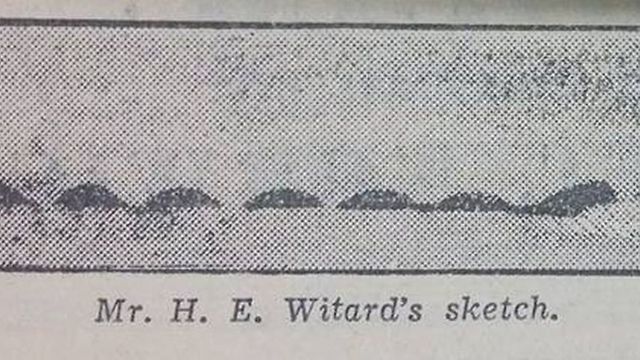
In early August 1936 the monster was seen by three prominent political bigwigs. Herbert Witard, former lord mayor of Norwich, was with Charles Ammon (Labour Member of Parliament for Camberwell North) and his wife and children and Archibald Gosling, a former Labour MP at Eccles on the Norfolk coast. This is how Witard described what he saw in the sea on that day:
Herbert Witard Courtesy Norfolk Record Office
‘The creature looks like a huge snake. It was at least a mile out to sea and swimming parallel with the coast. Its speed was terrific. From 90 to 100 miles per hour would not be an exaggerated estimate. It disappeared very quickly on the skyline in the direction of Happisburgh.’[vi]
Charles Ammon, MP, added that the creature was ‘about 40 feet long and different parts of the body rose in and out of the water with the movement of an eel’.[vii]
Witard dismissed the idea that they were mistaken and had misinterpreted a line of porpoises: ‘The suggestion that we mistook a shoal of porpoise for a serpent is ridiculous. I am an old sailor and I know something about the habits of porpoise.’[viii]
Courtesy Eastern Daily Press
These prominent witnesses made front page news in the UK, and in the weeks following their reports, more sightings occurred up and down the east coast of England…
Slippery Sam
Sightings of a monster off the Yorkshire coast continued in the first few weeks of August, 1936. Mr J. Barkley, owner of the Cliff Café at Sewerby was an official coast watcher for the Board of Trade. He told the Leeds Mercury that he had watched the creature through a telescope from the top of Sewerby cliffs for twenty minutes: ‘After lying on top of the water it would rush and dive as though feeding on something below.’ He described it as being between fourteen and twenty feet long and looking like a huge black fish.
Mr J.G. Twigy, a member of East Riding of Yorkshire county council also saw something off the coast of Withernsea. At first he thought it was a speedboat, but then realised it was moving three times too fast for that. He improbably claimed, as did Witard, Ammon and Gosling, that the creature was moving at around 100 miles per hour.[ix]
As sightings continued, thousands of visitors flocked to the coastal towns of Yorkshire in the hope of catching a glimpse of the monster, and many did. Six witnesses at Roker saw what appeared to be a huge black fish which cavorted and jumped out of the water for fifteen minutes. Sightings also occurred in Scarborough and further north in Sunderland.[x]
The factor that can bring disparate and conflicting eye witness accounts together is a recognisable name. Strange shadows, movements or shapes occurring on Loch Ness can coalesce under the banner of ‘Nessie’. However, the newspapers of the day were remiss in not deciding on a definitive name for this creature. It was sometimes given localised names such as the Humber Monster or the Withernsea Visitor, but the monster seemed to roam up and down the east coast, so these names did not really stick.
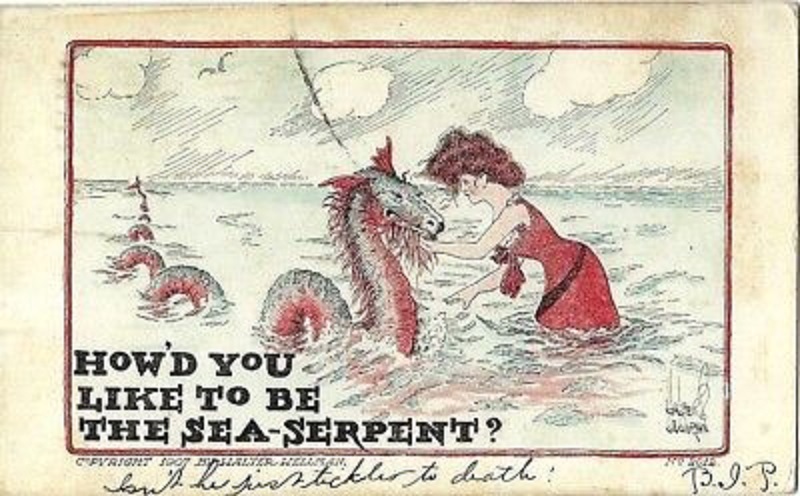
Among the thousands of monster hunters scouring the Yorkshire coast, though, the creature had been given a much more appropriate name – Slippery Sam.[xi] This name reflects the fact that the witness descriptions of him are very varied – like a huge fish, like a serpent, like a horse, like a hippopotamus….
And the fact that descriptions were so varied leads to the obvious question: were people witnessing the same thing?
Cleethorpes Catches the Monster!
A number of explanations were offered in the press for the monster sightings. Some suggested porpoises swimming in a line would give the impression of humps near the surface.[xii] Although former Lord Mayor Witard dismissed this explanation, looking at his sketch, it could plausibly be seen as the backs of a line of porpoises. Others suggested it might be a shark.[xiii] Another explanation offered was that witnesses had actually seen a flock of birds flying close to the surface of the sea, looking at a distance like a long undulating creature. Seals were another explanation, though these would be rather too slow to explain most sightings of our speedy monster.[xiv] However, the claims that the creature could swim at a hundred miles per hour must surely be an exaggeration!
The differing descriptions and different locations suggest that witnesses had seen or misinterpreted a number of different creatures for the monster, but perhaps the most likely explanation for a majority of the sightings was a whale.
In mid-August 1936 a party of campers saw what they thought was an upturned canoe on the beach near Cleethorpes. On closer investigation, it turned out to be a stranded whale. The Hull Daily Mail crowed that ‘Loch Ness and other resorts may claim to see monsters, but Cleethorpes catches them!’[xv]
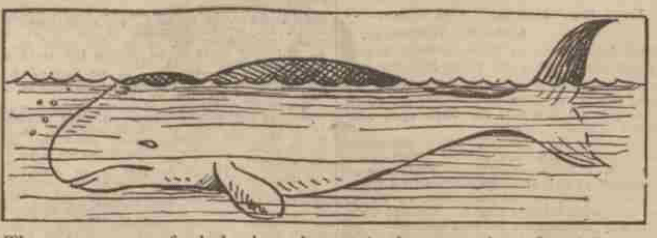
Other papers pointed out that a whale with part of its body and tale above the surface of the water takes on the appearance of a classic sea monster, with the tail being the monster’s head and the body of the whale being the monster’s hump.[xvi]
How a whale might be seen as a sea serpent (Leeds Mercury)
Epilogue
Slippery Sam’s star witnesses and the thousands strong monster hunt off the Yorkshire coast marked the peak of the creature’s fame. Although the beached whale may have been the origin of some of the sightings, it can’t have been the only cause as sightings continued in the summer of 1937 when bus driver Joseph Shepherd stopped his bus on the promenade near Withernsea to watch a jet black twelve foot long creature move through the waves like a speedboat.[xvii]
Sea monster sightings in the 1930s were very similar to UFO sightings later in the century – they occurred in ‘flaps’ (or perhaps more appropriately ‘waves’). Early media reports result in more people being hyper-vigilant about their environment, scouring the sea or the skies and noticing and misinterpreting mundane objects that they would not normally see or pay attention to, and perhaps that’s what happened with Slippery Sam. And of course, the numbers of visitors looking out to sea in search of a monster would be much higher in the tourist season when these flaps occurred.
It’s pretty clear that the newspapers didn’t take the sea serpent stories seriously, though. The Leeds Mercury referred to the monster as an ‘annual August sensation’. It went on to say that ‘the sea serpent is one of the great stock jokes of the British race, like mothers-in-law and Wigan Pier.’[xviii]
The Louth Standard, after reporting a 1936 sighting of a monster near Mablethorpe, Lincolnshire that was forty feet long and racing like an ‘express train’, commented that ‘we should love a real life monster here. The children would love to ride on it. So much more thrilling than a donkey ride.’[xix]
The world probably seemed a dark place in the mid-1930s at the height of monster mania, and these silly season stories no doubt provided some relief. The Ballymena Observer commented:
‘We are fed daily horrors, satiated with the deeds of desperate men. But here, rising from the sea like Venus, with the action of a worm and the pace of a speedboat, is our old friend, escaped once more from Eden and showing himself more of a dove than a serpent, to remind us that the holidays have begun.’[xx]
Perhaps it was the darkness of those years leading to the outbreak of World War Two that prompted the Yorkshire Post to suggest that ‘if the sea serpent is wise he may well prefer to maintain his anonymity until the human race has advanced a little further towards civilisation’.[xxi]
In any case, the nature of human perception means that if we look hard enough, we will see monsters, whether they are there are not.
In the summer of 1924, a shroud of mystery descended on the West Yorkshire village of Eldwick, near Bingley. Rumour had it that a beautiful but excitable young woman whose only companion was a grey cat had taken up residence in a cave in the nearby popular beauty spot of Shipley Glen. On her visits to nearby villages, she couldn’t or wouldn’t reveal any details about herself beyond that her name was Florrie, and it was assumed that she was suffering from memory loss and how and why she came to be living in the cave was a matter of much speculation. The mysterious cave dweller and her plight hit the headlines around the country, and strange and romantic stories were told about her, her cat and a certain tall young man who had been seen visiting her at unearthly hours. And then she vanished…
Florrie All Alone
Florrie All Alone (as the villagers of Eldwick dubbed her) was thought to have started living in her cave in Shipley Glen in the July or August of 1924.[i] The Cave Girl came down into the village on occasion and kindly local women befriended her, though they could get no more out of her than her name being Florrie. Florrie was described as being in her early twenties with dark hair. She wore a ‘smart brown costume’ and had a ‘somewhat excitable disposition’. She was ‘passably good-looking’ according to the Leeds Mercury, though the Daily Mirror described her as a ‘pretty cave woman’.[ii]
As the stories about the ‘pretty cave woman’ spread, local youths searched Shipley Glen to try and find her cave, which they did. On entering, they couldn’t find her, but suddenly became aware that she was sitting at the back of the cave reading a paperback novel and laughing at them, which either embarrassed or scared them, for they left immediately. Another local boy saw her in her cave at 8pm one evening, and another Eldwick resident saw strange lights when crossing the Glen at around 1.30am one night. He assumed that the cave woman was responsible for this.
Shipley Glen (courtesy of Tim Green)
Eldwick shopkeeper Mrs Holgate described how the strange woman had rushed excitedly into her shop one day unwashed and dishevelled and asked for a comb, saying she needed it because she was going to Leeds the next day. Mrs Holgate provided her with one, but noted that a mysterious tall man was waiting for her outside the shop.[iii]
But perhaps the villagers who got to know the mysterious troglodyte best were owners of Eldwick’s tea shop, Timothy Bruce and his sister. One Saturday afternoon, Mr Bruce heard a banging at the door of his shop and was surprised to see the bedraggled cave girl standing there, soaked by the torrential rain. She asked for a cup of tea, but because the shop was closed and the fire was out, he took pity on the woman and brought her to his house where he gave her tea and a meal, which, to his surprise, she insisted on paying for. Mr Bruce was even more surprised when she asked for and smoked ten cigarettes, which she described as her only comfort.[iv]
It was a stormy evening and the woman, who introduced herself only as Florrie, asked if she could stay the night. When Mr Bruce agreed, she then asked if she could fetch her cat, her only friend. She said the cat had come to her when she was in the cave and slept with her, helping her to keep warm by snuggling up to her. Mr Bruce agreed to the extra guest, and Florrie disappeared, returning soon after with her faithful companion, a fine grey cat.
The tea shop owner was touched by Florrie’s kindness to the cat, and offered her a trial period of employment helping him in his business. Florrie agreed. It seemed the unfortunate woman’s luck had turned.
Florrie told Mr Bruce that she had been employed as a nurse to a Bradford man for two years but that he had died leaving her destitute and forcing her to seek the shelter of the cave on Shipley Glen.[v]
On the first day of her employment, Florrie left early to open up the tea shop. Mr Bruce followed a little later to find the shop open and the grey cat snoozing in front of the fire. But Florrie was gone, never to return. Mr Bruce put the cat outside so that it could, he supposed, go after its mistress.[vi] Why she had left so suddenly and without her faithful cat was a cause of much speculation.
Cave Girl Vanishes!
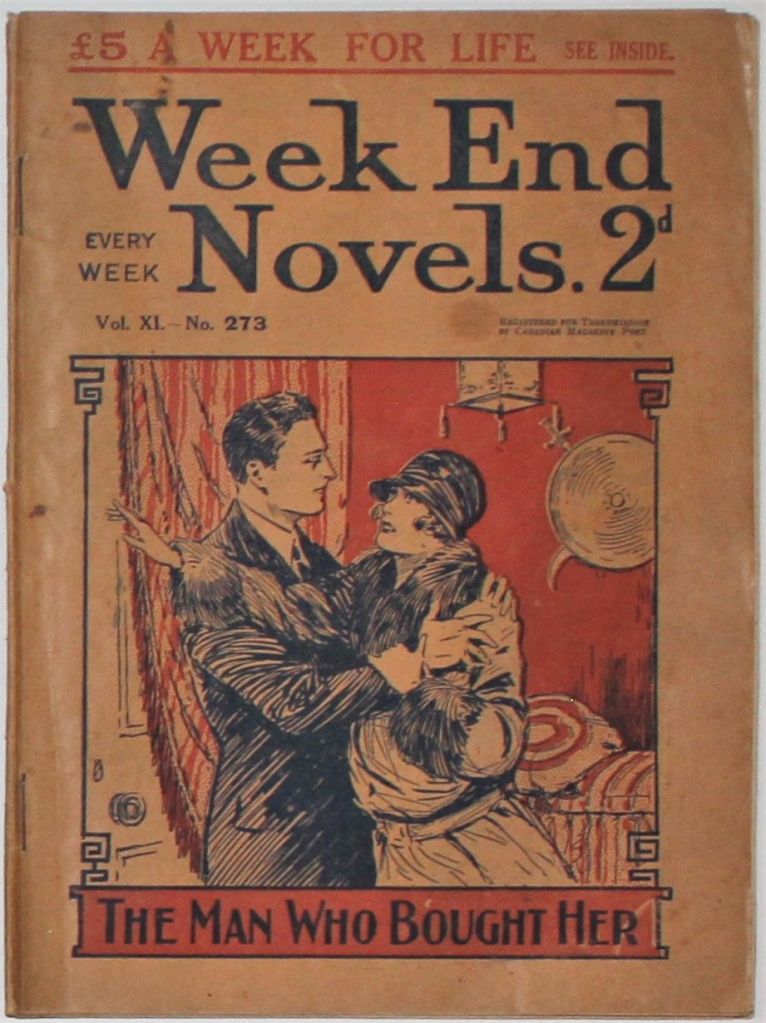
The local police were informed that a young woman, apparently suffering from memory loss, had been living in a cave in Shipley Glen and had disappeared and officers from Baildon and Bingley police investigated. They found the ‘cave’ Florrie had been using – it was actually a hollow called Fox’s Hold under a large protruding rock rather than a cave. They found some discarded women’s shoes and a glove, along with empty cigarette packets and toffee papers. They also discovered a lurid ‘twopenny novelette’ – a melodrama about an arranged marriage called The Man Who Bought Her.[vii] The floor of the ‘cave’ had some bracken spread over some old carpet, which was assumed to be Florrie’s bed.[viii]
Who was this strange but beautiful Cave Girl? Who was the mysterious tall man she had been seen with? What had happened to her and her faithful feline companion? What clues did the objects left in her cave provide?
The ‘lurid’ novel the cave girl was reading before she disappeared
Cave Girl Found!
Florrie was discovered soon after her disappearance in Eldwick village by a constable and taken to Bingley police station. At the time she was found, she was with a young man from Leeds. Her name was confirmed as Florrie, though her full name was not reported. She was a native of Derbyshire.
It turned out that she was not, in fact living in the cave, and never had been.[ix] She had spent some time there eating meals she had bought from local shops or reading trashy novels, which had perhaps inspired her to make up the story of her being destitute and living in the cave. She had also shown the cave to her male friend, the tall man of mystery the villagers had been speculating about.
There were no charges against Florrie, so she was released. She had, though, fooled the villagers and the local and national press into imagining strange and romantic stories of a mysterious cave girl who had lost her memory and was forced to hide out on the Yorkshire moors with her only friend in the world being a little grey cat.
And I’m afraid, we have no idea of what became of the cat.
Fishermen are known for their tall tales, but few are as tall as the tale told of the gigantic fire breathing sea serpent that attacked a Scottish trawler in 1903. Reports of sea monsters were fairly common in the newspapers of the nineteenth and early twentieth centuries, but the desperate battle between the crew of the Glen Grant and the North Sea Monster is one of the most exciting.[i] The account below is based on supposed eyewitness accounts described in the British press.
In the early hours of Tuesday 8 September, the steam trawler Glen Grant was heading away from Fraserburgh, Aberdeenshire towards its fishing grounds. In charge of the vessel and the nine man crew was Captain Joseph Carter, described as an ‘old and tried seaman’.
An Enormous Monster with a Head Like a Chinese Dragon
At 5am, those on deck became aware of a roaring sound accompanied by a seething turmoil in the water. It was assumed that this was caused by whales, but the crew looked on in disbelief as ‘an enormous monster with a head like a Chinese dragon’ rose up from the sea.
The size of the monster was estimated to be around 200 feet – twice as long as a blue whale, with an improbably long 50 foot neck standing up out of the water. The serpent was described as dark in colour with a head like a sea horse (or a Chinese dragon in some reports) and with a long fin or mane running down the back of its neck. Its eyes burned with a terrifying green fire and glistening teeth were visible in its cavernous mouth. Around the mouth were great tusks and whiskers that ‘stood out like topsail yards’.
The strange creature ploughed through the waves towards the Glen Grant with a strange swaying motion and most of the terrified crew scrambled to various hiding places. The monster then ‘rested his chin reflectively on the truck of the mainmast’ while the few crew that remained on deck watched unable to move.
Fiery Breath
The creature’s attention was caught by the open skylight of the cabin, and he thrust his head through the opening. Inside, Captain Carter, the ship’s mate and the steward were about to take their morning coffee when ‘the awful looking head swung across the table’. The Captain and the mate, being strict teetotallers, knew this was not a hallucination and dropped their coffee mugs and fled. The unfortunate steward, though, found himself cornered and unable to make his escape.
The monster slowly inspected the inside of the cabin before scorching the steward’s whiskers and the cabin’s paintwork with his fiery breath. The creature then removed his head from the cabin.
Back on deck, one of the crew hurled a belaying pin (a metal rod used in ship’s rigging) at the monster. The noise it made when it hit the creature ‘sounded as if an iron tank had been struck’. The monster then disappeared into the sea with a strange hissing sound.
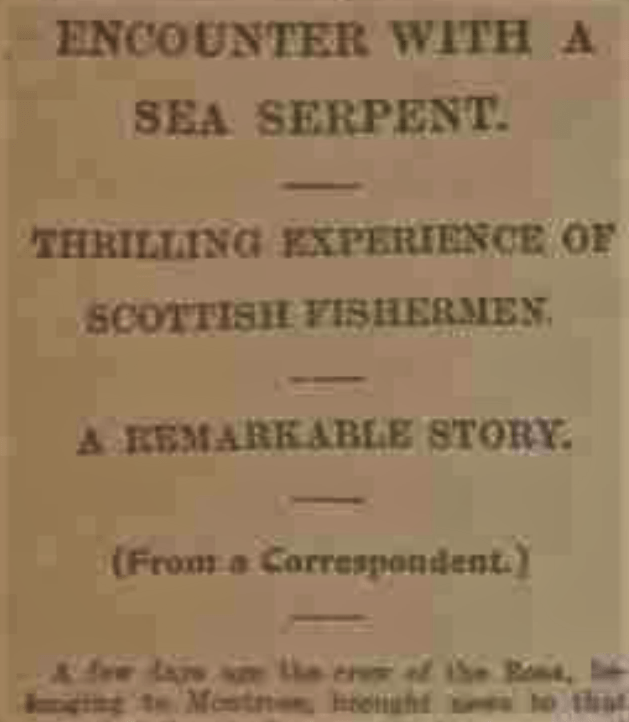
Headline from The Dundee Courier 12 September 1903
Lifted by Some Giant Hand
Their ordeal wasn’t over. The serpent dived under the Glen Grant and the vessel found itself lifted out of the sea as if by a ‘giant hand’. They hung in the air for a few seconds with the waves foaming below them before being plunged down with such force that everything on deck was swept away and the cabin and engine room were flooded.
The horrified crew watched as the monster swam some distance away from the Glen Grant. Then, to the crew’s utter consternation, it turned and began to head back towards the trawler at a furious speed ‘as if he was resolved to crush the ship to pulp’.
At this point, one of the crew – a fisherman called Wiseman – dashed to retrieve his gun from below deck. When the monster was about 15 yards away he aimed and fired. It’s not clear if the shot was accurate, but in any case the monster hesitated before diving beneath the waves showing a ‘long sinuous body’. They watched the creature through their glasses as it undulated under the water, but it did not attack again.
It took the crew some time to recover their senses after the sensational events, though they eventually turned to pumping out the ship and pulling in their nets before steaming back to shore. The Captain, we are told, was reluctant to come forward with his testimony but was persuaded to do so by his crew, who were all natives of Aberdeenshire.
How Long is a Sailor’s Yarn?
So how plausible is this 200 foot long, green-eyed, dragon-headed, lion-maned sharp-toothed, whiskery fire-breathing sea monster? Well, although the account was widely reported in 1903, the press treated the story with tongue-in-cheek sarcasm. Many pointed out that tales of mysterious sea serpents cropped up every year and treated this report as an unlikely but thrilling yarn. The monster’s size – twice as big as the world’s largest animal, the blue whale – is certainly implausible, and fire-breathing is an unlikely superpower for an underwater creature.
However, the Glen Grant was a real trawler. Furthermore, the crew of another steam trawler, the Montrose, had reported a much less dramatic encounter with a sea serpent off the eastern Scottish coast a few days before. This creature was estimated at over 100 feet long and raised its head 5 or 6 feet above the water. It moved in a ‘snaky’ fashion and ‘humps’ also protruded from the waves in stereotypical Nessie style, though no other details were given, and there were certainly none of the fantastic elements attributed to the much more impressive monster that supposedly attacked the Glen Grant.[ii] The Montrose sighting is consistent with a misperceived whale, perhaps, but was widely reported as being the same creature that attacked the Glen Grant.
So what happened to the crew of the Glen Grant? Did they have an ambiguous encounter similar to the men on the Montrose and then decide to add some colourful details? Or were the exciting events invented by sensation hungry journalists hoping to fill in some column inches? Were the whole crew of the Glen Grant in on a monster hoax? Or is there really a fire-breathing monster – the biggest on earth – inhabiting the North Sea?
Some of the improbable details – the size, the fire-breathing, the metallic clang the monster made when hit with the belaying pin, the way it rested its chin ‘reflectively’ on the ship – makes me feel someone is pulling our leg, but if hoax it is, it’s a delightful one and deserves to better known. It would make a great monster movie.
But this wasn’t the last time that a monster from the deep visited our shores. Stay tuned for the story of Slippery Sam – the Yorkshire Sea Monster….
[i]Dundee Courier, 12 September 1903; Westminster Gazette, 14 September 1903; Derry Journal, 16 September 1903; Northern Scot and Moray and Nairn Express, 19 September 1903
[ii]Dundee Courier, 7 September 1903; Montrose, Arbroath and Brechin Review, 11 September 1903














 Paul Weatherhead