You’ve heard of phantom black dogs haunting the moors. You’ve heard tales of grey ladies, howling werewolves, wailing banshees and headless horsemen. Perhaps you’ve read about fairies, elves and boggarts. But surely the strangest entity ever to haunt this land was the demonic headless bear from hell. This strange monster is nowadays forgotten, but he left odd tracks in the realms of demonology, the works of William Shakespeare and also in the language we speak.
A monstrous headless bear, a flaming demonic snail, levitation and a possessed woman rolled around the house like a human hula hoop. And that’s just the beginning.
A True and Most Dreadful Discourse
The story of the Somerset woman and the headless bear from hell was first published in a pamphlet titled A True and Most Dreadful Discourse in 1584.[i]
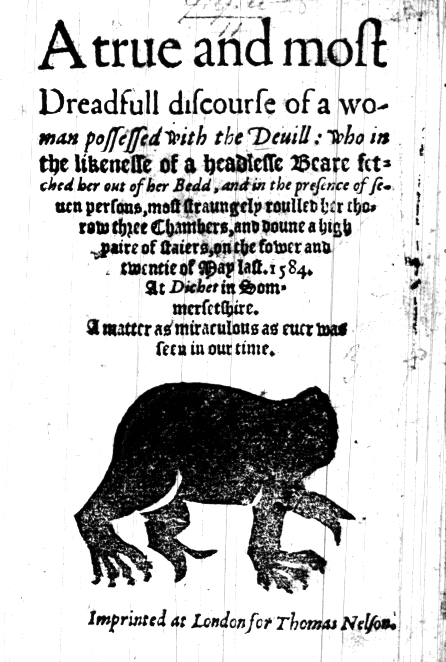
The ‘true’ events happened in Spring 1584 in the village of Ditcheat in Somerset. Margaret Cooper was sent to Gloucestershire to oversee a farm they had there. Normally, Mr Cooper would have gone himself but was too ill to travel.
When she returned, she was a different woman. She rambled incessantly about the farm and an old coin her son had found. We’re not told exactly what she said, just that it ‘idle’, ‘vain’ and non-stop. Mr Cooper suspected she had been bewitched or was possessed by an evil spirit.
Mr Cooper told Margaret to repeat the Lord’s Prayer after him, which she attempted to do, successfully at first. Very quickly, however, she began to wail horribly for her son’s coin and her wedding ring. Mr Cooper tried to ignore his wife and continued praying for the evil spirit to be cast out, but the more he prayed, the more agitated and angrier Margaret got, still calling out dreadfully for her coin. Eventually, Margaret silenced her husband with a stare that struck him dumb with terror.
Foamed at the Mouth
At this point Cooper called in Margaret’s sister and his brother to help hold Mrs Cooper down. Margaret struggled so violently that the three of them could barely restrain her. Then, the pamphlet tells us, ‘she was so tormented that she foamed at the mouth and was shaken with such force that the bed and the chamber did shake and move in most strange sort.’
When the shaking stopped, Margaret told them she had been into town to ‘beat away the bear’ which had followed her home from the countryside. This bear ‘to her thinking had no head.’
Her family told her she was talking nonsense and tried to comfort her.
Her attacks came and went over the next two weeks, and many friends and neighbours came to visit and comfort the afflicted woman.
The Fiery Snail and the Headless Bear from Hell
On Sunday 9 May 1584, Margaret had seemed calm during the day, but as midnight approached the candle in her bed chamber burned out and she woke up crying that she could see ‘a strange thing like unto a snail, carrying fire’.
Now, a snail isn’t very demonic and couldn’t catch you even if it was, and some academics have wondered if the fiery snail was a typo and that it should have read fiery snake, which would be much scarier.
In any case, seeing the candle had burned out, Mr Cooper called for his brother, Margaret’s sister and some friends who had been staying with them to help when the fits came.
They placed a new candle on the table. ‘Do you not see the Devil?’ Margaret cried. ‘Well, if you see nothing now, you shalt see something by and by.’ A sudden loud noise like two or three carts rumbling by terrified everyone, causing them to scream in fear as they wondered what was approaching. A nauseating stench filled the room.
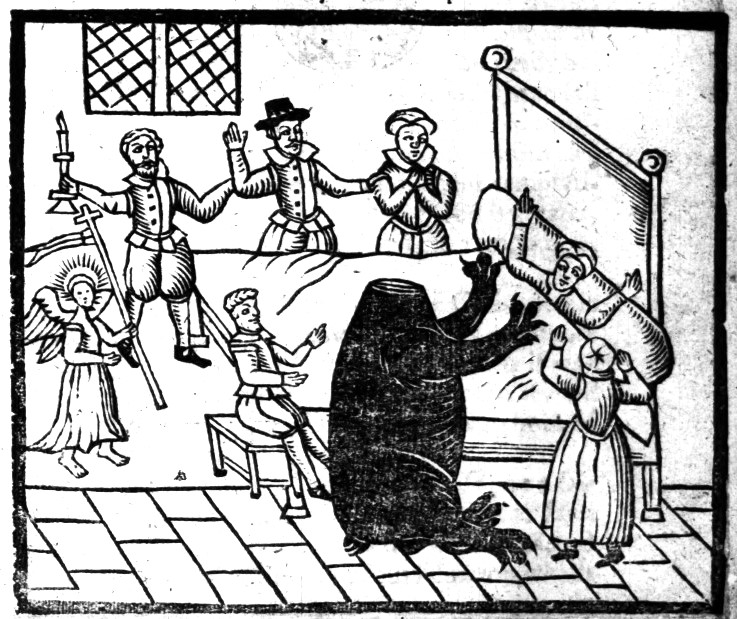
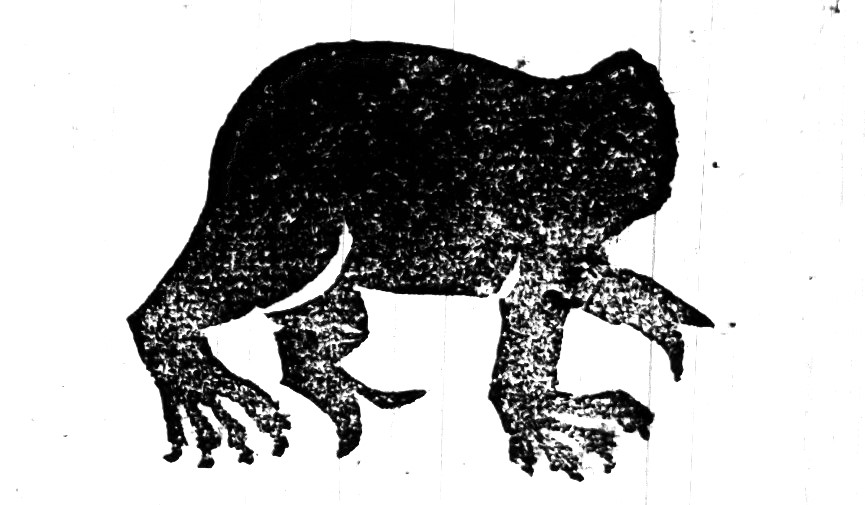
Mr Cooper, who was still in bed, looked up and beheld the creature – a bear with neither head nor tail. The bear was half a yard tall and half a yard in length, which doesn’t sound particularly monstrous. A teddy bear sized headless bear would seem comical rather than hellish. Possibly the half yard refers to the archaic agricultural and surveying measurement of a land yard. This would make the headless bear just over eight feet in height and length which is much more respectable for a scary monster.[ii]

Cooper grabbed a stool and struck the bear but to no effect. The bear climbed onto the bed where Margaret lay and struck her three times on the feet. Then it took the woman out of her bed and rolled her around the room and under the bed before the eyes of several astonished witnesses who prayed in terror as the candle guttered and dimmed.
In the words of the pamphlet:
“At last this Monster which we supposed to be the Devil, did thrust the woman’s head between her legs and so rolled her in a round compass like a hoop through three other chambers down a high pair of stairs in the hall.”
For fifteen minutes the headless bear from hell used poor Margaret Cooper as a human hula hoop. The air was alive with strange flames and the house was filled with a noxious stink. Cooper and the other witnesses could do nothing except weep, pray and cover their noses with their napkins.
‘He is gone!’ Margaret suddenly cried, and she appeared next to her husband and the others with what seemed like supernatural speed. They took her back to bed and resumed praying for her. Again, the candle burned dim, and somehow Margaret ended up with her legs sticking out of the window, one on either side of the post in the middle. As the astonished witnesses looked out of the window, they saw a great fire under Mrs Cooper’s feet and the horrible stench returned.
Mr Cooper and his brother found their courage and charged the Devil in the name of the Father, the Son and the Holy Ghost to cease tormenting Margaret and depart. They managed to pull her back into the bed chamber.
Margaret then said she could see a little child outside the window. Everyone ignored her at first, but when they did look, they saw a child with a bright shiny face, and it was at that moment the candle suddenly burned bright again.
The company fell on their knees and thanked God. The child vanished.
Margaret was taken back to bed and penitently asked for God’s forgiveness, acknowledging that it was for her sins that she had been tormented. What her sins were, we are not told.
As for what happened to Margaret after her ordeal, we are only informed that since her experience she had ‘been in some reasonable order’ because many godly and learned men had visited her.
The pamphlet ends with the names of several witnesses who attested to the truth of the events described.
Return of the Headless Bear
The story was too good to die, and the pamphlet was reprinted in 1614 and 1641 but with the supposed date changed. Old fake news, we might say, was being shamelessly plagiarised and reissued as new fake news.
Amusingly, the third issue of the pamphlet relocates the action to Durham and changes Margaret’s surname from Cooper to Hooper, which fits nicely with her experience of being rolled around like a human hula hoop by the headless bear.
The idea of a headless bear seems odd to modern sensibilities, but the fact that the pamphlet was so popular raises the question of whether headless bears were a thing, a recognized type of apparition akin to the black dog, the grey lady or the headless horseman.
There are several historical references to headless bears. Shakespeare mentioned them in Midsummer Night’s Dream (1595) where Puck the trickster says:
Sometimes a horse I’ll be, sometimes a hound A hog, a headless bear, sometime a fire.
In his Anatomy of Melancholy (1621) Robert Burton refers to ‘ghosts, goblins, fiends… headless bears’ as if they are a widely known apparition. In fact, Burton’s famous book suggests that the headless bear’s paw prints may still be faintly visible in the language we speak.
Bugbears
We’ve all got our own bugbears whether it’s an obsessive fear that haunts us or an obsession over some annoyance or other. But what exactly is a bug bear? ‘Bug’ here has the same linguistic root as bogeyman, boggart, bugaboo – a scary thing. Shakespearean scholar Richard Macey has suggested that ‘bugbear’ may be a synonym for ‘headless bear’.
One piece of evidence for this is that in Burton’s Anatomy of Melancholy there are two similar lists of scary apparitions. One list includes bugbears but not headless bears and the other includes headless bears but not bugbears…. could they be one and the same thing?
Furthermore, in 1560 playwright John Heywood wrote about how mothers playfully frighten their children ‘when they put on black scarves and go like bear bugs’. The suggestion seems to be that the scarf over the woman’s head makes her look like a headless bear, or ‘bear bug’, in other words a bugbear.
The evidence is intriguing if inconclusive. But we can be sure that the headless bear had a life beyond the bizarre pamphlets of early modern England.
The Headless Bear of Worcester
According to a 1691 book called The Certainty of the World of Spirits by Richard Baxter, a soldier called Simon Jones encountered a headless bear while on guard duty in Worcester:
Simon Jones, a strong and healthful man of Kidderminster, in no way inclined to melancholy or any fancies, hath oft told me that being a soldier for the King in the war against The Parliament, in a clear moonshine night, as he stood sentinel in the College Green at Worcester, something like a headless bear appeared to him and so effrighted him, that he laid down his arms soon after and lived honestly, religiously and without blame.[iii]
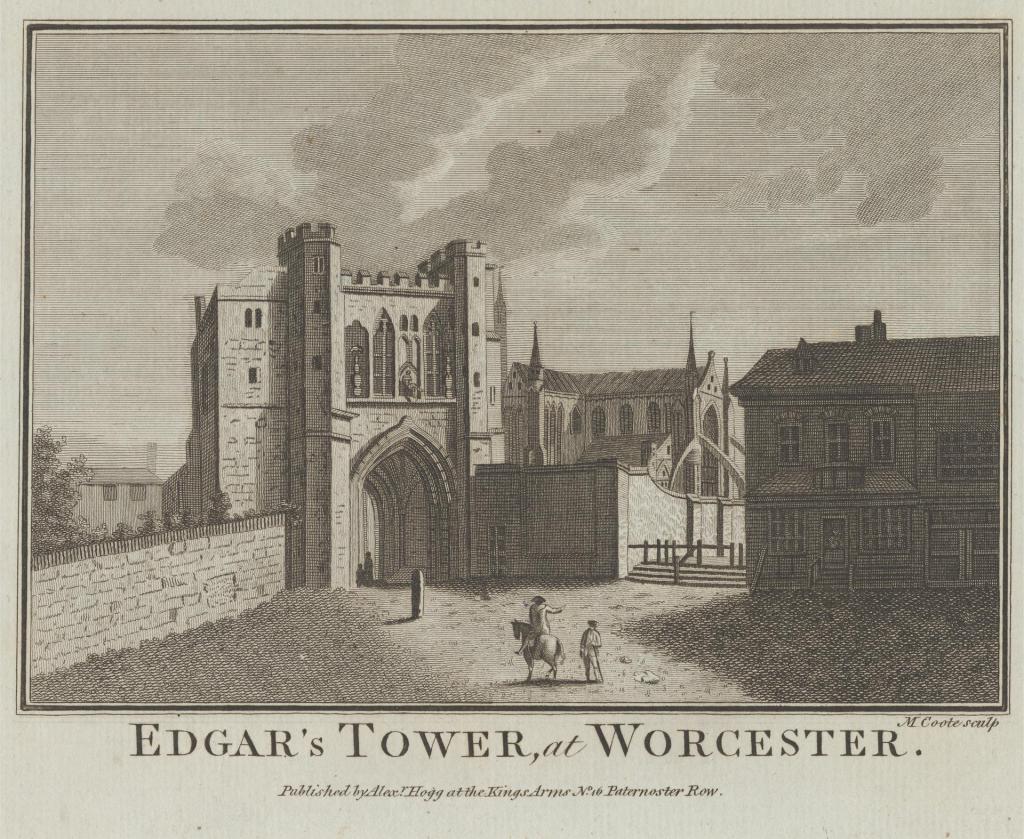
Local legends says some apparent scratches in the wall of Edgar Tower, Worcester, were made by this phantom headless bear. According to author Hugh Williams, the headless bear has even been witnessed by staff and students at a local school.[iv]
The bizarre phantom of the headless bear, though endangered, is not quite extinct.
Exit, pursued by a headless bear….
[i] The pamphlet is easy to find online, or see Joseph Laycock’s excellent Penguin Book of Exorcisms for the full text in a readable format
[ii] Richard David Macey, Fake News and News Anxiety in Early Modern England (2018), PhD thesis, Loyola University Chicago
[iii] Gary Bills-Geddes ‘Ghost bear in a time of war at Worcester Cathedral, Worcester News, 25th October 2019 Available at: https://www.worcesternews.co.uk/news/17992749.ghost-bear-time-war-worcester-cathedral/ I’ve slightly modernised spelling and punctuation
[iv] https://www.mysteriesofmercia.com/post/edgar-tower-it-s-spectral-bear
 Paul Weatherhead