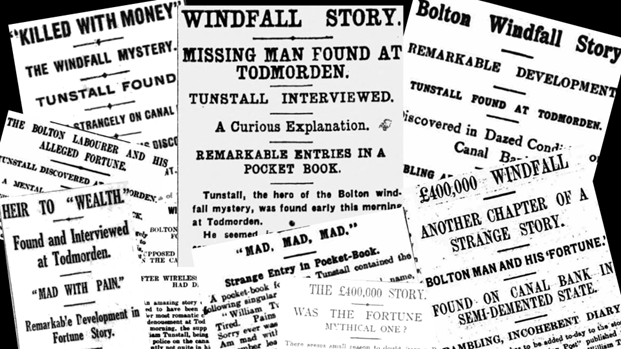
Killed with Money: The Bolton Windfall Mystery

In the early hours of 20 August 1913, PC Machlachlan saw a man behaving in a strange manner on the banks of the Rochdale Canal, in Todmorden, West Yorkshire. The man seemed dazed, confused and dejected and as if he were not in his right mind. The policeman worried that the man was about to throw himself in the canal, so he engaged him in conversation, though the man only rambled incoherently about trouble and pain in his head.

In the man’s pocket was a notebook with some strange messages that gave a clue as to his identity:

William Tunstall; Westwell real name; tired, pains in the head something awful… Mad, mad with pain… Where have I been? God only knows, I don’t… Wish had never known about money… Mad, mad, mad, killed with money… If this is having money I am tired of it. You will find me where you find this. Goodbye and God bless you.

W. Tunstall Westwell[i]

The only thing was, William Tunstall had been reported dead and buried at sea a few days earlier…

The officer took the forlorn Tunstall to the police station, and it became a sensation as news spread around the town. The remarkable story of William Tunstall, how he inherited a fortune but then died mysteriously before he could claim it, had been on everyone’s lips for days. And now here he was, seemingly back from the dead and walking the towpaths of Todmorden.

The press called it the Windfall Mystery, but the solution to it was right under their noses all the time.

The Bolton Windfall Mystery

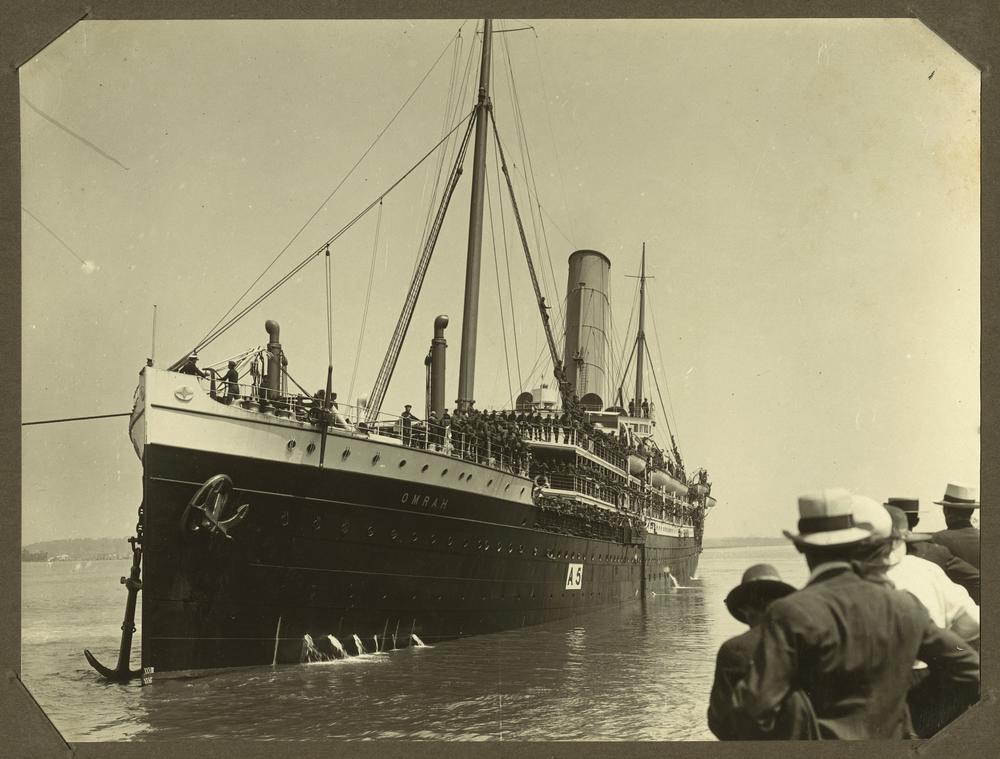
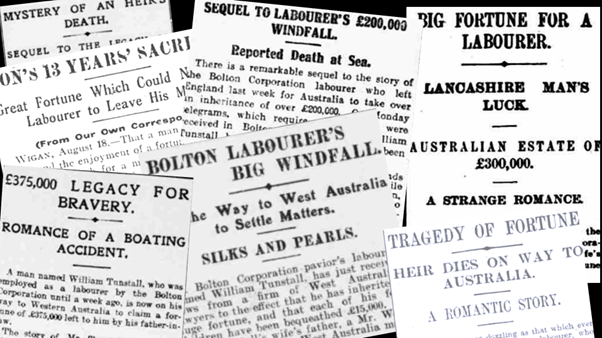
In the summer of 1913, the great feelgood news story was that of middle-aged Bolton man William Tunstall. Tunstall worked for the council laying paving stones and seemed to be somewhat down on his luck, when in true rags-to-riches fashion he received a telegram from Australia. His father-in-law had died leaving him a legacy of around £400,000, which would be close to £60 million in today’s money. His father-in-law, Mr Westwell, had emigrated to Western Australia where he had made a fortune in the silk and pearl fishing industries, and all this along with a huge estate was William’s. The only condition was that he take on his late father-in-law’s surname. With the help of Harry Hart, a friend from Glossop, William planned to join the steamship Omrah to sail to Australia and claim his inheritance.

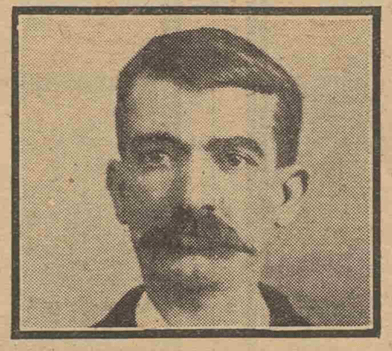
William Tunstall (Daily Mirror 19 August 1913)

In a letter sent just before he was due to sail, Tunstall wrote touchingly: “I have had a hard struggle through life with short exception… I have always been true, honest, upright, and attentive to my work.” He was seen as a pious, abstemious and down-to-earth man who attended Bible classes and supported several orphaned children on his meagre income.[ii]

The story of how William came into his fortune was a romantic one indeed. It began when he was on holiday in the Isle of Man and rescued two women after a sailing accident. A pleasure boat was struck by a sudden squall and capsized, and Tunstall being a strong swimmer became the hero of the day. The husband of one of the women Tunstall saved was Mr Westwell, and they became friends.

Some years later William was being treated in hospital for a mystery illness and fell in love with the young nurse who was looking after him. The nurse, though, disappeared and William despaired of ever seeing her again. To help him recover, Mr and Mrs Westwell invited him over to Douglas in the Isle of Man to be their guest for a while. It was there that he finally found the young nurse he had fallen for, and sounding like something from a Mills and Moon love story, she turned out to be the daughter of the Westwells.

A romance blossomed between the two and the young Miss Westwell asked William to marry her, such was the admiration and gratitude she felt for the man who had saved her mother’s life. But William, we are told, was a modest man and painfully aware of the difference in social status between the couple and refused for a time before eventually setting aside his scruples and marrying her in 1900. They had a child together.[iii]

Soon after, Mr and Mrs Westwell decided to move to Australia and insisted their daughter and grandchild go with them, but William declined and stayed at home to look after his ailing mother.

A few months later, William received devastating news – his wife and child had been killed in a carriage accident.

Ten years later William married the woman who had taken over the care of five orphaned children he had been financially supporting.

And now he was a rich man, heir to a silk and pearl fishing fortune. His second wife and the children had moved to the South of France using an advance on his inheritance and he said goodbye to his family, workmates and friends from his Bible class, and headed to London where the steamship Omrah waited to take him to his fate. His biggest fear, we are told, was that news of his fortune would leak out making him famous, in which case he would have to ‘disappear suddenly’, as he said ominously.[iv]

Steam ship Omrah

Shortly after the Omrah had set sail, Tunstall’s brother John received a terse telegram: Sorry, your brother dead: buried. Myself am going to Canada.[v]

Tunstall’s landlord received a similar message: Sorry Tunstall dead; buried. Tell friends.[vi]

The laconic telegrams were unsigned, but it seemed likely that it had been sent by Harry Hart, the man who was organising William’s passage to Australia. The mysterious death of the windfall man was a media sensation that seemed straight out of the pages of a Sherlock Holmes mystery…

The Plot Thickens

As journalists began to investigate the suspicious death of William Tunstall, the whole story began to unravel. Reporters from the Daily Express found that Australia didn’t have a significant silk industry and the pearl fishing business was nowhere near as lucrative as Westwell’s supposed fortune. Furthermore, no record of anyone of that name in the pearl fishing enterprise could be found.

Journalists from the Manchester Evening News checked the passenger list for the Omrah. Nobody called Tunstall had been on the ship, let alone died and been buried at sea.[vii]

Further enquiry revealed that nobody – not even his own brother and sister – had ever seen or met Tunstall’s supposed first or second wife.

But if Tunstall had not sailed on the Omrah, then where was he?

Mad, Mad, Mad…Killed with Money

It turned out that Tunstall had been working as a labourer in Hollingwood, near Oldham. It was from near here that he had sent the telegrams to his brother and landlord. At his lodgings in Hollingwood, his landlady saw him write his name and address on an insurance card and then realised he was ‘the fortune man’ but decided not to say anything as he seemed comfortable there and wasn’t causing her any trouble.

One night in Hollingwood Tunstall went out for a herbal beer, and as he was walking down the street someone shouted, “lucky dog!” at him. He returned to his lodgings, presumably distressed that he had been recognised, though he told his landlady that there was a labourer from Bolton that had the same name as him that had been left a fortune. Tunstall told his hosts that he was going to a friend in Newcastle to find work. The journey involved changing trains at Todmorden, where he was found by PC Machlachlan dazed and confused on the banks of the Rochdale Canal.[viii]

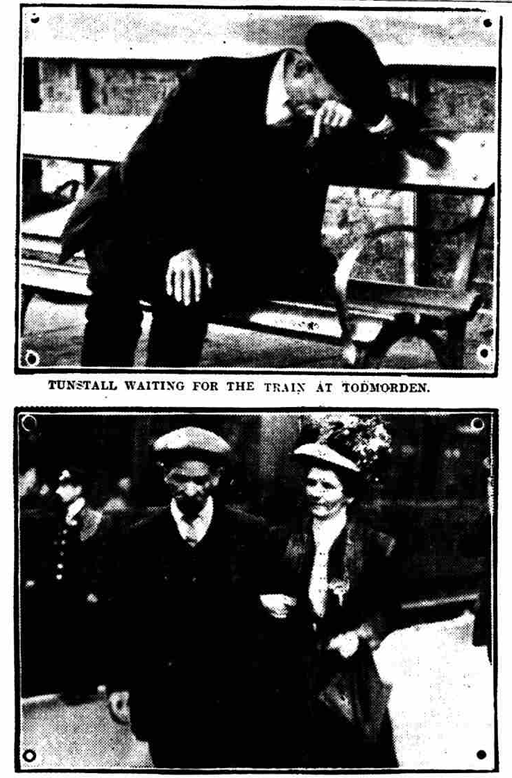
A Todmorden journalist went to Vale Street police station to meet the famous Mr Tunstall and found him lying on a bench complaining of a pain in his head and saying that he had gone blind. ‘My eyes are gone,’ he said in a weary tone, and this seemed to be confirmed when the journalist put his fingers close to his face and got no reaction. Tunstall maintained his inheritance was true, and that he had gone to London with Harry Hart to sail to Australia but had no memory of what had happened. ‘I wish I had never had the money,’ he told the journalist. When asked directly why he hadn’t sailed to Australia, he replied ‘That’s what I want to know.’

Todmorden police had contacted Tunstall’s sister Sarah who arrived at this point. When she saw her brother, she let out a glad cry and ran to embrace him. She then shook him vigorously and told him he was coming home with her and talked of how worried they’d been after the telegrams about his death.

Tunstall began to weep on his sister’s shoulder. ‘That’s right, have a good cry, you’ll feel better. He has been like this many times,’ she then told the journalist. ‘And it does his eyes good to cry. I like to see him cry. It always does him good when he has trouble with his eyes.’[ix] It seems he had gone temporarily blind on previous occasions.

William Tunstall and sister Sarah Whalley (Todmorden District News 22 August 1913)

The last we hear of the mysterious Mr Tunstall is that he returned to Bolton with his sister, still blind and supposedly in a critical condition.

Epilogue

William Tunstall was a teller of tall tales. His Australian fortune. His heroic sea rescue. His serendipitous romance. The tragic death of his wife and child. His second wife and retinue of orphans. His apparent betrayal by the mysterious Mr Hart. His suspicious death and dramatic burial at sea… all were pure fiction. So, perhaps, was his seeming madness, loss of memory and blindness when he was discovered on the banks of the Rochdale Canal in Todmorden.

However, Tunstall’s story was believed by his sister and brother, by his friends at Bible class and by many others in and around Bolton. He had faked his death because of the stress and strain caused by all the public attention his fortune had brought him…

Perhaps Tunstall was what contemporary psychiatrists might call a pseudologue – that is someone suffering from Pseudologia Fantastica, the symptoms of which are a pathological compulsion to tell self-aggrandising lies in which the teller is always the hero, heroine or victim. In doing this they harvest attention and nurturing from those around them, perhaps out of a sense of emotional desperation.[x]

My own research on episodes like the Halifax Slasher, ghost hoaxes and fake abductions makes me think that pseudologues may be far more common than we believe.[xi]

In any case, I can’t find any subsequent accounts of the further adventures of William Tunstall in the newspaper archives, but I can’t help but think his imagination kept on spinning melodramatic narratives to anyone who would listen.


For more exciting but dubious tall tales, see below…

[i] ‘Windfall Story’, Manchester Evening News, 20 August 1913, p.4

[ii] ‘Bolton Labourer’s Big Windfall”, Lloyd’s Weekly News, 17 August 1913

[iii] ‘Sequel to Labourer’s £200,000 Windfall’, Staffordshire Sentinel, 19 August 1913, p.2; ‘Son’s 13 Year Sacrifice’, Daily Mirror, 19 August 1913, p.4

[iv] ‘Bolton Mystery’, Huddersfield Daily Examiner, 20 August 1913, p.4

[v] ‘Windfall Mystery’, Manchester Evening News, 19 August 1913, p.4

[vi] ‘Mystery of an Heir’s Death’, Daily Express, 19 August 1913, p.5

[vii] ‘Mystery of an Heir’s Death’, Daily Express, 19 August 1913, p.5; ‘Windfall Mystery’, Manchester Evening News, 19 August 1913, p.4

[viii] ‘Mysterious Mr Tunstall’, Manchester Evening News, 21 August 1913, p.6

[ix] ‘Bolton Romance’, Todmorden and District News, 22 August 1913, p.8

[x] Marc D. Feldman(2024) Playing Sick Routledge pp. 38-39

[xi] Robert Bartholomew and Paul Weatherhead (2024) Social Panics and Phantom Attackers, Palgrave Macmillan; Paul Weatherhead (2022) Weird Calderdale, Tom Bell Publishing

Beam me up, Ezekiel: Erich von Däniken Returns to the Stars

Erich Von Däniken, the man who popularised the enduring ancient astronaut theory, has boarded his chariot of fire and returned to the stars. He’s left behind him over 60 million books about ancient aliens building pyramids and mating with us monkeys to create the human race. A plethora of books and popular archaeology (or ‘starchaeology’, as I call them) documentaries.

Alien Cave Girl Shaggers Built the Pyramids

It was in the early 1980s when browsing my favourite section of Hebden Bridge library – the one that was labelled ‘The Mind’ – that I came across his first book, Chariots of the Gods? (1968). I was a voracious reader of books about aliens and UFOs, and this was right up my street. Alien cave-girl shaggers built the pyramids? I was convinced. I was hooked.

Daniken’s Debut

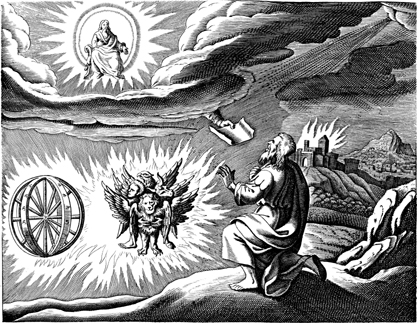
The Chariots of the Gods? of the books title – note the cheeky question mark – was a reference to the biblical Book of Ezekiel. This ancient Hebrew prophet and had a bizarre vision of God on a flying throne with wheels within wheels and strange winged creatures with sparkling calves’ feet and four faces each – one like a man, one like an ox, one like a lion and one like an eagle…[i]

If you thought that sounds like a UFO full of weird aliens, Von Däniken was of the same opinion.

God in a flying saucer? Ezekiel’s chariot vision by Matthaeus Merian 1593–1650)

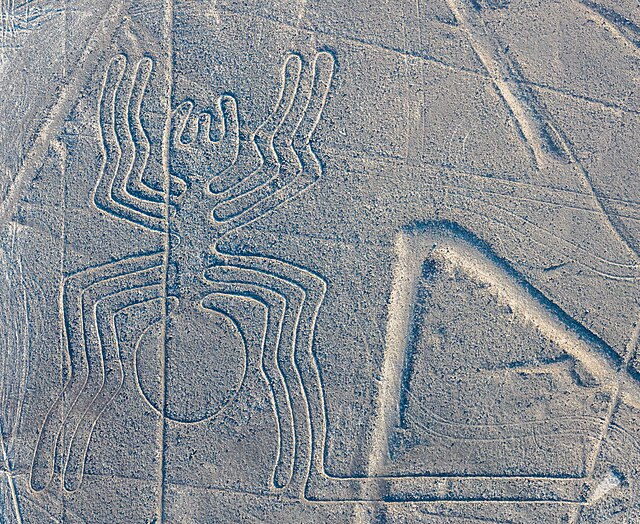
And this is what Von Däniken did. He combed ancient texts, art and archaeological sites for evidence of ancient randy astronauts. That’s not a halo over the saint’s head – it’s a space helmet! That flying chariot isn’t an apocalyptic vision, it’s a flying saucer! The weird shapes carved in the desert sands of Nazca, Peru, they’re a runway for alien spacecraft!

Alien airport? Expect delays…. The Nazca Lines (Diego Delso)

In my early teens I devoured his books… Chariots of the Gods, Gods From Outer Space, Gold of the Gods, Miracles of the Gods, Signs of the Gods, Return of the Gods, Oh no not more Gods….

OK, I made the last one up.                  

But the evidence was clear. Daniken’s overall thesis was this: Long, long ago in a galaxy far away, two ancient alien civilizations had a war and the losers picked Earth to go into hiding, building a huge network of underground tunnels to hide from the victors who were still in pursuit of them.

To throw them off their trail, the losers put some decoy beacons on the fifth planet in our solar system and the victors blew it up. All that’s left of that planet is the asteroid belt between Mars and Jupiter…

Dumb aliens blew up the wrong planet – doh! – and created the Asteroid Belt?

All makes sense, doesn’t it?

These randy aliens just couldn’t keep their hands off our primitive earth girls and by mating with them and genetic engineering, they created us!  In the Book of Genesis it says:

There were giants in the earth in those days; and also after that, when the sons of God came in unto the daughters of men, and they bare children to them, the same became mighty men which were of old, men of renown.[ii]

Debunking of the Gods

One day in the library searching for the latest von Daniken, my eye was caught by a book titled Some Trust in Chariots, edited by Barry B. Thiering and E. W. Castle. I rushed home expecting more ancient astronauts, randy aliens and chariots of fire, but instead found essays by scientists and historians that pulled von Daniken’s thesis apart. I was devastated.

But the more I read, the more it became clear that von Daniken’s thesis was based on misunderstanding, ignorance, cherry-picking of evidence and wild speculation.

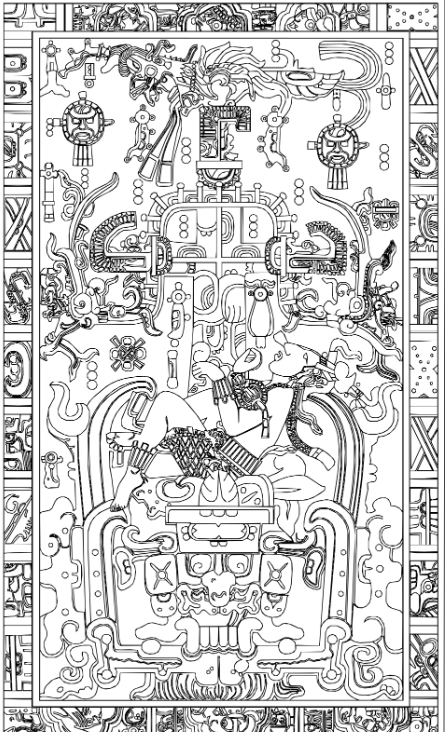
Mayan King Pacal the Great blasts off in his spaceship

And at the heart of the ancient astronaut thesis is the arrogant belief that ancient humans were incapable of the majestic structures they created because they were just stupid primitives without the miracle of alien technology.

It all taught me a valuable lesson – always investigate what the other side say with an open mind. Seek out the contrary view, the one you don’t agree with, the opinion you find deplorable. You never know what you might learn…

Epilogue of the Gods

Erich von Daniken had a colourful past, mostly working in the hospitality industry in Switzerland. He was imprisoned for fraud a number of times, and it was while behind bars that he wrote his best-selling debut Chariots of the Gods?[iii]

After the success of his many books, he opened a theme park in Interlaken, Switzerland called Mystery Park in 2003. The park had pavilions dedicated to various ancient mysteries related to his ancient astronaut thesis – the pyramids, the Nazca Lines, Stonehenge – but closed due to financial issues a few years later.

Theme Park of the Gods? Von Daniken’s Mystery Park design (Swiss Info)

Although von Däniken’s arguments and evidence have been roundly debunked over the decades, he certainly had imagination and vision (if not many scruples) and he filled my young teenage brain with awe and wonder leaving me with a lifelong obsession with the weird

Rest in extraterrestrial peace, Herr von Däniken (1935-1926)

Erich von Daniken (Michal Manas)

[i] Ezekeil 1:1-28

[ii] Genesis 6:4

[iii] The Associated Press, Erich von Däniken, author who spawned alien archaeology theory, dies: Available at: https://www.msn.com/en-gb/news/world/erich-von-d%C3%A4niken-author-who-spawned-alien-archaeology-theory-dies/ar-AA1TZOo2?ocid=socialshare

The Calverley Ghost ~ A Yorkshire Tragedy

“Old Calverley, Old Calverley, I have thee by th’ ears

I’ll cut thee in collops unless thou appears…”

(Chant to raise the spirit of executed child killer, Walter Calverley)

The West Yorkshire village of Calverley became the centre of public attention at Christmas 1904 after reports of a mysterious phantom were widely published. However, the Christmas ghost of Calverley has a long history, involving tales of schoolboys raising the dead, headless horses, exorcism and haunted preachers. The story begins, though, with a horrifying Jacobean murder spree that spawned a grim piece of gory theatre that William Shakespeare may have had a hand in…

A Yorkshire Tragedy

In the West Yorkshire village of Calverley, between Leeds and Bradford, stands Calverley Old Hall, once the family home of the illustrious Yorkshire family that gave their name to the village and the ancient house. It was in the oak-panelled bedroom of this house that Walter Calverley committed his infamous murders in April 1605.

Calverley Hall, Woodhall Road, Leeds by Mark Stevenson

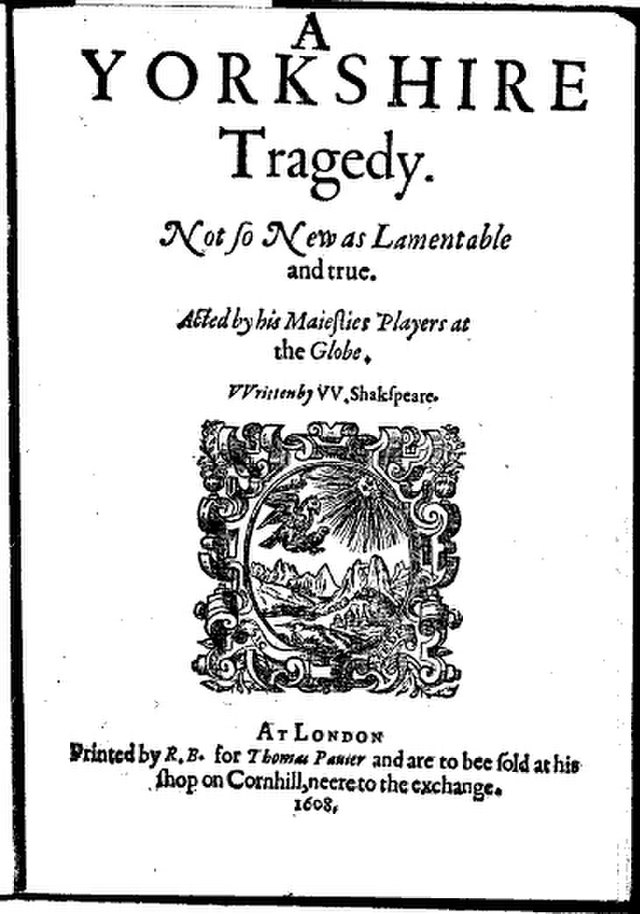
Much of what we know about the Calverley murders comes from an anonymous pamphlet published in 1605 titled Master Calverley’s Unnatural and Bloody Murder. The pamphlet also formed the basis for a Jacobean domestic drama called A Yorkshire Tragedy (1608) which was once attributed to William Shakespeare, though most modern scholars consider Shakespeare’s contemporary Thomas Middleton to be the true author.[1] In any case, the gory drama is perhaps the Jacobean equivalent of a sensational modern serial killer docudrama or true crime show.

Title page of the quarto publication of A Yorkshire Tragedy, 1608 – written by W. Shakespeare (not)

Walter Calverley had been one of Yorkshire’s most eligible bachelors, but after marrying Phillipa Brooke he frittered away his fortune on gambling, riotous parties and various unnamed vices. He took to brooding and raving, blaming his family for his ruinous finances. Deep in debt, despairing and horrified by the thought of his wife and children in penury, he brutally murdered two of his infant sons and attempted to stab his wife to death, though she was saved when her whalebone corset deflected the blade. Calverley was on his way to murder his youngest son who was out to wet nurse, but his horse stumbled and he was caught.

Illustration of the play A Yorkshire Tragedy, from The Works of William Shakespeare (Nicholas Rowe)

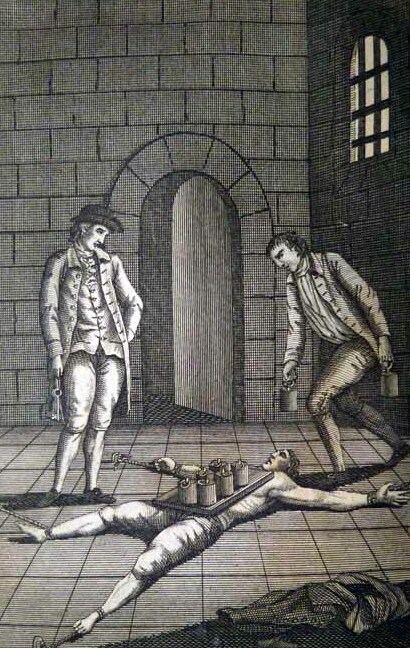
Although he was undoubtedly guilty of the heinous crime, Calverley refused to enter a plea, meaning that his surviving family would not forfeit his estate to the crown. Calverley therefore was sentenced to be pressed to death, a slow and agonising form of execution reserved for prisoners who refused to plead guilty or not guilty. He was stretched out naked with his wrists and ankles tied to a post with a board placed over him. Weights were gradually added to the board to try and force a plea from him. Local lore has it that Calverley defiantly cried, ‘A pound more weight – lig on, lig on’ – ‘lig’ being Yorkshire for ‘lie’. It’s said that a loyal servant took pity on his master and ended his suffering by standing on the board and hastening Calverley’s end. The servant was duly hanged.

Pressed to death 1780 edition of the Malefactor Register

Local legend holds that the bloodstains on the floor of the murder room could never be washed clean, no matter how hard they were scrubbed.  The notorious murders committed in Calverley Hall would echo down the centuries, as the tragic events were retold and embellished and local legends developed.

A Night in the Murder Room ~ The Preacher’s Tale

As the village of Calvery shuddered under the early January snow one Saturday evening in 1777, renowned methodist preacher Richard ‘Dickie’ Burdsall came to deliver a sermon at Calverley Hall.[2]  Afterwards, Burdsall stayed as a guest in the murder room and recorded what happened in his 1797 autobiography.[3]

This is what he wrote:

…and after being asleep some little time, I thought something crept upon me up to my breast, pressing me much; I was greatly agitated and struggled to awake.

Not only was something crawling onto his chest and crushing the life out of him, his bed seemed to swing such that he was thrown upon the floor. He got to his knees and gave thanks that he was unhurt. Fearing for his sanity, he checked there was nothing unusual about the bed before summoning up the courage to get into it again. Twice more, he was violently tumbled onto the floor.

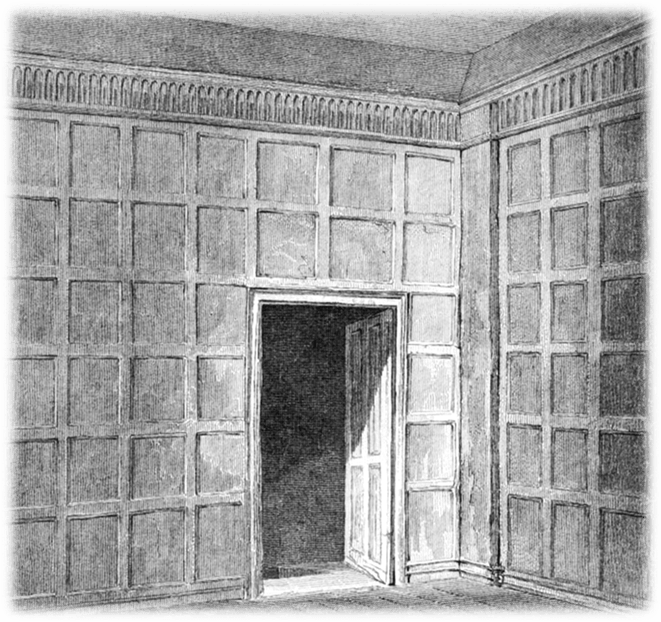
The Murder Room (Loidis and Elmet by Thomas Dunham Whitaker 1816)

By now it was one in the morning, and Burdsall decided that he would not lie down on the bed again and got dressed. On several occasions he went to the bedroom door as if to leave the room, and he was often about to cry out and wake the household, but he finally decided to face his waking nightmare alone. At a loss to explain what was happening to him in this gloomy oak panelled room, he could only conclude that Satan himself was testing his faith. This is how Burdsall described his agonising wait until daybreak:

I longed to see the light of the morning, and had I been immured in a dungeon and heavily fettered in irons I think I could not have been more desirous of my liberty than I was for the return of the morning.

When the wintry light eventually crept through the window of the oak-panelled bed chamber with the dark stains on the floor, Burdsall saw that his room adjoined the churchyard, and below him, under ancient yew trees were the melancholy snow-covered graves of many past inhabitants of this great Yorkshire hall.

Of course, when Burdsall related his nocturnal adventure to his hosts, they informed him of the Calverley murders of 1605. They would also have told him about Walter Calverley’s agonising execution – a demise that seems eerily similar to the preacher’s experience of something crushing his chest.

However, if you’ve ever experienced sleep paralysis, a fairly common sleep disorder, you might recognise elements of Burdsall’s night of terror. When sleep paralysis strikes, nightmarish hallucinations often accompany the feeling that someone – or something – is crushing one’s chest. These waking nightmares feel utterly real, and being paralysed and unable to escape adds to the terror. Perhaps Burdsall suffered an episode of sleep paralysis, and later interpreted it in the light of the murders that had been committed in the room in which he had slept.

Furthermore, we don’t really know how much Burdsall embellished his experience. Historian and Calverley resident Edward Garnett points out that Burdsall somewhat spoiled his story by saying his room looked out onto the graveyard. There is no view of the graveyard from Calverley Hall.[4]

It seems likely that news of Burdsall’s adventure would have spread quickly through the community, and those of a certain age might remember stories their grandparents told them of ‘Owd Calverley’ and his monstrous deeds. And so ghostly legends and traditions, and eventually a Christmas connection, began to emerge.

Ghost Tales

If you were riding across Greengates Beck Bottom in Calverley after dark in the early nineteenth century, you might feel someone leap onto the back of your horse and not leave you until the beck was crossed. This was the ghost of Owd Calverley, according to local ghostlore.

There were also stories that Calverley’s spirit would gallop around the village of a night clutching his bloodied dagger on a headless horse. Sometimes he might be accompanied by the faithful servant who had put an end to his master’s sufferings and paid with his own life. He too, of course, would be on a headless horse. There seems to be no particular reason why the horses were headless, apart from, perhaps, it creates a striking ghostly image.

In any case, as Owd Calverley’s ghost atop his headless horse galloped through Calverley woods, it would cry ‘A pound more weight – lig on, lig on!’ Of course, if the ghost confined itself to the woods, he wasn’t much bother, but he created great consternation if he rode his ghastly horse into the village. Locals say that a skilful exorcist cast a charm that prevented Owd Calverley from passing the church as long as the holly grew green in Calverley Woods.[5]

Nevertheless, many of the village children believed that the murderer’s evil spirit could be raised if you performed a certain ritual. An anonymous correspondent reminisced about his childhood ghost hunts in the Bradford Observer.[6] In order to summon Old Calverley’s spirit, first the children would pile their caps in a pyramid in the churchyard and some pins and breadcrumbs leftover from tea were scattered about. Then the children would hold hands to form a circle around their caps and recite the magic words:

       Old Calverley, Old Calverley, I have thee by th’ ears,

       I’ll cut thee in collops unless thou appears.[7]

Collops are cutlets or slices of bacon.

At the same time as the recitation was being chanted, some of the braver boys would go and whistle through the keyhole of the church door before repeating the rhyme. The correspondent claimed that on one occasion he and his friends saw – or thought they saw – a pale and ghostly figure appear, though they did not stay to have a proper look but fell over themselves in a mad dash to escape the graveyard.

The ghost of Owd Calverley was also thought to have been responsible for a campanological mystery. Around Christmas 1872 the bell in the church tower at Calverley began tolling in the early hours of the morning. They continued ringing for a long time, and the villagers came running from their warm beds into the cold night to see what the matter was. The door to the empty church was locked, but still the bells tolled. For a long time the bells rang on as the villagers searched in vain for the key to the church door. When it was finally located, the bells stopped the instant the key was put in the lock.[8]

Perhaps it was the Preacher’s winter adventure, or the mysterious tolling of the church bells in December 1872 that first connected Calverley’s ghost with Christmas. Or perhaps it’s his name being associated with holly that makes him a seasonal ghost, for the exorcist’s charm made the murderer’s shade avoid the village while the holly trees grew green in Calverley Wood. Or it could just be that everyone loves a ghost story at Christmas.

The Horsforth Man’s Tale

In 1904, some boys started a fire that left twenty acres of the holly trees in Calverley Wood burned black. Could this be why the ghost of Old Calverley chose the Christmas of that year to make his presence known again?

On Sunday 18 December 1904, a gentleman referred to only as ‘the Horsforth Man’ (after a village near Calverley) was walking home past the church yard. It was a cloudy night, though at times pale moonlight peered through the darkness. According to the Yorkshire Evening Post, this is what happened next:

…without any preliminary warnings there was a flash and a phantom-like form floated before the astonished pedestrian. He was all alone, the villagers having long since retired to bed. The apparition then disappeared, and all was quiet again.[9]

The next day the Horsforth Man told a friend who was acquainted with local folklore about his experience. When he heard about the Yorkshire Tragedy, he became convinced that he had seen the ghost of Owd Calverley himself.[10] Of course, the story was widely reported in the local and national media, and many locals embarked on nocturnal ghost hunts in the hope of catching Calverley’s restless spirit.[11]

Epilogue

There was some scepticism about the Horsforth Man’s story, and the anonymity of the witness suggests it may have been a journalistic joke, ‘trading on the credulity of a number of London journals,’ as the Leeds Mercury put it.[12] The Mercury suggested the mysterious Horsforth Man didn’t even exist – and if he did, his spooky experience was a case of one too many festive tipples down the pub.

Calverley Hall is now holiday lets.

The Yorkshire Tragedy lives on as a gory curio in Shakespeare’s apocrypha.

This is an edited excerpt from Phantoms of Christmas Past: Festive Ghost Hoaxes, Ghost Hunts and Ghost Panics by Paul Weatherhead (6th Books).

First published in Northern Life Magazine


[1] R. V. Holdsworth ‘Middleton’s Authorship of A Yorkshire Tragedy’, The Review of English Studies, 45:177 (1994), pp.1-25

[2] ‘A Christmas Ghost’, Yorkshire Evening Post, 21 December 1904, p.4.

[3] Richard Burdsall, Memoirs of the Life of Richard Burdsall, (York, 1797), pp. 118-123

[4] Garnett, (1991) p.75

[5] ‘Tragical Story’, Christian World, 1 December 1868, p.10; ‘More about the Calverley Ghost’, Yorkshire Evening Post, 24 December 1904, p.4

[6] ‘Calverley Forty Years Ago’, Bradford Observer, 28 March 1874, p.7

[7] Ibid

[8] John H. Ingram, The Haunted Homes and Family Traditions of Great Britain (London: Gibbings and Company, 1897), p.399

[9]A Christmas Ghost’, Yorkshire Evening Post, 21 December 1904, p.4

[10] ‘A Christmas Ghost’, Cheshire Daily Echo, 21 December 1904, p.3

[11] ‘More about the Calverley Ghost, Yorkshire Evening Post, 24 December 1904, p.4

[12] ‘Alleged Apparition at Horsforth’, Leeds Mercury, 24 December 1904, p.13

A Titanic Christmas Coincidence?

It’s Christmas 1892, and controversial newspaper editor W.T. Stead has just published a short story titled ‘From the Old World to the New’. The story involves a massive ocean-going liner called the Majestic and a tragedy at sea. As the Majestic sails through dense fog crossing the Atlantic, a psychic passenger has a dream about a ship hitting an iceberg and sinking:

“…last night, as I was lying asleep in my berth, I was awakened by a sudden cry, as of men in mortal peril, and I roused myself to listen, and there before my eyes… I saw a sailing ship among the icebergs. She had been stoved in by the ice, and was fast sinking. The crew were crying piteously for help: it was their voices that roused me. Some of them had climbed upon the ice; others were on the sinking ship, which was drifting away as she sank. Even as I looked she settled rapidly by the bow, and went down with a plunge. The waters bubbled and foamed. I could see the heads of a few swimmers in the eddy. One after another they sank, and I saw them no more… Then, in a moment, the whole scene vanished, and I was alone in my berth, with the wailing cry of the drowning sailors still ringing in my ears…”[i]

Another psychic passenger has the gift of automatic writing and is in telepathic contact with a friend who was stranded on an iceberg after his ship has gone down. These two psychics then have to convince the captain to rescue the survivors of the accident.

A giant ocean-going liner crossing the Atlantic. Fog. An iceberg. A disaster at sea… All this is an eerie foreshadowing of the Titanic’s fate twenty years later. Stead set his story aboard the real White Star liner Majestic. At the time Stead wrote the story, the Majestic’s actual captain was Edward J. Smith — the same man who would later command, and die aboard, the Titanic on 15 April 1912.

Captain Edward Smith aboard the Titanic 10 April 1912

The man who wrote this eerily prescient story, W.T. Stead, was a pioneer of tabloid style journalism, even having spent time in prison for purchasing a child in order to demonstrate that this practice was common in London in his famous ‘Maiden Tribute of Modern Babylon’ campaign against child prostitution.  His sensational articles resulted in the age of consent for girls being raised from 13 to 16, the law coming to be known as the Stead Act. In the 1880s, along with many scientists and intellectuals of the time, he became fascinated by Spiritualism and mediums, a fascination seen in his story about the psychics at sea.

Like Arthur Conan Doyle, Stead’s attraction to Spiritualism and its colourful rogues gallery of charismatic mediums was understandable. Both men had lost sons in the Great War.[ii]

However, Stead’s story about the maritime disaster has a macabre twist. W.T. Stead was one of the 1,500 or so souls who perished when the Titanic hit an iceberg and sank below the Atlantic in 1912. He was last seen heroically giving his lifebelt to another passenger.

The Blue Island

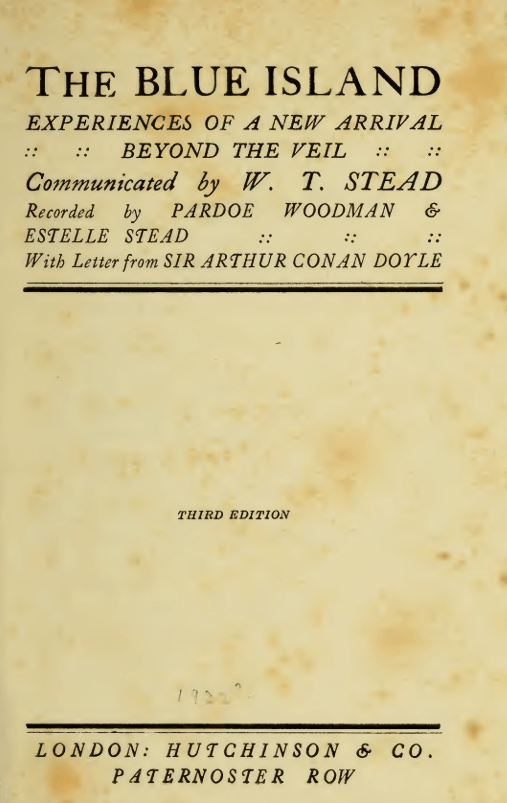
Of course, given Stead’s interest in Spiritualism, the ghost-botherers just wouldn’t let him rest in peace. Stead supposedly wrote a book from beyond the grave called The Blue Island: Experiences of a New Arrival Beyond the Veil, in which he detailed his adventures in the afterlife to Spiritualist medium Woodman Pardoe. Pardoe supposedly channelled Stead’s account of the afterlife using the technique of automatic writing, and the book was coauthored by Stead’s daughter Estelle who was a keen Spiritualist.[iii]

The Blue Island – supposedly written by W.T. Stead after his death on the Titanic

So what happened to Stead after he died on the Titanic?

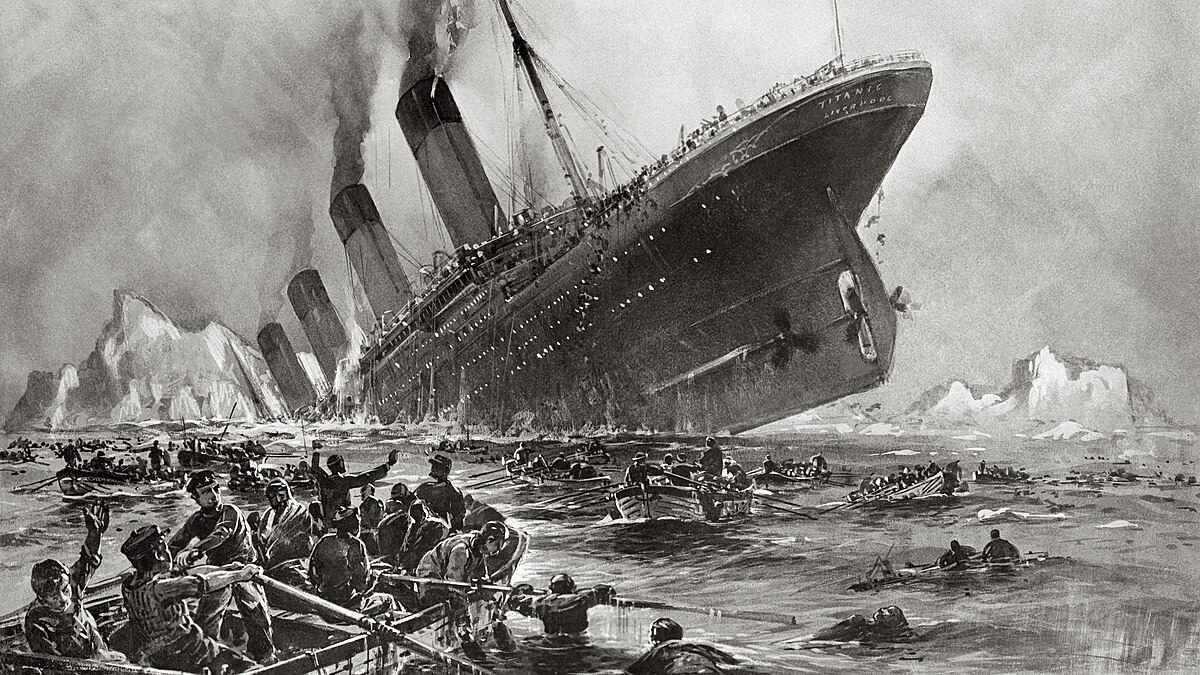
On realising he’s dead and that everything he’d read about the afterlife was correct, being a true journalist, he longs for access to a telephone so he can phone in the news headlines. He describes the scene from his vantage point above the Atlantic:

“A matter of a few minutes in time only, and here were hundreds of bodies floating in the water – dead – hundreds of souls carried through the air, alive… Many, realising their death had come, were enraged at their own powerlessness to save their valuables. They fought to save what they had on earth prized so much…”

Titanic Sinking by Willy Stower

When all who had perished are present and correct, some kind of astral mass transit system shoots them up into the air at terrific speed as if they’re standing on some kind of platform. Minutes later, they find themselves in a place of light and beauty where they are greeted by the souls of dead friends and relatives. This is the Blue Island, a kind of holiday camp for spirits of people who had died suddenly to help them relax after their traumatic passing.

Stead was greeted by his dead father and an old friend and shown around the Blue Island, populated by souls of people of all races. ‘Life’ there goes on as normal. People eat, sleep and smoke out of habit until they gradually begin to lose the desire to do so. They engage in their hobbies and pastimes, though soon feel pulled towards studying esoteric and spiritual matters.

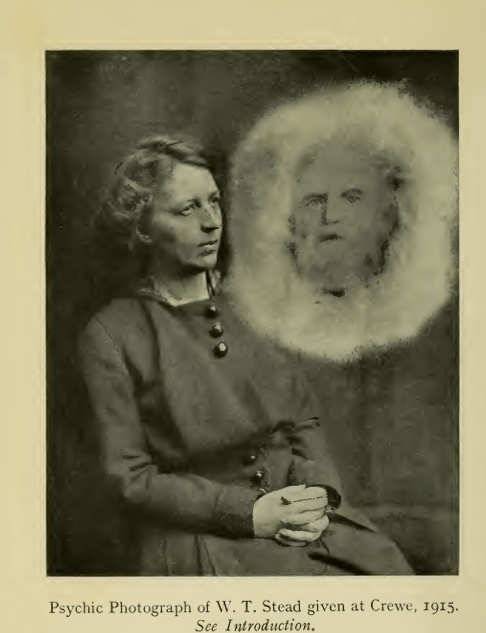
Stead spent much of his time in a building that was like a spiritual telecommunications hub where souls could contact mediums on the earthly plane and either appear before them as ghosts or send them messages. There he managed to telepath his face on to spirit photo, which I think is probably referring to the one below, taken in Crewe in 1913 or 1914.

Proof of life after death or a crude fake? You decide!

Stead visited other higher planes of existence, though only vague accounts are given in the book.

The Real World

When souls are ready, they can leave the Blue Island to what Stead calls the Real World, their permanent residence in the afterlife. The Real World is very much like Earth with the same animals and plants, and the souls there spend their time developing spiritually and discarding any remaining Earth habits while still indulging in their favourite hobbies and pastimes. Here, you can live in a palace if you want, though you must earn this through spiritual development.

Advanced Spiritual Instructors interview everyone individually and in great detail about their life on Earth and every misdeed or unworthy thought they have ever had. Penance for all this is contact with Earth until your debt is considered paid.

Next, Stead tells us, souls progress to a ‘stay or go’ sphere. Here, depending on your spiritual progress you will have the option (or be obliged) to be reincarnated on Earth to learn the lessons you have yet to learn. Judging by the contents of the Blue Island, these lessons consist mostly of rambling spiritualist gobbledygook. The book was marketed as a Christmas gift, and everyone loves a festive ghost story. Speaking of which…

Epilogue

The same year that Stead wrote his prescient short story, he became interested in a notorious Christmas poltergeist episode in Peterborough involving mysterious lights, terrifying noises, spirit messages, witchcraft and a fiery hound from hell… You can read all about it in my latest book Phantoms of Christmas Past: Festive Ghost Hoaxes, Ghost Hunts and Ghost Panics.


[i] W. T. Stead “From the Old World to the New” The Review of Reviews December 1892

[ii] W. Sydney Robinson, Muckraker: The Scandalous Life and Times of W.T. Stead (London: The Rodson Press, 2013)

[iii] Pardoe Woodman and Estelle Stead, The Blue Island (London: Hutchinson and Co, 1922)

For more resources on Stead see https://attackingthedevil.co.uk

Stoned Spooks and Other Ghosts That Time Forgot…

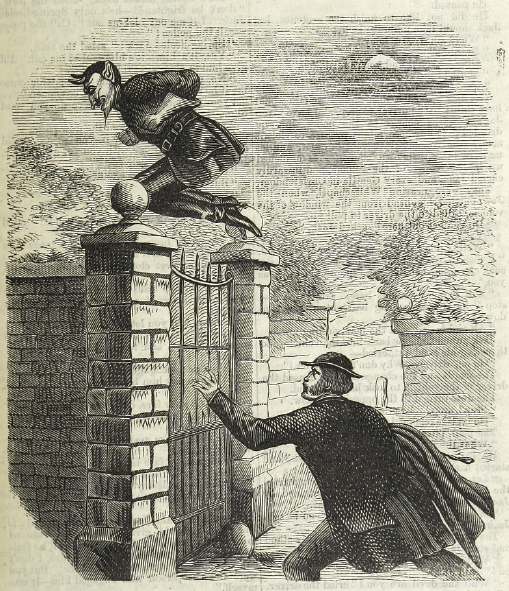
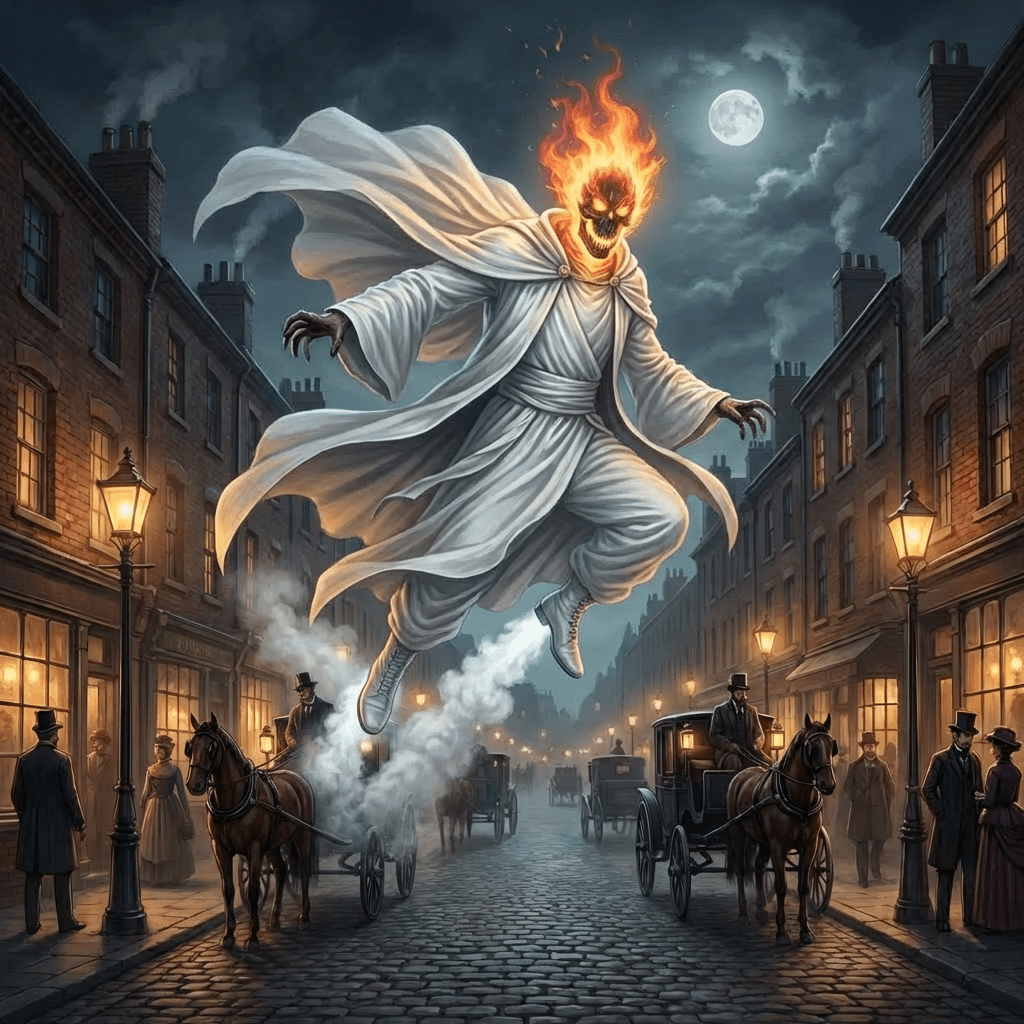
As Halloween approaches, our thoughts often turn to ghostly matters. I’ve long been fascinated by the forgotten phenomenon of ‘playing the ghost’ – dressing as a ghost and hanging out in spooky locations to scare the wits out of passersby. Sometimes the pranksters wore just a white sheet over their heads, though some would use devil masks, animal skins, outlandish clothes and luminous paint to create more imaginative spooks.

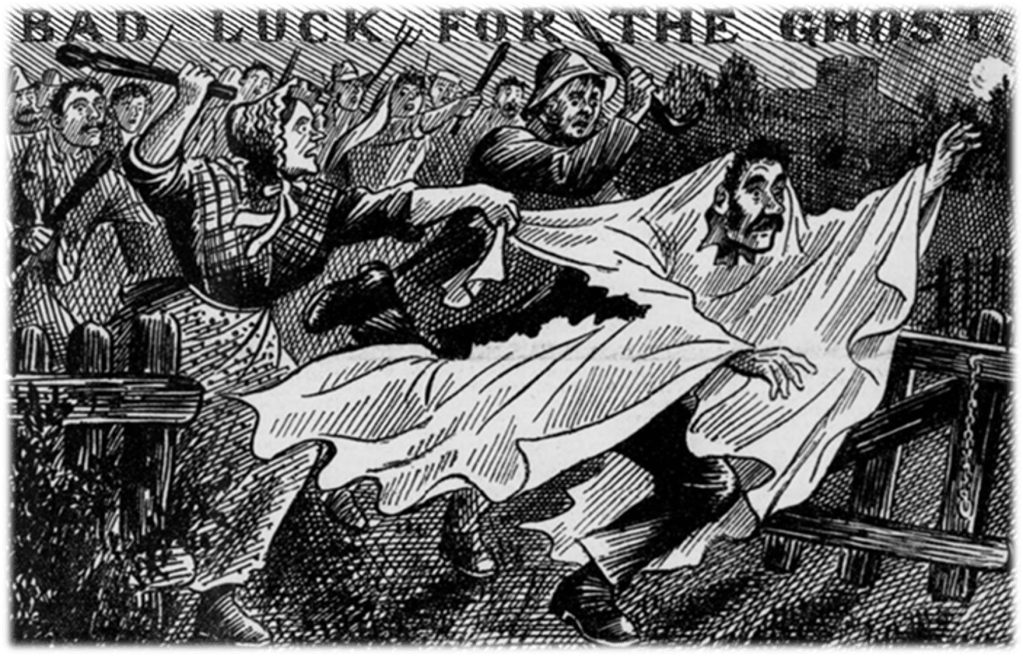
Often gangs of young men would patrol the streets hoping to catch the ghost and give him a well-deserved drubbing. These ghost hunts would frequently degenerate into a drunken riot with the ghost hunters dressed as women hoping to honey trap the ghost into attacking them.

This strange hobby of playing the ghost was rife throughout the nineteenth and early twentieth centuries, and some of the episodes were immortalised by images from the tabloid known as Britain’s worst newspaper, The Illustrated Police News.

Giant Ghosty Scares the Postie: The Garstang Ghost (1881)

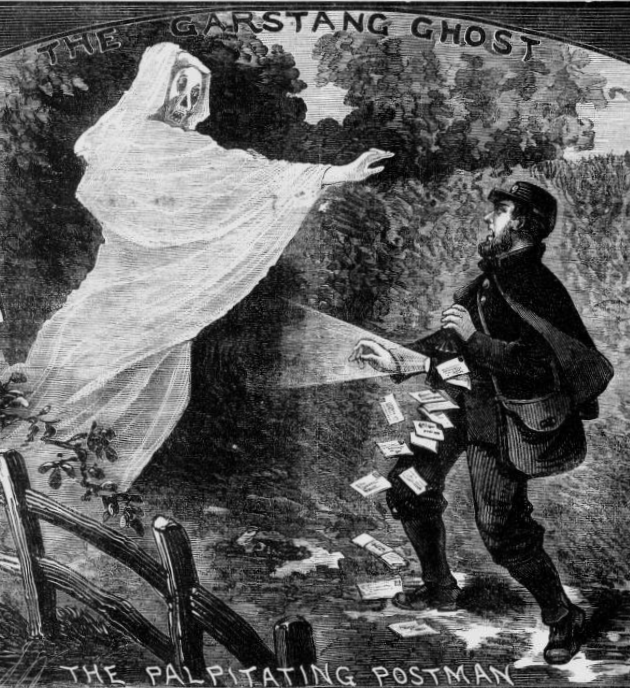
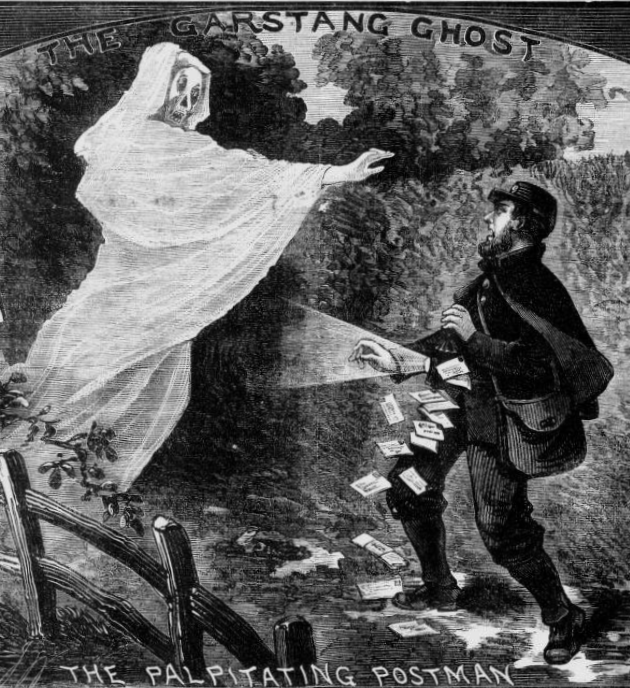
In September 1881, an unnamed postman was on his way to pick up the mail that was arriving on the night train to Garstang, near Preston in Lancashire. As he walked down the dark country lane, a white ghostly figure appeared before him. It was, according to press reports, of ‘abnormal stature’ and a ‘horrid pallor of hue’. The figure seemed to be giving mysterious and portentous signs in a ‘variety of terror-striking gestures….’

The moment is captured in a drawing from the Illustrated Police News depicting the poor ‘palpitating postman’ dropping his letters as the giant spectre looms over him.

The Garstang Ghost in the Illustrated Police News 10 September 1881

The postman took the ghost’s gestures as a warning not to proceed and he turned and fled. So terrified was he that he gave up his job rather than risk encountering this fearsome vision again.

The ghost was also encountered by a young servant girl. She described its fearsome height, its white robes and ominous gestures. She threw her apron over her head and ran home. We are told that she has not spoken since and retired to bed in shock.

Each night gangs of young men armed themselves with stout cudgels and patrolled the streets of the town, though it seems it was never caught. Lucky for him. When ghost hoaxers like this were caught, they were often badly beaten and dumped in the nearest canal, river… or sewer.

The press reported a few days later that the ghost had disappeared, and that the suspect was a resident of nearby Barnacre.[i]

Ghost Gets Stoned: The Woolwich Ghost (1897)

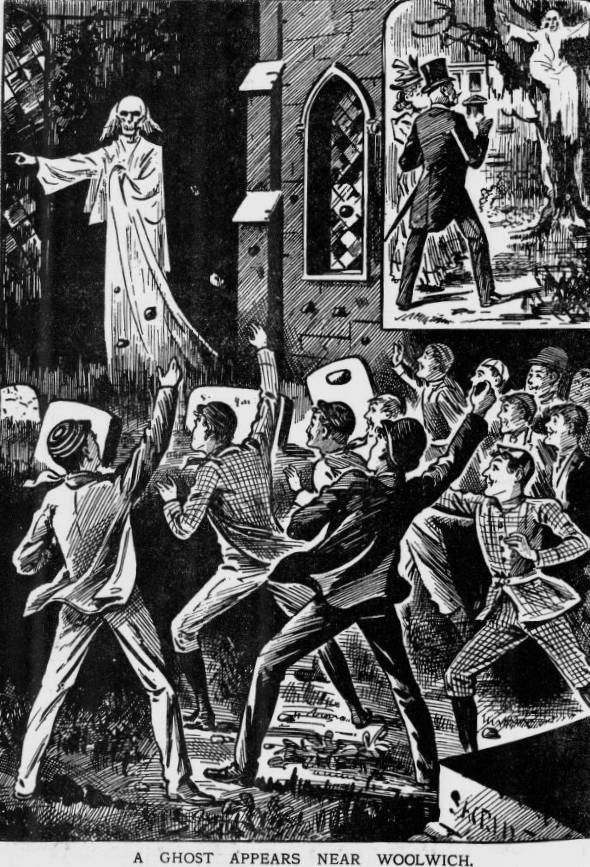
As Halloween approached in 1897, the children attending the schools in the grounds of Saint James’ Church, Plumstead in London got the fright of their lives. A ghostly figure in white was seen by several pupils who were so scared they had taken to their beds.

As news spread, a gaggle of around 100 young lads turned up on subsequent nights waiting for the ghost to reappear. When it did, the boys employed ‘the usual tactics of Plumstead lads’, in other words, ‘throwing stones and bad language’. The stone throwing broke several windows in the grounds.

Schoolboys pelt the Woolwich Ghost in the Illustrated Police News 6 November 1897

Three constables soon arrived and arrested the ringleaders of the boys who were later charged with disorderly conduct, and the ghost fled the scene.

Later, the ghost was seen in similar white attire up a tree in the garden of Mr Jolly a Justice of the Peace. The culprit turned out to be a cycle maker who was committed to an asylum by his friends for his own safety before he could be arrested. The man was described as being of Herculean strength and it took several police officers to get him out of his house.[ii]

Impromptu ghost hunts like this were often carnivalesque and transgressive. It would have been very tempting for many of the boys to deliberately miss the ghost and put a rock through the school window as an act of rebellion.

Naked Lady Ghost Gets Stoned (1887)

Exactly 10 years earlier, there was another ghost stoning in the Woolwich area. Rumours spread that a naked lady ghost was appearing in the upstairs window of a shop on the corner of Ogleby Street.

Hundreds gathered around the shop, including gangs of young lads. When someone shouted ‘there she is!’, the boys unleashed a volley of stones at the window. Hundreds more gathered and blocked the whole street the following night and the police found it difficult to keep order, especially when the cry of ‘there she is’ rang out and the gangs of youths began hurling stones.

These episodes continued for a week, with the region said to be in a ‘perpetual ferment’ over the naked lady ghost and the rock-throwing youths. Eventually, two teenage boys who were taken to be the ringleaders were arrested and charged with disorderly behaviour. They were given seven days in prison.

Mrs Marsh, the landlady of the shop, said that if anyone was seen in the windows it was probably one of her lodgers, though they denied any trickery.  Mrs Marsh also told the press that someone had come into her house and walked along the corridor moaning in a ghostly fashion.

There’s some indication that Mrs Marsh and her lodgers didn’t get on, so it’s quite possible the episode was caused by one of them pretending to be a ghost in front of the upstairs window. More plausibly, based on the press accounts, the rumours may have been maliciously started by the gangs of stone throwing teenagers.[iii]

Epilogue

Did I mention I’ve got a new book out? It’s called Phantoms of Christmas Past: Festive Ghost Hunts, Ghost Hoaxes and Ghost Panics. It features forgotten true stories of Christmas ghost hoaxes that are dark, comic, tragic and bizarre.

And it’s never too early to start your Christmas shopping!

Available wherever you get your books from, or online here.


[i] ‘A Troublesome Ghost’, Staffordshire Sentinel, 5 September 1881, p.4:  ‘The Ghost at Garstang’, Preston Chronicle, 10 September 1881, p.6; ‘A Ghost at Large’, Illustrated Police News, 10 September 1881, p.4: ‘Disappearance of the Garstang Ghost’, Lancaster Gazette, 21 September 1881, p.2;

[ii] ‘A Ghost at Plumstead’, Brockley News, 29 October 1897, p.4; ‘A Ghost Appears Near Woolwich’, Illustrated Police News, 6 November 1897, p.6

[iii] ‘Woolwich Ghost’, Greenwich and Deptford Observer, 12 August 1887, p.5; ‘A Ghost Story at Woolwich’, Kentish Mercury, 12 August 1887, p.5; ‘Stoning the Woolwich Ghost’, Greenwich and Deptford Observer, 19 August 1887, p.2

The Pudsey Bitch Daughter

The West Yorkshire town of Pudsey, about halfway between Leeds and Bradford, famously gave its name to Pudsey the Bear in the BBC Children in Need charity campaigns. But it also gave its name to a far more sinister figure that haunted the nightmares of many: the Pudsey Bitch Daughter…

You find yourself suddenly awake in the middle of the night unable to breathe. Panic turns to terror as a sinister figure approaches your bed and climbs on top of you as you lie utterly paralysed and unable to cry out. As the figure kneels on your chest crushing the life out of you, you see the horrible leering face of a witch and clutched in her hand is a carving knife which she raises above her head, and as you watch on spellbound in immobile horror, she plunges it into your thudding heart. You have just encountered the Pudsey Bitch Daughter.

The only historical reference I can find to the Pudsey Bitch Daughter (or ‘Dowter’ in local dialect) is in Joseph Lawson’s 1887 book Letters to the Young on Progress in Pudsey During the Last Sixty Years.[i]This suggests belief in – or at least an awareness of – the Pudsey Bitch Daughter lasted well into the early to middle nineteenth century.

But who or what was the Pudsey Bitch Daughter?

Bitch Daughters

The Bitch Daughter was a common name for a demonic witch-like figure that was said to sit upon her victim’s chest and suffocate them. A common expression was to be ‘ridden by the bitch daughter’ – in other words, to have suffered an attack from this nocturnal entity.[ii]

These attacks are what we call today sleep paralysis: your body in immobilised as it would be when you’re dreaming, but you feel fully conscious. Being paralysed increases the feeling of panic, and the sleep disorder is often accompanied by frighteningly real hallucinations or a sense of a malignant presence in your bedroom.

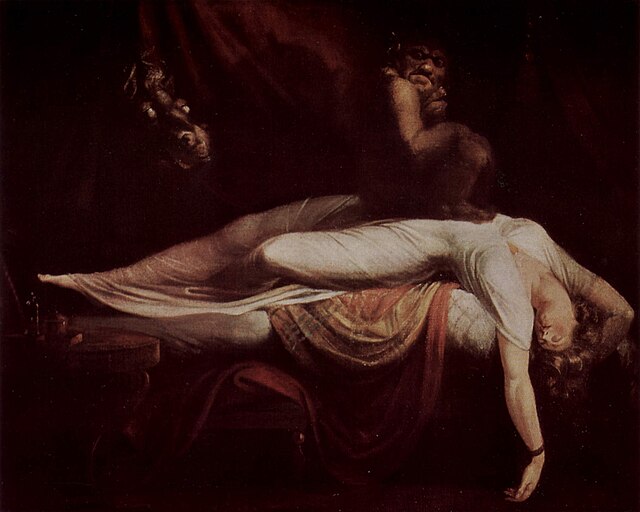
Henry Fuseli’s The Nightmare

The experience is fairly common. One study found that around a third of college students had experienced a bout of sleep paralysis.[iii] However, other studies get very different results, and this may be down to how questions in surveys are phrased, how such experiences are viewed in the local culture or innate or cultural differences in prevalence in populations.

The experience of sleep paralysis has a common core of characteristics: feeling unable to move, negative emotions, a sense of a sinister presence and a tightness in the chest. However, the entities involved differ across cultures. In Newfoundland, it would be a hideous hag, in China it might be a ghost, in Egypt it could be a jinn and in Japan a demon.

In Europe a few centuries ago, experience of sleep paralysis would be explained as a visit from an incubus or succubus – horny demons that would have sex with their sleeping victim.

The Bitch Daughter is another way of describing these experiences, with the Pudsey Bitch Daughter being a local variant on this.

Is it the case that the experiences of sleep paralysis create the folklore around these entities, or does the retelling of these stories of nocturnal attacks make a population more likely to interpret sleep paralysis with reference to the folklore?

It’s hard to tell, and the influence may run both ways. In my own experiences of sleep paralysis (see link below), I saw a monkey faced demon sitting on my chest and crushing the life out of me. But I can’t help but wonder if this was influenced by a painting known as The Nightmare by Henry Fuseli from 178I which I was familiar with from the cover of the Penguin Classics edition of Frankenstein.

Hag Stones

So how would the good people of Pudsey go about protecting themselves from the Bitch Daughter?

It’s likely that they used hag stones – pebbles, slates, flints or other stones with a natural hole in them. These would be tied to the bed with some string through the hole in the stone to ward off evil hags like the Pudsey Bitch Daughter who were wont to attack helpless victims in their sleep. Some folklore says the stones must be stolen or given to be effective, rather than found oneself, though in the available accounts it seems clear that they were passed down in families and this was thought to increase their potency.

A hag stone… don’t know where, don’t know when

In Yorkshire, the magic was said to be inactive until or unless the string or cord was looped through the hole and a knot tied. Furthermore, a new string had to be tied in place before cutting an old worn out one, or the magic would dissipate.

Troublesome demonic witches like the Pudsey Bitch Daughter not only haunted people in their beds. When horses were found in their stable sweating and mysteriously exhausted in the morning, it might be assumed that the animal had been ridden by witches throughout the night. A hag stone hung in the stable was thought to offer protection.[iv]

Hag stones were convenient folk magic. No rituals, blessings or magic words required. No priest, cunning man or wise woman need be employed. You didn’t even have to look for one – they were said to only work if you hadn’t been purposefully searching for one. All you did was tie a piece of string through the hole and hang it in the desired place.

Although the Pudsey Bitch Daughter has vanished into history, hag stones have not. They were still in use in parts of rural Yorkshire in the early twentieth century to guard against witchcraft.[v]

Occultist Aleister Crowley was rumoured to have cursed the town of Hastings so that whoever tried to leave would be condemned to eventually return there. The only way to escape was to take a stone with a hole in it – a hag stone – from the beach, according to local legend.[vi]

Epilogue: The Hat Man

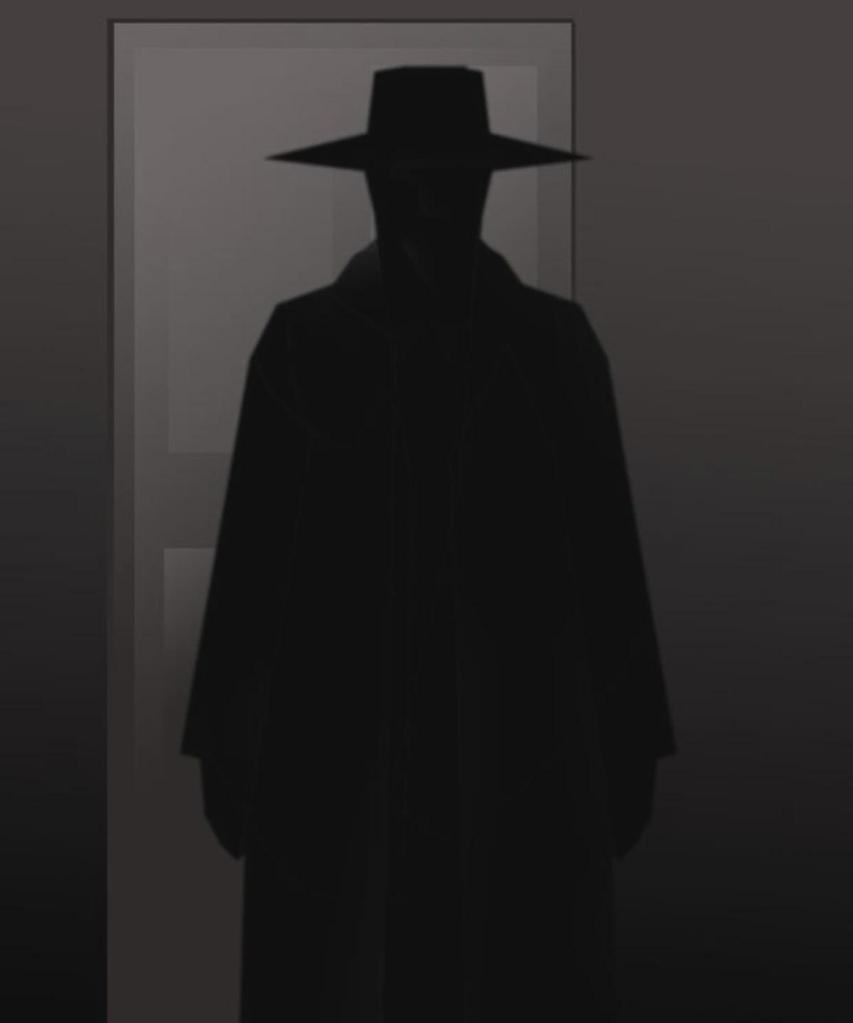
Although the Pudsey Bitch Daughter remains elusive, she is part of a tradition of shadowy entities inhabiting the edges of our consciousness. In recent years, the Hat Man has emerged as a sinister figure haunting people’s nightmares. Victims have described this mysterious humanoid figure with his trademark Freddie Krueger fedora appearing before them when they suffered from attacks of sleep paralysis or when they had taken too much Benadryl, an over-the-counter anti-allergy medication.  

Artist’s impression of the sinister sleep paralysis demon the Hat Man (Amanda Aquino 2001)

Personal accounts with the Hat Man have spread since the early 2000s and become a popular internet meme.[vii] This has allowed it to spread far and wide across cultures far more effectively the Pudsey Bitch Daughter could ever dream of.

So if you happen across a stone with a hole in it, pick it up and take it home. It might get you a better night’s sleep…

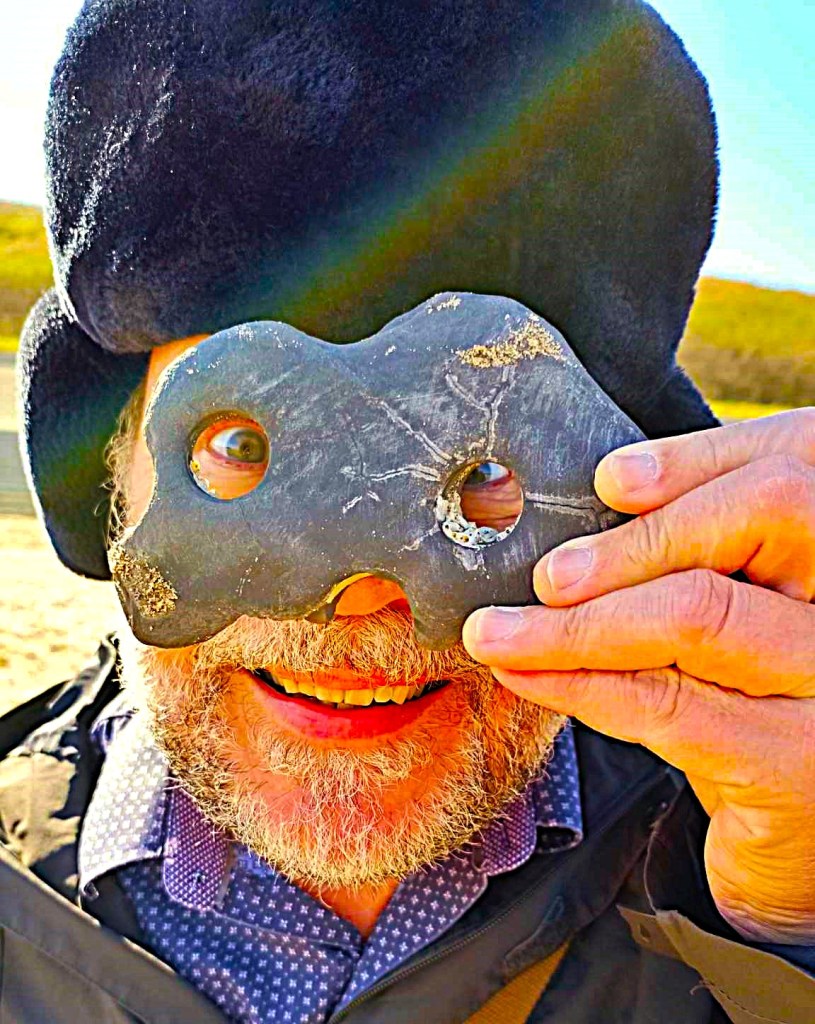
The author with a double hag stone found on the Yorkshire coast

For my adventures with sleep paralysis and a demon haunted light switch, see here

For more horny demons, see here


[i] Joseph Lawson (1887). Letters to the Young on Progress in Pudsey During the Last Sixty Years, p.49

[ii] Karen Stollznow (2024). Bitch: The Journey of a Word (Cambridge University Press), p.26

[iii] G. Benham, (2020). ‘Sleep paralysis in college students’, Journal of American College Health, 70(5), 1286–1291. https://doi.org/10.1080/07448481.2020.1799807

[iv] J. Geoffrey Dent (1965). ‘The holed stone amulet and its uses’, Folk Life, 3(1), pp.68-78, doi:10.1179/flk.1965.3.1.68

[v] ‘Guard against witches’, Yorkshire Evening Post 12 April 1927,  p.7
[vi] https://www.hastingsinfocus.co.uk/2021/10/26/crowleys-curse-you-can-check-out-any-time-you-like-but-you-can-never-leave/

[vii] https://knowyourmeme.com/memes/the-hatman

Croydon Cat Killer: Mystery Solved!

A maniac is stalking the streets of Croydon, killing and dismembering cats and leaving the remains in a gruesome display to maximise the shock and horror when the corpse is discovered by owners.[i] Over 500 cats have so far fallen victim to the maniac, and the killer is likely a psychopath who will sooner or later start taking human life.

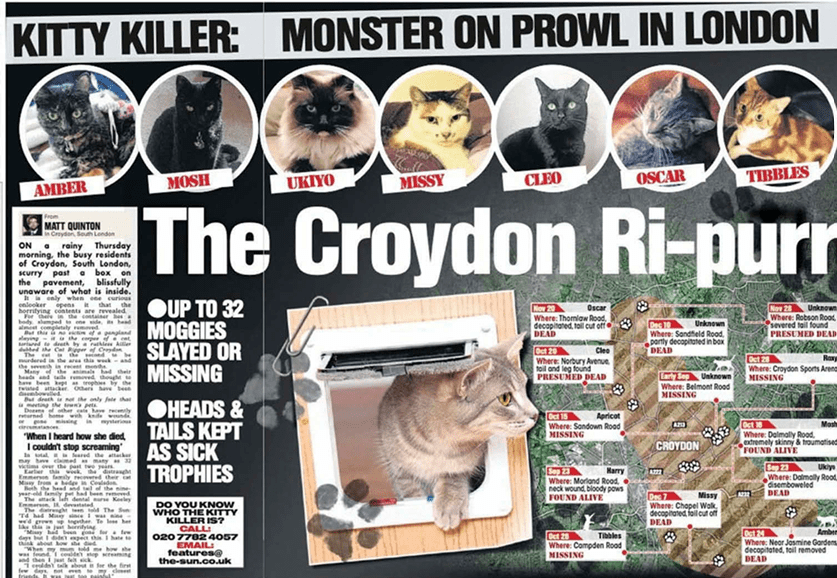
Newspapers and local TV stations interviewed distraught owners and showed photos of the unfortunate pets. At the same time, tabloids found puns impossible to resist. The Sun referred to the Croydon Cat Killer as ‘Jack the Ri-purr’ and the Purrminator’.

The Sun 11 December 2015

I researched and wrote about the history of pet killing panics, including the one in Croydon in the book I co-wrote with Robert Bartholomew, Social Panics and Phantom Attackers, so I’ve spent a lot of time examining this and similar episodes.

 So, let’s solve the mystery of the Croydon Cat Killer…

The Croydon Cat Killer

First, the good news. There is no Croydon cat killer, despite the unquestioning media reports, social media posts, podcasts and animal charity campaigns. The Croydon Cat Killer doesn’t exist.

A 2022 study published in the journal Veterinary Pathology examined the corpses of 32 ‘victims’ of the Croydon Cat Killer. The postmortems revealed that fox DNA was present in all cases, though only ten kittens had actually been killed by foxes. Eight of the cats had died of heart failure, six had been hit by traffic and the others had died from liver failure or from ingesting poison. Foxes had mangled all of the corpses. There was no human involvement.

Expert in fox behaviour Stephen Harris came to similar conclusions. Foxes will often chew off heads and limbs from roadkill, leaving the carcass looking as if it had been deliberately displayed.

The Sun 28 September 2018

Pet killer panics have been happening for over a century and tend to follow a pattern. First there is a cluster of mysterious pet deaths. These are reported in the media (or social media). A figure of authority – usually a vet or someone from an animal charity – states that the deaths were deliberately caused by humans. More and more cases are reported, police investigate but find nothing. An individual or small group (what sociologists might call ‘moral entrepreneurs’) then task themselves with catching the killer, seeing themselves as intrepid detectives on the hunt for an evil pet killing maniac. They spread the word through media campaigns and the fear of the mythical pet killer spreads. Finally, it all blows over, only to reappear some time later in another town.

The Croydon panic began in 2014 when a number of mutilated cats were reported. Many concluded that there must be a cat-hating serial killer on the loose – why else would the cats be mutilated and left for the devastated owners to find? The catalysts in the Croydon panic were founder members of animal charity SNARL, Boudicca Rising and Tony Jenkins, and they made it their mission to put a stop to the killings. After a cat was found mutilated, Boudicca and Tony would arrive at the grisly scene like Moulder and Scully from the X-Files investigating a mystery.

Tony Jenkins and Boudicca Rising (Metro 28 August 2025)

They’d interview distraught owners, take photos of the remains and search for clues. Tony’s freezer was stuffed with the dismembered corpses of cats so they could get postmortems done. When the postmortems showed no human DNA on the cats, Boudicca and Tony concluded that the killer must be forensically aware.

When you’re in the grip of a phantom attacker panic, you don’t believe what you see, you see what you believe, and that was what was happening to Boudicca and Tony. Tony would claim that the cuts made in the cat carcasses examined were ‘too clean’ to have possibly been caused by foxes scavenging, echoing the claims made by UFO believers that cattle mutilations were too clean to have been done by scavengers so must have been done with an alien laser. However, corpses bloat and burst, giving the impression of a surgical incision, and this likely explains the apparently clean cuts found in some of the cats.

Nevertheless, and despite regular debunking of the Croydon Cat Killer myth, Boudicca Rising and Tony Jenkins continue their campaign to catch a non-existent maniac. Newspapers, podcasts and radio and TV documentaries continue to follow them and give their campaigns publicity. Their new charity, SLAIN (South London Animal Investigation Network), is again popping up in news reports with eager journalists lining up to go out with them on night patrol hunting for the killer.

Satanic Cat Killers

Strangely, a very similar cat killing panic occurred in the Croydon area in the 1990s. This time, when mutilated cats were found, rumours spread that Satanists were using the pets in depraved rituals. Stephen Harris, the fox expert referred to above, described how police delivered a sack of headless cats to him and asked him to investigate. He concluded that most of the cats had been run over and then scavenged by foxes, whose weak jaws mean they often gnaw heads, tails or limbs off roadkill they find. The police had spent 13 months hunting for a coven of cat killing Satanists that didn’t exist.

Epilogue: The Dog Question and the Cat Question

Pet killing panics tend to reflect the concerns and anxieties of the time. In Weird Calderdale, I wrote about the Halifax Dog Poisoner episode of 1899 when a number of prize hounds were found apparently poisoned. A vet, the appropriately named Mr Walker, told the press that he was sure that there must be a maniac with a hatred of dogs at large in Halifax, though in the end the poisonings seemed to stop. It was more likely that dogs were dying of natural causes or had ingested some arsenic probably intended for rats. In any case, just like Boudicca Rising and Tony Jenkins in the Croydon episode, Mr Walker is the expert who really gets the panic going.

The Halifax Dog Poisoning panic spread in the context of what was called ‘the Dog Question’ – should dogs be allowed to roam free in the streets? Should they be muzzled in case they attack a child? What about the dangers of rabies? There was intense public debate and concern about dog ownership at the time, especially as raising prize-winning animals and entering them into competitions (‘dog-fancying’ or ‘the Fancy’ as it was called) was particularly popular in Halifax and other northern industrial towns at the time.

In recent years, though, the Cat Question has emerged. Should cats be kept as house pets, or should they be allowed to freely roam, knowing that they will likely hunt and kill birds and other wildlife? Outdoor cats are also more likely to become ill, be run over, get lost or decide to adopt another owner in another house. The average lifespan of an indoor cat is 12-15 years. The average lifespan for a cat allowed to go outside is 2-5 years.[ii]

And it’s not psychopathic kitty killers that are responsible for this. As we argued in Social Panics and Phantom Attackers: ‘Allowing the death of one’s cat to be projected onto a depraved cat slayer may reflect anxiety and guilt about the cat’s role as predator and the pet owner’s responsibility for their own cat.’[iii]

Of course, people are capable of great cruelty to animals and it’s well-known that some psychopathic serial killers started on animals before moving on to humans. There are some real cases of sadistic cat killers. But the Croydon Cat Killer has all the signs of being a phantom attacker panic, a kind of hysteria where the community fears an imaginary monster lurking in the shadows – a bogeyman that reflects their own fears and anxieties.

Two things are clear from my research on pet killing panics. The first is that charismatic, well-meaning and dedicated animal charity volunteers are very often central to the spread. They collect ‘evidence’, organise online campaigns and get media coverage, but one can doubt their expertise in forensics. As I said, during phantom attacker panics, people see what they believe rather than believe what they see.

The second is that panics like these come and go and lessons are never learned. The Croydon Cat Killer will have another day in the sun as a number of podcasts and a BBC radio documentary come out. But the bubble will burst and it will all blow over – until the next time. As the Purrminator said: I’ll be back!

Ozzy my new kitten

[i] Brooke Davies, ‘Is the Croydon cat killer back? Gruesome incidents hint “he never went away”’, Metro, 28 August 2025. Available at: https://metro.co.uk/2025/08/28/croydon-cat-killer-back-data-shows-never-left-23914052/

[ii] https://vetexplainspets.com/indoor-vs-outdoor-cat-lifespan/

[iii] Robert Bartholomew and Paul Weatherhead, Social Panics and Phantom Attackers (Palgrave Macmillan: 2024), p.270

Playing the Ghost

Imagine walking alone late at night along a lonesome dark avenue with a church yard full of teetering gravestones on one side of you and the jagged remains of a crumbling church on the other. Ahead of you in the gloom, you see a white figure glowing eerily, cavorting and striking dramatic poses while emitting melancholy groans.

He seems to be draped in a white sheet and covered in luminous paint. He’s sporting devil horns and wearing an animal mask. Perhaps it’s someone having a drunken lark, you think. But could it be a maniac who means you harm – why else would he be lurking among the tombs in the dead of night? Or, quite possibly, the dark gloomy atmosphere and your jangling nerves convince you that it’s a spirit from beyond the grave…

What would you do? It would take courage to continue on your way, ignoring the prancing, moaning figure in white. Would you turn and run? Would you assume it’s a prankster and attempt to pull off his ghostly disguise and deliver a punch to the miscreant’s nose?

This is a dilemma faced by countless individuals throughout the nineteenth and early twentieth century when such ghost hoaxes were ubiquitous. The practice of ‘playing the ghost’ as the press called it was so common that almost every town in the country suffered from it regularly. These hoaxes are a strange but largely forgotten slice of weird history, and one that’s fascinated me for a long time.

Perhaps because of the lengthening nights, these hoaxes would often begin around Halloween, escalate over November before peaking around Christmas and New Year. We love ghost stories at Christmas, so this was the ideal time for newspapers to pick up on the ghost rumours, but also to exaggerate and sensationalise them. It’s these bizarre and darkly comic festive ghost hunts, ghost hoaxes and ghost panics that I’ve unearthed for my book Phantoms of Christmas Past.

Playing the Ghost

A classic example of one of these hoaxes is the story of the Hammersmith Ghost. Towards the end of 1803 a prankster had been scaring the citizens of West London by jumping out on them at night wearing a white sheet or an animal skin. Some of the ghost’s victims were so shocked that they were driven mad and never recovered, or so the press informed us.

As news of the ‘ghost’ spread, many were afraid to venture out at night and extra patrols of watchmen and vigilantes were organised. Other pranksters were inspired by what they read in the papers and carried out copycat hoaxes. On Christmas Day 1803, a coachman driving past a Hammersmith field saw a ghostly figure in white that was covered from head to foot in pigs’ bladders filled with dried peas – a common but grisly children’s toy at the time. The bladders rattled eerily as the ghost pranced and struck melodramatic poses, causing the coachman to flee in terror. Other accounts talked of the ghost breathing fire or vanishing into the ground.

As Christmas gave way to New Year, a febrile hysterical panic gripped Hammersmith, and that’s when events turned tragic.

After a night of drinking, excise man Francis Smith decided to confront the ghost on 3 January 1804. Waiting on the dark winter streets, Smith eventually came across a white clad figure and asked it to identify itself. When no reply came, Smith pulled out a fowling gun and fired. He had killed innocent bricklayer Thomas Milward, who was wearing the white clothing that was typical of his profession.

Francis Smith confronts the ‘ghost’

Francis Smith was found guilty of murder and sentenced to death, though was soon after pardoned. The Hammersmith ghost pranks were later blamed on shoemaker John Graham who admitted to dressing in a scary white costume to exact revenge on his apprentice for terrifying his children with spooky stories. Graham was certainly not the only ghost hoaxer at work in Hammersmith, but he was a convenient scapegoat which allowed the panic to dissipate.

Ghost Panics: Playing the Ghost goes Viral

The story of the Hammersmith Ghost demonstrates how these ghost hoaxes could escalate into full-blown panics where people were afraid to walk the streets at night and well-meaning but not particularly sober vigilante groups were often formed. In some cases, such as when the Hammersmith Ghost made a comeback around Christmas 1824, burley young men walked the night streets dressed as women to try and honeytrap the ghost into attacking them. These cross-dressing ghost hunts were fairly common in the nineteenth century when ghost pranksters were at work, and were probably more of a drunken lark than a serious attempt to catch the ghost. However, if a ghost was caught, he would likely be badly beaten and perhaps dumped in a nearby river, canal or sewer. There was a great deal of anger directed against these hoaxers and the Hammersmith Ghost panic shows how things could easily turn ugly if you were in the wrong place at the wrong time.

Ghost Busters

On many occasions, the vigilantes would be joined by hundreds of enthusiastic ghost hunters who’d heard rumours or read press reports about the ghost and wanted to be part of the fun. This sometimes created the conditions for what I’ve called the ghost hunting flashmob – spontaneous gatherings of enthusiastic, mischievous, and probably inebriated amateur psychic investigators.

This is what happened in Islington in 1899. A letter by someone calling himself James Chant was printed in the Islington Gazette and claimed that a ghost had been seen on Christmas Day haunting the graveyard of Saint Mary’s church. Soon, hundreds of people congregated in the churchyard and had a riotous time making uncanny noises, screaming, chasing one another among the tombs and pretending to be ghosts. The press called it ‘a vulgar riot’ and noted that many of the ghost hunting revellers returned home with their watch or wallet missing. The press speculated that the rumour had been started deliberately by thieves who would find it very easy to pick the pockets of the drunk and jostling crowds that would inevitably rush to the site of the supposed haunting.

Hackney Churchyard ghost hunt 1895

A beautiful example of Christmas ghost flashmobs involves the splendidly monikered Clanking Ghost of East Barnet. When accounts of this skeletal figure in his long cloak appeared in the press in the Christmas of 1926, it sparked not only a discussion in the local council over whether watchmen guarding haunted locations should be paid extra, it also led to thousands of ghost hunters descending on East Barnet every Christmas well into the 1940s. The ghost was said to be that of Sir Geoffery de Mandeville, a rebel baron who died in 1144, and it was the metallic rattling of his armour that gave him his nickname of the Clanking Ghost of East Barnet.

The Clanking Ghost of East Barnet

Serious psychic investigators and spiritualists descended on the town every year hoping to make contact with Sir Geoffrey, but hordes of rowdy ghost hunters full of the Christmas spirit blocked the roads and foiled their attempts.

These Christmas ghost hunts, hoaxes and panics combine local folklore, trickery, comedy and tragedy. They still have something to teach us about how the media uncritically spread gossip and rumours and how easily populations can be swept up in panics. But these little-known episodes also reflect our love for scary stories, our penchant for mischief and riotous festive merriment.

Out now!

A Yorkshire Ghost: The Poltergeist of Storrs Hall

Christmas 1877 at Storrs Hall was not a merry one at all. The gloomy house, which stood in the hamlet of Storrs on the moors between South Yorkshire and Derbyshire, was tormented by a restless and destructive presence. The Storrs Ghost, as it was dubbed by the press, became a sensation as hundreds came to investigate this window smashing poltergeist…

Storrs Hall, as hallucinated by our AI overlords

The Ghost of Storrs Hall

Storrs Hall was occupied by Mr and Mrs Ibbotson and their fourteen-year-old servant girl Anne Charlesworth, though a milk maid and farm labourers were also employed to work on the farm. It was around Christmas 1877 that life at the Hall took a turn for the weird.

Inexplicable rappings were heard throughout the farm. The nervous farm hands had probably heard rumours of ghostly activity in the house. On one occasion a farm hand and a milkmaid heard banging on the farm door, but when they opened it, no body was to be seen. They fled the house in terror. Later, one of the farm labourers stood in wait behind the door so that if a human culprit was responsible, he would be sure to catch them. Still the rapping happened, though the man saw nothing.

As well as the odd noises scaring the staff, the washing line would be mysteriously cut and the clothes flung out into the road.

But it seems this ghost really loved the sound of breaking glass. Windows would smash without warning in different parts of the house. When the glazier came to repair a window, it would almost immediately be broken again. Whenever any of this this happened, farm hands would grab their hayforks and go tearing around the farm hoping to catch a prankster, but they never found a sign of any human involvement.

When news of the strange events spread round the area, many locals concluded that the house was haunted. As was common in the nineteenth and early twentieth centuries, crowds went to see the house they’d heard about in local gossip or read about in the press. There they might share their own spooky experiences and theorise about the supposed ghost. It’s very likely, especially at Christmas, that they were full of the spirits of the season, and these impromptu ghost hunts could sometimes become riotous, though thankfully this did not happen at Storrs. Nevertheless, a large number of men patrolled the farm grounds with stout sticks, but the destructive presence evaded their searches and carried on its mischief.

Storrs Hall was owned by Mr Thomas Wragg, an industrialist who had made his fortune in the local firebrick industry, and after witnessing the mysterious window smashing for himself, offered a ten-shilling reward for information as to who was responsible.

Within a week of the troubles starting, Mrs Ibbotson was too afraid to sleep in the house and would only enter it with a policeman present.

Poltergeist Cluedo

Seargent Hobson of Hillsborough police station was sent to Storrs Hall to investigate, so let’s join him in a game of poltergeist Cluedo. Who was responsible for the destructive spooky pranks that were terrifying the maids and farmhands of Storrs Hall? Seargent Hobson noticed that the windows appeared to have been broken from the inside, and suspicion fell on servant girl Ann Charlesworth. She denied everything.

Then she admitted that she may have broken one of the windows but was certainly not responsible for everything else.

Finally, and sobbing bitterly, Anne confessed that she was indeed the ghost. It all started when she rapped on the barn door while a servant was milking a cow and scared him silly. She was somewhat taken aback as to how successful her little prank had been. She went on to cutting the washing line, banging on doors and throwing stones through windows. The Seargeant was astonished at the girl’s cunning and ingenuity in evading capture.

Anne Charlesworth expressed remorse at her actions and promised not to do it again, though it seems likely that she would have lost her position and returned to her parents in Deepcar.[i]

Poltergeist pranks were commonly played by servant girls in the nineteenth century and beyond. I suspect they still are. Men and boys carried out ghost hoaxes too, though they had more freedom to do so outside the home, usually by donning a white sheet or scary costume and jumping out on strangers in the dark. For more on this bizarre phenomenon, see my new book, Phantoms of Christmas Past: Festive Ghost Hoaxes, Ghost Hunts and Ghost Panics.

Available for pre-order wherever you get your books from!

Some scholars might see cases like Anne’s as an act of protest against a repressive patriarchal society, or something along those lines. And perhaps it was an act of rebellion on Anne’s part – she was clearly intelligent (or at least deceptive and cunning) and her talents may have been wasted in Storrs Hall, or so she might have felt.

Folklorists might say she was engaging in ostension, the acting out of legends in real life. Indeed, the Hall had a reputation for being haunted (according to one anonymous old man mentioned in a newspaper). But this doesn’t really address Anne’s motive.

Psychic investigators might say that young girls are more likely to exhibit telekinetic powers, and that’s why poltergeist cases frequently involve their presence. However, there are very many cases where maids, servants and young family members have confessed or been caught in the act of faking poltergeist activity. There is a longstanding belief in investigators of psychic phenomena that a silly young girl could never pull the wool over their eyes. They are wrong.

Some people are mischievous and enjoy scaring people then watching the drama unfold. Perhaps what starts as a joke suddenly takes on a life of its own and spirals out of control. Poltergeist scares often led to huge crowds of rowdy, drunk amateur ghost hunters swarming round the supposed haunted house

When Anne first terrified the hapless servant as he milked a cow, she made a shocking discovery that is important to understanding episodes like this. Fooling people is easy.

The Storrs Ghost featured in the Illustrated Police News 19 January 1838

Epilogue

An interesting little footnote to this story comes in the form of a letter from someone signing himself as J.A.G. and printed in the Sheffield Independent in early January at the height of press interest in the Storr Ghost.[ii]

His friends had for some time been complaining about the incessant ringing of their doorbell and they suspected it was a gang of young lads up to no good. Others in the household thought it was spirit activity and were greatly alarmed. Nevertheless, the author of the letter volunteered to watch outside the house, and if anyone tried to ring the doorbell, he could pounce on them.

As he waited, the bell started clanging, so he ran to the door to find nobody in sight. He searched the garden to no avail. This seemed to confirm to some of the residents that there was something supernatural afoot. The ringing continued night after night, with the young servant girl frequently having to trudge all the way from the kitchen, where the bell was, to the front door only to find no one there.

The author immediately suspected the servant girl who denied everything, and her employers scorned the accusation. However, when the intrepid author investigated the kitchen, he noticed suspicious marks on the wall near the bell. Furthermore, whitewash from the wall was on the handle of a broom standing nearby. He suspected the girl had been hitting the bell with the broom handle and confronted her with the evidence. She once more denied everything but left her employment soon after.

However, the family later discovered that the servant had indeed been the culprit but was aided by her boyfriend who sometimes rang the bell from outside before running away. This meant that the family would have heard the bell ring when the girl was in the room with them and so removed suspicion from her.

For more Poltergeist Cluedo, see below:


[i] ‘A ghost at Sheffield’, North Derbyshire and North Cheshire Advertiser, 12 January 1878, p.2: ‘The latest ghost story’, Wakefield Free Press, 12 January 1878, p.5; ‘A Yorkshire Ghost’, Illustrated Police News 19 January 1878, pp.1-2

[ii] J.A.G. ‘The Ghost at Storr Hall’, Sheffield Independent, 8 January 1878, p.8

New Book Announcement! “Phantoms of Christmas Past: Festive Ghost Hoaxes, Ghost Hunts and Ghost Panics”

My new book is available for pre-order wherever you get your books from and will be out at the end of August. More details and reviews below…

Some advanced reviews:

Folklore, spooky legends, weird experiences, ghost hoaxes, and riotous drunken ghost hunts all collide in a unique darkly comic book of true Christmas ghost stories…

I’m really excited about this coming out. If you liked Weird Calderdale, then you’re sure to enjoy this. Or buy it as a Christmas present for your weirdest friend….