Weird Musical History #3 ~ The Elvis Presley Séance (1979)

Two years after Elvis Presley died, a seance was arranged in a North London Spiritualist Church. The aim was to contact the King of Rock and Roll from beyond the grave. The event was recorded and released as a vinyl LP by Shadow Records in 1979.

Front cover of The Elvis Presley Séance (1979)

The event is narrated by the softly spoken Radio One DJ Stuart Colman, and the séance was also attended by fan club member Theresa Currie (whose job it was to test the medium by asking questions only someone who know Elvis could answer), some tabloid journalists and a few other witnesses.

As side one of this odd record progresses, the medium, Carmen Rogers, arrives. She is, the sleeve notes tell us, a ‘nationally known medium of exceptional talent’. Carmen organises those present into a semi-circle with her at the front.

When the spirit of Elvis enters the building, there is little fanfare. Carmen mutters ‘the fella’s here,’ and tells us that Elvis is getting annoyed. Carmen then describes the King’s nervous habit with his fingers and his stuttering, which she claims he always did before a performance. Carmen also sensed that Elvis suffered from terrible headaches and was taking drugs (not LSD, Carmen clarifies, but ‘medicated drugs’).

Back cover and sleeve notes

Then Elvis, through his medium, asks those present: ‘Who’s got the music?’ It seems the spirit Elvis is unhappy about someone messing with the arrangements of one of his songs for a commemorative concert. Perhaps it’s someone called Lenny who’s doing the messing, Carmen says, before moving on to say that there is some argument between two performers as to who will sing at the concert.

Here Stuart Colman interrupts and suggests the spirit Elvis may be referring to a 1979 movie by John Carpenter which starred Kurt Russell as Elvis but had vocals recorded by country singer Ronnie McDowell.

Carmen is having none of this. She is adamant the performance she’s talking about is some kind of posthumous award.

As the séance progresses, Carmen says Elvis drank a lot. When this is met with silence, she adds that it wasn’t alcohol but something else. Theresa from the fan club suggests it’s Gator Aid. The medium claims she can taste it in her glass of water.

Next Carmen offers some comments on Elvis’s autopsy. He had a problem with his throat and was losing his voice, she claimed. No, answers Theresa. Undeterred, Carmen goes on to observe that the King’s feet were terribly big….

But now comes a killer question from Theresa: ‘What kind of magazines did Elvis read?’ Carmen answers that he didn’t read much, mainly trade papers….

Which is not at all true. He apparently took trunk loads of (mainly spiritual) books on tour with him.

But with that clanger, side one draws to a close. I was disappointed that the medium did not try to speak in Elvis’s voice and that the spirit Elvis didn’t sing us a song. In fact, the whole affair was rather tawdry and dull, and I only listened to side two so you don’t have to…

So here we are on the Other Side. The séance continues where it left off. The fan club member asks the medium what Christmas gift Elvis gave to Lisa Marie Presley in 1976 that she still uses. Carmen answers that it was a silver car, though it was in fact a golf buggy. ‘Was it silver?’ Carmen asks repeatedly with a touch of what sounds like desperation in her voice, though the fan remains non-committal.

Theresa from the fan club asks Carmen what happened to Elvis’s blingy TCB (‘taking care of business’) ring after his death. Carmen says it’s in a bank or safe, which doesn’t enlighten us much, though when pressed says it’s in the possession of a female family member. From what I gather, Elvis had more than one such ring. In fact, one of them (given by Elvis to one of his backing singers in 1969) was sold at auction in 2020 for over $400,000.[i]

However, this leads Theresa to ask the question of what happened on Elvis’s last day. Carmen clearly doesn’t want to answer this. ‘You don’t really want a description, do you?’, carmen asks. ‘Yes,’ comes the reply.

And so Carmen describes how Elvis was unshaven and in his dressing gown after just getting up. He felt a blinding headache and a choking sensation, as well as feeling heavy as if he was drunk. He heard a door slam and the ringing of bells before he lost consciousness. Carmen’s account seems devoid of detail and pretty far from the official narrative, it has to be said.

In reality, it seems Elvis died on the toilet on the evening of August 16th. His death has been variously blamed on the cocktail of prescription drugs he was taking, heart problems, allergy to codeine and Valsalva’s manoeuvre (in other words, straining to poo too hard).

Anyway, soon after, Carmen intones that ‘he’s away…. He’s away….’ The spirit of Elvis had left North London… Somehow the medium resists the temptation to say he has left the building, though I can’t.

Side two finishes with interviews and discussions with the participants, all of whom think (or at least say they think) that Elvis had really been present.

The participants believed that the medium had successfully identified the present Elvis had bought his wife as a silver golf buggy, though the medium actually said a silver car. And the golf buggy, as far as I can tell from photos, was actually cream. Several other of the medium’s comments were also deemed correct, though the misses were not discussed, or were reverse engineered to fit. One example of this is Carmen’s claim that the ghost of Elvis was unhappy with a commemoration performance where the organiser (‘Lenny’) was planning to alter his musical arrangements, and that there was a disagreement between two singers as to who was going to sing an Elvis song. Stuart Colman is pretty insistent that this is referring to John Carpenter’s TV movie, though this is a rather a stretch as the medium herself insisted she was referring to a performance at an award ceremony.

The record finishes with the revelations that several of those who attended had heard Elvis songs on the radio or a juke box shortly before the séance… Hardly unlikely as the séance was recorded as the second anniversary of his death was approaching.

This record promised high weirdness, but instead delivered a dull performance of supposed mediumship to gullible attendees, and is likely to convince no one. Perhaps I’ve just got a suspicious mind!

I’ve seen this crappy album go for £30 (apparently only a few thousand were pressed, which is more than enough!). It’s worth picking up for a quid or so (as I did in a Haworth charity shop), if only for the moment when a fan is allowed to ask the disembodied Elvis any question she likes about life, death and the great beyond. She asks what magazines he likes reading.


[i] https://www.nationaljeweler.com/articles/8283-elvis-tcb-ring-takes-in-more-than-400k-at-auction#:~:text=Memphis%2C%20Tennessee%20jeweler%20Lowell%20Hays,at%20auction%20over%20the%20weekend.

Needle-Spiking Hysteria ~ A Brief History

Imagine sinister predatory men armed with syringes dripping with date rape drugs stalking nightclubs and festivals hunting for unsuspecting young women. The hapless victims may know nothing of the attack when it happens. Or they might notice a slight pricking sensation somewhere about their body. Soon, they feel dizzy, nauseous or intoxicated. They may pass out and the rest of the night is a blur… They wake the next day with no memory of what happened to them, but there is often a tell-tale sign – a bruise or puncture wound on an arm or leg where they had been injected with a powerful but mysterious drug. This is needle spiking.

However, needle spiking is a myth born from anxiety related to covid, lockdowns, vaccination concerns and fear of contamination.[i] It’s an example of what used to be called mass hysteria, though we might nowadays prefer a less loaded term such as social panic. Whatever you want to call it, needle spiking is a delusion, and in this article I’ll explain why. I’ll also summarise the recent flap of spikings before an exploration of some weird historical precedents for this bizarre phenomenon which actually goes back more than a century.

Getting to the Point

The first reports of needle spiking incidents in recent years were in the UK in the autumn of 2021. This was a time when lockdown restrictions were easing, students were returning to campus and nightclubs were opening again. By October, news and social media were filled with shocking accounts of young people being drugged by sinister but elusive needle wielding maniacs. Police received 1,392 complaints of needle attacks between October 2021 and January 2022.[ii]

By Christmas 2021, there were multiple cases of similar attacks with syringes in Australia. By May, there had been 300 reports in France.[iii] In the Netherlands on 21 May 2022, six people at an outdoor party in Kaatsheuvel presented to the first aid post with symptoms of suspected needle-spiking.[iv] On the same day in Belgium, women at a football match started collapsing in the stands one after another. As emergency services rushed the victims away, more began to collapse. Fourteen people in total were suspected to have been targeted in a mass needle-spiking attack.[v]

Still in Belgium, on 25 May 2022, the Hasselt Festival was halted as 24 girls suffered from nausea, hyperventilation and headaches. Some of the victims had felt something prick them…[vi]

However, despite the sheer number of attacks no perpetrator has been caught or charged. Toxicological tests have typically found nothing. And consider this: it’s pretty much impossible to pull out a needle in a crowded place, inject someone through their clothes and hold the syringe in place long enough to inject the drug before removing and hiding the needle without the victim realising, all without being seen.

This is not to say that drink spiking never happens, nor that people who fear they have been spiked should not be taken seriously. It’s more that our reaction to – and uncritical acceptance of – these accounts will increase anxiety and create the conditions where more and more people interpret the symptoms of anxiety and alcohol intoxication as a needle-spiking attack, when in fact it isn’t. This is exactly what is happening across Europe at the moment – a mass panic.

Poison Needle Outrages

The phenomenon of needle spiking hysteria is actually nothing new. In the early twentieth century there were reports in the USA of ‘poisoned needle outrages’. In these attacks, a young woman (invariably described as ‘pretty’) would be approached by a sinister stranger and then surreptitiously jabbed with a hypodermic needle. It seems the plan was that as the victim fell under the spell of the narcotic, the stranger would pretend to be a friend or relative of the incapacitated woman and guide her to a waiting vehicle where she would be whisked away to a life of sex slavery in South America, or some other dismal fate.[vii]

Image by Mo Costandi, Wiki-commons

A typical example of one of these drug needle panics occurred over several weeks at the end of 1919 and early 1920 in London. Young women had been approached by an apparently benevolent old man with a friendly smile who won their trust before patting them on the shoulder in a seemingly friendly manner, though in fact he was injecting the victim with a hypodermic needle. He would then disappear as the drug took effect.[viii] In many of these reports, the victim is not named and the events described often have the whiff of urban legend about them.

This can also be seen in some nice examples widely reported in the press from the early 1930s.

In one story an unnamed girl was looking in a shop window in Holborn, London when she was approached by a well-dressed woman. The woman touched the girl’s arm and said that there was a pin sticking out of her coat. The woman then appeared to pull something off the girl’s sleeve and throw it away. The woman left, but then returned a short time later claiming that she felt unwell, and asked the girl if she would escort her to a nearby car. However, as something didn’t feel right, the girl made an excuse and hurried off to the office where she worked. No sooner had she arrived, than she collapsed and was unconscious for three and a half hours. The verdict of the doctor was that she had been drugged with a needle. Had she escorted the woman to the waiting car, she would no doubt have been bundled inside and taken who knows where. All the other young women in the office were given a stern warning about this menace to their safety and virtue.[ix]

In a similar example from 1932, a sinister old lady dressed in black approached a 16-year-old female student near Victoria Station, London and asked for help crossing a road. As the girl helped the mysterious lady to the other side, the woman suddenly hit the girl on the shoulder. The woman apologised as if it had been an accident and the girl ran and jumped on her bus home. She began to feel ill and when she got to her house she collapsed. On her swollen and bruised shoulder were three puncture marks from a hypodermic needle.[x]

And these evil needle druggers could strike anywhere. In 1935, many believed that women were being targeted in cinemas or other darkened places of entertainment. The fear was that the nefarious villain would take a seat next to or behind a (pretty, of course) young woman and inject her with a soporific drug before escorting her away, never to be heard of again. And it was claimed that just such a thing happened to many women, though in the newspaper reports the frequently anonymous woman just manages to evade kidnapping and the mysterious villain is frustrated.

The concern was such that managers of a major UK cinema chain were sent circulars warning them to beware of such attacks and to report them to police if they occurred. However, even then some were skeptical. One cinema manager in London’s West End, perhaps worried about the effect the drug needle panic was having on his business, said ‘I think it extremely unlikely that any woman could be injected with drugs from a hypodermic syringe without her knowing about it.[xi]

In fact, the panic over these mythical attackers was such that the media speculated that there was a sophisticated drugging gang consisting of both men and women working for a mysterious organisation, drugging and kidnapping pretty girls to nefarious ends.[xii]

Phantom Attacker Panics

What these stories from a century ago demonstrate is that needle-spiking panics are nothing new.

What we’re witnessing is a strange social phenomenon known as a Phantom Attacker Panic. There are many examples of these hysterical episodes where an imagined assailant attacks innocent victims seemingly from out of nowhere and always evades capture. The attacker can never be caught because he doesn’t exist. The victims may have imagined or made up the attack, or lurid urban legends may have been taken too literally.

A classic example of one of these phantom attacker panics is the Halifax Slasher. In the November of 1938, reports began to emerge of a razor blade wielding maniac roaming the streets of Halifax, Yorkshire and mounting violent and terrifying slashing attacks on his mostly female victims. The fear of this attacker led to vigilante mobs roaming the streets, businesses staying closed and widespread fear and panic. The attacks escalated beyond police control and then, strangely, the horrible assaults spread across the country….

… Until Scotland Yard arrived in Halifax and began to re-interview the victims. One by one, the victims admitted they had slashed themselves and made up the story of the mystery attacker. The Halifax Slasher of 1938 is, like the dastardly Phantom Needle Spiker of today, an imaginary bogey man.[xiii]

Of course, a bogey man serves as a warning and a threat – be good, or he’ll get you. The drug needle panics of the 20s and 30s perhaps reflect anxiety about women being independent and outside the home, or God forbid, having fun. This can be seen in the fact that the attacks were often reported as happening to women going to work, attending dances or visiting the cinema or other places of entertainment. This is what can happen to you, girls, if you go out and enjoy yourself… Next thing you know, you’ll be a drug-addled sex slave in a South American den of iniquity.

In the needle spiking hysteria of today we can also see a prudish morality tale. This is what happens to you if you go drinking, dancing and cavorting in a nightclub when there’s a pandemic going on.

There have been many other phantom attacker panics: Spring Heeled Jack scared the wits out of Victorian London with his supposedly supernatural leaps and fire-vomiting. The Mad Gasser of Mattoon was a sinister anaesthetist who released toxic gas into people’s homes in 1940s Illinois. The Phantom Sniper of Esher who took pot shots at passing motorists with an air rifle in 1950s Essex. The Delhi Monkey Man from 2001 was a hairy creature with red eyes, a helmet and sharp claws that attacked sleepers in their beds and could leap from building to building…

Police Sketch of the Delhi Monkey Man, 2001

All of these monsters turned out to be imaginary bogey men. It’s just a fact that we as humans are prone to these panics and it’s easy to be swept up in them.

Rather than warning young people about the imaginary danger of needle-spiking, we should be discussing the signs and symptoms of hysterical mass panics so that when they occur they can be recognised for what they are – delusions.


[i] Robert E. Bartholomew and Paul Weatherhead ‘The British Needle-Spiking Panic’, Psychology Today (2022) https://www.psychologytoday.com/au/blog/its-catching/202202/the-british-needle-spiking-panic

[ii] House of Commons Home Affairs Committee, Spiking: Ninth Report of Sessions 2021-2022. Available at: https://committees.parliament.uk/publications/21969/documents/165662/default/ 

[iii] https://time.com/6183433/needle-attacks-spiking/?fbclid=IwAR3sbvkWIPZC-FtvTIU9f4WNW5JOlRNevtU28tP05hZyqNElAVVBdCwR8dw

[iv] https://nltimes.nl/2022/05/22/six-people-say-pricked-kaatsheuvel-young-woman-unwell

[v] https://www.brusselstimes.com/227255/syringe-spiking-14-people-attacked-during-mechelen-rc-genk-football-match

[vi] https://www.brusselstimes.com/228745/hasselt-festival-closes-as-24-teen-girls-fall-ill-after-suspected-needle-spiking

[vii] Manchester Evening News 14 April 1914

[viii] Dundee Evening Telegraph 5 January 1920

[ix] Taunton Courier 23 December 1931

[x] News Chronicle 16 January 1932

[xi] Daily News 11 March 1935

[xii] The Daily Herald 25 January 1932

[xiii] Paul Weatherhead, Weird Calderdale: Strange and Horrible Local History, (Hebden Bridge: Tom Bell Publishing, 2021)

The Quack That Cured The King

This is the story of the Rochdale quack that cured the King of England.[i]

The king was George the Third, the so called mad king who lost America. The quack was John Taylor, one of the so called Whitworth Doctors, an extended family of practitioners based in the village of Whitworth, near Rochdale. The condition causing the King much agony was quinsy, an abscess behind the tonsils. I don’t recommend looking it up on google images.

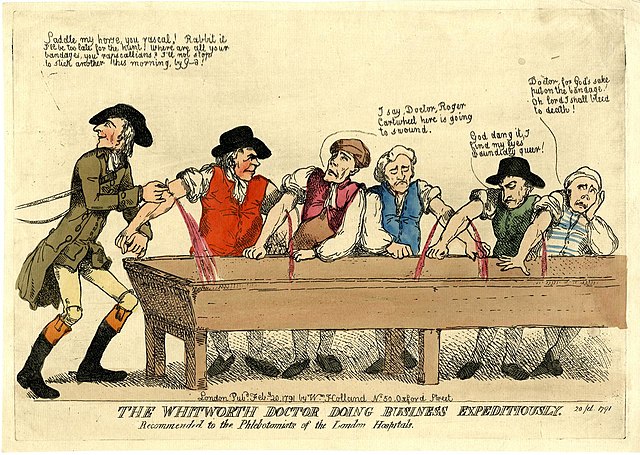
The Whitworth Doctors bleed multiple patients into a horse trough (1791)

The Taylor family’s cottage health industry dominated the village of Whitworth for decades in the eighteenth and nineteenth centuries, and huge queues of patients would wind through the streets waiting to be treated. The whole family was involved in the prosperous business of pill production, but the doctors also provided that all-purpose treatment for just about any ailment under the sun – bloodletting.

If you wanted this service from the Whitworth Doctors, the best time was on Sunday mornings when it would be provided for free. You would, though, have to join a hundred people at a time sitting in a circle. One by one, the doctors would methodically go round the circle opening the veins of the patients, their hot blood streaming into overflowing troughs. Not a sight for the squeamish.

The head of the doctors, John Whitworth, or Doctor John as he was more familiarly known, had a reputation as a gruff and grumpy no-nonsense northerner. Indeed, these doctors had no formal medical training or university education. They were self-taught health entrepreneurs. If you were less kind, you might call them quacks.

The Whitworth Doctor abandons the bleeding Bishop of Durham in order to treat horse (1791)

In any case, the Whitworth Doctors were in high demand by all levels of society, and this is where King George III enters the picture. George had already used the services of Doctor John to treat an undisclosed ‘complaint in the head’ of his daughter Princess Elizabeth. The treatment Taylor offered the Princess was a snort of his home made extra strong snuff. The violent and lengthy sneezing fit that followed cured her mysterious ailment.

So, when King George was suffering greatly from his abscess, and all the expert treatment of his Royal Surgeon, John Hunter, had failed, Doctor John’s skills were once again required.

When John Taylor arrived and was brought to the King’s bedchamber, he demanded that the assembled doctors and surgeons leave the room. This included John Hunter, the King’s own surgeon, who would not have been happy at this exclusion and was desperate to know what treatment his unconventional rival was about to administer.

King George III

Taylor examined his royal patient and then concocted a bolus of medicine. Sources are coy about what ingredients were in the medicine which Taylor manufactured for the King. We are only told that it was nasty. For some reason, this evil substance was applied to the King’s eye and the eagerly waiting medical men were allowed to return to the room.

The King’s Surgeon was most annoyed when Taylor refused to tell him what was in the goo that had been applied to the King’s eye. Hunter was so keen to know that he stuffed a glob of the concoction into his mouth to try and work out the ingredients by taste. The King, however, had seen what unmentionable filth had been used in the medicine, and on seeing his surgeon put it in his mouth went into such hysterical fits of laughter that his abscess burst and he at last found relief from his agony. Taylor was paid handsomely for his services and given hunting rights for the whole of Rochdale in perpetuity.

John Hunter ~ The King’s Surgeon

There are plenty of other anecdotes told about the Whitworth Doctors, and it’s not clear how many of them are apocryphal. The above story reflects the tension between the emerging credentialed, professional medical men and their rival amateur entrepreneurs, and that’s a theme that also resurfaces in a Halifax related epilogue to this tale…

Epilogue ~ The Halifax Witch Doctor

The Halifax Witch Doctor was the nickname of John Brierley, a quack healer who attracted huge crowds of patients across the north of England in the middle of the nineteenth century. He was cousin to George Taylor, one of the Whitworth Doctors, and although he had not been trained by his cousin, he had ‘watched him a little’.

Brierley came to national attention in 1849 when one of his patients, Sheffield mattress maker Richard Lindley, died two weeks after receiving Brierley’s unconventional treatments. Brierley had told the unfortunate Lindley that his heart was three inches out of its correct position and his lungs were full of water. Then, as some assistants wheeled Lindley’s arms around behind his back, Brierley massaged the patient’s heart back into its correct position.

When Lindley died two weeks later, Brierley found himself under suspicion of being responsible for the death of his patient. Transcripts from the two day inquest were reproduced almost in full in many of the country’s national and local papers and caused a great deal of hilarity.

Brierley claimed that he had been a doctor since the age of twelve, and that his skills were so great that he had set three of his own broken ribs just the day before the inquest after being thrown out of his carriage when his horse shied.

The biggest surprise of the inquest occurred when it became apparent that Brierley had no clue what was in any of the medicines he prescribed. In fact, he couldn’t even read the labels. When the coroner asked Brierley to sign a statement, he fenced and prevaricated for some time spinning a story about having forgotten his glasses, but it soon became clear to all present that the celebrated Halifax Witch Doctor was illiterate.

The coroner ordered Brierley to attend Lindley’s post mortem, but he didn’t show up, blaming his broken ribs. It seems he had exaggerated his skill at doctoring himself and a surgeon had to be called for.

On the second day of the inquest, Brierley came face to face with a representative of the medical establishment, a respected surgeon with the unfortunate name of Mr Payne. It’s clear that Payne was scandalised by Brierley’s eccentric diagnosis of Lindley’s condition being caused by his heart being several inches too low, and he no doubt seethed with humiliation when, in front of the whole inquest, Brierley grabbed the haughty surgeon’s arms and wheeled them around in the air in a most undignified manner to demonstrate what he had done to move Lindley’s heart back into its correct place.

In the end, though, Payne could not say that Brierley’s treatment of Lindley was the cause of his demise, and a verdict of death by pulmonary apoplexy was returned.

In summing up, the coroner confessed that, although he was normally a grave man, he had struggled to keep a straight face during the proceedings, and it’s clear from the transcript that the same was true for the attendees at the inquest, with the exception, perhaps of Lindley’s widow.

The coroner concluded that the crowds waiting to see the renowned Halifax Witch Doctor were ‘imbeciles’ and that ‘for such numbers to put their lives in the power of a man of so little education that he could not write his name, and did not even know the composition of the medicines he prescribed, he thought did not say much for the discernment of John Bull.’[ii]

In trawling newspaper archives while researching Weird Calderdale, I happened on multiple stories of disreputable quacks involving fraud, sexual assault, fare dodging, fighting, infidelity and bigamy…

So, stay tuned for more tales of West Yorkshire quacks behaving badly…


[i] This story is taken from Northumberland Weekly Chronicle , 13 June 1891. It’s a reprinting of an article originally published in the same paper from 1834, which was in turn a summary of an article by William Howitt titled ‘A Visit to the Whitworth Doctors’ published in Tait’s Magazine. For more on the Whitworth Doctors, see Patricia Chisnall, Whitworth Doctors (Whitworth Historical Society: Whitworth, 1959)

[ii] See the full post about the Halifax Witch Doctor for more details and sources here: https://paulweatherhead.com/2021/09/03/weird-calderdale-bonus-chapter-the-halifax-witch-doctor/

Demonic Possession in Lancashire ~ The Surey Demoniack

What should you do if your son is possessed by the devil? Why, turn him into a demonic freakshow and invite the drunken public to come and gawp at him as he gibbers, capers and blasphemes, of course! Well, that’s what happened in this weird case of demonic possession from 17th century Lancashire…

Richard Dugdale – The Surey Demoniack!

Richard Dugdale was a 19-year-old gardener living near Whalley, Lancashire. One night in the summer of 1688 he was drinking at the Whalley rushbearing festival when he saw a young woman he wanted to dance with, though he was not much of a dancer. He went as far as to say he would give himself to Satan if only he could be a great dancer.[i] And that’s when his troubles began.

Soon after, Dugdale experienced a sudden burning in his side as if he were being stung by nettles or pricked with needles. He began to hear voices and see visions, one of which was a disembodied head, and he felt an irresistible inclination to dance. He started to have frequent and violent fits, and people suspected he was possessed by the Devil.[ii]

The Reverend Thomas Jolly collected many witness statements and published them in his 1697 pamphlet The Surey Demoniack. Witnesses claimed to have seen Dugdale float up out of his chair such that he had to be held down. He was said to have vomited stones and curtain rings, and to have spoken in a voice that was not his own, as well as in Greek and Latin, languages which he did not know.

Others said Dugdale produced horrible noises like those made by a pig or a bear, or that he would describe in awful and graphic detail the torments awaiting in Hell. Witnesses saw a lump as big as a cat or dog appear on his leg and then migrate along his body to his chest. A knife suddenly appeared in his mouth lengthways. Witnesses also said that during his fits Dugdale would be as light as a feather and then become as heavy as a horse.[iii]

Dugdale was taken to a barn known as the ‘Surey’. There his father exhibited him in what must have been a grotesque Satanic freakshow, and many came to see Richard Dugdale, ‘the Surey Demoniack’ as he danced, leapt and performed his possessed repertoire before a drunken crowd of onlookers. This is how the Reverend Jolly described his dancing:

[Dugdale’s dancing] … excelled all that the spectators had seen or heard of, or probably all that mere mortals could perform; for he often, for 6 or 7 times together, leapt up so, as that part of his legs might be seen shaking and quavering above the heads of the people; from which heights he often fell down on his knees, [on] which he long shivered and traversed on the ground, at least as nimbly as other men can twinkle or sparkle their fingers; then springing up into his high leaps again and then falling on his feet, which seemed to reach the Earth but with the gentlest, and scarce perceivable touches, when he made his highest leaps.[iv]

Sometimes a thousand spectators would come to see the spectacle and to witness Reverend Jolly converse with the Devil himself through the medium of the Demoniack.[v]

In the spring of 1689 Richard Dugdale and his father Thomas travelled to Todmorden to seek the help of Henry Krabtree. Krabtree was the curate of St Mary’s church in Todmorden, but also had a reputation as a healer, magician and some would say necromancer who did a bit of ghostbusting on the side.[vi]

They stayed for two weeks while Krabtree bled young Dugdale, a common treatment for many ailments at the time. The first occasion this happened, Dugdale’s blood was supposedly as black as ink and only drawn with great difficulty. At a later time, Krabtree gave Richard ‘physick at once enough for six men’.[vii]

It’s not known which, if any, other treatments Krabtree employed, though perhaps he administered herbs or even performed magical rites. Although Dugdale’s fits abated while under Krabtree’s care, they returned more violently than ever when father and son returned home.

After Krabtree’s unsuccessful treatment of him, the Surey Demoniack’s fame continued to spread.

In July 1689, the Surey Demoniack visited Reverend Jolly and over the next year Jolly and several other prominent dissenting ministers attempted to exorcise him.[viii] One year later, Dugdale’s strange fits ceased. The Reverend Jolly claimed to have successfully exorcised him, though doubters said Dugdale had also been treated by two different doctors.[ix]

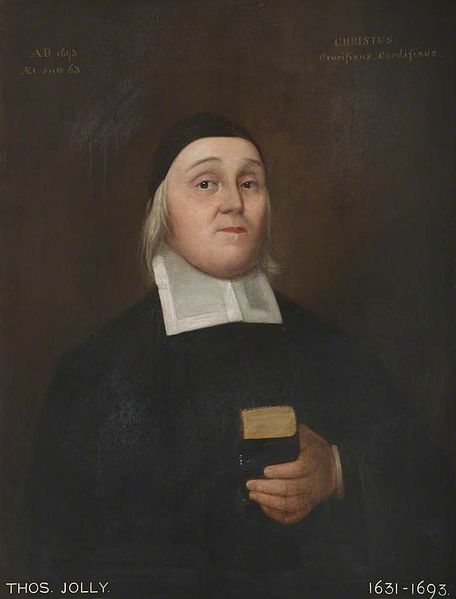
Rev Thomas Jolly ~ Exorcist

But what of Dugdale’s amazing supernatural feats and the signed statements by witnesses? Well, it turned out that the people who signed Jolly’s witness statements were illiterate and did not know what they were signing.[x]

This strange episode from Lancashire history is somewhat reminiscent of the fairy story The Red Shoes by Hans Christian Anderson. In the story, a vain girl, obsessed with her shiny new shoes, is punished for her vanity when the shoes take on a life of their own and force her to dance uncontrollably until, in despair, she gets an executioner to chop off her feet. Even then, the shoes, with her severed feet inside, continue to dance off into the sun set.[xi] Fairy tales were dark in those days…

However, dancing manias were a real phenomenon and there were several episodes throughout the Middle Ages.  In these hysterical outbreaks, the poor sufferers suddenly began to dance uncontrollably. They danced until their feet bled, and still didn’t stop. They cried out in anguish to passers-by for help. They danced till they dropped. Many danced until they died.

These cases often started with one person, like Richard Dugdale, suddenly having an uncontrollable urge to dance. This then spread to others, until more and more dancers joined in.[xii]

However, when we get to Richard Dugdale’s time these epidemics of contagious dancing hysteria had pretty much died out, which is perhaps a good thing. If Dugdale had been around a couple of centuries earlier, perhaps the whole of Lancashire would have started dancing uncontrollably as happened in Strasburg and several other cities and regions round medieval Europe!

In the end it’s not clear what exactly happened to poor old Richard. Was he suffering from a mental illness or hysteria that was interpreted through the superstitious culture of his time? Was it simply a show put on for paying customers? Was he exploited by his father and the Reverend Jolly, or was Dugdale himself a trickster controlling the would-be exploiters?

It’s certainly a fascinating slice of weird Lancashire history. Stay tuned for more true tales of demonic possession from the red rose county coming soon…


[i] Lieut-Col Fishwick ‘The Lancashire Demoniacs’, The Historical Society of Lancashire and Cheshire, volume 35, (1886) p.139

[ii] Thomas Jolly, The Surey Demoniack, London (1697)

[iii]  Fishwick (1886) pp.40-41

[iv] Jolly (1697) p.32 (I’ve modernised spelling and vocabulary)

[v]  Ibid p.40

[vi] Paul Weatherhead, Weird Calderdale (Tom Bell Publishing: Hebden Bridge, 2021) pp.193-204

[vii] John Birch, Henry Krabtree: Curate of Todmorden, (Paper Portal Publishing, 2019) p.112

[viii] Ibid p.114

[ix] Ibid p.114

[x] Zachery Taylor, The Surey Imposter, (Manchester, 1697)

[xi] http://hca.gilead.org.il/red_shoe.html

[xii] See John Waller, The Dancing Plague (Illinois: Sourcebook, 2009)

Weird Musical History 2 ~ Musaire! Calderdale’s Unsung Pioneer of Electronic Music

In the spring of 1950, an unsung pioneer of electronic music and variety star returned to his native Calderdale for a series of concerts at the Drill Hall, Halifax as part of the Halifax Home and Industrial Exhibition.[i] His name was Joseph Forest Whiteley, but he was best known by his stage name Musaire because he plucked music from out of thin air.

Musaire with his customised theremin

And the way he did this was by playing the theremin, the weird electronic instrument developed by its eponymous Russian inventor in the 1920s. The theremin works by creating electromagnetic fields around pitch and volume antennae and the player moves his or her hands within the fields to create musical notes. The closer your hand is to the vertical pitch antenna, the higher the note. The further away your other hand is from the horizontal volume antenna, the louder the note. It’s the only instrument that’s played without actually touching it.  You’ve probably heard its eerie tones in vintage sci fi and horror movies, such as The Day the World Stood Still or Thing from Another World. Musaire was billed as a ‘Musical Man of Mystery’ and was responsible for introducing the theremin to the UK in his long and illustrious showbiz career.[ii]

He was born in 1894 to a Ripponden family but moved to Canada as a young boy.[iii] He had a varied career which included being a lumberjack in Nova Scotia before becoming an entertainer whilst serving in World War One. He only managed to survive the war years because his train to Halifax (Canada) was a few minutes late. This is because at 8.45am on the sixth of December 1917, two ships collided in Halifax Harbour, and one of them was packed with high explosives. This caused the biggest man-made explosion ever up to that point in time and flattened large areas of the town. Nearly two thousand were killed and thousands more were injured.[iv]

Musaire’s late train meant he had survived the famous Halifax Explosion by minutes. The train he was on was loaded with casualties from the tragedy, and Musaire went back with them to Truro (again, the Canadian one) and was present at thirty operations.[v]

An experience like that would surely make you reassess your life, and perhaps that was what Joseph Forest Whiteley did. Perhaps it started him on his journey into the weird world of the theremin.

He bought and learned to play a customised theremin like no one had played it before. Yes, there had been a few musical theremin virtuosos like Clara Rockmore, and Musaire did not have her amazing technical ability.

In fact, since its invention classical theremin players have been trying hard to get the theremin to be taken seriously as a melodic instrument rather than a gimmicky novelty for making crazy noises and sound effects. Serious thereminists have always been slightly embarrassed by the theremin’s association with flying saucer noises and lurid B movies. However, as well as being able to play melodically, Musaire embraced the novelty aspect of the instrument and used it as the basis for his musical comedy act. Perhaps he was the Bill Bailey of his day.

In 1932 he was the first to introduce the theremin to the UK and it caused a sensation.

Throughout the 1930s and 1940s he amazed and baffled audiences on music hall bills by playing the tunes they requested simply by waving his arms skilfully in the air in front of his instrument, which looked like a writing desk with a vertical antenna sticking up from one side and a looped horizontal antenna on the other. Newspaper reports at the time inform us that Musaire could make his instrument sound like a human voice, a cello, bassoon or violin.[vi] Not only that, he used his theremin to create a range of amusing sound effects such as a dog being stung on its tail by a bee, a steamship approaching docks, seagulls squawking, horses neighing and pioneering aviators Amy Johnson and Jim Mollison taking off in their aeroplane.[vii]

His audiences were mystified, and it’s apparent many thought there was some trickery involved. To convince audience members that the instrument was real, he would call for volunteers to have a go themselves at playing a tune. The result was almost invariably ‘weird grunts and groans and ear-splitting squeals’, until he stood behind the volunteers and guided their hands, when once again recognisable tunes could be heard.[viii]

Sometimes in his performance he would open the cabinet of his instrument to satisfy the curiosity of sceptics and produce from within the innards of his contraption sweets and bananas.[ix] At other times, the inside of his theremin was revealed to contain a hidden cocktail cabinet.[x]

Musaire and his theremin entertained millions over the decades. He performed his shows in theatres, cinemas, schools, hotels and restaurants around the country. He played before royalty and appeared alongside stars of the era such as Arthur Askey and Stanley Holloway. It’s reported that he guided the hands of countless mayors of provincial towns throughout the UK as they attempted to pull a tune out of the temperamental beast that is the theremin.[xi] As recently as 1982 he performed with the London Symphony Orchestra.[xii]

In his later years he was involved in setting up and running Pendley Manor, the world’s first School of Music Hall. He served on the board of Equity, the actors’ union, and become Vice President of the British Music Hall Society for life.[xiii]

Musaire and showbiz chums (L-R: Musaire, Leslie Crowther, Arthur Askey, Cyril Fletcher, David Nixon (The Stage 8 February 1979)

He died on 23 February 1984, a few weeks short of his 90th birthday. However, his theremin can still be seen at the Musical Museum, Brentford and there are some clips of him in action. Here’s one from 1937:

https://www.britishpathe.com/video/musaire-musical

Epilogue

As a fan of both the theremin (I played theremin and other oddball instruments with Hebden Bridge’s much missed psychedelic garage band the Electric Brains for many years), I can’t resist debunking a couple of theremin myths as a little footnote.

Myth 1: The theremin is easy to play.

No, it isn’t. Yes, it was originally marketed as something that anyone could play. If you can whistle, you can play the theremin was one of the early marketing slogans for it. And, yes, it’s easy to make spooky noises on it. But the thing is, when it comes to actually playing a melody, with no keys, and no fret board, it’s just about the most difficult instrument ever invented.

The Electric Brains (author second from right)

If you’ve ever tried to play one, you’ll know what I mean. The theremin can smell fear. When novices have a go on a theremin, the first warbling scream it makes causes the player to instinctively step back in shock, resulting in the squeal getting louder as the player moves away from the volume antenna. Panic often ensues. Not many have tamed this weird musical beast, but a few who have that you might want to look up are Peter Pringle, Lydia Kavina and Charlie Draper.

Myth 2: The Beach Boys used a theremin on their hit ‘Good Vibrations’.

No, they didn’t. The Beach Boys never recorded with a theremin. I know Brian Wilson says they did, but he’s wrong. What they actually used was an electro-theremin (sometimes called a Tannerin after its inventor, Paul Tanner).[xiv] This is a very different beast that involved moving a slider along a keyboard strip. It sounded similar to a theremin, though was actually very easy to play. And playing the electro-theremin involved touching the instrument, which means an element of theremin magic is missing.

The Beach Boys used this fake theremin soundalike on ‘I Just Wasn’t Made for These Times’ from the Pet Sounds album, and again on ‘Wild Honey’ as well as their classic ‘Good Vibrations’. But they never used a theremin. In fact, Paul Tanner was asked to tour with the band but declined because of his studio commitments. And besides, Tanner quipped, his hair was too short![xv]


[i] Halifax Evening Courier, 18 April 1950

[ii] The Stage, 22 March 1984

[iii] Halifax Evening Courier, 18 April 1950. Some sources put his place of birth as Leeds

[iv] https://www.britannica.com/event/Halifax-explosion

[v] The Courier and Advertiser, 24 February 1940

[vi] The Gloucestershire Echo, 7 August 1946

[vii] The Northern Whig and Belfast Post, 10 November 1935; Leicester Evening Mail 7 September 1936

[viii] Eastbourne Gazette, 18 April 1934

[ix] Midland Daily Telegraph, 9 December 1935

[x] Gloucestershire Echo, 7 August 1946

[xi] The News, 16 October 1969

[xii] The Stage, 22 March 1984

[xiii] The Stage, 22 March 1984

[xiv] Albert Glinsky, Theremin: Ether Music and Espionage, (University of Illinois Press: Chicago, 2005) pp.294-295

[xv] Ibid

When Ghost Hoaxes Go Bad…

Playing the ghost – dressing in a white sheet, devil mask or animal skin and then jumping out on innocent victims to scare the wits out of them in dark and lonely locations – was a popular but much frowned upon pastime in the nineteenth and early twentieth centuries. It was assumed that delicate ladies who were on the receiving end of these pranks would be liable to lose their wits, or possibly even die from fright.

In an earlier article I wrote about how playing the ghost supposedly led to the death of the victims, and certainly led to the killing of an innocent man, in the case of the Hammersmith Ghost.[i]

However, the ghost hoaxes gone bad I’m going to recount in this post are both from the late eighteenth century, a decade or so before the golden age of playing the ghost. Both of these supposedly true stories have a nice twist with the tables turned on the fake spooks…

An angry mob chases a ghost hoaxer, Illustrated Police News

The Ghost of Teethill Wood

In the winter of 1794, a young sailor called William Johnston returned to Scotland for a few days’ leave to visit his mother in Saint Andrew’s.

While working as a mate at sea, William had discussed the subject of ghosts with a clergyman who happened to be a passenger on the ship. The priest had told him that because everybody knows that ghosts are insubstantial, if a ghost has footsteps or makes other noises, it is obviously physical in nature and so therefore cannot be a real ghost.

This was a hypothesis that William decided to put to the test on the Teethill Ghost. The Teethill Ghost was a towering apparition in white that had been seen many times in Teethill Wood, Elgin, and the locals were afraid to venture near the area after dark.

William assembled three young mates to be witnesses on a nocturnal expedition to investigate this mysterious haunting. The intrepid ghost busters went to the spot where the ghost was wont to haunt and waited…

It wasn’t long before a huge figure in flowing white robes appeared in front of the party. As the spectre drew near, William remembered the clergyman’s comments about the nature of ghosts. Footsteps were clearly audible. When the apparition was six yards away, William pulled out a pistol, aimed at the ghost and pulled the trigger.

As the shot rang out, the ghost fell to the ground crying, ‘Mercy! Mercy! I’m a dead man!’

Although William did not recognise the voice, his companions did. It belonged to a local eccentric named Bailie J—-n from Elgin.

Fortunately for Bailie, there was no shot in the gun but it still took the ghosthunters some time to convince the ‘spirit’ that he was in fact unharmed and the pistol had been empty.

However, in a plot twist straight from the Scooby Do playbook, it turned out that the oddball Bailie was a smuggler of tobacco and gin and concealed his contraband in thickets in Teethill Wood. At night, his servant would collect the forbidden goods from the hiding place and deliver them to various places in the neighbourhood. Bailie, meanwhile, would put on his wife’s white gown and hold her petticoat above his head, knowing that this would scare away superstitious locals.

And, he would have gotten away with it if it hadn’t been for those pesky kids![ii]

Black Devil White Devil

This second story also took place (or was first recorded) in the 1790s and concerned a young woman called Molly, described as an ‘idiot’ who was resident at St James workhouse in Taunton. Molly, it seems, had an aversion to sleeping in a bed, so she would often run away at night and sleep in a nearby cow shed.

One night, two men decided they would try to scare her out of this habit. When they knew Molly was in the cow shed, one of the men donned a white sheet and walked back and forth where the unfortunate woman would see him, while his friend hid and watched.

Eventually, Molly saw the apparition and exclaimed ‘Aha! A white devil!’

However, the prankster was not expecting what happened next. Molly suddenly added, ‘A black devil, too! A black devil too!’

The confused ghost looked behind him and saw – or thought he saw – a figure all in black behind him, and ran home in a state of mad terror. As he ran, Molly clapped her hands in great glee and shouted, ‘Run black devil and catch white devil!’

The man, whether from shock or exertion, died within minutes of reaching his home.

I like to think poor young Molly was not such an idiot after all and, realising she was being hoaxed, gave as good as she got. In any case, she was left to sleep in her cow shed in peace.[iii]


[i] Scared… to Death! – Paul Weatherhead

[ii] This story first appeared in James Grant, ‘The Haunted Wood’, Elgin Annual (1833) and was reproduced in the Elgin Courant and Courier 4 April 1893.

[iii] This story first appeared in James Lackington, Memoirs of the forty-five first years of the life of James Lackington, (1793) pp.57-59. Reproduced in the Derby Mercury 23 May 1793

Weird Musical History 1 ~The Cat Orchestra

It’s the middle of the eighteenth century and an expectant audience is crammed into an exhibition room in London’s Haymarket to witness a bizarre performance that is the talk of London. The audience settles and the show begins.

Three cats sit ready to play their dulcimers, their sheet music on little music stands in front of them. The conductor signals for the performance to commence, and the cats pluck and strum the dulcimers while caterwauling different notes in turn to produce various tunes. As if the this was not surreal enough, rhythm is kept by a trained hare marching around on his hind legs and beating a drum while a monkey and a dog dance and caper together in time to the music. This is the strange but true story of Samuel Bisset and his amazing cat orchestra.[i]

Bisset was born in Perth, Scotland in 1721 to a watchmaking family and later settled in Ireland and worked as a shoemaker. At some point he moved to London and married into wealth, eventually becoming a broker and making even more money. In 1739, he read about a horse that had been trained to do tricks and decided that this was his calling.

Samuel Bisset

He started with a dog and then moved on to a horse, training them both with great success. Next came a couple of monkeys which he taught to do various acrobatic tricks as well as training them to play a barrel organ and to dance with his dog. But his biggest challenge was yet to come: cats.

He bought three young cats, and with infinite patience, trained them to strum dulcimers with their paws to accompany themselves while they meowed in turn and in key. He positioned little music stands in front of them with sheet music on, and he soon had a show that became a sensation.

The shows took place in his house, which became ever more crowded with spectators. Soon, the performances were so successful he rented an exhibition room in the Haymarket and called his show the Cat Opera. The musical kitties, dancing dog and monkeys and drumming hare attracted even more crowds and the money rolled in.

Bisset extended his menagerie to include dancing turkeys (which he rather cruelly got to dance by putting them on a heated floor) and other birds. Unfortunately, the time and expense of looking after and training such a large troupe meant that he eventually had to sell some of his animals and to take the show on the road round Britain and Ireland.

Eventually, enough was enough for Bisset and he gave up on his cat orchestra and the dancing critters and moved into a pub in Belfast.

But he just couldn’t resist his calling for long. He again trained a dog, and then a goldfish, to do tricks before settling on his next challenge, an animal even more obstinate than a cat: the pig.

After much work, he finally succeeded and took his ‘learned pig’ to shows in Belfast and Dublin where it astounded the audiences. The pig was able, we are told, to tell the time, spell out names and do arithmetic. It’s not clear how this was done, but probably Bisset recited numbers or letters and the pig grunted or signalled with a trotter when the required number or letter was spoken.

But tragedy was about to strike. For reasons that are obscure, one of the Dublin shows was violently raided by police who assaulted and injured Bisset. One of the officers even drew his sword and was ready to execute the poor pig on the spot, though in the end Bisset was told not to repeat the performance or face prison.

Bisset never recovered from the shock of the assault and died soon after in Chester while taking his learned pig to London.

We’ll never know what Bisset’s cat orchestra sounded like or just how proficient they were on their dulcimers. Perhaps, as with the learned pig (where the trainer can send subtle signals to the animal) there was some trickery involved with the cats’ performance. There were other cat orchestras in the following years, but these mostly involved them being trained to turn a handle on a barrel organ.[ii]

Anyway, none of them compared to Samuel Bisset and his amazing feline musicians wailing plaintively as they accompanied themselves on their dulcimers while the marching hare beat time on his drum and the twinkle-toed monkey and dog pirouetted and waltzed around them.


[i] GH Wilson, The Eccentric Mirror (1807)

[ii] For more on learned pigs and other odd animal stories see Jan Bondeson, The Cat Orchestra and the Elephant Butler: The Strange History of Amazing Animals (The History Press, 2006)

Scared… to Death!

A bizarre pastime emerged in the nineteenth and early twentieth century: ‘playing the ghost’. This usually involved a prankster donning a white sheet, perhaps with a scary mask and some devil horns and then cavorting in a spook like manner at a creepy location such as a dark lonely road or grave yard at midnight to frighten the wits out of any unfortunate passer-by. These ghost hoaxes terrified the victims and sometimes led to outraged vigilante mobs and violence, not to mention madness or murder and sometimes even spawned hysterical mass panics. The concern about these ghostly shenanigans was so great that it generated cautionary urban legends about the dangers of such supernatural hoaxes. A couple of my favourites are outlined below…

The Hammersmith Ghost Hoax of 1804

The Dead Hand

The first case is set, I would guess, in the middle of the nineteenth century and was widely reported in 1885. It concerns an old lady who had recently died and whose body was lying overnight in a curtained four poster bed. It fell to the old lady’s young niece (and heiress) and her cousin to sit and watch with the departed relative overnight.

This was an eerie duty for the young women, and as the wind howled and the snow fell outside, they decided to amuse themselves by recounting spooky stories. At first, they noticed creepy coincidences around the room. The ash by the fire had formed the shape of a coffin. They thought they could see the image of a winding sheet in the flickering candle flame.

The niece told her cousin a scary tale about being alone upstairs in a large empty house and hearing someone – or something – creep up the stairs. The sound of creaking came nearer until it reached the door, when it stopped. And then the door handle slowly began to turn…

It was at this point that the niece’s story trailed off. There seemed to be a creak coming from the bed where her aunt’s corpse was lying. The curtains round the bed rustled. The niece’s eyes nearly started from her head, she turned white and backed away towards the door, trembling violently and then fled the house into the night.

The cousin had her back to the bed, but on seeing the niece’s reaction, she turned to look behind her. A long, bony hand was slowly stretching out towards her from behind the curtains.

She leapt up, but as she tried to run, something clutched her skirt with an iron grip and prevented her from escaping. She struggled to free herself only to knock over a table and extinguish the room’s only candle. Alone, in the darkness, with the unremitting grip on her skirt preventing her from fleeing, she shrieked and fell silent…

Outside the house the cousin’s boyfriend and his mate were laughing their heads off at their prank. Knowing the girls would be alone in the room with the corpse, they had tied a length of cord around the old lady’s wrist, and from outside the room, pulled it so that the withered arm appeared from behind the bed curtains.

The boys found the niece outside in a swoon. Inside, on lighting a candle, they saw the cousin lying dead on the floor. She had caught her dress on an iron stove in trying to escape the horror, the horror which had scared her to DEATH![i]

This night thy soul shall be required of thee!

The second example was told by John Strange Winter (actually a pen name for novelist and journalist Henrietta Stannard) in 1911. This cautionary tale (which was ‘repeatedly vouchsafed as true’) involved a highly religious young girl at a boarding school.

One night, two pranksters crept into the girl’s dorm room as she slept and daubed on the wall opposite her bed in luminous phosphorus paint ‘This night thy soul shall be required of thee’.

Then, one of the tricksters got under the girl’s bed and kicked the mattress to wake her up. The girl did indeed wake and see the flaming letters (a quote from Luke 12:20). She let out a scream and then fell silent.

Her friends were disappointed that this was the only reaction and assumed that she had seen through the trick. They crept out of her room, thinking the girl had gone back to sleep.

In the morning, it was found that the poor girl was DEAD.

The two jokers did not receive capital punishment for their cruel trick, but they did carry the knowledge that they had caused their friend’s death just as if they had plunged a knife through her heart.[ii]

Cautionary Tales

Both of the above tales seem to me to be urban legends rather than real events. No names or clear dates are given. The stories are told with much relish in the newspaper sources than would be appropriate if they were relating a real tragedy. They are more of a warning as to what might happen if one should engage in such cruel hoaxes and they reflect the fears and moral concerns of their time.

However, ghost hoaxing did indeed lead to tragic consequences, the most well-known instance being the story of the Hammersmith Ghost. Towards the end of 1803 a prankster had been scaring the citizens of this part of West London by jumping out at them at night wearing a white sheet or an animal skin. The rumour emerged that it was the ghost of a man who had killed himself by cutting his own throat. Some of the ghost’s victims were so shocked that it seriously affected their health, and a pregnant woman is said to have died as a result of the fright.[iii]

After a night of drinking, excise man Francis Smith decided to confront the ghost on 3 January 1804. Walking the dark winter streets, Smith eventually came across a white clad figure and asked it to identify itself. When no reply came, Smith pulled out a fowling gun and fired. He had killed bricklayer Thomas Milward, who was wearing the white clothing that was typical of his profession. Milward’s mother-in-law had warned him about the danger of being mistaken for the Hammersmith Ghost and urged him to change his clothes.[iv]

Francis Smith was found guilty of murder and sentenced to death, though was soon after pardoned. The real culprit was later shown to be a shoemaker who was dressing as a ghost in order to exact revenge on his apprentices for scaring his children with spooky stories.[v]

Stay tuned for more tales of ghost hoaxes gone bad!


[i] South London Chronicle and Southwark and Lambeth Ensign 26 December, 1885

[ii] Forres, Elgin and Nairn Gazette 23 August, 1911

[iii] Owen Davies The Haunted (Palgrave MacMillan: Basingstoke, 2007) p.21

[iv] Ibid

[v] Caledonian Mercury 14 January 1804

Easter Ghost ~ Halifax 1843

At Easter 1843 crowds began to gather round a certain Halifax house, and more curious onlookers joined the throng each day. The house was said to have been unoccupied for 20-30 years and yet strange sights had been seen through its upstairs window: a bed was seen to fly around the room and a ghostly female figure had appeared there over the Easter weekend. It had been seen the previous two days and was expected to be seen again as Easter Monday came. The spectral figure was, according to onlookers, the spirit of a housemaid who had cut her own throat on Easter Monday around 40 years ago.

A random Victorian lady

As Easter Monday came, the crowds clearly saw the figure of a young woman appear at the window. People in the throng (according to the Halifax Guardian) shouted: ‘Here it is!’ and ‘Nah, will ta believe it, does to see it nah?’ The ‘ghost’ in question turned out to be a servant in the house, which was not empty at all, and behind the upstairs window was her bedroom, shared with another female servant. She had heard the clamour of the gathering crowds and looked out to find a large audience gawping at her. It seems a few days ago, she had taken down the blinds from the window for washing and temporarily replaced it with a makeshift substitute that looked a little like a female figure.

The Halifax Guardian lamented: ‘Who could have imagined that in the 19th century… crowds should have assembled in the centre of a populous town, and in mid-day to witness the feats of a Hobgoblin.’ The paper concluded thus:

It is a pity that a fire engine was not used to disperse the credulous men and children who could spend several hours in looking at nothing but a bare wall and windows. As for the women, they are more excusable; their curiosity is uncontrollable.[i]


[i] Halifax Guardian 24 April 1843

The War Between Monkeys and Dogs

At the end of 2021, bizarre reports of a strange war emerged from India: monkeys versus dogs. Villagers in Maharastra state, 300 miles east of Mumbai, claimed that revenge mad langur monkeys were slaughtering puppies by the hundreds. The attacks were so thorough that in Lawul village, every single puppy had been wiped out.[i]

According to the locals, the conflict started when a pack of stray dogs attacked two monkeys and their infant. The baby monkey was mauled to death in the attack. In revenge, monkeys began to systematically hunt down puppies and then carry them onto roofs or up trees before hurling them to their deaths. The number of dogs killed is estimated by villagers to be more than 250.

The strange story of the monkeys’ vendetta against the canine population was widely reported and the monkey-dog gang war led to the predictable proliferation of internet memes.

After virtually all the area’s dogs had been dealt with, the revenge mad monkeys apparently turned their attention to local children and started harassing them. Something had to be done and the main culprits responsible for the doggy massacre were finally captured.[ii]

The Forest Department investigated the ‘war’ and it seems that the truth of the matter may be more complex than the villagers and the press have reported.

For one thing, the figure of 250 dogs killed seems to be unfounded. According to Sachin Kand, a local Forest Officer, the actual number is closer to 50, though some sources provide a much lower number.[iii]

Furthermore, it’s also possible that the motives for the monkeys’ behaviour may have been grief rather than revenge. Kand suggests that the distraught monkeys who had lost their infant to the pack of dogs were actually trying to replace their baby with a puppy, which they would carry around the villages with them, including onto roofs and treetops. The unfortunate dogs would then either starve on the roof or, not being built to navigate trees, fall to their death.

The Forest Department report concluded that the ‘clashes between dogs and monkeys in Lawul village cannot be termed as an act of revenge.’[iv] Indeed, revenge is a very human emotion.

It seems we looked at these horrible events and completely misunderstood them. We projected our own feelings onto what was happening and created a distorted narrative that reflected our own thoughts and prejudices based on sensationalist and inaccurate reporting.

It’s never a good idea to rush to judgement without being aware of our own biases, prejudices, lack of reliable information and the tendency of media sources to amplify and distort sensational events.

At times of war, information is a weapon and a healthy scepticism is the only defence.


[i] https://www.opindia.com/2021/12/angry-monkeys-take-revenge-by-killing-250-dogs-after-puppy-kills-baby-monkey/

[ii] https://www.theguardian.com/world/2021/dec/21/monkeys-blamed-for-hundreds-of-puppy-deaths-captured-in-india

[iii] https://www.boomlive.in/news/beed-monkeys-revenge-dogs-puppies-nagpur-maharashtra-16114

[iv] Ibid