Mystery Christmas Drones: Ghost Riders in the Sky

Sinister mystery drones are haunting American air bases in the UK. Swarms of similar drones have been flitting around military bases in New Jersey and other parts of the USA. Some say the drones are spying on sensitive areas, others say they are testing air defences. Some think it’s preparation for an all out attack by a nefarious hostile power…

And who’s responsible for these ghost riders in the sky?

You guessed it – the modern day equivalent of Emperor Ming and Davros King of the Daleks all rolled into one demonic figure: Vladimir Putin. Well, that’s the theory of somewhat ironically named ‘intelligence’ officials quoted in the media.

‘It’s a distinct possibility if not a certain probability this is all down to Russian intelligence,’ Philip Ingram, a former British military intelligence Colonel, told the Daily Mail. He supports this ‘certain probability’ by arguing that the drone activity has ‘all the hallmarks’ of an operation by the GRU – the Russian military intelligence service.

Ingram continues his insightful analysis: ‘They [Russian Intelligence] and the GRU are just a bunch of petulant little boys. They’re trying to suggest they have the ability to disrupt and influence through a level of nuisance action.’

Not only that, Russia is using these mystery drones to ‘massage Russian tyrant Putin’s bruised ego, after his failures in Ukraine.’[i]

Strange lights over RAF Lakenheath, Suffolk – what is Putin up to?

Interestingly, despite Colonel Ingram’s background in intelligence, he seems to have missed the news that Russia is winning the war in Ukraine, Ukraine has no path to victory that doesn’t involve dragging Europe and the US into a nuclear confrontation. And this seems to me an important key to the mystery.

I’m going to argue that we’re witnessing a hysterical mass panic that reflects the anxiety caused by western geopolitical schemes and the fear that these reckless adventures at regime change, colour revolutions and the wars and chaos that follow in their wake, might one day come home to roost…

When Phantoms Attack

What I think we’re witnessing in the US and the UK is a phantom attacker panic. This is when free-floating anxiety and hypervigilance over ambiguous threats leads to a hysterical over-reaction and the creation of an imaginary assailant – a mythical bogeyman in the shadows.

The Halifax Slasher episode of 1938 is a classic example. A spate of mysterious razor blade attacks terrified the community leading to widespread terror and panic, angry vigilante mobs roaming the street and a huge police investigation. The attacks multiplied and spread to other parts of the country. Soom there were slash attacks everywhere – Manchester, Glasgow, Birmingham….

However, a Scotland Yard investigation revealed that the ‘victims’ of the attacks had in fact cut themselves and invented the story of the sinister attacker for a variety of motives.[ii] The Halifax Slasher didn’t exist.

There are many other similar panics where a community becomes consumed with the mistaken belief that a malignant assailant lurks in their midst. There’s the Delhi Monkey Man, the London Monster, the Mad Gasser of Mattoon, the Penis Thieves of Nigeria…

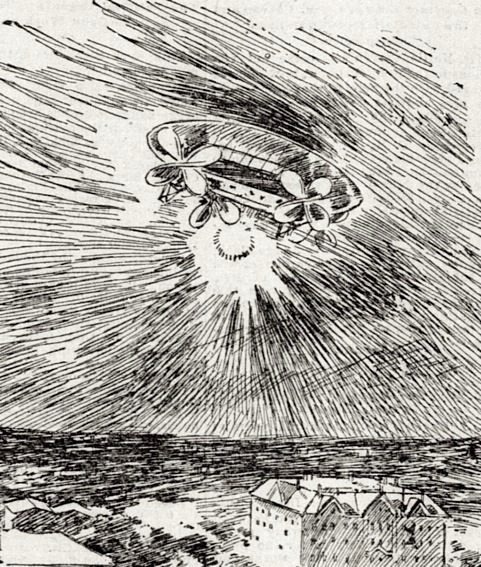
However, most relevant to the mystery drones are the phantom airship scares that occurred in the early twentieth century. These steampunk flying saucers haunted the US and the UK in the anxious years leading to World War One. It was feared they were advanced German flying machines engaged in gathering intelligence or some other nefarious mission. All these episodes reflect the fears and anxieties of the times.

Phantom Airship over San Francisco 1896

Phantom attacker panics often follow a familiar pattern of four phases, so let’s see how this might apply to the mystery drone scare sweeping the US and, to a lesser extent, the UK.

Phase 1: the Latent Phase

This is the background to the panic. There is a sense of anxiety about real or imaginary threats. In the case of the mystery drones, this could be related to the fact that the US and UK governments have helped Ukraine to carry out direct attacks on Russia with Russia threatening consequences for this escalation.

Phase 2: the Breakout Phase

In the breakout phase, the media latches onto a spectacular episode which causes widespread alarm. This leads to people becoming hyper-vigilant to potential threats in their environment. In the case of the New Jersey drones, this seems to have been sightings over the US Army’s Picatinny Arsenal on 18 November. The news reports with speculation about secret testing of military drone technology or hostile foreign powers preparing for an attack caused people to study the night sky – something they would not normally do. They become hyper-vigilant, searching the night skies for threats and at the same time projecting their fears and anxieties onto what they saw.

Human perception is fallible, and many will have likely mistaken regular aircraft or stars or planets as mystery drones.

Another ironically titled British intelligence analyst, Tim McMillan, told the Daily Mail that the drones over Picatinny ‘sound exactly like Russian Orlan-10 drones’ – they have a red light on the right wing, a green one on the left and white taillights. In other words, they are practically indistinguishable from regular aircraft.[iii] Given that this is standard aircraft lighting, it seems to me more likely that people are misinterpreting normal planes for sinister drones.

Phase 3: The Peak Phase

This is the climax of the panic. Reports spread and the whole community become infected with the panic. In the case of the Halifax Slasher and similar episodes, armed vigilantes patrol the streets and business close. In terms of the drone mystery, people are encouraged by journalists to examine the night skies and send in any evidence they capture.

It also seems likely that as word of the mystery drones spread online, many hobbyists took the opportunity to engage in some mischief, adding to the panic by flying their drones at night, possibly in close proximity to sensitive military installations.

During the Peak Phase of a phantom attacker episode, the panic spreads to other areas. This is the stage we appear to be going through at the moment, with mystery drones appearing in other parts of the US and then the UK. If I’m right, this is likely to spread further as the Peak Phase plays out. There may also be vigilantes taking the law into their own hands and taking potshots at lights in the sky. And the ‘experts’ will demand that something must be done.

Phase Four: the Decline Phase

After the peak comes the decline. There is increased scepticism as the panic grows more absurd. Some in academia or the media will start to cast doubt on the events, making it less likely that new episodes get reported….

And then all is forgotten until the next panic comes along…

In the meantime, before the Great Christmas Drone Panic of 2024 blows over, I expect it to spread to other parts of the USA and the world. I predict politicians will seize the opportunity to scare monger about the bogey man with the Russian accent. Or the Chinese one. Or is it the Iranians….?

In any case, something must be done, the wise intelligence experts will argue. And when intelligence experts do stuff, we should be worried.

We’re closer to nuclear confrontation than we’ve ever been, and this is reflected in this outpouring of collective anxiety.

But it will dissipate. It always does. But don’t worry, in troubled times, we will always find some new bogeyman to scare ourselves with…


[i] https://www.dailymail.co.uk/news/article-14192269/Putins-drones-spotted-Britain-nuclear-weapons.html

[ii] Bartholomew, Robert E., and Weatherhead, Paul (2024), Social Panics and Phantom Attackers: A Study of Imaginary Assailants. Singapore: Palgrave Macmillan

[iii] https://www.dailymail.co.uk/news/article-14192269/Putins-drones-spotted-Britain-nuclear-weapons.html

The First UFOs over Todmorden

Todmorden has a reputation as a UFO hotspot largely due to the UFO sighting of PC Alan Godfrey in November 1980. The story has everything – a mysterious death, teleporting cows, a flying saucer, a scoundrel hypnotist, alien abduction and a space dog.

For the full story, see my book Weird Calderdale.

However, I think I have found the first reported UFO over Todmorden – and it goes way back…

The Tomb of One Unknown

Stoodley Pike monument is surely the Calder Valley’s most iconic landmark, with perhaps only Wainhouse Tower giving it a run for its money. The first version of the monument was built in…. to commemorate the end of the Napoleonic Wars, though this structure collapsed in a storm on the eve of the Crimean War. The present version is rich in Masonic symbolism with its Egyptian architectural influences and dark spiral staircase in which the intrepid wanderer must feel his or her way through darkness before achieving the light of the panoramic viewing balcony.

Steve Partridge A Storm Brews Over Stoodley Pike

However, the importance of the site goes back beyond the present and previous monuments. In 1832, local poet William Law published a book of verse Wanderings of a Wanderer in which Stoodley Pike (which is actually the name of the hill on which the monument stands, not the monument itself) was referred to as ‘the tomb of one unknown’.

In the footnotes to the poem, Law relates some of the local folklore. Before the first monument was built the hill was crowned by a cairn housing the bones of an ancient king or chieftain. If any of the stones of the cairn were moved, then strange noises and mysterious door slamming would plague the locals. What is more, strange flames would be seen flitting around the stones until the landowner had put everything back to how it should be.

So – strange lights in the sky above Stoodley Pike. The poem was published in 1832, so we can assume the folklore Law described would stretch back decades, perhaps centuries before that. And there we have it – Todmorden’s skies have long been haunted by mysterious phenomena…

Artwork by Larisa Moskaleva

The London Monster

In 1790, Georgian London was haunted by a Monster. No woman was safe. Typically, he would approach a pretty young lady as she walked home and make lewd comments to her, and then he would attack her with a blade. Sometimes the blade would be attached to his knee and he would kick his victim in the buttocks or thighs until she bled. Sometimes he had a metal claw attached to his arm with which he would scratch the unfortunate lady. At other times, he would force a bouquet of flowers under his victim’s nose, and then stab her in the face with a knife hidden among the flowers.

London was in a state of hysterical panic. Many were afraid to go out at night and any man in the wrong place at the wrong time might find himself accused of being the Monster. John Julius Angerstein, a founder of Lloyds and well-known philanthropist conducted a massive poster campaign offering a reward for the Monster’s capture.

Isaac Cruikshank – Monster Cutting a Lady (1790)

The London Monster’s reign of terror was amplified by lurid newspaper reports and salacious prints. In the image above by Isaac Cruikshank, the Monster with blades attached to his knee attacks a woman with a knife – note Angerstein’s poster in the background. In the second panel, the young lady buys herself some copper knickers to frustrate any future attacks by the Monster. Above them are copper knickers of varying sizes and prices for young ladies, ladies and very fat ladies.

In the image above, two old maids are accosted by the Monster – depicted with three fire-breathing heads with a little green demon sitting on the middle one. The implication is that they are dreaming about the Monster as he was rumoured to only attack the most beautiful of women. One of ladies dashes in terror from the bed, putting her foot in the chamber pot and spilling the contents on the floor.

James Gillray The Monster Disappointed of his Afternoon’s Luncheon (1790)

The famous satirist James Gillray also featured the London Monster in some of his work. In the above print the Monster is depicted as a grotesque ogre clutching a huge knife and fork about to tuck into the behind of a young lady who he’s holding aloft by her skirts, revealing her backside. Unfortunately for the Monster, the woman is wearing a copper cooking pot strapped over her bottom, thus frustrating his appetite.

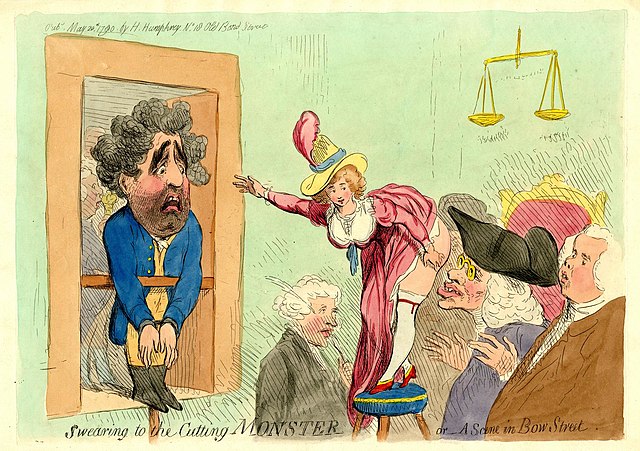
Another of Gillray’s bawdy prints highlights the concern that the investigators and monster hunters were a little overzealous in their inspection of the wounded thighs and bottoms of the young and pretty victims. The print (below) shows the Monster (depicted as politician Charles James Fox) handcuffed in the Bow Street office. A pretty young woman stands on a stool bending over with her dress pulled up over her waist displaying her stockinged leg and buttocks to grotesque caricatures of Bow Street Magistrate Sir Samson Wright who peers grotesquely at the woman’s behind.

James Gillray Swearing to the Cutting of the Monster 1790

Angerstein’s poster campaign offered a generous reward for the capture of the Monster and resulted in dozens false arrests and accusations as well as some mob violence as vigilantes went monster hunting on London’s dark streets.

German Sugar Boiler in Drag Hunts the Monster

My favourite London Monster panic anecdote is the story of the German sugar boiler who thought he might win for himself some glory and make himself £100 richer with a cunning plan to catch the Monster. He decided to dress as a woman and walk the streets waiting to be stabbed and thus secure the culprit.

He borrowed some clothes from the cook at the sugar factory where he worked, and she helped the German boiler to pass as a delicate and modest young maid. As he set off down the street, however, he stood aside to let a young couple pass, but not being used to walking in petticoats, his legs became entangled in them and he fell against the woman. The husband shouted “You damn’d drunken old whore, can’t you see?” The boiler replied, “I beg your pardon; d—n the narrow pavement.” On hearing the rough masculine voice, the wife cried “Oh, that’s the wretch who cuts the women.”

The husband grabbed the German and shouted for help, and it wasn’t long before an unruly mob arrived. As the crowd jostled and manhandled the boiler, they ripped his clothes to shreds and the more he tried to explain in broken German, the more the mob became convinced he was the Monster. Many were relieved to find that – as they suspected – the Monster was not an Englishman, but a foreigner. The German was dragged to the watchhouse where, fortunately, someone recognized him and using a watchman’s cloak to cover the last torn rags of the cook’s best underwear, he was brought safely home.

The London Monster panic fizzled out when one Rhenwick Williams was arrested, charged and after two farcical trials found guilty of being the Monster. He was very likely an unfortunate scapegoat.

Some of the Monster attacks turned out to be hoaxes, and others were thought to be the result of clumsy pickpockets slashing at pockets to get purses. It’s unclear how many, if any, of the attacks were real.

The episode is an example of a Phantom Attacker panic. A community becomes convinced that an imaginary assailant is haunting the streets and reacts with an escalating cycle of fear, hysteria and vigilantism.

For the amazing full story of the London Monster and other bizarre phantom attackers such as the Halifax Slasher, Delhi Monkey Man, The Mad Gasser of Mattoon, Satanic Cat Killers and Nigerian Penis Thieves, see my new book – coauthored with Robert Bartholomew (the world expert on such things) – Social Panics and Phantom Attackers.

Skeleton Catches Burglar… and the Viking hoaxes of Frank Cowan

In 1874, a macabre and bizarre criminal fail was widely reported in the UK press – a burglar was captured by a skeleton.

In January 1874, so the story goes, two unnamed burglars broke into a doctor’s surgery in Greensburg, Pennsylvania. While one of the men explored one part of the room with the lantern he was carrying, the other opened a closet and groped around in the dark feeling for clothing at the height of clothes hooks.

As he fumbled blindly, a ghoulish fear that he might be sticking his fingers into the jaws of a skeleton struck him. At that moment, his hand was grasped – bitten – by what felt like teeth.

The burglar gave a surprised shriek, and his companion turned his lantern on the closet. The burglar’s hand was indeed immured in the jaws of a skeleton. The jaws had been adjusted with a coil spring and held open with a thread which the hapless thief had broken when he inadvertently stuck his hand in the skull.

When he saw that his fears were indeed true and that his hand was gripped in ‘the grim and ghastly jaws of death’, overcome with terror, he fainted, pulling the skeleton down on top of him. His companion, seeing his partner in crime wrestled to the floor by this skeletal vigilante, fled.

Of course, the commotion was such that the doctor ran in and secured the robber, who was still lying in the skeleton’s bony embrace.[i]

It’s a great story, splendidly captured in an image from the Illustrated Police News.[ii]

However, although the story was widely reported in the British press, none have any details (such as the exact date, the name of the burglar or the doctor), and all the accounts are almost word for word the same. In fact, it looks like an urban legend – a   story that’s just too good to be true.

To try to get to the bottom of this, I tracked down the medical journals that many of the news reports cited as the source of the story, the Philadelphia Medical Times and the Medical and Press Circular.[iii] Frustratingly, these accounts are exactly the same as those that appeared in the British press.

The Toe of his Boot

The story of the skeleton and the burglar was also widely reported in the US, and though no names are given in American versions, some accounts have a nice epilogue to the report which was not included in British papers.

After the doctor finds the burglar sprawled on his surgery floor with the skeleton on top of him, he recognises the criminal as a man of some esteem in the local community. When the thief recovers from his swoon and realises he’s been caught, he begs and pleads most piteously to the doctor so that instead of turning him in, he orders him to get out of town and ‘showed him the door and bade him goodnight with the toe of his right boot’.[iv]

Moreover, a number of US newspapers attribute the story to Greensburg newspaper proprietor and writer Frank Cowan – a man with a reputation for pranks and hoaxes, some of which were both macabre and skeletal in nature.[v]

The Last of the Vikings

Frank Cowan was born in Greensburg, Pennsylvania in 1844. He was a man of many talents, qualifying as both a doctor and a lawyer as well as writing fiction and non-fiction. However, he was also known as a prankster, and it was his fascination with Viking mythology that was the inspiration for his best-known hoax.

Frank Cowan

The hoax took the form of a letter to the Evening Union newspaper published on 8 July 1867 from Cowan writing under the name of the fictitious Thomas C. Raffinnson of Copenhagen Royal Society of Northern Antiquaries.

The letter claimed that he had discovered the skeletal remains of an Icelandic woman along with various Viking artefacts on the banks of the Potomac river, around 15 miles north west of Washington D.C.

Nearby a runic inscription covered in lichen was found, saying in translation:

Here rests Syasy, or Suasu, the fair-haired, a person from the east of Iceland, the widow of Kjoldr, and sister of Thorgr, children of the same father….twenty-five years of age. May God make glad her soul. 1051.

Raffinnson argued that this proved that the Vikings were in North America centuries before Columbus, an idea that although widely accepted now was in Cowan’s time on the fringes of academic respectability. Furthermore, the letter suggested that the presence of this (entirely invented) Viking find provides support for the Skalholt Saga which told of the voyage of Hervadur to Vinland (the Norse word for the North American coast) and how his daughter had died at ‘White Shirt Falls’.

Raffinnson’s letter explained that the Skalholt Saga also told how even before the Vikings, the Irish had settled in North America. This, it was claimed, was now more plausible as the remains of the Icelandic woman proved the reliability of the Skalholt Saga.

The only problem was the Skalholt Saga, like Syasu the Fair-haired Viking,  was entirely a figment of Frank Cowan’s imagination.

The newspaper was in on the joke and printed the letter on the front page and it caused a media sensation. The hoax also fooled scholars and was reported in some academic journals, even after it had been revealed as a prank to boost newspaper circulation.[vi]

In 1872, Cowan started his own newspaper titled Frank Cowan’s Paper, and this seems to be where the story of the skeleton catching the burglar originated. Given Cowan’s mischievous reputation, it seems likely that he made up the story (or possibly retold an urban legend that he had heard).

Epilogue

Frank Cowan went on to write numerous books on a variety of subjects, travel the world and work as secretary to President Andrew Johnson. However, even on his deathbed he had one more macabre hoax up his sleeve. He commissioned a local carpenter to build him a Viking funeral ‘fire-ship’ which he was to be buried in under a tree on his estate. He wrote to a local paper:

I, as the last of the Vikings or Berserkers, desire my effigy or cold corpus to drift away over the mountainous billows of the Sea of Appalachia and sink in a blaze of glory in the womb of the west – which, from the pier of my departure is the cloud of smoke and soot over the city of Pittsburgh.[vii]

A flood of angry letters followed, including from a member of the clergy outraged at this ‘heathenish’ desecration of a Christian burial rite.

Cowan died aged 60 in February 1905 and was buried in a local cemetery, and not in a Viking funeral ship. He had fooled the world again.[viii]

Just as he had fooled and amused the world with his skeleton catches burglar story. The skeleton can now come out of the closet and join the Viking Princess Syasy the Fair-Haired as a character in one of Cowan’s most effective journalistic japes.


[i] ‘A burglar bitten by a skeleton’, Illustrated Police News, 26 June 1874, pp.1-2

[ii] Ibid

[iii] ‘The burglar and the skeleton’, Philadelphia Medical Times, 16 May 1874, p.528; ‘Burglars Beware’, Medical Press and Circular, 10 June 1874, p.498

[iv] ‘A burglar captured by a skeleton’, Kingston Daily Freeman, 6 December 1874, p.2

[v] ‘Captured by a skeleton’, Harrisburg Telegraph, 26 January 1874, p.1

[vi] Scott Tribble, ‘Last of the Vikings’, Western Pennsylvania History, Fall 2007, pp.48-57

[vii] Ibid

[viii] Ibid

Old Leathery Coit Rides Again… in the 1970s

Delivering newspapers on a dark winter morning in Elland in the late 1970s, a young lad had a terrifying encounter with one of Calderdale’s best known spooks – Old Leathery Coit. This forgotten ghostly adventure only came to light after I discussed Leathery Coit on BBC Radio Leeds in August. Listen to the interview here.

But first a quick recap…

According to legend, Old Leathery Coit is a headless horseman who drives a carriage pulled by headless horses from a barn behind the Fleece Inn in Elland. As midnight strikes, the barn door supposedly opens without the aid of human hands, and then an icy blast of wind whips through the streets before the phantom thunders by in the battered and bloody old leather coat that gives him his name.

Some say he’s the spirit of a traveller murdered at the notoriously riotous Fleece Inn – his indelible blood stains still visible until recent times.

The Fleece Inn, Elland

Icy wind whistles up the skirts

Even today, when an icy wind whistles up the skirts or trouser legs of the good folk of Elland, they might be heard to mutter, ‘There goes Old Leathery Coit’….

The first mention of Elland’s headless horseman in print seems to be Olde Elland by Lucy Hamerton, published in 1901. She relates two anonymous and rather vague anecdotes about supposed sightings of Old Leathery, which presumably were doing the rounds at the end of the nineteenth century.[i]

The first involved a husband and wife returning home late from visiting a sick relative. They felt the ominous rush of wind before Old Leathery whooshed by. The second sighting was by Lucy Hamerton’s uncles when they were children. They claimed they had seen Leathery and his headless horses ride past their house in Northowram. The fact they were none too afraid of this grim apparition may be cause for scepticism!

But as Kai Roberts noted in his Haunted Halifax and District, Leathery seems to be the kind of ghost that is well-known as rumour but rarely witnessed.[ii] Apart from Hamerton’s dubious and anonymous accounts, the only other reference to an actual encounter with Leathery was a vague comment in the Huddersfield Daily Examiner from 1973 that the last time anyone had seen Leathery Coit was 1966.[iii]

Because of all this, I was surprised and delighted to hear of a more recent meeting with Elland’s most distinguished phantom.

Return of Old Leathery Coit

Jon Whitehead got in touch with me after hearing my radio interview to say that his dad’s friend’s son, Andrew Johnson, had seen the ‘full apparition’ one morning on his paper round in the 70s and was badly shaken by the episode.

I got in touch with Andrew and asked him what he could remember:

It was a dark morning in the winter,  1977-9.

I was delivering a newspaper to the Fleece, and as I came around a corner to walk across the front I saw a dark figure, slightly hunched over.

It turned and walked around the opposite corner.

I ran (not sure why) toward the corner. When I followed around the same corner there was nothing there.

The figure was hunched over, and no head was visible, but unfortunately (or perhaps, fortunately!) there were no headless horses.

In any case, Andrew abandoned his paper round and fled in terror. His father, caretaker at a local school, took the boy’s story seriously as he was clearly in shock.

Looking back over four decades later, Andrew takes a sceptical attitude. Although his fear and the fight or flight response he felt were real, he now thinks that he knew the story of Leathery Coit and his mind and the dark spooky atmosphere surrounding the reputedly haunted old pub did the rest. ‘I knew about the ghost so I saw one’, he told me.

The story clearly spread among Andrew’s friends and relatives and deserves its place in weird Calderdale history. Andrew is, as far as I know, the only named person to have an encounter with Leathery Coit. Even if he doesn’t now believe he saw the ghost, at the time he and his family and friends assumed that Andrew had met with Old Leathery – such was the power of the legend.

It’s interesting that the ambiguous figure Andrew saw was assumed to be Old Leathery when many of his distinguishing characteristics were absent. No headless horses or carriage. No blast of icy wind. It’s not even clear that the figure was headless or simply hunched over. But the Leathery Coit legend was closely linked to the Fleece Inn, so it’s understandable that Andrew and the people he told about his adventure would naturally think of Elland’s infamous spook.

Although no specific sightings are ever mentioned, the story of Leathery Coit appeared regularly in both local and national press from the 1930s onwards.[iv] The legend was also trotted out in local press in 1978 – around the time of Andrew’s sighting – which surely would have helped to keep Old Leathery’s name in the public mind.[v]

The sceptic in me thinks that perhaps the hunched figure Andrew saw was the silhouette of a deer at a confusing angle that nimbly disappeared before he got round the corner. Or perhaps it was just a figment of his imagination on that spooky winter morning, as Andrew himself suspected.

Or could it have been Old Leathery Coit putting his headless horses to rest before turning in after a hard night’s haunting?

Thanks to Gayle Lofthouse, Jon Whitehead and Andrew Johnson.

Image of Leathery Coit by Larisa Moskaleva


[i] Lucy Hamerton, Olde Elland (1901), p.104

[ii] Kai Roberts, Haunted Halifax and District, (The History Press: 2014), p.56

[iii] Denis Kilcommons, ‘Hallowe’en Legends to Chill Your Very Soul’, Huddersfield Daily Examiner, 31 October 1973, p.7

[iv] See for example ‘Ghost Hunting at Elland’, Yorkshire Evening Post , 16 May 1933,p.9

[v] ‘Spirits Galore at the Old Fleece Inn, Elland’, Huddersfield and Holmfirth Examiner,  25 May 1978, p.26

Satie’s Vexations: Weird Musical History #14

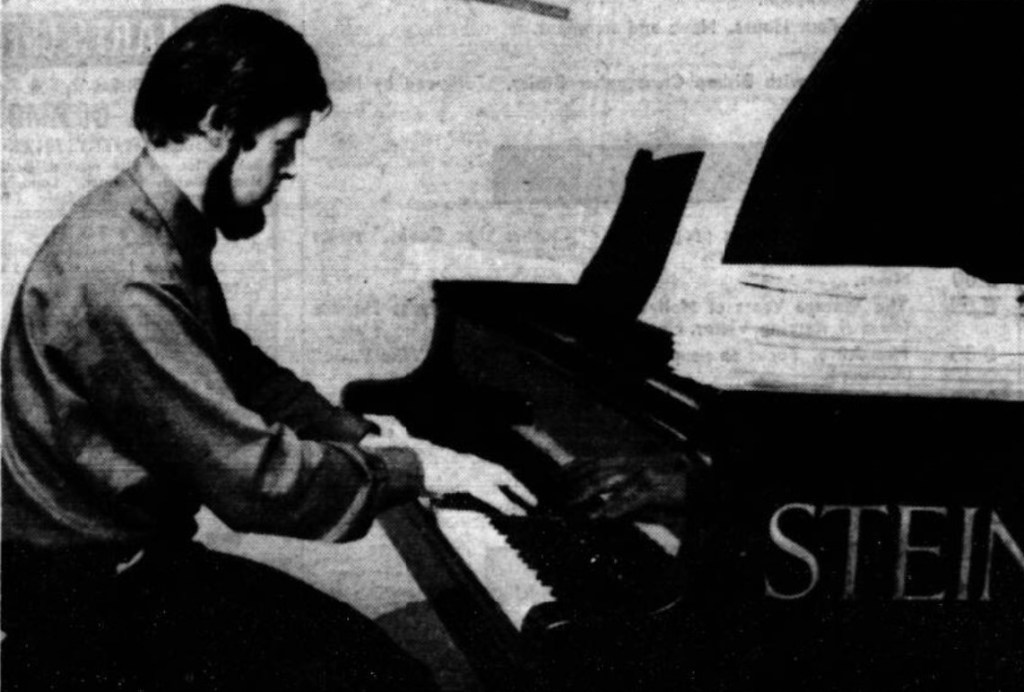
On 21 February 1970, pianist Peter Evans sat at a piano in Watter’s Gallery, Sydney and prepared himself for a performance of French composer Erik Satie’s 1893 composition Vexations. The piece is notorious for its weird intervals and disturbing effects on both the performer and audience… and the fact that Satie gave instructions that the motif should be repeated 840 times. Depending on the speed it’s played, that’s a performance lasting somewhere between 18 and 24 hours.

Evans started well, performing the unsettling and repetitious melody, but things started to go wrong as he approached repetition number 595. He felt his mind fill with evil thoughts, and he saw animals and ‘things’ peering at him through the musical score.

‘I would not play this piece again’, he said. ‘I felt each repetition slowly wearing my mind away. I had to stop. If I hadn’t stopped I’d be a very different person today… People who play it do so at their own great peril.’

Another pianist called Linda Wilson took up the challenge when Evans abruptly stopped and played the remaining 245 repetitions without any ill effects.[i]

Cats on a Piano

I first became aware of Satie’s weird composition when I accidentally tuned in to an all-night performance of it on BBC Radio 3 in 2006. I’d been looking for some soothing music to help me drift off to sleep, rather than something that would cast its disturbing shadow over my dreams. When I awoke the next morning, it was still playing.

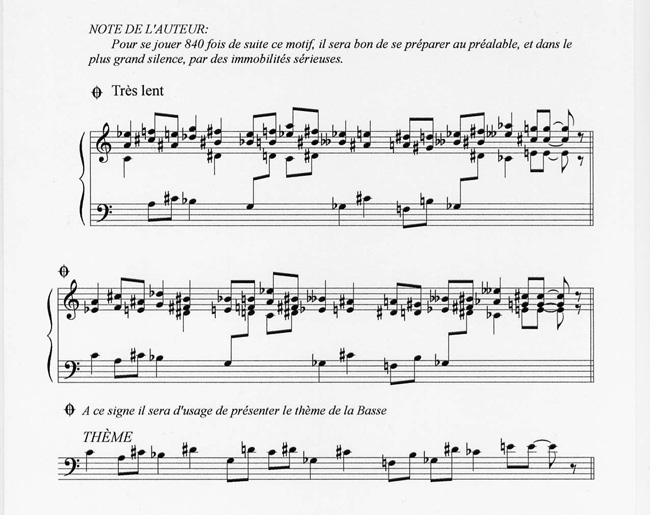
The score for the piece includes an enigmatic note from Satie saying ‘To play this motif 840 times in succession, it would be advisable to prepare oneself beforehand in the deepest silence, by serious immobilities.’

The score consists of a short single line melody. This seemingly directionless tune is then repeated but harmonised with mostly diminished chords. Then the theme is played again without the harmony. Finally, the tune is repeated with the same harmonised chords, though in different inversions. This cycle lasts about a minute. And then, repeat 840 times…

Erik Satie’s score for Vexations

But Satie wanted to keep any performers on their toes. His notation is eccentric with liberal use of double flats and scoring the B as a flattened C. The pianist has to really concentrate – it’s so unnerving and confusingly notated that it’s impossible to get used to it. As you can imagine, after a few repetitions, the confusing sharp, flat and natural symbols all begin to blur into one another.

You can hear a few minutes of it here.

To me Vexations sounds like a cat gingerly plodding over the piano keyboard, followed by two cats gingerly plodding over the piano keyboard in unison. However, some scholars think the weird melody includes arcane numerological and esoteric references, something that Satie was interested in.[ii]

It’s quite possible that Satie was expressing his feelings about his short and stormy relationship with artist Suzanne Valadon.[iii] In any case, the melody and harmonies feel dissonant and unresolved, whatever the obscure cabalistic or numerological significance hidden in the piece.

Suzanne Valadon’s self portrait and her portrait of Erik Satie

It was often assumed that Vexations would be nigh on impossible to perform. However, musicians around the world cried, ‘Hold my beer…’

Hold My Beer

One contender for the first full performance was given by Richard David Hames in 1958, who remarkably was only a 13 year old school boy at the time. It took place at Lewes Grammar School in Sussex and raised £24 for charity, though this claim to the first performance hasn’t really been confirmed.[iv]

Probably the best known confirmed early performance was organised by avant-garde composer John Cage, famed for his composition 4.33 in which the pianist sits in silence at the piano for four minutes and thirty-three seconds. Cage used a team of 10 pianists to perform Vexations in the Pocket Theatre, New York in 1963. The performance took nearly nineteen hours.[v]

She Loved Nudity

Cage organised another performance in Berlin in 1966, this time involving a relay team of six pianists. One of these, Charlotte Moorman  performed her parts with her boobs out because, well, it was the swinging sixties after all. Moorman was known as the Topless Cellist for her habit of performing in a state of undress, though sometimes on televised performances she would play cello while wearing a bra made of two mini televisions.

Charlotte ‘the Topless Cellist’ Moorman wears her TV bra

Moorman said she performed her parts of Vexations topless because she ‘loved nudity’, but it also seems John Cage had bet her $100 that she wouldn’t do it. She won the bet.[vi]

A phial of amphetamine

The first confirmed solo performance was by Richard Toop in 1967 at the Arts Lab, Drury Lane, London. Toop used 840 numbered copies of the score so that he could avoid the danger of losing count. After around sixteen hours, Toop was flagging and asked for some extra stimulant in his coffee, expecting a vitamin pill. Instead, as he found out later, he was dosed with a phial of amphetamine. ‘The effect was hair-raising’, he said. ‘My drooping eyelids rolled up like in a Tom and Jerry cartoon.’ No wonder some newspaper reports commented on the performer’s glazed expression…

Richard Toop speeding through Vexations (Coventry Evening Telegraph 11 October 1967)

The performance took 24 hours, and Toop noted that even after playing the piece for so long and so many times, he still couldn’t play it from memory.[vii]

The same feeling Frankenstein must have had

Another notable performance of Satie’s piece was by Gavin Bryars and Christopher Hobbs in Leicester Polytechnic in 1971. The two pianists took it in turns to play, and while on breaks between shifts wrote each other notes to be read when they changed places. This gives a fascinating insight into what it’s like to be one of the performers.

As he played, one of the performers had the unnerving impression that there was someone standing behind him, though at that early stage in the performance, the only other person in the room was the caretaker, and he was sweeping the floor.

‘When I make a mistake’, the other wrote, ‘it’s like the end of the world. The music is unnerving because it’s impossible to get used to it – the unexpected keeps happening.’

One pianist commented on the difficulty of following the score. The disorientating use of sharps and flats meant that he was never sure he was playing the right notes and that the symbols on the score started to melt into one another. ‘It’s the same feeling Frankenstein must have had,’ he wrote.

The performance was remarkably fast, taking a mere fourteen and a half hours. Perhaps, like Richard Toop, someone had put something in their coffee…

Epilogue

Some have said Satie’s piece is an avant-garde study of boredom and frustration, others suggest it’s the musical equivalent of a zen koan. Scholars have discussed the esoteric significance of the disturbing harmonies and tangled numerological meaning hidden in its off-kilter progressions or the occult magical properties of the number 840.

But the fact is that there’s no indication Satie ever thought of having the piece published let alone performed. It’s been suggested that Satie’s comment about playing the piece 840 times is not actually an instruction, but more a kind of note to self: If you wanted to play the piece 840 times, it would require careful psychological preparation and meditation – which is perhaps what Satie meant by ‘serious immobilities’.[viii]

Could he simply have been having a joke?

I picked up a vinyl copy of a performance (pictured below). It has twenty cycles on each side, so that’s forty altogether. To listen to the equivalent of a ‘full’ performance, I’d have to play both sides of the record 21 times. I’m afraid I can barely get past the first few minutes…

Modern vinyl issue of Variations. Don’t forget to turn it over. And over. And over…

For more weird musical history:

[i] Gavin Bryars (1983) ‘Vexations and its performers’, Contact: Journal for Contemporary Music, 26, pp.12-20 (p.13)

[ii] Robert Orledge (1988) ‘Understanding Satie’s ‘Vexations’’, Music & Letters, 79(3) pp. 386-395. Available at: http://www.jstor.org/stable/855366

[iii] Ibid p.390

[iv] Bryars (1983) p.13

[v] Ibid

[vi] Ibid

[vii] Ibid

[viii] Steven M Whiting (2010) ‘Serious Immobilities: Musings on Satie’s “Vexations”’, Archiv für Musikwissenschaft,  67(4) pp. 310-317

Doomsday Herrings and Fishy Farts

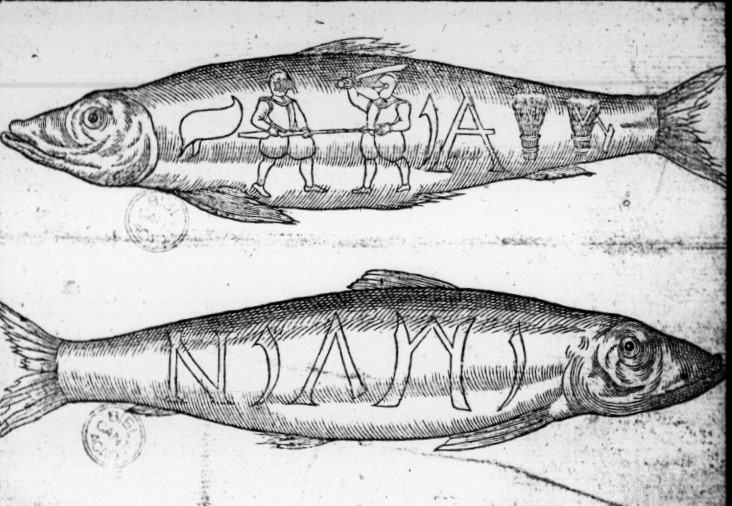
Norwegian fishermen were astonished when they landed a most strange and portentous fish on the 26 November 1597.

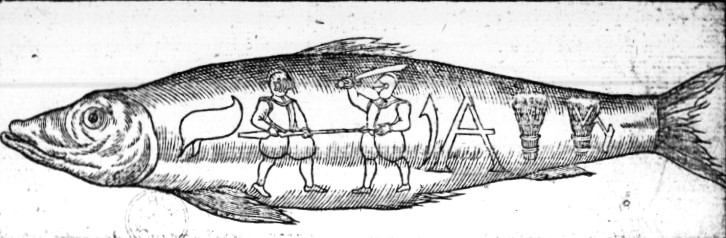
On one side of the 14 inch long herring was the image of two soldiers in combat wearing military helmets, with one waving a sword while being struck in the belly by the other’s lance.

Next to this image were some symbols, one of which looks like a capital A, followed by what seems to be two bushels of wheat.

On the other side of the herring in the same blood red were some letters or symbols, some familiar (M) and others not.

The strange and wonderful herring caught off Norway in 1597

A Most Strange and Wonderful Herring

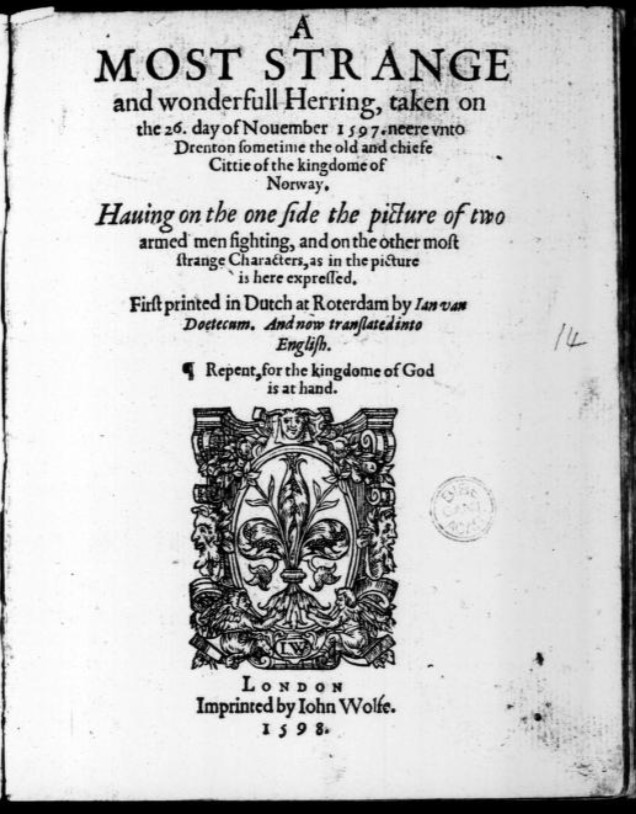
The fish was taken to local magistrates and the nobility and an account was printed in Dutch before being translated into English in an anonymous pamphlet titled A Most Strange and Wonderful Herring 1598.[i]

According to the author, the herring was sent by God as a sign to turn us away from sin. It is, he says, ‘a strange and wonderful token of God’s wrath figured forth in a silly herring’.

The Fishy pamphlet

The two fighting soldiers are there to tell us that God will visit war upon us to scourge the wicked. The bushels of wheat are taken by the author to be rods for whipping sinners, representing the two scourges that the Lord will use on us – war and famine.

As to the letters on the fish, the author of the pamphlet admits defeat. He acknowledges that although some characters are familiar, others are ‘strange and not understood’.

He is certain, though, that whatever the characters stand for, it is a ‘heavy sentence against the sins of this age.’ The author sees the miraculous herring as a sign that the end of the world is near. ‘Repent,’ he tells us, ‘for the Kingdom of God is at hand’.

Did an enterprising artistically inclined Norwegian fisherman carve the pictures and letters into the fish for a prank or a money making scheme? Or were superstitious fishermen interpreting natural markings on the fish in the light of contemporary fears and anxieties? Unfortunately, we have no way of knowing how accurate the drawings reproduced above are, or how they might have been embellished.

The pamphlet tells us that the doomsday herring was caught near the city of Drenton which does not appear to exist. My best guess is that the city is Trondheim which in some historical sources is rendered as Drondheim which could be plausibly if clumsily anglicised as Drenton.

However, this is not the only fishy tale about apocalyptic herring. Scandinavia has a weird history of ominous doomsday fish…

More Prophetic Fish

The early modern period was replete with accounts of strange signs and wonders related in bizarre pamphlets to a sensation hungry public. The upheavals, persecutions and conflict that came with the religious reformations of the times gave many in Europe the sense that they were living in the end of days, a feeling that has some resonance with our troubled times.[ii]

But why would God send his message on a fish, you might ask? The pamphlet suggests this is because the herring is a popular fish and one of the most commonly eaten.

Strangely, the doomsday herring was not the first portentous fish to carry God’s warning. In November 1587, king of Denmark and Norway Frederik II set his wisest experts the task of deciphering gothic script found on two herring. The best his learned men could do was suggest the characters said something along the lines that his herring fishing days were numbered.[iii]

King Frederik II – victim of doomsday herring?

In any case, everyone assumed the gothic letters meant the King was doomed. And doomed he was – he died a few months later…

In November 1587, four fish covered in letters, hieroglyphs and symbols were caught off the Danish coast. A learned theologian studied them and worked out the message from God: the world as they knew it was coming to an end, and Jesus was about to return and judge the living and the dead…[iv]

Unfortunately, there doesn’t seem to be an image of this doomsday herring. In any case, the doomsday prediction is some four centuries overdue.

Epilogue

Speaking of doomsday fish, could herring farts bring about a nuclear apocalypse? Well, throughout the 1980s the Swedish military, media and government were convinced that Soviet submarines were intruding on their waters. This was understandable after a Soviet ‘whisky class’ submarine ran aground off the country’s south coast in 1981. The press jokingly referred to it as ‘whisky on the rocks’, but it caused a major cold war diplomatic incident.

In the years following this, the Swedish navy were constantly hunting mysterious Soviet submarines in their waters, though never found any. Military equipment was picking up acoustic signals of underwater activity, and all the experts were convinced the Soviets were all over their waters. However, whenever Swedish submarines picked up one of these signals and pursued it, the source was never found.

Even after the cold war ended, the mysterious submarine activity off Sweden’s coast continued. It prompted Swedish Prime Minister Carl Bildt to complain to a bemused Boris Yeltsin about Russia’s nefarious submarine activity.

Eventually the military enlisted some outside scientific help to solve the mystery. And two of the scientists on the team, Magnus Wahlberg and Hakan Westerberg, happened to be experts on herring farts.[v] They knew that when herring in shoals of several square metres get spooked by a predator, or a Swedish submarine hunting phantom intruders, the collective release of fishy farts is huge.

The scientists demonstrated their theory in a top secret military backed experiment that involved squeezing herring they bought from the supermarket in a water tank to create bum bubbles from the fish

Once the fishy flatulence was recognised for what it was and ruled out, reports of invading submarines stopped.[vi]

Sweden’s military, media and political class – the best and the brightest – had been fooled by fish farts.

For the Yorkshire serial killer witch whose chicken laid a doomsday egg, see here: https://paulweatherhead.com/2024/03/19/yorkshire-serial-killer-witchs-chicken-lays-doomsday-egg/


[i] Anon, A Most Strange and Wonderful Herring…(London: John Wolfe, 1598). Available at: https://archive.org/details/bim_early-english-books-1475-1640_a-most-strange-a-wonder_herring_1598/page/n7/mode/1up?view=theater

[ii] Diarmuid MacCulloch, Reformation: Europe’s House Divided 1490-1700 (London: Penguin, 2003), pp.550-556

[iii] ‘Prophetic Herrings’, Rigby’s Encyclopaedia of the Herring, Available at: https://www.herripedia.com/strangely-marked-herrings/

[iv] A breefe coniecturall discourse, vpon the hierographicall letters & caracters fovnd upon fower fishes taken neere Marstrand in the kingdome of Denmarke, the 28. of Nouember 1587. Treating by considerations poligraphicall, theologicall, Thalmudicall & cabalisticall. Seene and allowed.” In the digital collection Early English Books Online 2. https://name.umdl.umich.edu/A07082.0001.001. University of Michigan Library Digital Collections.

[v] Magnus Wahlberg, and Håkan Westerberg (2003) ‘Sounds produced by herring (Clupea harengus) bubble release’, Aquatic Living Resources,16(3), pp.271-275, https://doi.org/10.1016/S0990-7440(03)00017-2

[vi] Marc Abrahams, The curious true tale of the Swedish prime minister, a Soviet submarine, and farting herring. 23 March 2014 available at: https://improbable.com/2014/03/23/the-curious-true-tale-of-the-the-swedish-prime-minister-a-soviet-submarine-and-farting-herring/

Horny Demons: Incubi and Succubi

If you lived in seventeenth century Italy and wanted to know about Demoniality – carnal relations with demons – the man to speak to was Father Lodovico Maria Sinistrari. As well as being a Franciscan monk, consultant to the Holy Inquisition and lecturer in philosophy and theology, he was the authority on demonic sex. In fact, sometime in the mid-seventeenth century, he wrote a book about it: Demoniality: Incubi and Succubi.[i]

Father Sinistrari – probably writing about sin or demon semen…

Incubi (male) and Succubi (female) are demons who are supposed to have intercourse with humans as they sleep. Typically, the victim would wake up to feel a heavy weight crushing and suffocating them as well as a feeling of paralysis.[ii] Perhaps there would be weird or terrifying visions or apparitions…

Fritz Schwimbeck My Dream, My Bad Dream (1915)

Many would nowadays put experiences like this down to sleep paralysis, the fairly common sleep disorder, but Father Sinistrari had other ideas.

The handwritten book was discovered in London in 1872 and then translated into English, and it’s certainly a strange read. It covers everything from the qualities of demonic sperm to the moral distinctions between bestiality and demoniality.

Demoniality by Father Sinistrari

Here’s one of the stories he uses to illustrate his learned tract.

Hieronyma and the Horny Demon

In Pavia, where Father Sinistrari was lecturer, there was a married woman of virtue called Hieronyma. One day she kneaded some dough and took it to the bakery to be baked. When it came back, the bread was accompanied by a large, oddly shaped cake. She told the baker it wasn’t hers, but the baker assured her it must have been ordered by someone from her household.

She ate the cake.

The next night she was awoken by a shrill voice hissing in her ear asking her if she had liked the cake. Hieronyma became scared, and began making the cross and calling on Jesus and Mary. The voice reassured her:

Be not afraid. I mean you no harm; quite the reverse. I am prepared to do anything to please you; I am captivated by your beauty, and desire nothing more than to enjoy your embraces.

She felt soft kisses on her cheek for an hour but resisted the demon and it finally left her.

The following day she called in a priest who provided her with some holy relics to protect her from the demon. These didn’t work. The incubus, for that is what it was, came and troubled her again the next night. She then went to see an exorcist, fearing she was demonically possessed. The exorcist blessed her house and demanded that the demon leave her.

But this demon was lovesick, or so he told Hieronyma, as he wept with love for her.

The incubus soon began to appear before her in the form of a handsome youth, sometimes when she was in company. He would kiss her hand and beg her to return his favours. Thankfully, only Hieronyma could see him, for he was invisible to everyone else.

As the months went by, and Hieronyma continued to refuse her demonic suitor, he became aggressive. He stole her jewellery and relics, beat her leaving her with bruises on her face and arms which appeared and then magically disappeared.

Even worse, the demon would snatch her three-year old daughter from her and place her in dangerous locations such as on the roof or in the gutter, though the child was never harmed. Furniture would be suddenly upset and plates would be smashed only to be miraculously restored.

The demon’s behaviour became more outrageous, according to Father Sinistrari. One night after coming to Hieronyma’s bed and being refused, the incubus disappeared only to return with some stones with which he built a wall surrounding the bed that almost touched the ceiling. The poor woman supposedly needed a ladder to get out of her bed. When the wall was torn down, many witnesses were said to have seen all the stones vanish.

However, the demon’s most audacious piece of mischief came when Hieronyma’s husband was entertaining some military friends. The company were about to sit down to eat when the whole table and everything on it simply vanished, as did all the pots, pans and crockery in the kitchen as well as all their bottles and glasses.

The guests were leaving when they heard a crash and returned to see the table was back, groaning with food and wine. The food was different to what had previously been there, so the guests were unwilling to try it, but when they overcame this, they found everything delicious and polished it off. It was only then that the original food miraculously appeared again, though by now everyone was too full to eat it.

Even more embarrassment followed for poor Hieronyma. She was walking past some crowds of people to hear mass, but as soon as she set foot on the church threshold, all her clothes fell to the ground before being blown away by a gust of wind leaving her stark naked before the astonished eyes of the congregation. Finally, two gallant cavaliers covered her nakedness with a cloak and escorted her home.

The incubus eventually gave up and left poor Hieronyma alone, but this was after several long years…

This tall story has both fairy tale elements (the mysterious cake) and odd dream-like elements (the vanishing food, finding oneself naked in church), as well as a kind of saucy slapstick humour, though I don’t think this was intentional.

Anyway, if you want to know more about the sex lives of Demons, read on…

Demon Semen

According to some experts on the matter, Father Sinistrari instructs us, demon semen is very thick, warm and rich. This is because the demon transforms into a succubus and extracts the sperm from a sleeping man and only the strongest men are chosen. It is this sperm that the demon uses to impregnate the woman of his choice. In other cases, the demon may animate a male corpse and use that to inseminate the object of his desire.

However, Sinistrati does not concur. His belief is that the incubus impregnates the woman – and only with her consent – with his own sperm. This is because demons are corporeal fallen angels rather than immaterial spirits. Because of this their sperm is ‘subtle’ rather than thick, and in Old Testament times liaisons between women and these fallen angels resulted in mighty giants (or the Nephalim, as they are referred to in the book of Genesis (6:1-4).

Sinistrari believed that demon-human hybrids were often bold, tall, strong, proud and wicked. Examples of people born from a demonic liaison include legendary founders of Rome, Romulus and Remus, Pliny the Elder, Plato, Alexander the Great, Caesar Augustus and Merlin the wizard. And that ‘damned’ heretic, Martin Luther. Meow.

So, if demons are still consorting with human women, where are all the giants now, you might ask.

Well, Sinistrari has an answer. Demons can be aerial, aqueous, earthy and igneous. Since the great flood, the atmosphere of the earth has become much damper, so the variety of demons that fathered giants have moved to the upper atmosphere where they can no longer get up to mischief. The demons left behind father normal sized babies.

If you want to know what a demon-human hybrid looks like, according to demonologist Nicholas Remy in the sixteenth century:

It had a hooked beak, a long smooth neck, quivering eyes, a pointed tail, a strident voice, and very swift feet upon which it ran rapidly to and fro as if seeking for some hiding-place in its stable.[iii]

Woman Wailing for her Demon Lover

In his poem ‘Kubla Khan’, Samuel Taylor Coleridge wrote of ‘Woman wailing for her demon lover’, but having a demonic paramour was highly dangerous according to Sinistrari. For one thing, voluntary consorting with a demon lover would be considered witchcraft and therefore a sin.

As part of the Inquisition, Sinistrari knew a great deal about this and other sins. In fact, in order to help priests hearing confessions he had written a substantial analysis and classification of all the sins there were, with each being divided into sub-categories, and further Aristotelian sub-divisions within those.[iv]

However, Sinistrari had considerable sympathy for people like Hieronyma who were pestered by lusty demons and resisted them. He recommended a number of herbs, stones and other substances that could be placed around the bedroom to discourage an amorous demon – cardamon, ginger, cinnamon, cloves, nutmeg in vessels of hot water. If you want your room to smell like a pub rather than a curry house, you could use tobacco and brandy. Or you could use diamonds or menstrual blood.

If you don’t have any of the above to hand, you might be in trouble. Sinistrari argues that when a man confesses to bestiality, the priest orders him to slaughter the animal to avoid being tempted again. Congress with an inferior creature is sinful. However, incubi and succubi are fallen angels, so in the case of sexual relations between them and humans, it’s us that are the inferior creatures. And because Sinistrari sees these lusty demons as capable of salvation, if and when the demon sees the error of his ways he is liable to kill his human lover to avoid further temptation, or so we are warned…

Epilogue: The Lancashire Connection

If you’ve got this far, you might be wondering why I’m reading seventeenth century tracts on demonology. Well, it’s because I’m doing research for a book on demonic possession in early modern Lancashire. The Lancashire witch trials are well known, but around the same time Lancashire was troubled by several bizarre cases of supposed possession by evil spirits, as attested to in a number of astonishing contemporary pamphlets. And this is the rabbit hole that led me to Father Sinistrari’s Demoniality

Sweet dreams…


[i] Father Ludovico Sinestrari, Demoniality: Incubi and Succubi

[ii] Rosemary Ellen Guiley, The Encyclopaedia of Demons and Demonology, (New York: Facts on File, 2009) p.19

[iii] Guiley, p.120

[iv] Alexandra H.M. Nagel, Tracing the mysterious facts of “Demoniality” (“De Daemonialitate”) by Ludovico M. Sinistrari and published by Isidore Liseux, (2008). Available at: https://www.academia.edu/4046753/Tracing_the_mysterious_facts_of_Demoniality_De_Daemonialitate_by_Ludovico_M_Sinistrari_and_published_by_Isidore_Liseux

Churn Milk Joan: Lonely Stone Tells her tales

Secret lovers’ trysts, a deal with the devil, a vengeful ghost, pennies from heaven, the plague and killer foxes… all have been associated with one of my favourite standing stones – Churn Milk Joan.

The stone stands around 7 feet tall on the outskirts of Midgely Moor overlooking the Calder Valley, and although it probably only dates back to around 1600 when it was erected as a boundary stone, it has been a magnet for a variety of legends and traditions.

The Awful Death of Churn Milk Joan

Joan was a young farmer’s daughter and would often make the lonely journey over the tops of Midgely Moor to deliver her churn full of milk to the villages beyond. One snowy evening, though, she encountered the devil where the stone now stands (at a crossing of paths), and he told her he was on his way to take the souls of her ailing parents. However, Joan made a bargain with the Devil – her soul in the place of her parents. Presumably Old Nick thought this a good deal, for the next morning Joan’s frozen body was found under the standing stone, surrounded by the icy milk spilt from her churn.

And that’s how the stone got its name. At least according to my favourite version of the legend.

According to Mytholmroyd poet Ted Hughes, who wrote a poem about the standing stone in his 1979 collection Remains of Elmet, Joan was done in by killer foxes. The poem, titled ‘Churn Milk Joan’, begins:

A lonely stone

Afloat in the stone heavings of emptiness

Keeps telling her tale. Foxes killed her.

I think you’re about as likely to be killed by a shark as a fox on Midgely Moor, but that’s the legend as our Ted tells it. It caused some controversy when a sculpture was commissioned for the centre of Mytholmroyd depicting a milk churn and two rather cute foxes – representing the Disneyfication of Ted Hughes and his work, according to one article in the Guardian.[i]

Churn Milk Joan: Foxy Lady (Royd Regeneration)

Other versions have poor Joan getting lost and disoriented in a blizzard, and laying down to freeze to death next to the stone that subsequently bore her name. This seems to be the most common version of the story. Indeed, a similar story is attached to the Two Lads cairns on the moors above Crag Vale.[ii]

But not all the legends are so dark. According to Samuel Fielding (writing in 1903), the name came from the custom of boundary officials taking a break at the stone and being supplied with a welcome drink of milk from Joan, who was a ‘merry buxom farmer’s wife’.[iii]

Other sources say that the stone was the location where a fam girl called Joan used to meet her lover.[iv]

Turn Turn Turn

Churn Milk Joan is said to turn round three times at midnight on New Year’s Eve when the church bells in Mytholmroyd chime for midnight. I’ve often thought of spending New Year on Midgely Moor with a video camera to record what happens as the church bells ring and the valley is lit up with fireworks…

But a night on Midgely Moor in winter is not that appealing, and I can’t help thinking that anyone who witnesses her nocturnal perambulations would not live long…

Relic of the Plague

Churn Milk Joan has a hollow on top of it, and the custom is for passers-by to take a coin out and replace it with one of their own. The common belief is that the stone was, as Hughes puts it in his poem, a ‘relic of the plague’. The idea was that during times of plague, the hollow at the top of the stone would be filled with vinegar so that any coins that exchanged hands between traders and customers could be disinfected.

It’s a nice idea, though as John Billingsley has pointed out, Joan is a bit too tall for such a purpose.[v] Robin Hood’s Pennystone – just over the moor – has a similar hollow and is a more realistic height for a ‘plague stone’.

Other legends say that the hollow was used to collect funds for Joan’s funeral, or that the stone has magical properties and produces coins magically from thin air.[vi] Or that Joan’s ghost will haunt you if you don’t leave an offering for her…[vii]

Some of the newspaper sources from the early twentieth century suggest that although the tradition of putting money into Joan’s hollow was known about, it was very rare to actually find any.[viii]

However, in the many visits I’ve paid in the last three decades, there have always been a few coppers or some silver nestling on top of her. One time when I visited to take some photos for the first edition of my book Weird Calderdale, I neglected to take some loose change with me and balked at the idea of leaving her a twenty pound note. When I went to take the photos, the camera’s battery was completely flat, despite it being fully charged when I set off… as far as I can remember, anyway.

I’m not superstitious but…after that, I always make sure I have something to drop in her little hollow to placate Joan’s ghost. The last time I visited (June 2024), instead of the usual copper, there was a pound coin – inflation even affects folklore. I naturally swapped Joan’s pound with one of my own.

I can’t help wondering if one day Joan will be card payments only

Joan in June 2024

[i] Martha Gill, ‘Even Ted Hughes has fallen to the sickly cult of the twee’, The Guardian, 9 October 2022. Available at: https://www.theguardian.com/commentisfree/2022/oct/09/even-ted-hughes-fallen-sickly-cult-of-twee

[ii] John Billingsley, Folk Tales from Calderdale Vol 1, (Northern Earth: Mytholmroyd, 2007), pp.55-63

[iii] S. Fielding, ‘Walks About Hebden Bridge’, Todmorden and District News, 22 October, 1903

[iv]Churn Milk Joan’, Halifax Courier and Guardian, 10 February, 1932

[v] Billingsley (2007), p.58

[vi] S. Fielding, ‘Walks About Hebden Bridge’, Todmorden and District News, 22 October, 1903; ‘Country Day by Day’, Halifax Evening Courier, 20 October 1941

[vii] See some of the comments here:  https://www.themodernantiquarian.com/site/5553/churn_milk_joan.html

[viii] Churn Milk Joan’, Halifax Courier and Guardian ,10 February, 1932

The Bradford Ghost 1868

“For the first time he then looked back and stopped. I felt the effect of that look creep over me like the feeling must be that comes over the prey of the boa-constrictor when it first knows its doom. I trembled…”

(Mr Chester, 1868)

In the spring of 1868, Bradford was in the grip of a ghost fever. A series of bizarre letters to the local newspaper described a mysterious and ghostly red-eyed stranger who wandered round the night streets of the city muttering profundities about the state of humanity. Soon the local police were struggling to control crowds of several thousand as the city was gripped by a riotous ghost hunt mania…

The Stranger

On the Thursday 27 February 1868, a strange letter appeared in the correspondence column of the Bradford Observer. The letter was purportedly written by a Mr T. Chester and concerned the nocturnal wanderings of a mysterious old man. The old man was around five feet tall, aged about sixty with grey hair and was poorly dressed in seedy black clothes and a greasy battered old hat. His eyes were described as red hot and staring. The old man had been seen by many walking the streets of Bradford with his hands in his pockets, red eyes staring straight ahead, chin buried deep in his shirt collar. He never accosted or spoke to anyone and nobody seemed to know who he was or where he lived.

The author of the letter, Mr Chester, said that he had met the old man on many occasions and that he became intrigued by his regular nocturnal ramblings. He went so far as to ask the police if they knew anything of the Stranger (as the letter was subtitled), but drew a blank. Unfortunately, being of portly frame and a poor walker, Mr Chester was unable to keep up with the old man so was unable to follow him. He did the next best thing – he paid a shoeshine boy sixpence to do his detective work for him.

However, the boy got tired after two hours stalking the old man round the streets of Bradford and gave up. He did, though, overhear the man muttering something odd: ‘Five miles to see a clock and then to find it stopped.’

The next day, Mr Chester relates, his own son saw the Stranger at 5am on Tyrell Street. He was muttering to himself: ‘Ten drunken gentlemen, and ten children starved to death. Forty dogs surfeited with dainties and the widow’s two daughters ruined for want of bread.’

Mr Chester signed off by asking whether something should be done to stop the Stranger as he was evidently insane and might hurt someone.[i]

Pity He Marked His Own Grave

A week later, Mr Chester had another letter published in the Bradford Observer. Since the first letter appeared, he wrote, he had been overwhelmed with requests for more information about the mysterious old man, and what’s more, various offers came in to help follow the Stranger to find out who he was and where he lived.

Mr Chester eventually hired an unnamed young man who had been in training for a competitive walking competition. At 7.30 that evening in Well Street, the Stranger appeared and Mr Chester pointed him out to the amateur sleuth, who set off after him.

According to Mr Chester, he heard nothing until 8.30 the next morning when his door burst open. It was the young man, ashen faced and trembling violently. He threw himself into a chair and Chester poured him a brandy, and soon he was recovered enough to relate what had happened to him.

The young man told how he followed the shabbily dressed old man in black along Well Street, noting how he never looked from right to left, his hands always in his pockets. When the Old Man passed the Mechanic’s Institute he stopped, took his hand from his pocket and tipped his hat, saying, ‘To the kind endeavours of good labour.’ When a merchant passed the Old Man, he muttered, ‘Pity he steals; greater pity, shames not to show it.’ The Stranger then headed onto Market Street where he saw some young women being merry in their colourful clothes and mumbled, ‘Coals of fire on the head of virtue.’

The letter continues at some length to describe the Stranger’s route round Bradford and his gnomic mutterings. As he passed through the crowds of Westgate, the amateur sleuth on his tail heard him mumble, ‘Crimes for some, carelessness for others, want of duty for all.’

On passing a woman described as bloated and pimpled with bloodshot eyes, with a dirty face and a torn dishevelled dress who was staggering down the street, he muttered, ‘Two years from purity to filth; pity she was so ugly.’ When a carriage carrying elegantly dressed gentlemen and ladies on their way to a ball drove by, he uttered, ‘Pity that there is deception, but good that the breast is opaque.’

However, it was just after this that the young man lost his quarry in the crowds, and despite diligent searching, could find no trace of him. The young man returned to Market Street hoping the Old Man would pass him here once more. He waited patiently for hours, hearing the clock strike nine, ten, eleven but still no sign of the Stranger. He then returned to Well Street and waited there for a while. He was about to give up in despair, but as the clock struck midnight, the Old Man appeared again. The young man assumed he had finished his nocturnal route and was now heading home, so by following him he was sure to learn where he lived.

The Old Man headed up Church Bank, and opposite the graveyard, again reverentially raised his hat though did not say anything. Rather, he crossed the road to the cemetery and then climbed over the wall. The intrepid young man followed him. And this is when he finally came face to face with the mysterious stranger that had been haunting the streets of Bradford. According to Mr Chester’s letter, this is how the young man described his encounter in the graveyard:

For the first time he then looked back and stopped. I felt the effect of that look creep over me like the feeling must be that comes over the prey of the boa-constrictor when it first knows its doom. I trembled.

The Old Man with piercing red eyes waved his pursuer back, and he staggered against the cemetery wall, slumped down and wiped the beads of sweat from his brow. When he looked up again, the Old Man had gone.

The young man returned home to try and sleep but could not get the glowering red eyes out of his mind. Finally, he rose at 5am and on going outside, the first person he saw was the Old Man, still walking purposefully and muttering. This time the Old Man brushed past him, lamenting, ‘Pity he marked his own grave…’

The young man was now in fear of his life, assuming that the Old Man was prophesying his death and burial in the cemetery where they had confronted each other the previous night.

The letter finished by reiterating that the account was truthful, and that the Stranger was in need of investigation, before reminding us that his mysterious nighttime wanderings began every night at 7.30 on Well Street.[ii]

It was practically an invitation to a ghost hunt…

The Great Bradford Ghost Hunt

On the evening of Thursday 4 March, crowds began to gather in Well Street and nearby areas, hoping to catch a glimpse of the red-eyed ‘ghost’. Each successive night, the crowds grew bigger, and by Monday 9 March, it numbered seven or eight thousand, according to a police estimate.[iii] Most of the unruly ghost hunters were young men of ‘the lower orders’, though there were both sexes and people of respectability joining the crowds. Young lads tore up sods from the churchyard and threw them at each other and passersby and some windows were smashed. Gangs of youths ran yelling and screaming round the streets, sometimes accosting unfortunate elderly gentlemen who they thought might be the Stranger mentioned in the enigmatic letters. The papers described the scenes as being of extraordinary excitement.

The police tried in vain to get the crowd to go home, but they had lost control. They were eventually saved by the fire brigade who had been using their hoses to clean some warehouse windows. The police turned the hoses on the ghost hunters, drenching them and finally dispersing them.

However, the following night crowds began to gather again, fuelled by a rumour that the ‘real’ ghost would appear, attracting hordes of would be ghost hunters from Bradford and surrounding towns and villages. This time, though, the church gates were locked to prevent youths from running wild in the graveyard and the police manged the crowds. By the next day, the excitement had all but ceased.[iv]

Three young men, William Longbottom, John Forrest and Edward Milnes were summoned to the borough court charged with loitering on Well Street and refusing to move on when told to by the police. P.C. Bradbury told the judge how a crowd of seven or eight thousand had gathered and refused to disperse, until, that is, the firemen’s hoses were turned on them. The three young men got away with just paying costs.[v] Perhaps the judge thought that these three were police scapegoats, given that thousands of others also refuse to move on.

These kinds of ghost flashmobs occurred frequently in the nineteenth and early twentieth centuries. Often a prankster with a scary costume might prance around at night in a spooky location or jump out on a passer-by, and this would lead to wildly exaggerated rumours of people being scared to death or the ghost possessing amazing powers. These would be picked up by the press, and copycat hoaxes would follow, as might attention-seeking fake victims. Often impromptu ghost hunts would ensue, many of them riotous and drunken in nature.

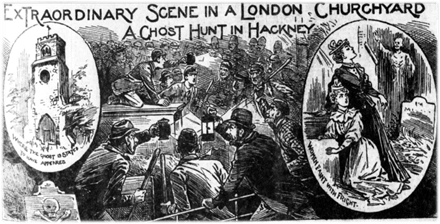
A couple of examples from London towards the end of the nineteenth century bear a remarkable similarity to the events in Bradford in 1868. In 1895, a rumour spread that a ghost was haunting a Hackney churchyard leading to thousands of ghosthunters armed with various weapons running riot in the cemetery and clambering all over the graves. There were false alarms and wild goose chases, friends hoaxing each other and wild screaming and ghost noises from frolicking ghost hunters. The scene was heightened by a violent thunderstorm as thousands dashed madly round the gravestones chasing and scaring each other.[vi]

Hackney Graveyard Ghost Riot 1895 (Illustrated Police News 31 August 1895)

A few years later in January 1899, one Mr James Chant wrote a letter to the local paper saying he’d seen a ghost by Islington church on Christmas Day and he was going to look for it again that evening at 8 o’clock. As with the Bradford episode, this was practically an invitation to a mass ghost hunt, and that’s exactly what ensued in the churchyard after dark. The police lost control as hundreds of ‘roughs’ conducted a ‘vulgar riot’ among the graves. Many people in the crowd found that their watch, wallet or purse was missing, and there was some speculation that the letter about the ghost had been sent by a pickpocket hoping to cause a large crowd to gather where he could ply his trade.[vii]

In any case, these ghost flashmobs and their riotous exploits usually burned themselves out after a few days, and that’s what happened in Bradford.

Epilogue

Of course, most people who read Mr Chester’s letters about the strange old man and his wanderings and gnomic pronouncements would have realised it was a joke, intended as satire. These kinds of surreal, rambling and ironic letters were rather common in the papers of the time, but the particular description of the Old Man from the graveyard and his comments on contemporary society struck a chord with the people of Bradford, and the fact that a specific location and time were mentioned (Well Street at 7.30) meant that many would be tempted to turn up and see what happened.

The press at the time assumed that because Bradfordians turned out in their thousands to see the ghost, they must have taken Mr Chester’s satirical letter literally.[viii] I’m not so sure. Judging by what happened at other similar ghost flashmobs occurring around graveyards, it seems more likely that as the talk of the mysterious stranger spread, many just turned up to have a laugh with their mates and engage in some carnivalesque tomfoolery and pranking that sometimes got out of control. The Bradford ghost hunt was, like the many other mass Victorian ghost hunts, both transgressive and carnivalesque.

As for the letter that started it all, there are some clues that the whole thing was meant as a joke. Firstly, the author is named Mr T. Chester which seems to be a play on words with ‘jester’. The second clue comes in a final letter from Mr Chester, published in the Bradford Observer on 2 April 1868.[ix]

In this missive, Mr Chester writes that he met the mysterious Old Man once again in the Park area of the city in broad daylight while he was enjoying a cigar. The Stranger appeared beside him as if out of nowhere and he was so startled, he made for a bench and sat down. The Stranger stared ahead, breathing heavily and then took out a strange looking pouch and pipe and began to smoke. The heady aroma filled the air, and the Old Man demanded that Chester speak, but he was unable to. The Old Man went on, ‘Better perhaps to be silent, for lying goes about from mouth to mouth like the exhaled air.’

Eventually, according to the letter, Chester plucked up the courage to speak and ask the Stranger who he was and why he was wandering round Bradford at night. The man replied:

Seek not to know, for direful would be your knowledge. What I am I cannot tell, what I have been – listen! A phantom, a Nemesis, a murder undiscovered; a bad deed dropped on the past and sprung into a man. I am a magician; behold!

At this point, the Old Man held up a mirror, and as Mr Chester’s eyes were drawn inextricably towards it, he saw his whole like flash before him in the glass.

…bad, bold and heinous; the good, overshadowed and dim. I trembled and tried to shut my eyes, but they would not close, and I feared I was going mad…

Finally, the Old Man said, ‘Adieu, forget it again, and again shall I appear. To everyone shall I appear, my mission is to all!’

And then the vision in  the mirror vanished and when Mr Chester looked round, the Stranger was no more.

The date of this strange meeting, Mr Chester informs the reader, was the first of April.


[i] T. Chester, ‘A Stranger’, Bradford Observer, 27 February 1868, p.7

[ii] T. Chester, ‘A Stranger’, Bradford Observer, 5 March 1868, p.7

[iii] ‘A Ghost in Bradford’, Bradford Review, 14 March 1868, p.5; ‘The Well Street Ghost’, Bradford Observer, 19 March 1868, p.5

[iv] ‘A Ghost in Yorkshire’, Liverpool Mercury, 13 March 1868, p.8; ‘A Ghost in Bradford’, Bradford Review, 14 March 1868, p.5 ; ‘The Well Street Ghost’, Bradford Observer, 19 March 1868, p.5

[v] ‘The Well Street Ghost’, Bradford Observer, 19 March 1868, p.5

[vi] ‘The Hackney Ghost’, Sheffield Evening Telegraph, 23 August 1895, p.2; ‘Hackney Ghost Hunters’, Morning Leader, 22 August 1895, p.3; ‘A Hackney Ghost’, Shields Daily Gazette, 23 August 1895, p.3; ‘The Hackney Ghost Hunt’, London Evening News, 23 August 1895, p.3; ‘The Hackney Ghost’, Sheffield Evening Telegraph, 23 August 1895, p.2

[vii] James Chant, ‘A Ghost at St Mary’s Churchyard’, Islington Gazette, 3 January 1899, p.3; ‘The Ghost Trick’, Islington Gazette, 4 January 1899, p.2; ‘Looking for a Ghost’, Echo, 1 January 1899, p.2; ‘Ghost Scare at Islington’, Globe, 4 January 1899, p.5; ‘Stupid Ghost Hoax’, Bingley Echo, 4 January 1899, p.8; ‘Waiting for a Ghost’, Westminster Gazette, 4 January 1899, p.5; ‘Islington Ghost Scare’, Islington Gazette, 5 January 1899, p.3

[viii] ‘A Ghost in Bradford’, Bradford Review, 14 March 1868, p.5

[ix] ‘The Stranger Departs This Time’, Bradford Observer, 2 April 1868, p.7