The UFO Cult That Saved the World

In December 1954, a close-knit group of believers were anxiously awaiting the arrival of the flying saucer that was to save them from an apocalyptic flood they believed would destroy the USA. The Chicago UFO cult predicted that the whole continent would be submerged on 21 December, though the true believers would be whisked away to safety by spaceships from the planet Clarion.

The group knew all this because their leader, Chicago housewife Marian Keech, was getting messages from Sananda, who was an alien incarnation of Jesus Christ. These messages came in the form of automatic writing, in which Sananda would take control of Mrs Keech’s hand and write messages of cosmic wisdom, as well as the dire doomsday prediction. Another member of the group, Bertha Blatsky, went one better – she channelled The Creator.

Also among this flying saucer cult were several psychologists, observing the group incognito. They wanted to see what would happen when the flying saucers didn’t come and the world didn’t end. How would the believers cope with the disappointment? How would they explain it? The resulting book, When Prophecy Fails (1956) by Leon Festinger, Henry Rieken and Stanley Schachter, became a psychological classic.[i]

When the time came for the alien saviours to appear, the believers had to remove everything metal about their person, including belt buckles, jewellery, buttons and zips. The flying saucers didn’t allow metal aboard, presumably for some cosmic health and safety reasons. With only a few minutes before a saucer was expected, one of the authors realised he had not cut the zip off his trousers. In a tense moment, a believer with trembling hands slashed out the zip with a razor and finished the job with wire cutters just in time.

But nothing happened. The saviours from space didn’t show. And, like in Waiting For Godot, they didn’t just wait for nothing to happen once.

So what happens when prophecy fails? What would you do when confronted with glaring evidence that what you believe so deeply is wrong?

When the saucers failed to show in December 1954, some members did walk away from the group. But the true believers didn’t. Perhaps, they reasoned, the prediction was just a drill or a rehearsal to test their readiness. Perhaps the message had been misinterpreted by the group. It could be that the reporters and onlookers gathered outside Keech’s house were deterring the aliens. It was just a delay. ‘No plan has gone astray’, were the enigmatic words sent by Space Jesus to comfort the believers.

A flying saucer, just like the ones that didn’t come in 1954

Finally, it was decided that because of the spiritual light and faith of the believers, God had intervened and prevented the flood. They had saved the world. They had to spread the word about this miracle, and frantically informed the media of the good news.

The saucers failed to come, the world failed to end but the true believers continued with strengthened belief despite the evidence to the contrary.

The words of one believer, Dr Armstrong, are revealing:

I’ve given up just about everything. I’ve cut every tie: I’ve burned every bridge. I’ve turned my back on the world. I can’t afford to doubt. I have to believe. And there isn’t any other truth.[ii]

As Festinger et al noted, not only were these beliefs deeply held, the believers had committed themselves by taking important actions that are difficult to undo. They had left families, quit jobs, dropped out of education, and bet everything on their certainty. However, the key to their beliefs strengthening after the failed prophecies is the social support the group offered each other in the face of each disconfirmation of their beliefs.

The group finally splintered. Complaints by neighbours led to the police informing Keech’s husband (who was a heretic) that if meetings did not stop they would raid the house and that his wife would face detention in a mental institution.

The depressing truth is that when a narrative that we’ve invested in collapses before our eyes, we tend to believe in it even more vehemently whatever the absurdities and contradictions we’re confronted with. And this is especially true if everyone in our community agrees.

Imagine a medical treatment designed to prevent you catching a disease. You have the treatment, and you still get the disease. You repeat the treatment, and get the illness again. You would probably ignore the evidence and conclude that the treatment is working.

Imagine pouring billions of dollars’ worth of arms into an impossible war. When the war is not won, more weapons and cash follow. When the war is still not won, you would probably ignore the death and destruction and conclude that what’s required is more of the same.

With the UFO cult from 1950s Chicago, every time the spacemen didn’t show up, a few members made the painful decision to walk away. Perhaps that leaves some room for optimism. They refused to take part in the lie.

Our leaders know it’s a sign of political weakness to abandon their beliefs in the face of evidence. Better to censor the evidence, or at least ignore or distract from it.

But the flying saucers aren’t going to save them.


[i] Leon Festinger, Henry Rieken and Stanley Schachter When Prophecy Fails (Pinter and Martin, 1956)

[ii] Ibid p.170

Vape Spiking – Smoke Without Fire?

A new danger for festival and party-goers emerged this summer – vape spiking. A stranger approaches a young woman and asks if she wants have a go on his vape, something that young people often do to try new flavours. Soon after the victim becomes dizzy, nauseous and loses control of her body before passing out…

She has been vape-spiked.

Vape spiking was reported across the media as a worrying new trend, a new weapon in the armoury of the innumerable spikers said to haunt the nightclubs and festivals of the world. Not content with spiking drinks with knock out drops, these invisible maniacs recently turned to stabbing women in nightclubs with syringes dripping with date rape drugs. And now they’re targeting you with spiked vapes…

Or are they?

Entire Body Shut Down

The vape spiking panic seems to have started when Chloe Hammerton, a 26 year old emergency care assistant, was at the Isle of Wight music festival this June with her partner, her brother and his girlfriend. She was in a queue for food with her group when a man approached her and encouraged her to try his vape.

Within a minute she was in and out of consciousness and unable to speak or move. She told the presenters of Good Morning Britain that the world seemed to go into slow motion, she felt pins and needles before collapsing into seizures, vomiting and suffering from incontinence.

Chloe and her partner say they waited for two hours for adequate medical help from the festival, though the festival authorities deny this. Neither the festival medics nor Southampton police (where they reported the next day) tested her for drugs. The implication is that the festival and the police thought that Chloe had simply drunk too much.

Chloe and her family and friends contacted the media and her experience was widely reported. She appeared on Good Morning Britain along with former Love Island star and anti-spiking campaigner Sharon Gaffka and answered some questions about what happened to her. In discussing the motive for the attack, one presenter noted that it was extraordinary that someone would spike Chloe with a vape in broad daylight and in a busy public place with lots of witnesses who might identify him.

And this is one reason for scepticism. If your aim is to sexually assault or rob someone, incapacitating them in a public place when they are surrounded by friends is not a rational strategy. A drug that leads to vomiting and incontinence of the victim is unlikely to be conducive to a sexual assault. There is also a good chance that the attacker would be seen and caught. It doesn’t make sense.

Another supposed victim of vape-spiking was Emma Sugrue-Lawrence. She got talking to a man in the smoking area of a club in Wolverhampton and she gave him her vape to try. The man went to the toilet, and when he returned she asked for the vape back. However, soon after using it, she started to feel unwell and she lost control of her legs before her whole body shut down and she could not move. Emma was taken to hospital but discharged herself before she was given a drug test. She believes she had been spiked with Mamba, a synthetic cannabinoid that she thinks might have been sprayed around the base of her vape.[i]

Now, it’s certainly possible that the vaping liquid was contaminated in these two episodes. Or perhaps these women had a reaction to nicotine or some other compound in the vape. Maybe they were drunk or on drugs (they were in places known for such things). Or perhaps they had a panic attack. The least likely explanation is a malevolent man intent on publicly drugging innocent women for no apparent reason.

So what’s going on?

Yes, it’s Hysteria…

We’re in the early stages of a hysterical phantom attacker panic. This panic is a new variant of needle spiking hysteria of recent years when young women (and some men) in nightclubs were allegedly injected with drugs by mysterious men without being aware of it. The victims would suddenly begin to feel intoxicated, dizzy and suffer from loss of memory and perhaps unconsciousness. The next day they might find a small scratch or puncture on their skin. The conclusion they drew was that a maniac had drugged them with a syringe, for what nefarious purpose is never really made clear.

However, no drugs have been found in the blood of needle-spiking victims and no charges have been brought, despite the supposed attacks taking place in busy public spaces often well-served with cameras. Add to this the fact that jabbing someone in a crowded place, holding the syringe still long enough for the drugs to be injected and then withdrawing the needle without being seen and without the victim noticing is practically impossible.[ii] We might also note that the symptoms of being spiked (nausea, loss of balance, vomiting….) are also symptoms of having drunk too much.

Phantom attacker panics occur when there is a background of free-floating anxiety. Anxiety makes people more vigilant for threats in their environment and more alert to what’s happening in their own body, which results in breathing too hard, increased heartbeat and panic as a fight or flight reaction takes place. Add drink and drugs to the mix and you have a heady cocktail. As nightclubs opened again after covid lockdowns, many young people would have felt anxiety about catching the virus given the deliberately frightening government fear campaign of the previous two years. They may also have felt guilt in that by partying in a club and then catching the virus, they could pass it on to a vulnerable loved one. Concern about the effect of the vaccine on young people may also have played a part – the syringe symbolising this.

All these elements combined to create a perfect hysterical storm, and a phantom attacker panic was created. The needle spiking delusion began in Britain and then spread to Europe and then around the world.

Although it seemed that needle spiking was a shocking new crime, it’s actually a hysteria with some pedigree. In the early twentieth century it was believed that sinister organisations were spiking young women with needles with the intention of whisking them away to a life of sex slavery in a South American bordello.[iii] In the late twentieth century, there were panics in many parts of the world when it was believed that AIDS patients were deliberately jabbing innocent people in nightclubs with syringes full of HIV contaminated blood.[iv] However, NONE of these needle wielding monsters ever existed. They were urban legends – phantoms.

With the emerging vape spiking panic, the background anxiety may be the concern about potential harmful effects of vaping. There have been several worrying newspaper stories of contaminated (possibly black market) vapes with users, including children, collapsing after using them.[v]

A Warning about Warnings

Young vapers are already being warned about this new danger of vape sharing and the ‘symptoms’ of spiking to look out for.[vi]

But here’s the thing. Warning people about spiking doesn’t stop it happening, but it does make people more likely to interpret a panic attack, anxiety or being drunk as being spiked. But the evil spiker stalking festivals and nightclubs doesn’t exist. He’s a bogyman. And perpetuating the myth of the maniac spiker by these well-meaning warnings is helping to create the climate of fear in which these hysterical panics develop.

In any case phantom attacker episodes seem to thrive in the autumn for some reason. As new students head for university, they are likely to be given dire warnings about the danger of being spiked – by drink, needle or vape. A new wave of spikings is likely to ripple through the media in October and November as the bogey man returns…

Never accept a vape from the bogeyman…


[i] Jade Biggs, ‘A woman was left paralysed after her vape was spiked on a night out’, Cosmopolitan, August 2023, available at: https://www.cosmopolitan.com/uk/reports/a37440817/woman-paralysed-vape-spiked/

[ii] Robert Bartholomew and Paul Weatherhead ‘Poking Holes in Needle-Spiking: Nightclub “Attacks” Scare Sweeps Europe’, The Skeptic, (January 2023) available at: https://www.skeptic.com/reading_room/nightclub-needle-spiking-attacks-scare-sweeps-europe/

[iii] Bartholomew and Weatherhead (2023)

[iv] Timothy Corrigan Correll, ‘You Know about Needle Boy, Right?”: Variation in Rumors and Legends about Attacks with HIV-Infected Needles’, Western Folklore , 67, (1) (Winter, 2008), pp. 59-100;  Jun Jing, ‘The Social Origin of AIDS Panics in China’ in AIDS and Social Policy in China edited by Joan Kaufman, Arthur Kleinman, and Tony Saich (Cambridge, Massachusetts: Harvard University Asia Center, 2006) pp.152-169

[v] Charles Harrison, Daily Express 21 July 2023; https://www.msn.com/en-gb/news/world/the-living-dead-fight-in-front-of-kids-in-city-labelled-spice-capital-of-the-north/ar-AA1eARyR?ocid=entnewsntp&pc=U531&cvid=8443d50d63e24cbf9bd071069ef77097&ei=42

[vi] Charlotte Grey, Festival-goers at Boardmasters being given help to avoid drink and vape spiking at the festival, 13 August 2023, available at: https://www.itv.com/news/westcountry/2023-08-13/festival-goers-being-helped-to-avoid-spiking-at-boardmasters

UFOs ~ the Empire Strikes Back?

UFOs are back with a vengeance. They’ve been all over mainstream news in the last few years, and most recently after former intelligence officer and so-called UFO whistleblower David Grusch testified under oath before the US senate on Wednesday 26 July.

Grusch worked for the US Defence Department until 2023. His job was to analyse reports of UAPs (Unidentified Anomalous Phenomena – the fashionable euphemism for UFOs), and while he was there, he saw some incredible things. Well, he didn’t actually see them, but he spoke to people who did. Or perhaps he spoke to people who had spoken to people… But in any case, he got the nod from the intelligence services to go public. Which is very sporting of them, given that intelligence agencies around the world are known for deception, manipulation, assassination, human experiments and God knows what else. If you doubt that, look up MKULTRA.

Biologics From Another Dimension

In any case, the stories told by Grusch are pretty remarkable. He claimed under oath that the US government had retrieved crashed craft of non-human origin and had been reverse engineering the technology since the 1930s. Furthermore, some of the craft had pilots – or as Grusch referred to them – ‘biologics’ that were not of this world. In his testimony and previous interviews, Grusch seems careful to avoid referring to aliens as such, suggesting they could be ‘biologics’ from another dimension.

However, details in Grusch’s testimony are scant. He hasn’t seen anything himself. Nor has he revealed any names, and this leads to the suspicion that these claims might be the result of Chinese whispers. On the other hand, Grusch supposedly had very high security clearance – in other words, he was in close contact with the murky world of espionage and big dollar defence. This automatically makes him a rather shady character, in my book. Call me cynical if you like.

And if we had been reverse engineering these amazing craft from beyond our world for nearly a hundred years, surely we’d all have our jet packs by now?

The Pentagon spokesperson Sue Gough denied any claims of aliens or extraterrestrial materials (interestingly, she didn’t address the suggestion that the craft and beings were from another dimension rather than another planet).

The Big One

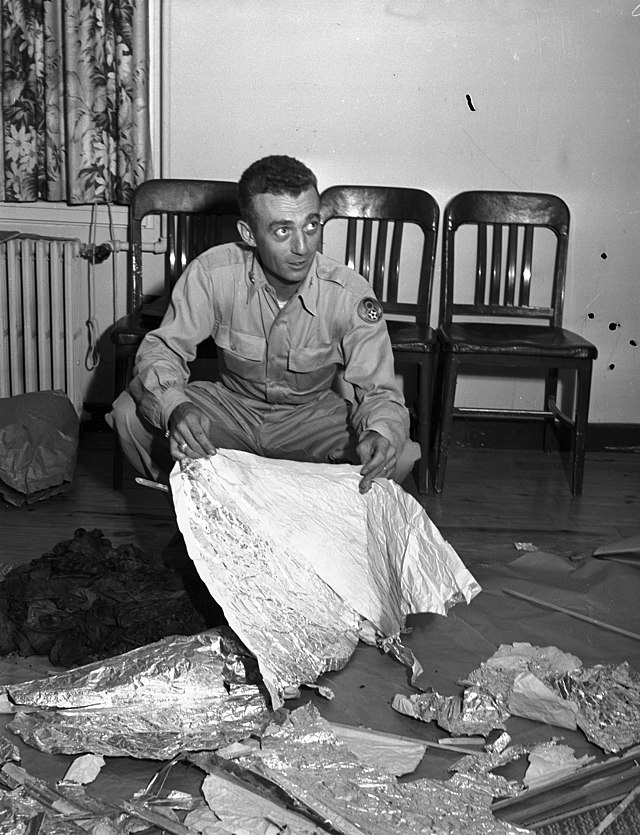
These claims that the big alien reveal is about to happen are nothing new. We’ve all heard of the supposed crashed flying saucer in Roswell. The authorities later claimed it was just a weather balloon, though it may actually have been a spying device designed to float high in the atmosphere and pick up signs of Soviet nuclear tests. But for many, the Roswell Case was the one. This case would convince the sceptics and prove that the UFO believers were right all along. Nope.

Major Jesse A. Marcel holding foil debris from Roswell, New Mexico, UFO 1947

There was also the time when the Secretary General of the United Nations saw a woman and three little aliens fly out of her New York apartment and be beamed up into a UFO hovering overhead. In some versions of the legend, the very important witness was named as Boutros Butros- Ghali, though I’ve also seen it told as happening to Kofi Annan, too. Budd Hopkins – often considered the father of alien abduction research – wrote about it in his book Witnessed: the Brooklyn Bridge UFO Abductions. Let’s just say the evidence for this tall tale relies on unreliable witnesses, unreliable hypnosis and unreliable mysterious phone calls… This case was also seen as the one – the case to end all cases. Nope.

So, regarding the Grusch claims, if you’re expecting major revelations from the powers that be that they have retrieved crashed saucers and ‘biologics’, I fear you will be disappointed. At least if the past history of ufological ‘cases to end all cases’ is anything to go by, and I think it is. With UFOs, the big disclosure of the TRUTH is always round the corner, is coming any day soon, and this one will be the case to end all cases… the one.

I think there’s more chance of Mr Godot turning up.

Which Bastards Want us to Believe This and Why?

This raises the question of why we are being given this ‘news’ now.

News isn’t something out there that’s waiting to be discovered by intrepid journalists and then communicated to their readers and viewers. News is created, curated and spun. If something’s on the news, then that means that someone powerful wants us to believe it, or at least be distracted by it.

So the first question to ask about any news item is: WHICH BASTARDS WANT ME TO BELIEVE THIS AND WHY?

The same applies to the current UFO flap. So, which bastards want us to believe in an alien (sorry, biologic) invasion and why? Have US intelligence agencies suddenly decided to embrace transparency, come clean and let the noble whistle-blower tell the world the truth? This seems highly unlikely.

It’s certainly possible that the US authorities want to distract the populace and the world media from the disastrous war in Ukraine, which is not going as planned. Russia has not collapsed under the unprecedented sanctions loaded upon it, and Ukraine’s much vaunted spring offensive has not succeeded. Ukraine, the USA, NATO and the collective west are staring defeat in the face. Anything that diverts the headlines away from the catastrophe might seem worth a shot.

There are also domestic issues that US elites might want to draw attention away from. One is Hunter Biden’s gun and tax related legal shenanigans, and the other is that more and more of America’s senior politicians are too senile to string a sentence together.

Another possibility is that the defence and intelligence agencies are hoping that trumpeting a vague non-human threat might release more funding for weaponry allowing for further militarisation of space. As countries start to turn their back on the dollar, Russia confronts NATO expansion and China grows in power and influence, could the militarisation of space be a desperate means for the moribund US empire to hang on to its global hegemony, as Caitlin Johnson has recently argued? Is the Empire preparing to strike back… from space? I don’t know, but it seems more likely than biologics from another dimension.

Of course, it’s also possible that Grusch is a fantasist – there are a lot of them about. Some perfectly sane people struggle to distinguish reality and fantasy and have what we might kindly call an overactive imagination. They’re known as ‘Fantasy Prone Personality’ types, and could make up four per cent of the population.

Maybe it’s all one big hoax, like the alien autopsy footage broadcast in 1995, and later made into a movie starring Ant and Dec. That fake footage of actors pretending to be scientists dissecting a latex little grey man was also the one, by the way. The case to end all cases… You get my point.

Who knows. We live in interesting times. May we one day return to more boring times.

Until then, I’m sticking with my paranoid question about these crashed saucers and the ‘biologics’ from the Twilight Zone – Which bastards want me to believe this, and why?

The Grumbleweeds Take A Trip

Weird Musical History #12

I loved this Leeds comedy cabaret band as a kid, so when I heard they’d recorded a ‘psychedelic’ album in the early 1970s I had to track it down. And it’s really rather good.

If you’re of a certain vintage, you’ll most likely remember the Grumbleweeds from their TV appearances and radio shows in the 70s and 80s. They mixed musical parodies, gags, comedy characters and catchphrases such as ‘You’re gettin’ right up my nose, you are, pal!’

But sometime at the dawn of the 70s, Maurice, Graham, Robin, Albert and Carl went into the studio to record a ‘straight’ album that at times sounds like it came straight from 1968.

The standout track is undoubtedly the titular ‘Teknikolor Dreem’, a blistering slab of fuzzy, heavy psych with bonkers lysergic lyrics about purple darts blowing your mind. Maurice’s blood-curdling scream at the end of the song, so the sleeve notes tell us, was so intense that he collapsed and lost consciousness for several minutes, his band mates assuming he was just playing a prank. It’s easy to find this track on youtube, and worth getting the record for this highlight alone.

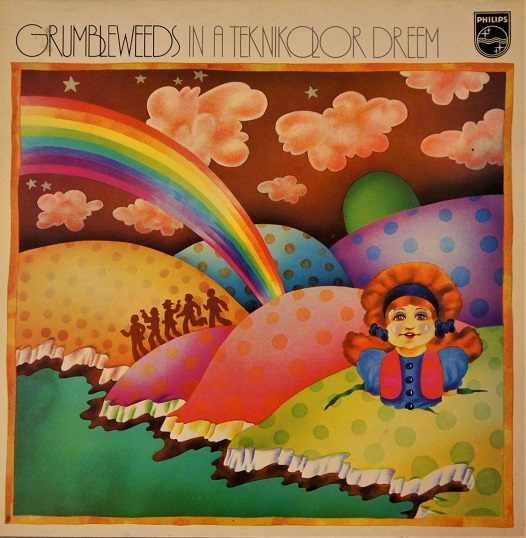
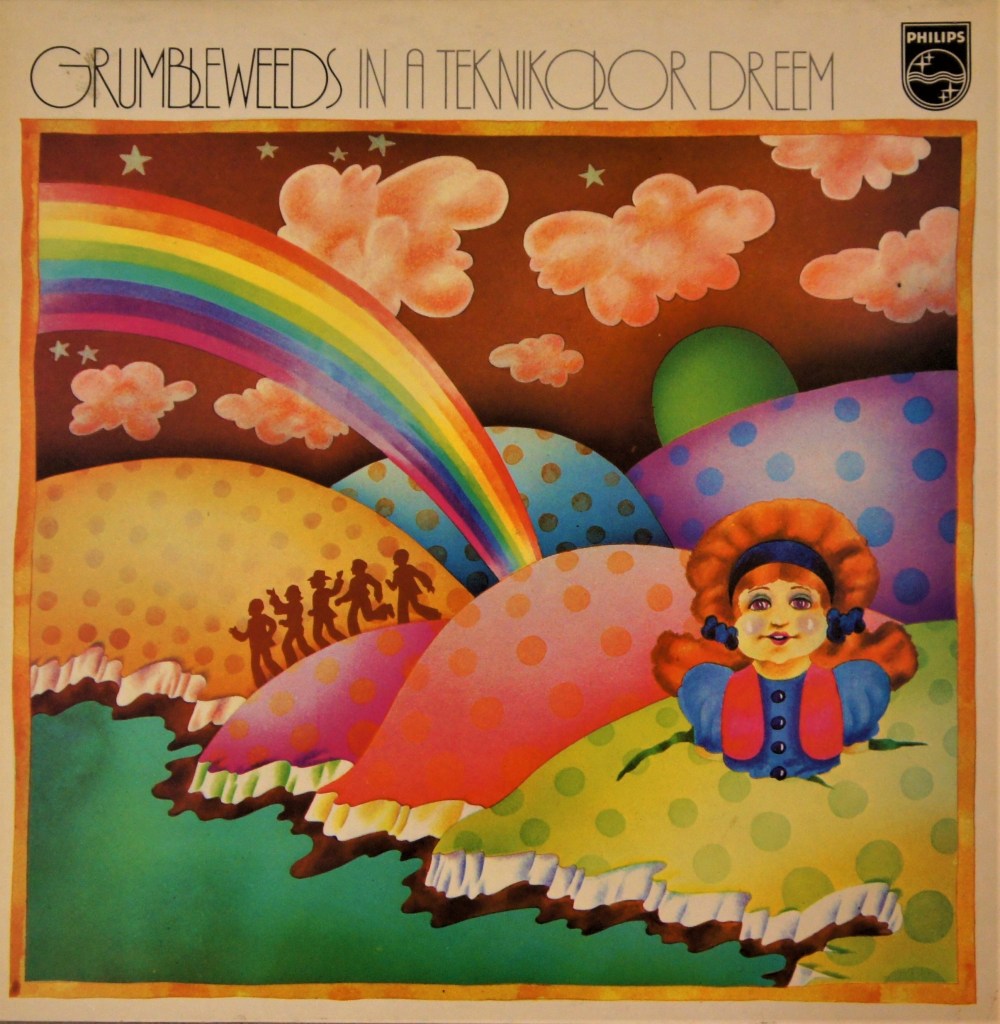
Front cover

The rest of the songs on the LP are pretty varied, though several have surprisingly philosophical, even existential lyrics such as ‘Dying to Live’, another stand out. Some songs have a searching, spiritual theme that reminds me at times of Sunflower era Beach Boys or Elvis in Memphis. At other times the album veers into baroque pop psych territory along the lines of the Zombies Odessey and Oracle. Of course, the Grumbles never hit the highs of those classic albums, but who did?

Back cover

Most of the songs are written by the band, with a few covers thrown in such as credible versions of Leon Russell’s ‘Stranger in a Strange Land’ and George Harrison’s ‘My Sweet Lord’. I never thought I’d hear the Grumbleweeds singing ‘Hare Krishnaaa, Krishna Krishnaaa…’ but the album has plenty of surprises. The least welcome surprise, though, has to be ‘So Sweet Netta’, (‘when she’s good, she’s very good, but when she’s bad she’s better’) in which the saucy innuendos fall rather flat as the last line of the song reveals that Naughty Netta is a three-year-old girl.

The album was arranged and conducted by ‘King of Library Music’ Alan Hawkshaw, who wrote the theme for Grange Hill and many other movies and shows.

The copy here is a white label test pressing with sides 1 and 2 hand written (on the wrong sides).

Er, side two actually

The great front cover with its pink clouded sky over polka dot hills shows the Grumbleweeds in silhouette heading off into the psychedelic distance… I have a soft spot for this album, as I have for that strange sub-genre of unlikely psychedelia – trippy tracks by artists you’d least expect to go psychedelic.

Stay tuned for more tales of unlikely psychedelia….

The Demon-Haunted Castaway

In January 1726 the British ships the Compton and the James and Mary anchored off a desolate uninhabited island in the South Atlantic for repairs. Men were sent ashore to find provisions, but instead came across a tent with a man’s skeleton lying near it. Next to the skeleton was a manuscript – a diary of the dead man’s last days as a castaway on this remote island. The diary was written in Dutch and told a horrifying tale of a man haunted by madness and despair and plagued by monstrous demons…

The Castaway

In May 1725 Leendert Hassenboch, a 30-year-old Dutch sailor was put ashore on Ascension Island as punishment for ‘sodomy’, a crime considered worthy of the death penalty at the time. He had some clothes, a cask of water, some rice, two buckets, a frying pan and a tent which he pitched near the shore.

Ascension Island measures 37 square miles and is situated in the South Atlantic, about halfway between Africa and South America. When Hassenboch was abandoned there, it was uninhabited, dry and barren. Vegetation was sparse but food was available in the form of easy to catch seabirds known as a boobies, as well as turtles and goats. What was hard to find was fresh water.

Ascension Island (circled)

Hassenboch made good use of the boobies and the turtles when he found them, but his searches for fresh water were fruitless. Within a month, his water was gone. And he was mad with thirst.

This is where Hassenboch’s diary, which has been fairly matter-of-fact up to this point, becomes ever more horrific.

The Devils Break Out of Hell

On the evening of the 16 June, Hassenboch heard voices cursing, swearing and blaspheming. He was, of course, alone on the island. This is his diary entry:

It seemed to me as tho’ all the devils had broke out of Hell. I was certain there was no man on the island but myself, and yet I felt myself pulled by the nose, cheeks, &c and beat all over my body and face… they tormented me without ceasing in this manner for several hours.

His ordeal continued on the night of 20 June. He wrote:

This night I was again miserable tormented and beaten by these devilish spirits, so that in the morning I thought all my joints were broken. There was likewise the same hellish and blasphemous noise as before…

On the same night Hassenboch wrote that he was visited by Andrew Marsserven, a debauched person he had known when they were both soldiers. Tormented by guilt at his sodomy, Hassenboch wrote of this vision of the man from his past:

I have heard him use the most blasphemous expressions that can be. I have likewise with my eyes seen a great many imps of hell; and I must also say this for a warning to the reader, that to my great sorrow now. I was a sodomite, of which I am now too sensible; for he follows me everywhere and will not let me be quiet.

Hassenboch spent the next few miserable weeks searching vainly for water and watching for ships that never came. On 1st July he wrote: ‘The water is dried up everywhere and I am almost dead with thirst.’

By 21 August Hassenboch could see only one solution to keep himself alive. He wrote on 21 August:

This day I began to drink my own urine, to try if I could bear it on my stomach. The reader may imagine to how miserable circumstances I was reduced on this desolate island, since necessity obliged me to try this method.

His stomach could not bear it. Nor could it bear the turtle blood and urine from a slaughtered turtle’s bladder that he also drank. He frequently vomited up whatever liquid he managed to take.

On 30 August Hassenboch climbed a small hill to look for any signs of water, but could see nothing. He began to despair:

My great misery gave me thoughts of killing myself; but thanks to God I at last got safe down, though I frequently fell by the way through weakness.

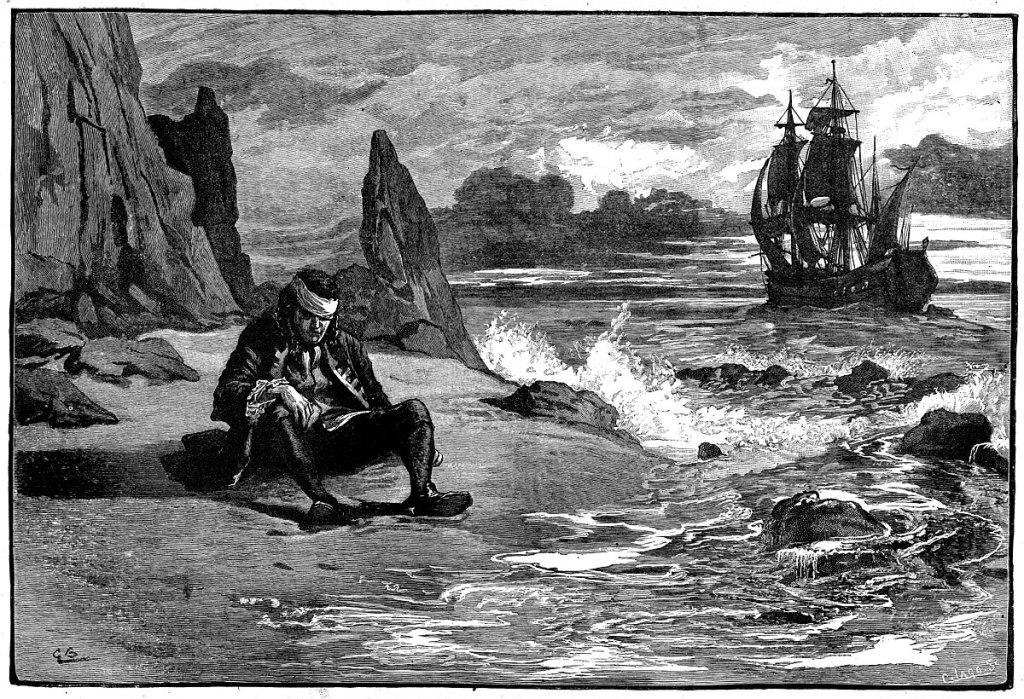
A castaway as imagined by Boy’s Own (Gordon Brown, 1889)

His evenings were grim indeed:

When the moon rose I went for eggs, and found here and there a bird, the heads I cut off and sucked of the blood. Going back to my tent, I talked to the dead stinking turtle like a man besides himself, and as I was going to my grave. I then drank a whole bottle of urine, and laid down…

As he grew weaker, the diary entries became less frequent and shorter. They tell of eating raw eggs, raw flesh and drinking his own urine.

The last entry on 14 October read simply ‘I lived as before’.

A True Relation of Sodomy Punished?

After the British mariners found Hassenboch’s camp and diary, they took it back to London where it was translated into English and published in 1726 under the title of Sodomy Punish’d and then again in 1728 titled An Authentic Relation of the Many Hardships and Sufferings of a Dutch Sailor. A third version was published in 1730 called The Just Vengeance of Heaven Exemplifyed.

The first published version of Hassenboch’s diary Sodomy Punish’d (1726)

Dutch historian Michiel Koolbergen discovered from researching shipping logs that Hassenboch was indeed a real person. He had been bookkeeper aboard the Prattenburg and was returning from Cape Town when he was sentenced to be abandoned on a deserted island for committing sodomy. The severity of the punishment was consistent with the times. Dutch sailors convicted of sexual relations with one another were often tied together and thrown overboard.

Koolbergen also consulted the ships logs for the Compton and the James and Mary, and they did indeed find Hassenboch’s camp and diary on Ascension Island. The skeleton, however, was a macabre and fanciful addition to the 1730 version on the diary. The ships logs note that they could find no sign of Hassenboch’s remains.

Diabolical Inventions

It would be nice to think that because his remains were not found, Hassenboch was rescued by a passing ship. Unfortunately, this seems unlikely – it would surely have been reported if he had been saved. Reports of castaways being rescued were popular – this was the era of Daniel Defoe’s Robinson Crusoe, which was published a few years prior in 1719.

It’s likely that Hassenboch either died of thirst or took his own life. It could be no body was found because he died on another part of the island, or it could be that his remains were washed away by the waves. Perhaps he threw himself into the sea to end his agonies.

Some of the most striking parts of Hassenboch’s diary are the sections where he feels himself to be mentally and physically tormented by demons and spirits. However, historians who’ve studied this story (such as Michiel Koolbergen and Alex Ritsema) suggest that these lurid passages, along with the ones where he laments being a sodomite, were added by the publishers to make the diary more exciting. The use of literary devices (such as addressing the reader) in these passages is suspicious. It’s not as if Hassenboch was intending his manuscript to be published.

Some historians have noted the similarities between the more haunted entries in Hassenboch’s diaries and episodes in Robinson Crusoe. The original diary (which was in Dutch) is lost, so it’s impossible to know how much of the diary was faked, but it seems likely the more sensationalist entries were fabricated by the publishers.

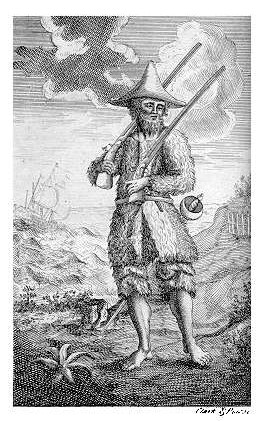
Robinson Crusoe

The 1726 and 1728 versions of the diary end abruptly on 14 August 1725. The 1730 edition of the diary ends on 14 September, and finishes with a different final entry, clearly made up by the publisher to give the story a sense of an ending by having poor Hassenboch die mid-sentence:

I cannot write much longer: I sincerely repent of the sins I committed and pray, henceforth, no Man may ever merit the Misery which I have undergone. For the Sake of which, leaving this Narrative behind me to deter Mankind from following Diabolical Inventions. I now resign my Soul to him that gave it, hoping for Mercy in –…

The various publishers of Hassenboch’s diary just could not leave him alone. They couldn’t resist sententious moralising by attributing spurious confessions and lamentations of his sin to the text. Nor, could they resist adding some imps, demons and spirits to haunt Hassenboch’s last days – a bit of sensationalist horror would certainly be good for sales.

And the publishers felt the need to bring the narrative to a more satisfying ending, fabricating an entry where the castaway dies melodramatically mid-sentence. All that was needed to complete the story was a more dramatic beginning provided by Hassenboch’s skeleton.

Illustration from The Just Vengeance of Heaven Exemplify’d (1730) – the third version of Hassenboch’s diary

FINIS

References

The full text of Sodomy Punish’d is available online

The most thorough examination of this episode can be found in the following work: Alex Ritsema A Dutch Castaway on Ascension Island 1725 (2010)

The Gorefield Ghost

In early 1923 a Fenland farm was visited by strange destructive phenomena – household objects mysteriously flying across the room and smashing. Some said the house was haunted by a poltergeist, others blamed witchcraft or even demons. The haunted house became a national sensation, leading to psychic investigators, spiritualists, an exorcist, a witch and Arthur Conan Doyle all trying to solve the mystery. But perhaps the answer was right under their nose all along…

New Barn Farm overlooked the haunting fenlands in the East of England and was covered by a light dusting of snow in February 1923. It was occupied by fruit farmer Joseph Scrimshaw, his elderly mother and Joseph’s 15 year old daughter Olive. The house was also shared by Olive’s pet lamb and fourteen cats.

New Barn Farm

The house had gained a reputation in the local area. Apparently, crockery would fly off the shelves and smash on the floor. The weighty pianola had mysteriously moved away from the wall. Wash stands had toppled over with no body in the room. Ornaments threw themselves off the mantelpiece and Mrs Scrimshaw’s night cap had gone flying across her bedroom. Books fell from the bookshelves and clocks dropped off the wall. And these events were happening daily, resulting in £200 worth of damage – a considerable sum at the time.[i]

When the newspapers got wind of the phenomenon, they dubbed it the Gorefield Ghost. By the middle of February, crowds of curious onlookers were flocking to the farmhouse, fascinated by rumours of the destructive spook. Mr Scrimshaw began receiving letters – hundreds and hundreds of them, according to the farmer – requesting permission to hold seances in the house…

Those blooming spiritualist people

In early March the Scrimshaws had another mysterious visitation. Just as the clocks were striking midnight, four strangers hammered on the farm door and invited themselves into the farm. Mr Scrimshaw would later refer to them as ‘those blooming spiritualists.’ The uninvited guests were Mr H. Racey, president of a nearby Spiritualist Society, Mr H. Stimpson, the secretary and members Mr and Mrs Taylor.

The spiritualists sat by the log fire along with the Scrimshaws and called for quiet before singing a hymn and then reciting a prayer. Not knowing they were spiritualists, Mr Scrimshaw was totally bemused by the performance, interrupting it to ask if he could smoke. The grumpy spiritualist told him he could but he must keep quiet. At this point another visitor arrived, a shire horse breeder and friend of the family called Mr Ward, and it was he who informed the Scrimshaws that their surprise guests were actually spiritualist mediums.

One of the mediums pointed to Mr Ward and said he could see the spirit of an elderly lady with grey hair with a centre parting, wearing a shawl and carrying a little child. No one else could see anything, and on being asked Mr Ward said he didn’t recognise the description of the invisible apparition.

The mediums then proceeded to describe various spirits they claimed they could see, but no body recognised any of them. Finally, Mrs Taylor asked Mr Scrimshaw if he knew anyone called Lizzie, presumably because she had a message from the beyond for him. Mr Scrimshaw said yes – he knew hundreds of Lizzies who’d helped out with the fruit picking on his farm, but they were all back in London now.

Mrs Scrimshaw had had enough and told everyone to stop this silliness. As they were being escorted out of the door, one of the spiritualists told Mr Scrimshaw that he had seen the ghost that was the cause of all the trouble. It was, he said, the spirit of a 20-year-old young man with a bandaged head. In life he had loved practical jokes, but died after falling from a horse. Now his ghost was continuing the pranks he had once loved. Mr Scrimshaw was assured that the spirit was now quietened and that they would have no more trouble.

The Society for Psychical Research

The following day it was the turn of Mr E.J. Dingwall, secretary of the Society for Psychical Research to investigate. Olive showed him round the farm and he made copious notes in his large notebook, commenting that this was a very important case for the science of psychical research. He noted that, curiously, nobody had actually witnessed the objects fly through the air. The episodes all happened when no one was looking, something that was common in poltergeist cases, according to Mr Dingwall. He concluded that Olive may have mediumistic ability and that this unconscious power was what was causing the phenomena.

He believed that the disturbance would stop in a few days, as most poltergeist cases usually do.

Arthur Conan Doyle

The next to offer a theory was Sherlock Holmes author, Sir Arthur Conan Doyle who had developed a keen – some would say gullible – interest in all things mediumistic. Doyle wrote to the Scrimshaws suggesting that ‘mischievous material children of the psychic world’ were using Olive to create the strange phenomena. Doyle concurred with Dingwall of the Society for Psychical Research, that Olive was the unconscious cause of the flying crockery. The solution was elementary – Olive must go away for a few days, the vicar should say a few prayers in the house and the windows should be opened.[ii]

It seems the Scrimshaws didn’t follow Sir Arthur’s advice, for still the ornaments fell mysteriously from the mantlepiece.

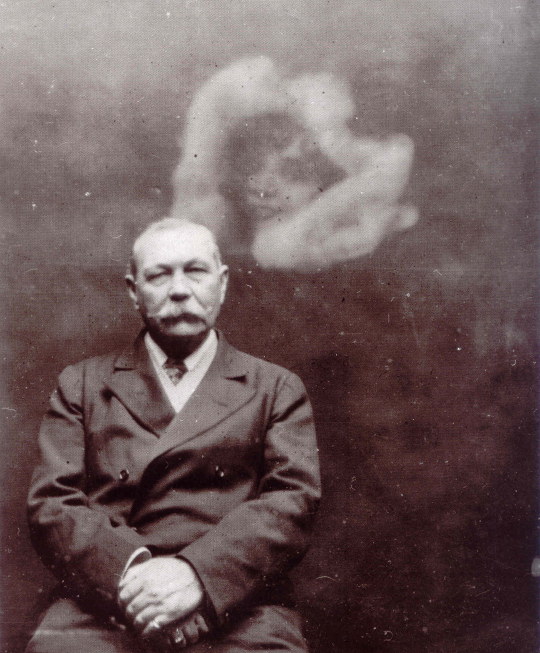
Arthur Conan Doyle with a ghostly companion

Under an Evil Tongue

However, many of the locals were not impressed with the theories of the spiritualists, the psychic investigator or even Sir Arthur. They had their own theory – witchcraft. The unfortunate family had been cursed, or as the locals put it, they were ‘under an evil tongue’.

A wealthy farmer called James Garner from nearby Wisbech decided to come to the rescue. He knew a wise woman who would break the spell with a ‘fire charm’. He introduced the Scrimshaw’s to Mrs Holmes, whom the newspapers noted, was not the wizened old crone one might expect, but was rather a ‘fine, healthy, buxom woman’ with a clean house. Mrs Holmes was born in the chime hours – at the time of night reserved for monastic prayer – and that gave her the ability to see things that others cannot.

Mrs Holmes arrived at the farm a couple of days after Mr Dingwall had visited and took toe nail and hair clippings from each family member. She put these in an empty bottle along with six apple pips and two black hairpins and warned the family not to say a word or they would break the spell. She placed the bottle on the kitchen fire. A few moments later it shattered with a bang. ‘There’, she said. ‘The spell is broken, and the ill tongue can do no more evil.’[iii]

The Spalding Guardian, which reported on these events, was astonished that in 1923 people still believed in witchcraft. In fact, it claimed that 60% of the population in the fens believed in witches, which was confirmed by Reverend Hagley Rutter, the local vicar.

A few days later Mrs Holmes died after suffering from a fit, a condition she was subject to. Nevertheless, her death would surely have fuelled tales among the locals that the farm really was cursed.

After a few days, the poltergeist activity resumed.[iv]

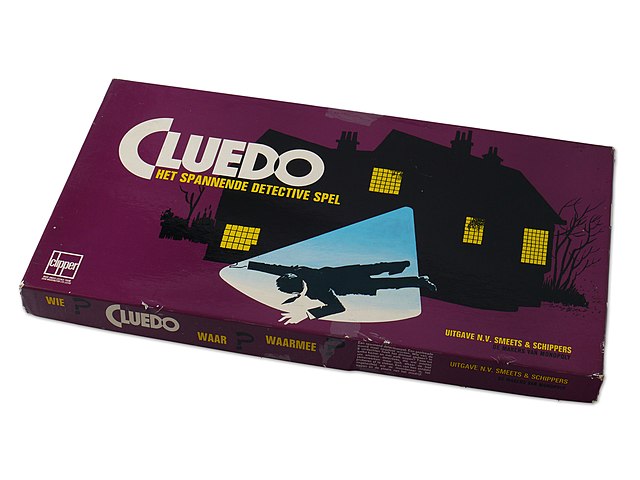
Poltergeist Cluedo

Let’s put aside talk of curses and witchcraft for the moment and play a game of Poltergeist Cluedo. The fact that nobody saw any of the objects actually flying means it’s reasonable to suspect that someone in the Scrimshaw household was playing tricks – dropping or throwing objects when nobody was looking. So, in my game of Poltergeist Cluedo, the suspects for faking the spooky phenomena are:

Mr Scrimshaw: He never seemed very perturbed by the weird goings-on in his house, which may be suspicious. One journalist overheard him say how this notoriety had been good for his trade in potatoes.[v]

Mrs Scrimshaw: Although an elderly woman, this would mean that nobody would suspect her of any mischief.

Olive Scrimshaw: Because she was a teenage girl, many thought Olive was at the centre of the poltergeist phenomena because she may have latent mediumistic talents or was being used by supernatural forces. However, it’s distinctly possible that she was at the centre of the whole episode but in a much more direct way, playing an audacious trick on her family and others.

The cats: There were (assuming the papers got this right) fourteen of them. Cats are well-known for their penchant for knocking objects off tables and mantlepieces. Could the mysterious damage have been caused by clumsy, careless or mischievous felines? Well, they couldn’t move a pianola, but I would be surprised if these cats were not in some ways accomplices to the mischief.

Although she may have been aided by the cats, I would put my money on Olive being the prankster. She was a teenage girl, and poltergeist activity is long known to occur in the presence of a teenage girl. Believers might say that’s because unknown forces can manifest themselves using the psychic energy of very young women. Because, it was assumed that an innocent young girl could never outwit her elders or those learned ladies and gentlemen who came to investigate.

But I think this is exactly what happened. I suspect that Olive managed to prank spiritualists, psychic investigators, witches, journalists and even the creator of Sherlock Holmes.

Epilogue

It is at this point that the Gorefield Ghost takes his (or perhaps I should say her) leave of the historical records. One possible explanation for the sudden cessation of the poltergeist larks was the fact that in early May New Barn Farm was visited by a tragedy. Frederick Robbins, a farm labourer for Mr Scrimshaw was burned to death when the discarded railway carriage he slept in on the farm caught fire, possibly because he had been smoking in bed.[vi] One could imagine that Olive would surely not continue her jinx after the awful death of one of their workers.

I can also imagine that after Robbins’ death by burning, many of the locals would give each other a knowing look. Perhaps the New Barn Farm really was under an ill tongue.


[i] ‘Ghost that moves furniture’, Daily News 19 February 1923, p.1; ‘Ghost as heavy weightlifter’, Daily News 20 February 1920, p.1

[ii] ‘The Cambridgeshire Ghost’, Saffron Walden Weekly News 23 February 1923, p.7

[iii] ‘The Gorefield Spook’, The Spalding Guardian 3 March 1923, p.7

[iv] ‘Fen Ghost Reappears’, Newcastle Daily Chronicle 10 March 1923, p.1

[v] ‘The Gorefield Spook’, The Spalding Guardian 3 March 1923, p.7

[vi] ‘Burned to death in bed’, Diss Express 11 May 1923, p.8

Doris Stokes – Welcome to my World

Weird Musical History #11

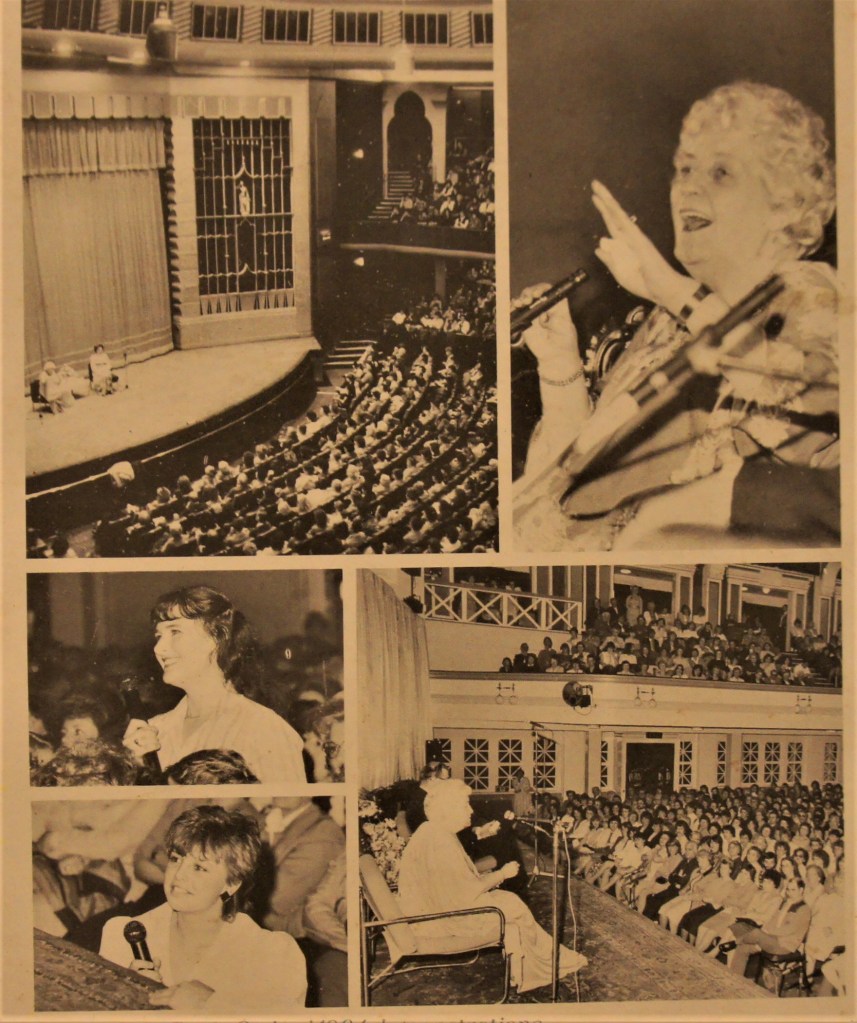
Doris Stokes was Britain’s foremost medium in the eighties. She was a regular on television, had a series of autobiographical books and toured the world selling out theatres with her displays of mediumship. She was spiritual advisor to the stars – John Inman, Freddie Starr and members of the cast of Coronation Street. Mrs Stokes claimed she had contacted Elvis Presley, John Lennon, Tommy Cooper and Diana Dors from beyond the grave.[i]

She didn’t

Which brings me to her strange album, Welcome to My World… in all its pinkness (pictured at the top). The LP has excerpts from three consecutive nights in which she communicated with the spirit world in the Dominion Theatre in London, interspersed with specially recorded music by guitar legend Bert Weedon. I’ve listened to it so you don’t have to…

Side One

The record begins with Doris being welcomed to the stage and in her chatty grandmotherly way she tells the audience that tonight she is going to prove that there is life after death…

But first she tells a couple of gags:

Two psychics meet in a supermarket. One says to the other, ‘You’re alright, love, but how am I?’

There’s more:

A man went to a medium and said he was very fond of sport and wanted the medium to inquire if they played cricket in the afterlife. The medium said she would find out during her next séance. The man returned the next day eager for the answer to his question. The medium said ‘I’ve got good news and bad news. The good news is they do play cricket in the afterlife.’

‘And what’s the bad news?’ the man asked.

‘You’re team captain on Tuesday.’

Then the demonstration begins. Sometimes, she reminds me of Frankie Howerd in the way she interacts with the spirits she claims to hear: ‘Did she? Oooo now, I can’t say that….’

Doris throws out a lot of correct names given to her by the spirits – too many to be coincidence. Some are very specific – Chalky White and Smudger Clarke are spirits she names as friends of an audience member. In a prosaic moment she correctly tells one woman that she has just bought a new cooker and saved £135.

Stokes produces names of departed loved ones, addresses, seemingly meaningful messages and details of audience members lives. In the interviews that are interspersed with the theatre performance, her fans are convinced that the only way Doris could have known these things was through communication with the spirit world.

Doris in action from the back sleeve of her album

The Other Side

Side two continues with the demonstration but is much less successful. She vainly (and it seems to me rather desperately) calls out names of spirits to see if anyone in the audience will claim them: David… Dennis… Dean… Paul…Paula…Pauline…Peter?

Compared to side 1, the first few minutes of side 2 seem rather embarrassing and it’s odd why she would include them on the record.

However, along come the silky strings of Bert Weedon – if you’re a guitarist of a certain age you may be familiar with his deceptively titled teach yourself guitar book, Play in a Day. He was a fan of Doris and so contributed some music for her album.

As Bert twangs ‘Welcome to my World’ accompanied by an accordion, Doris intones over the music, ‘Hello my loves, I’m Doris Stokes and I want to say to you welcome to my world for my world is full of hope and love…’

Between more pleasant noodling by Bert, Doris tells an interviewer of her life. She had lost four children and suffered cancer. She had been paralysed with stress for two years and the medication she was prescribed turned her into a zombie. Fortunately, her spirit guide told her to flush her drugs down the toilet and trust in God and the spirits, which she did and she was cured.

As if the record couldn’t get any more maudlin, Doris ends by reciting a poem about one of her spirit children backed by Bert Weedon’s sobbing strings:

In a baby castle just beyond my eye

My baby plays with angel toys that money cannot buy…

How to talk to the dead…

There are two ways to communicate with the dead: cold reading and hot reading.

Cold reading is when you throw out names, dates, illnesses, numbers or whatever until you get a hit. ‘Is there a John in the room… Johnny… Or is it Jonathon… Wait, it’s Jane… Jean… Jeannie… The spirits tell me there’s a birthday coming up in your family…. Or it’s an anniversary….It was a sudden passing, wasn’t it…..’ Just keep throwing stuff out, you’ll get a hit eventually. People remember the occasional hit and forget the misses.

However, although Doris did do some pretty unimpressive cold reading in her performances and on her album, her preferred method was hot reading. This means finding out information about the client before a sitting.

Doris would get many letters and phone calls from people who had lost a loved one. She would contact them and offer them comfort and at the same time pick up nuggets of information. The bereaved person would then get free tickets through the post to one of her shows and be seated in the front rows – Doris always booked out the first few rows to herself.

When the demonstration began, Doris would call out the name of people she knew would be in the audience as if these names had been given to her by the spirits. She would then impressively repeat the names, numbers, and other details she had already picked up from her previous communication. If we were going to be uncharitable, Stokes exploited bereaved people grieving for their parents, spouses or children and cynically planted them in her audience.[ii]

Magician Paul Daniels called her a phoney and made her a £10000 bet that she couldn’t convince him of her powers.[iii] The secretary of the Spiritualist Association of Great Britain defended her reputation against the accusations of fraud. He said that she was not clever enough to carry out such deceptions.[iv] I think she was.

Doris Stokes died in 1987. But her odd collaboration with Bert Weedon lives on…


[i] Daphne Oxland ‘Wiedersehen, Pat, by Doris’, Nottingham Evening Post 25 November 1985, p.8; Paul Callan ‘Doris Stokes: Trick or Truth’, Daily Mirror 15 June 1987, p.9

[ii] See Ian Wilson, The After Death Experience, (London: Corgi, 1987), pp.83-93

[iii] ‘She was a phoney’, Daily Mirror 16 June 1987, pp.14-15

[iv] John Preston, ‘Troubled Time in the Spirit World’, Western Daily Press 13 October 1987, p.13

Vampires That Time Forgot #3

Here are a couple of forgotten ‘true’ news reports about historical bloodsuckers…

A Family of Vampires

Baron de Gostovsky was a haunted man. The landowner from Sabousz near modern day Gdansk believed his family were vampires, so on his death bed in 1887, he requested that before burial, his head should be cut off. This was a service he had himself performed on his wife after her death. The Baron is quoted as saying:

‘We are a family of vampires and if this precaution be not taken we can find no repose in the grave, but come back and bring misfortune to our children.’[i]

When the Baron died, his eldest son complied with his request, and the Baron was buried with his decapitated head. However, a few days later the son began to feel ill, and suspected that his father being a vampire was somehow connected with this.

He returned to his father’s grave, and dug up the casket. Breaking it open, he turned the body over and hurled the head into a nearby field.

He was given two weeks in prison for disturbing the dead, but presumably avoided becoming one of the undead…

A Belgrade Vampire

In February 1888, police in Belgrade came across the body of a man who looked as if he had frozen to death in the street where he lay. Efforts to revive him proved fruitless and he was pronounced dead. The police arranged for a coffin to be brought, and the body was placed inside and taken in a carriage to the cemetery.[ii]

As the driver whipped his horses through the icy Belgrade streets, he was sure that he could hear noises coming from the coffin. There was a belief held by many in Serbia at that time, that a man who dies suddenly might return as a vampire, and this filled the driver with a great deal on unease.

As soon as he arrived at the cemetery, the driver told the priest he was convinced he had heard something unnatural coming from his carriage. The priest and a few others came to see for themselves, and they too heard a banging and scratching coming from the coffin. The priest and his companions fled in terror.

The desperate driver jumped back into his carriage and set off at a furious pace to the nearest police station, and all the while the banging and scratching from the coffin grew louder and louder.

The police wasted no time in forcing the coffin open, revealing a man who was very much alive, despite being very weak. He was also extremely displeased that he had almost been buried alive and that his remonstrances had been ignored for so long.

The gentleman revealed that he had been on a boozy night out, and was so drunk that he had passed out on the street. The journey in the carriage had jolted him back to consciousness, and he found himself in a coffin about to be buried alive, which would have been the worst hangover ever.

A. R. Tilburne to accompany “Return of the Undead” by OTIS ADELBERT KLINE and FRANK BELKNAP LONG for Weird Tales Volume 36 Number 12 (1943-07)

[i] ‘A family of vampires’, Congleton and Macclesfield Mercury and Cheshire General Advertiser, 12 March 1887, p.5

[ii] ‘Vampire superstition’, Witney Gazette and West Oxfordshire Advertiser, 18 February 1888

Virgin Mary Photographed in France!

January 1922, Noveant, north west France. As the sun sets behind the village church, a large crowd from the surrounding villages gather to witness a miracle. Then she appears – the Virgin Mary in robes of light floating in the trees and looking kindly down on the faithful.

This vision had appeared at sunset daily since 16 January and had been witnessed, we are told by many women and children at first, but was now attracting scores of visitors to witness the holy vision – and they were not disappointed.[i]

Mary herself can clearly be seen in the contemporary photo (cropped above, full version below) from the Illustrated London News. The same paper says that the sunlight shining through interlacing branches is what the ‘superstitious’ were fooled by.[ii]

The simulacrum still works well in the grainy low quality photos and is a nice example of pareidolia – our tendency to see patterns everywhere. Wish fulfilment at work:

When I find myself in times of trouble, Mother Mary comes to me

Speaking words of wisdom….From a tree…


The Virgin in the Trees (centre left), Illustrated London News 31 January 1920

[i] ‘Vision of the virgin’, Westminster Gazette, 20 January, 1920 p.4

[ii] ‘A mysterious appearance of the Virgin in France explained’, Illustrated London News, 31 January, 1920 p.3

Ghost Streakers!

In the dim moonlight of a nineteenth century lane, if you came across a pale spectral figure as naked as the day he was born, you might take it for a restless spirit. However, perhaps you had encountered a naked ghost – people who wandered the streets at night frightening any unlucky victim they happened to meet. They were a combination of ghost hoaxer, streaker and flasher and were surprisingly frequent, especially in the early nineteenth century.  

The sight of someone stalking a secluded location with his wan naked body eerily reflecting the gas lamps or moon light would have been a very disconcerting, threatening and scary experience. It has an element of the bizarre and surreal about it, so it’s easy to see why these figures would be seen as otherworldly – why they were referred to as ghosts.

Here’s a selection of true tales of ghostly streakers. Contains nudity.

A Giant Horny Naked Lady Ghost

The watchmen who patrolled the vicinity of the Walworth turnpike near Lambeth were initially sceptical when they heard tales of a ghost at the end of March 1818. An unnamed man had burst into their office scared out of his wits claiming he had seen a woman with horns on her head rise out of the earth in front of him. The watchmen had heard his screams and hurried to the vicinity, but dismissed the man’s claim that he had seen a ghost.

However, when another man told them that he had also seen a strange apparition that had vanished into thin air before his eyes, they began to take the reports more seriously.

A Watchman was likely to meet a naked ghost

The following night the watchmen were already feeling on edge as the sound of soft music was heard at around 11pm. This was followed by a man running to their office and telling them the ghost had made another appearance. One of the watchmen, Mr Snow, decided to get to the bottom of the mystery and followed the terrified man, when he was surprised to see another watchman, Mr Mathews, running in terror towards him fleeing from what seemed to be a gigantic naked figure. Mathews was desperately calling for help, and shouted at the apparition ‘If you follow me, I will shoot you!’

Snow was made of sterner stuff and approached the ghost which turned and retreated. Snow pursued the figure and when he caught it, realised the ‘ghost’ was actually a naked woman who burst into hysterical maniacal laughter. Snow put his coat round her and brought her back to the office, where from her incoherent speech and state of undress he assumed she was an escaped lunatic from an asylum. This was indeed the case, and Mrs Ashton, as she was called, had apparently been insane for some time and was taken to the workhouse before appropriate accommodation was found for her.[i]

The surprising thing about this sad but rather comical story is how the witness’s imagination could turn an unfortunate naked woman into a horned gigantic ghost that was capable of vanishing and spreading such terror among the night watchmen.

It’s not clear where the soft music was coming from, but we may suppose the ‘ghost’ was singing to herself as she wandered naked through the dark lanes terrifying the locals.

A Cheshire Boggart in the Buff

For three years in the 1830s, Windsford in Chesire had been bothered by a ‘boggart’. The word ‘boggart’ is often used to mean a malevolent spirit of a house or location such as a wood or a bridge, but was frequently used to describe any spooky phenomenon from goblin like creatures to ghosts to poltergeists. In this instance the boggart took the form of a naked man.

The naked boggart was often seen at dusk on local roads around this Cheshire village and led to many women being scared to go out at night for fear of meeting him. However, in January 1834, the boggart met his match in the form of a brave hearted pub landlord.

Late in the evening of 4 January a servant girl was washing the floors in the pub while other members of the household were asleep. She heard a gentle tapping on the window and looked up to see the naked boggart leering in at her through the window. She screamed and fainted, and the landlord, hearing the noise ran out of the house and gave pursuit to the mysterious figure.

On being caught by the plucky landlord, the ‘boggart’, who was a member of a nearby Wesleyan chapel and was named George Barlow, said he had only come for a glass of ale. Why he had left his clothes at home is unknown.
In any case, he was sentenced to three months hard labour on the treadmill at Knutsford.[ii]

Penal Treadmill, London 1817 – how a naked ghost might be punished

The Naked Ghost of Bolton

In late 1871 the people of Bolton, Lancashire were being terrified by an unclad ghostly figure stalking the streets after dark instigating what the papers called a ‘reign of terror’. The question on everyone’s lips was ‘Have you seen the ghost?’

In June 1841 Ann Gledwin was asleep on her sofa when she was awoken at around midnight by the barking of a dog. In her house was the naked ghost, behaving ‘indecently’. She screamed and the figure left.

Other residents were also shocked to find their home had been invaded by this audacious unclad apparition. In October of the same year Isabella Jackson was sitting by the fire with her young daughter when a naked figure entered her house. He stood there for a few minutes in silence before leaving.

On Shrove Tuesday Martha Weaver was in her shop when a little girl who was standing on the shop counter said, ‘Oh, there’s the naked man.’ Martha looked and saw the ghost peeping round the corner at them. He then moved towards the window and acted indecently.

Esther Hargreaves saw the naked apparition outside St James’s Church. She screamed and ran, though only after watching it for a full five minutes.

Saint James’s Church, Bolton – Haunt of the Naked Ghost

As reports continued, Chief Constable Thomas Beech took action and extra police were put on patrol and almost caught the miscreant. However, this ghost was lubricated from head to foot so whenever police managed to catch him, he slipped from their grasp with ease. He once even leapt from a railway bridge into the darkness below to escape capture.

The police tried to dial down the ghost rumours by telling the press that all that had happened was a ‘half-demented’ man had wandered naked into a neighbour’s house at around the same time that a flasher had exposed himself to a young woman, causing her to be scared into convulsions. These two unconnected events, they said, had given rise to the rumours of the naked ghost haunting Bolton’s streets.

Nevertheless, people were afraid to go out at night and the stories kept coming in. Citizen vigilante patrols were formed and finally the ghost was caught. In April 1872 John Henry Smith and several others saw the ghost – this time only half naked and with his trousers on – just before 11pm near Saint James’s Church and they gave chase. At one point the semi-clad ghost turned to his pursuers and said ‘You might as well go back, you will never catch me.’

However, catch him they did, and he soon changed his tune to ‘Oh Lord have mercy upon him [sic]; let me go this once, and I will do so no more.’ He was carrying his shirt under his arm and he was made to dress before carried by the legs and arms through the streets of Bolton to the police.

Ironically, this naked ghost turned out to be a tailor named Taylor. In court he gave a rambling defence blaming taking ‘salts of prunella’ for a disease of the lips possibly related to scurvy after which he went out forgetting his shirt. It was suggested that he may have been suffering from delirium tremens.

In any case, Bolton’s naked ghost was given 28 days in prison for indecency.[iii]


[i] ‘A ghost at Newington’, The Globe 30 March 1818, p.4

[ii] ‘Commitment of a ghost to the treadmill’, The Globe 21 January 1834, p.4

[iii] ‘A ghost panic in Bolton’, Bolton Chronicle 7 October 1871, p.5; ‘The Bolton Ghost’, Bolton Evening News, 17 April 1872, p.3; ‘The Bolton Ghost’, Bolton Evening News, 18 April 1872, p.3; ‘Capture of a ghost at Bolton’, Liverpool Mercury, 18 April 1872, p.3; Liverpool Weekly Courier, 20 April 1872, p.1; ‘Capture of a ghost’, South London Press, 27 April 1872, p.4